
Bangalore, Karnataka, India. 4th April 2023.
The flight from Sri Lanka back to Bangalore was the reverse of the one coming out, I’m very pleased to say. I went back to the same hotel and settled in for a few days.
I retrieved my bike from Mahi, pleased with most of the work he’d done, disappointed with some. He’d done some electrical work and had made alterations I hadn’t asked for, so I had to wait while it was put right. But the mechanical work he’d done was fine. Later, when I showed Jay the bill, he was amazed at how much I’d been charged, saying the Indian equivalent of “You’ve been had mate”. But I pointed out that Mahi does specialise in BMWs, so would always be dearer. Plus, he’d stored my bike for a month with no charge. So I wasn’t too worried.

Venu’s super blinged up Triumph 800TCX.
While there I met an Indian rider named Venu, who had a Triumph Tiger 800TCX. This is a large ADV style bike and had so many accessories on it there was barely anywhere to sit. But he’s not poseur, having taken it to Saudi Arabia and Iran, which counts as serious riding. He gave me some potentially handy contacts for my own trip to Iran, so it was a useful meet.
My Plan was to ride back to Pune, stopping at some interesting places en route. The first of these was Ballari, a town with a fort on the top of a hill. It was a hot, steep walk up to the top and when I got to it there wasn’t all that much to see. Just some ramparts, remains of buildings and some kids wanting selfies. That was no problem.

Ballari Fort ramparts. The style is typical of the era.
Onwards then, to Hampi, a place full of ancient temples. The road there passed through small hills made of tumbled, jumbled rocks, which looked as if a passing giant bird had dropped and scattered them over the ground, some forming into piles. Vegetation was sparse and crops were not to be seen. As I approached Hampi the road passed through a large gateway, formed from pillars and slabs of rock. And that set the tone for the whole complex. There was almost no modern infrastructure there, and it was virtually all bare rock.
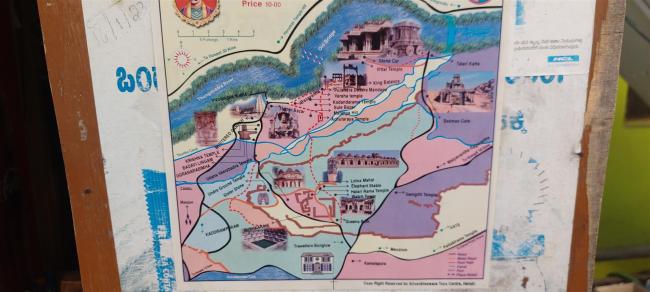
The general layout of Hampi. Lots to see.
Lying between the temple area and the river was a small village, where I found a nice guest house. It was very hot so I rested up for a while, waiting for the (slightly) cooler evening air. The temples were close by, less than five minutes walk.
The first one I went to was Virupaksha Temple, which is a typical, multi layer Hindu temple, approached through a gateway heavily decorated with carvings. There were a couple of smaller temples behind it. The ground was still hot enough to make walking across the stones uncomfortable and I was glad I hadn’t gone there earlier. Plenty of people inside, undertaking Puja. Some nice idols to see too.
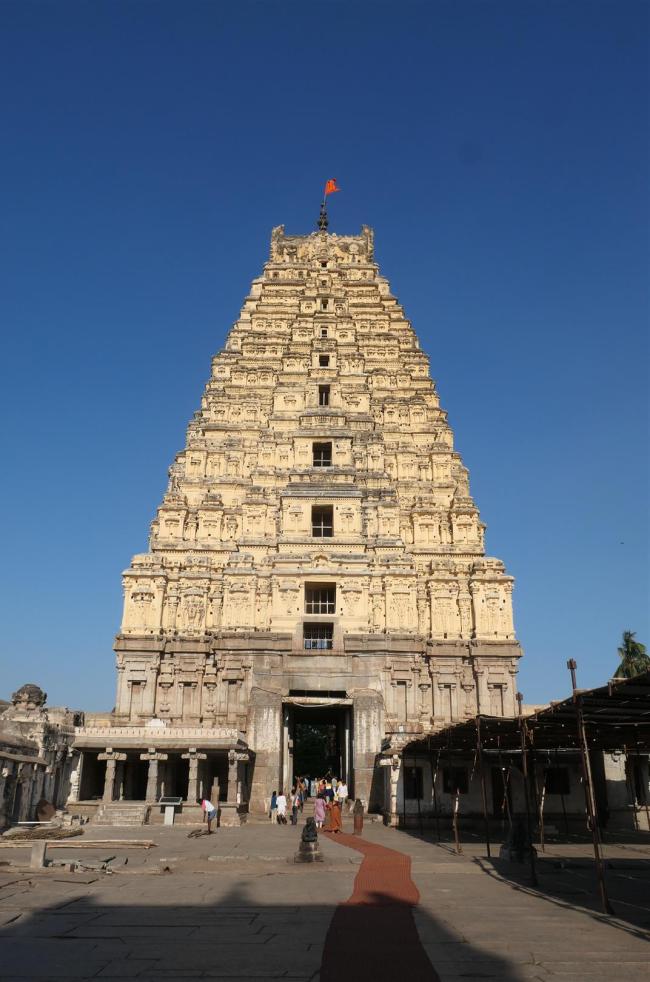
Gateway to Virupaksha Temple.
The older temples were spread out across an area that sloped upwards, rising with the hillside. I quickly realised that there would be too much to see in the time I had that evening so I decided to leave that area until the next day. Instead, I walked along Hampi Bazaar, a long, wide and ancient street lined with single storey buildings that used to house shops and other businesses. It ran from the gate of the temple for a fair distance, towards the low hill at the other end. The dearth of modern buildings made it easy to imagine how it would have looked a five centuries ago, bustling with worshippers looking for food, supplies and souvenirs.
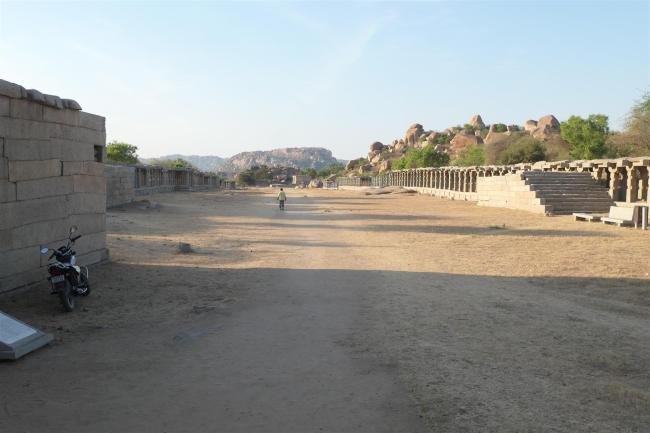
Hampi Bazaar. Endless shopping opportuntities.
The hill at the far end of this avenue of tumbled rocks. Steps and a path took me through them to the Achuteraya Temple hidden on the other side. There were several smaller temples there too and another street full of shops, the Krishna Bazaar. On the way back I came across a friendly elephant chained up in its stable. Not a sight I like to see.
The area occupied by Hampi has archaeological evidence going back to the 3rd century BCE. But the period during which most of the monuments were built dates from the 14th to the 16th centuries. It was the capital of the Vijayanagara Empire, the last great Hindu Empire of Southern India.. It was eventually brought down by the invading Mughal armies and the city was left in ruins. It covers a large area, around 16 square miles, containing over 1,600 ruins of various types. Pretty much all of those I visited are built on, and surrounded by, bare rock. The exception to that is the area close to the river, where there’s banana plantations, among other crops.
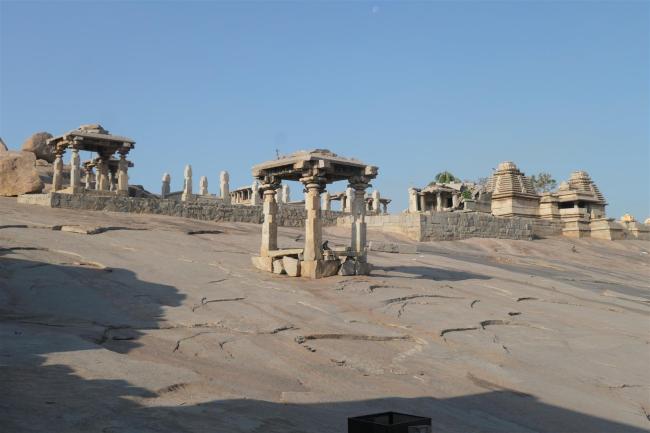
Some of the temples up on the hillside.
Early next morning I walked out to see the older temples, further up the hillside. They were all locked but I think their interesting aspects were on the outside anyway – carvings etc. I’m always a bit puzzled as to why there’s so many of these temples. There always seems to be more than the population might need. To be fair though, those 1,600 ruins include forts, riverside features, infrastructure, the aforementioned shops, as well as all the temples.

A big Ganesha statue, carved from a single boulder.
I trekked up the hill, snapping away with the camera as I went. Then I walked down the other side. A couple of the big temples down there were a bit more focussed, built for a specific purpose. Two of them had huge Ganesha statues, carved from solid rock. Another one an Angry Ganesha statue, although I don’t know what made him so.

The Angry Ganesha.
I walked around the other places nearby then made my way back to where I’d started. Those temples were still locked. It seems that Indian youth, just the same as everywhere else, like to carve or write their initials on the buildings. So no guard means no access. But over the back of this area I found a step well. It’s fed by a spring, meaning that the water is always fresh. For that reason the well supplies all the ceremonial water to Virupaksha Temple. Back to my guest house after that for some much needed breakfast!
I spent the middle part of the day resting and staying out of the sun. But once things had cooled down I walked along closer to the river to see the farthest temples. One big complex was just closing as I got there so I carried on walking around, just looking at whatever there was to see. There were more bazaars, with yet more two storey buildings for shops. Various temples scattered about.
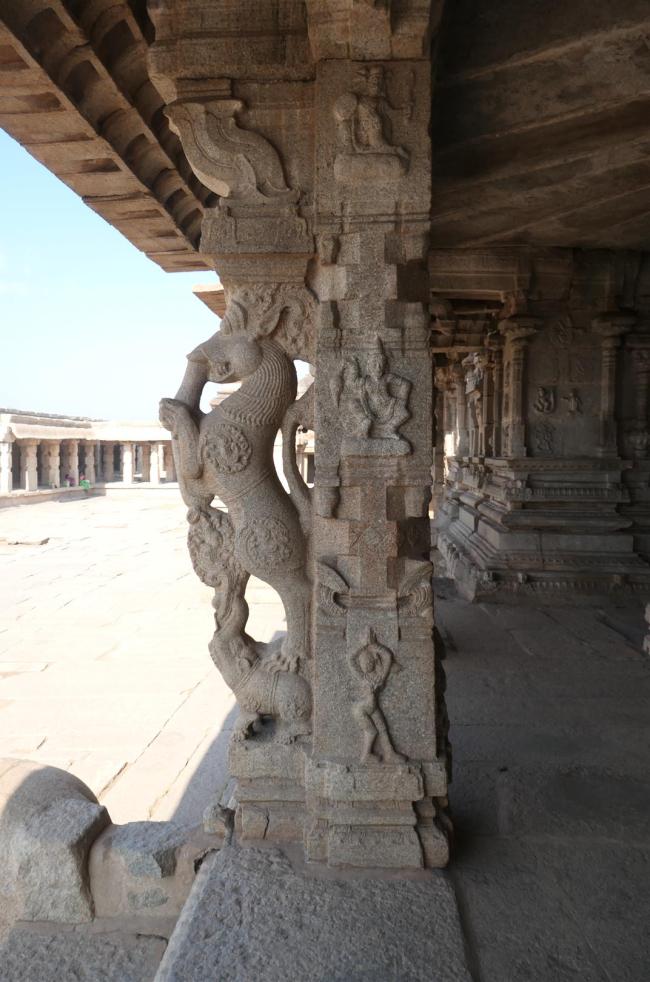
A fine piece of carving on this roof support pillar.
As the sun set behind the tumbledown hill I’d walked over, I decided to head back and managed to get lost! Following a path that seemed to be going the right way, I came to a dead end. I went back and this time found what I thought was the correct way. But it wasn’t. Oh dear. But I did manage to find the Achuteraya Temple that I’d visited the previous evening, which set me on the right path back. The only worry was that it was now almost fully dark. My concern was that I’d trip on the rough ground. But, needless to say, I got back in the end, happy to enjoy a much needed meal.

There’s always a monkey to photograph at these places.
I really enjoyed Hampi. I thought it was one of the best places I’d visited. It had been pretty much hidden since it had been abandoned about four hundred and fifty years ago. It had only been excavated out relatively recently. In my opinion they’d done a very good job. In my imagination it looked as if the occupants had gone off on holiday for 500 years but might come back any year now and pick up where they left off. Daft, of course but that’s the way its appearance made me feel. Much more info here.

The masonry work on these temples is amazing.
When I left Hampi I was generally heading towards Pune. That night I found a roadside hotel complex that included a restaurant and a bar. In fact there was a separate restaurant and bar not acrually connected to the hotel. When I wanted to eat later I asked for a drink to go with my meal. Not allowed. I’d have to go and get it myself. So I went to the other bar to get a beer and brought it back to my table. That’s not allowed either. The only solution was to take the beer to my room and use room service. Why on earth do most Indian states insist on these stupid rules?

Nice road to ride, nice view to see.
The route to Pune took me up through Goa so I stayed for a few days for some chill out time. Goa being a tourist state meant that I could actually eat and drink beer at the same time. Wonderful!
From there I worked out a route that went up into the hills and near to some reservoirs, on the Klass Plateau.. It turned out to be a very nice ride indeed. The road up was in very good condition, with plenty of nice curves and a great view of the water, I really enjoyed it. The road down was not so good but it was still good riding.
The only problem was that the bike started playing up again, cutting out sometimes, like it had before. Across the two days it got worse. I’d asked the workshop in Bangalore to find the problem, but they had clearly failed. To be fair to them it had been fine for the 1,000kms I’d ridden since then. My supposition was that the problem was connected with the very high temperatures – 45 to 50 degrees. The heat was coming off the ground in waves. It was OK for a while when I refuelled, suggesting that the cooler petrol relieved the problem. When I got to Pune I arranged for it to be looked at by a Royal Enfield workshop.
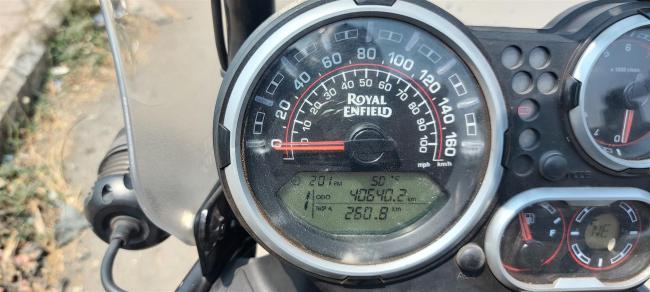
Hot, hot, hot. I didn’t like it, neither did the bike.
I was glad of the chance to cool down and clean up after that hot and sweaty ride. I’d gone to a hotel that I’d used before, which had a good restaurant and nice food. Jay came over later for beer and a chat.
He rang the Enfield workshop and explained to the service manager what the problem was. Unfortunately when I went there next morning that guy wasn’t there! So Jay had to explain it all again. My opinion was that there was a problem with filters or electrics. But all they found was a loose spark plug cap, which they replaced. But the only way to know is to replicate the circumstances under which the fault appeared. I wasn’t able to do that while I was in Pune.
The workshop also told me the forks were out of alignment and they’d need the bike for two days to sort it out. I was planning to leave the bike in Pune while I went to Pakistan and when I spoke to Dilip about it he said he’d get it sorted out. He’d let the dealer remove the forks then he’d take them to a place he knew to get them straightened and to another place to get the internals refurbished. He’d also get the other little jobs done too, regarding the fuel system. Excellent! It’s great to have such good friends as he and Jay are to me. I left them with a list of jobs.
One afternoon I met a guy named Soumo, who’d been in touch with me before and wanted to meet. We had a great chat about bikes, travel, politics, marriage (his wife divorced him), people and all sorts of other things. Next evening Jay took me to meet one of his a work colleagues, who lived in a very fancy apartment up on the 25th floor of a tower block. Beer, wine, food and more good conversation. Living the high life!

The outside of the Gurdwara at Amritsar.
It was time to move on and Amritsar was the next destination. It’s near to Attari, where the only border crossing between India and Pakistan is located. I’d booked a flight and a hotel in Amritsar so an early start saw me heading to the airport. Ever hopeful of a smooth check-in, I delivered my baggage and collected the boarding passes. That all went smoothly.
But the security check was happy to throw a spanner in the works once again. They decided I wasn’t allowed to take my GPS onto the plane, even though I’d done so in the past. When this kind of thing happens you’re faced with losing the forbidden item. Not a good plan for something that cost over £500. The security guy asked if I knew anyone who could come and take it off me. A good idea. A phone call to Dilip resulted in one of his nearby friends coming to the airport to collect it from me. Fifteen minutes later it was all sorted out. Phew!
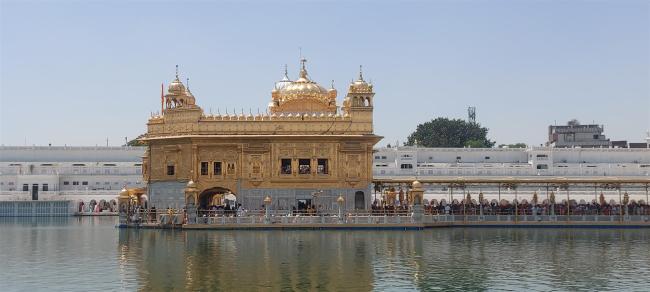
The striking view of the temple as you come to the entrance.
Amritsar is mostly famous for the Sikh Golden Temple, a place I was looking forward to visiting. Sikhism arose during the late 15th century. A holy man named Guru Nunak was recognised as a very spiritual, honest and holy man who gradually gathered disciples to him. Eventually they became known as Sikhs. The religion spread throughout the Punjab and was made up of converts from Islam and Hinduism. It includes principles from both religions as well as those developed within it. It is mono theistic so, in that sense, is closer to Islam. And yet the Mughals often attacked Sikhs and destroyed their temples. I imagine they didn’t much like people “crossing over”.

One of the smaller temples inside the complex.
The Amritsar Gurdwara was built in the 16th century and is the most important in Sikhism. It has been attacked and even destroyed over the centuries, by Mughals and invading Afghan armies. Its present iteration was built in 1809 although it was severely damaged when it was attacked by the Indian government in 1984 and had to undergo major repairs. They were trying to capture Sikh militants who’d barricaded themselves inside. The use of artillary and tanks didn’t do the building much good.
The temple sits in a specially created pool where pilgrims can bathe in the waters. The complex has a square design, with four entrances, depicting the Sikh belief that everyone is equal. There is a circumambulatory path around the pool and in each corner there is a stall supplying fresh water in cups. Pick one up, drink the contents then put it back to be washed. Very useful on a hot day.
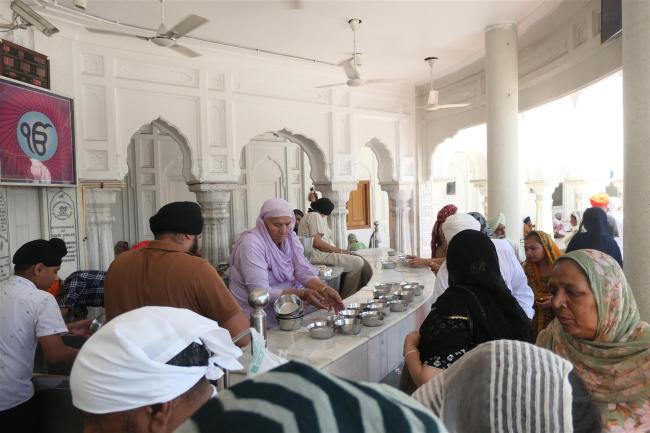
Cool water. An absolute essential.
When I first arrived I saw there was a shoe depository but the queues were long so I just left them under a bench, like many others had done. Upon trying to go inside I had to remove my baseball cap and had an orange handkerchief tied on my head. On walking up the steps I came to a short passage from which I could see the temple on the other side of the pond. It looked fabulous. Smaller than I expected but definitely very golden. At the bottom of the steps down were some engraved panels, mostly relating to Sikhs killed in various conflicts.
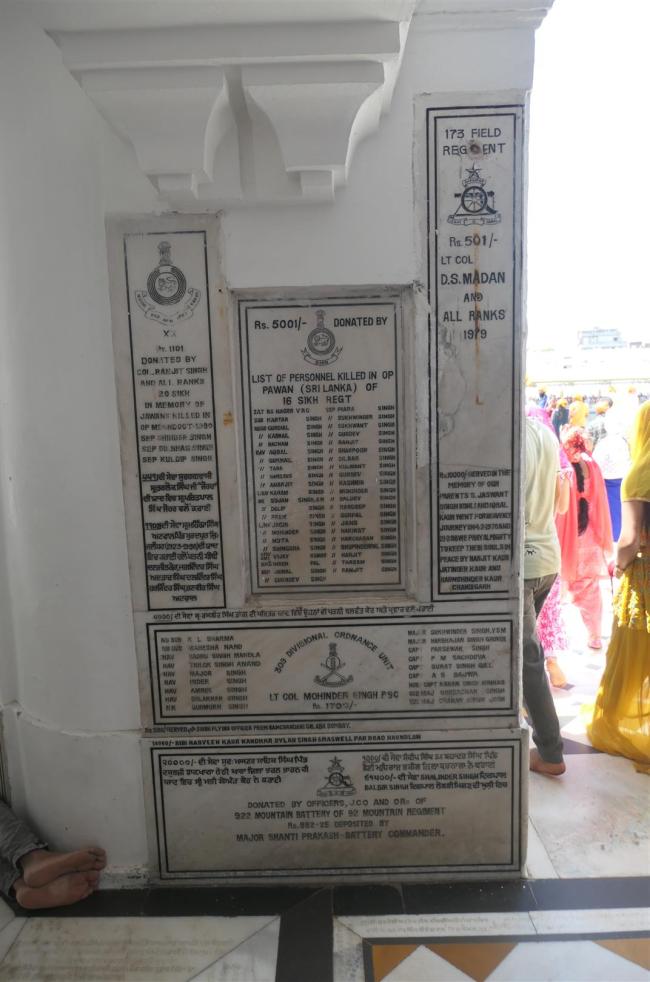
One of the engraved panels.
I walked around the pool, admiring the large koi carp swimming around. Pilgrims were bathing in there, the pool have steps down into the water to facilitate this. There were some smaller temples to look at, also an interesting museum. The queue to go into the golden temple was very long, extremely unappealing on such a hot day. At that point I pretty much gave up on going in there.
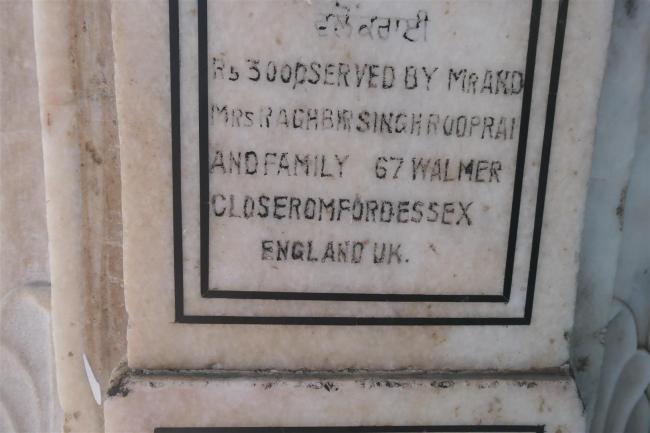
People donate money and get a mention on a stone on the wall..
Having walked around a bit, happy that the marble tiles they used somehow didn’t absorb the heat too much, I headed to the Langar Hall. All Gurdwaras will feed anyone who cares to come inside and sit down in the Langar Hall, for free. You don’t have to be Sikh. I wasn’t hungry at that time but I’d read that anyone was welcome to go and help with food preparation or washing up. I didn’t fancy peeling dozens of onions so I went to the washing up area and found myself a space at one of the water filled troughs.
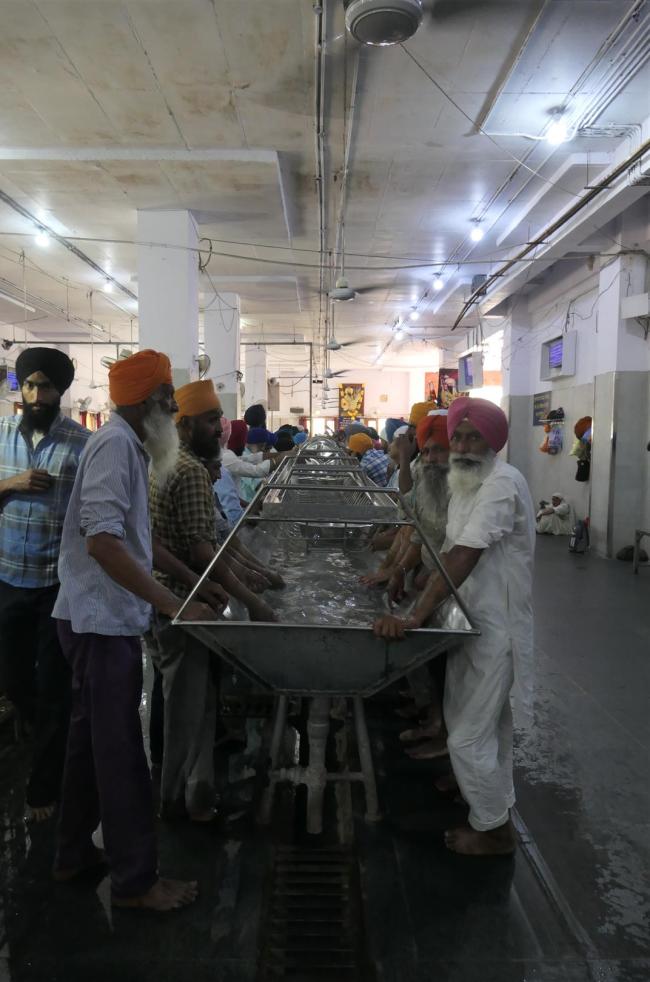
Doing the washing up.
All of the trays, cups and spoons are of stainless steel so you can imagine the noise they create as they’re dumped in the soapy water at the first trough, then moved along to the next one for the first rinse, then to the last one for the second rinse. I got a few odd looks as I joined the line of first rinsers but before long I was just one of the crew. There were three rows of troughs, two with men doing it and one with women. I was there about an hour and really enjoyed the feeling that I was contributing something.
By then I felt I’d earned some tea so I went to find that and enjoyed a couple of cups. But Amritsar offered more sights than just the temple. Not far away was the memorial park to the 1919 Jallianwala Bagh Massacre. The British had introduced a piece of legislation called The Rowlatt Act. It gave the police the right to arrest any person without reason. It allowed unlimited detention and imprisonment without trial. It was an attempt to curb the growing nationalist upsurge in the country.
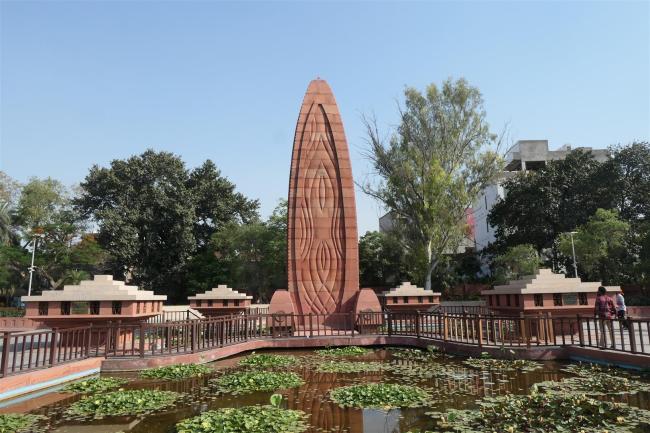
The memorial stone in the Jallianwala Bagh park.
Jallianwala Bagh was a square, surrounded on three sides by tall buildings. British Generl Dyer used troops to block the only entrance and ordered them to fire on the unarmed crowd. They did so until they ran out of ammunition. Estimates of those killed varied from 400 to 1,500, with many more injured. General Dyer was court marshalled but was cleared, although he never went back to active service afterwards. The story told by the museum was both shocking and shameful. But that’s the nature of colonialism. Full here.

The mid afternoon queue I decided NOT to join.
Later on I went back to the temple and enjoyed some food. Rice, roti, dal, aloo and some curd. I put some money in one of the collection boxes, although there’s no obligation to do so. Afterwards I noticed that the queue for the temple was quite short so I decided to join it. After an hour I was inside. It’s a fabulous place, built on two levels. Highly decorated, with plenty of flowers. Gold was the main theme, unsurprisingly. There was a Granthi (priest) reading from a copy of the Guru Granth Sahib, the holy book. I was able to wander round and take photos. I took some from the outside too, the illuminations giving a striking view of the building now that darkness had fallen. Lots more info here.
Next afternoon I went to look at the Partition Museum, all about events surrounding the Partition of India in 1947. The museum set out its displays along a timeline, beginning with the politics of the early part of the century, then covering the two world wars and how the Muslim and Hindu (plus others) representatives reached the decision that partition was the best option. It could have been different. India could have set up autonomous Muslim areas instead, but the participants chose not to do that.
There were some harrowing stories, such as about how Sikh fathers were killing their womenfolk, who asked for this to be done, rather than suffer at the hands of the marauding Muslim hordes. On the other hand, there were stories about how trains left Amritsar, in India, packed with Muslim refugees and when they arrived in Lahore, now in Pakistan, there was nobody left alive on the train. It’s estimated that two million people died as a direct result of partition. The Punjab was the centre of these troubles and is now split between the two countries.
The final displays told how Pakistan built itself up as a nation, investing in its people and infrastructure, especially hydro electricity. It has partnerships with China for the building of roads and dams, among other things. All very interesting.
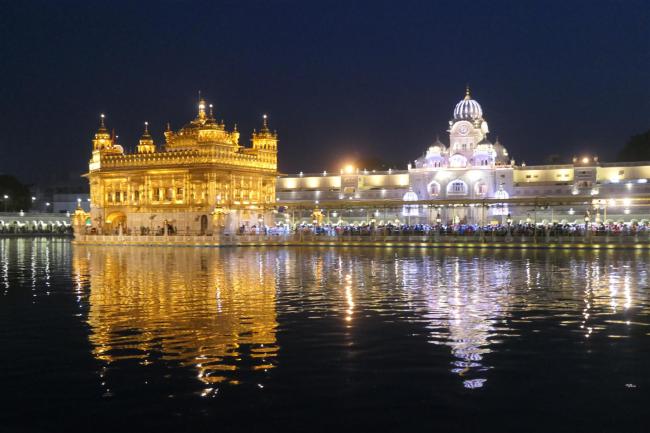
The temple by night.
When I went back to the Gurdwara to eat, I left my sandals under a seat but when I came back out I couldn’t find them. I looked all around but with no joy. In the end I had to find a pair of flip-flops to buy, fortunately not too expensive.
Next morning, when I went out to breakfast, I had another look for the sandals and found them. Where had they been? Had somebody borrowed them? Unlikely. Like a fool, I’d forgotten exactly where I’d left them and just hadn’t managed to look in the right place.
That day’s task was to get myself to the border town of Attari, ready for crossing over the next day. There’s a tourist bus that goes there from Amritsar so I bought a ticket and planned to stay there rather than come back. There was only one hotel in the town and I’d not been able to book a room. But the guide on the bus helped me out here and was able to ring them up for me and book one for me.
The reason why tourists visit Attari is to watch the gate closing ceremony at the Attari/Wagah border. I’m sure most of you have seen pictures or videos of this event so I was looking forward to seeing it for real.It involves the guards from both countries displaying their prowess with all sorts of high kicks, waving of swords and generally acting like prancing peacocks. I found a seat on the shaded side of the display area and settled down to wait. An ice cream and a fizzy drink helped to pass the time.

Armies waving their arms.
A soldier came out and started to gee up the crowd, getting some shouting and cheering underway. Some people from the crowd went down and danced around to music. There didn’t seem to be anything similar on the Pak side although there were spectators there. Eventually the area was cleared and the border guards came out on both sides of the gate. The gates had been closed up to this point but they were opened so the guards could do their ‘face off’ display. The crowd on the Pak side was now joining in as the the guards marched up and down, high stepping and kicking for all they were worth. Their uniforms and headgear were very fancy, as befits such an event, with the Indians in buff and the Paks in blue.
After lots more of this sort thing the last post was eventually played and both sides lowered their flags. More stomping around and waving of arms. Then the final act was of a guard from each side shaking hands before the gate was closed. What did I think of it? Very amusing but ultimately a load of silly nonsense really. But the partisan crowds loved it and, let’s be fair, prancing is better than shooting.

The flags are finally lowered while the Last Post is played.
Finally, it was back to the coach and I was dropped off outside the hotel. The owner fed me and booked me a taxi for the next morning, so I was now ready to prance across the border into Pakistan.
 MOTOPANGAEA