
Chilas, Pakistan. 27th May, 2023.
I said at the start of this Pakistan episode that I had plans to explore the eastern mountains and then the western. The east was done now, so time for the west. To do that it was most convenient to go south first and go along the GTR. I wanted to visit Islamabad anyway. It would also mean I could collect my camera afterwards.
I took the wrong road outside of Chilas, which left me a bit fed up but also wondering what this unplanned change would bring. It brought me a long hold up due to a road closure. There was a queue of traffic and I could see people on the road so I assumed it was some kind of demonstration. I had chai at a nearby café then rode down to the closure. The group of people I thought were demonstrators were actually a card school, sitting on the road while they waited. Others were standing around chatting. They invited me to join them but I declined and just waited, although I chatted to this group of young people. There was work going on at dam further down.

Roadworks card school.
The road opened and we all charged off, with the cars hustling their way past me on the rough road. There was a deep and fast flowing water crossing, and then two more stops, before I made it to the hotel.
Abbotobad came before Islamabad, with not very much to offer apart from a nice ride through the hills to get there. However, I did read something that reminded me of one of the city’s more infamous residents. It is the city where Osama Bin Laden met his demise and Google maps showed where he used to live. I found my way there but the compound had been pulled down and now it’s just grass. Some local kids pointed it out to me, one of whom had bright ginger hair. He got his photo taken, needless to say.

Nothing left of the Bin Laden compound now.
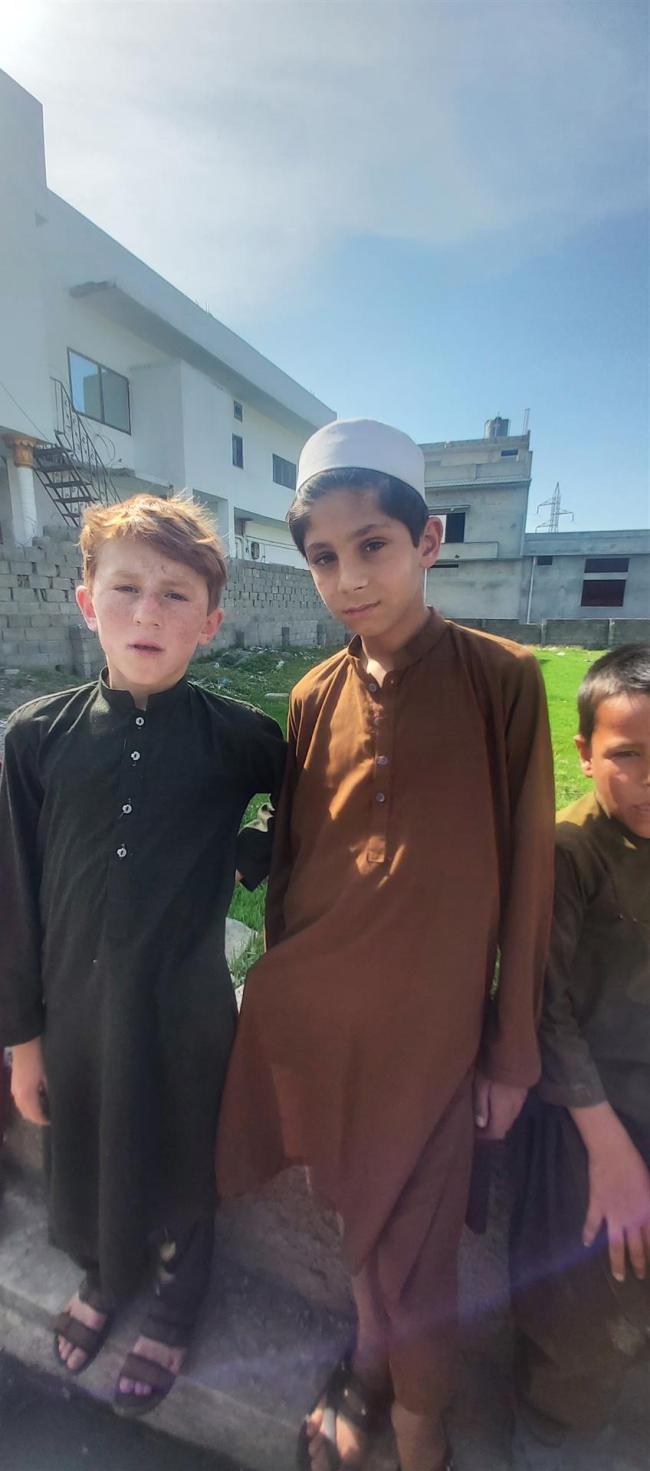
Quite odd to see a lad with ginger hair in this part of the world.
Islamabad, like Australia’s capital city of Canberra, was built for the purpose, in the 1960s. It sits right next to Rawalpindi and they are referred to as the Twin Cities. They couldn’t be more different though. Rawalpindi is old, messy, a plethora of small roads and alleyways where poorer people make a living as best they can. Islamabad has wide through ways, modern buildings, the roads have numbers, not names. But fortunately it also has areas that are less grand and that’s where I found a hotel.

Definitely the ‘less grand’ part of Islamabad.
There were cafés nearby and while I was in one of them, looking to find out what they had to offer, a guy sitting at a table pointed out to me that he’d just asked me to sit down with him and share his food. I was very apologetic as I hadn’t heard him and thought he must have felt insulted. So I sat with him and we chatted for a while, him with very good English. It wasn’t the first time someone had invited me to share their meal and it typifies the hospitality shown to strangers in this part of the world.
Murree is a town up in the hills and pre-dates Shimla as the summer home of the British Raj. The road up there was a decent dual carriageway, with fast and fun bends for my little bike to enjoy. Like Shimla, it too has a Mall Road to stroll down and enjoy the shops. There wasn’t anything else to see in the part of the town I went to. Just as I’d bought cake and got into the coffee shop it started to rain. So I hung around until it stopped before riding back down again.
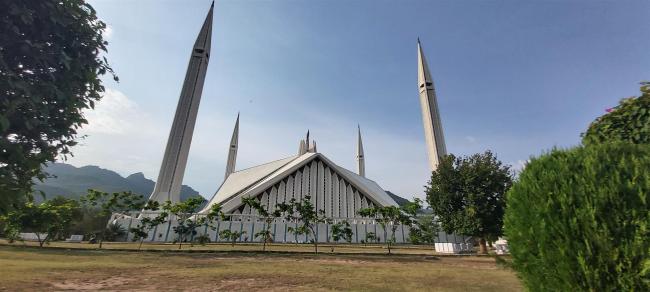
Masjid Shah Faisal.
In the city itself I went to see the Jamia Masjid Shah Faisal, the city’s main mosque. It’s a very striking building, designed to look like a Bedouin tent. It has a tall, thin minaret in each corner and is all in white. It looks very impressive.
I went to see the National Monument, which is a very cleverly designed to represent the cultures and peoples of Pakistan It has four large petals, to represent the four main cultures – the Punjabi, the Balochi, the Sindhi and the Pakhtun. There are three smaller leaves to represent the minorities, Kashmir and Gilgt Baltistan. Across the other side of the Peace Plaza is the Monument Museum, telling the story of the arrival of Islam in India.

National Monument.
That happened in several waves over the centuries, with one set of Muslim invaders chasing out the previous rulers. They initially came from Arabia, followed by Persians, Turks, Mongols, Afghans and Mughals, who came from Central Asia.
The way the museum tells it India was comparable to a garden full of dead wood and weeds that needed sorting out. They came in and cleaned it up. I don’t know whether the Hindu rulers of the time would have agreed but it’s true to say that Muslims had a talent for organisation and the rule of law. In reality India was a collection of Princedoms and individual states, often at war with each other. So that claim is probably correct in many ways.

Benefits of the Islamic takeover, the way it’s seen in the museum.
There was a more modern section which focussed on a politician/poet/writer called Iqbal, who promoted separation from India. And then on Muhammed Jinnah, who led the independence movement and became Pakistan’s first Governor General. If that sounds odd the position existed because Pakistan was initially a British Dominion Territory, as were all former colonies post independence..
My last visit on this busy day was to the Loq Versa Cultural Museum. It focussed on the culture of the different peoples who occupied Pakistan, so plenty of dioramas showing life in ancient times, pottery etc. There were sections for the different peoples that had influenced the area – Iran, Turkey, Afghanistan and China. Very often I walk around these places, feeling that I’m there because I ought to be, and suppressing yawns. But this time I enjoyed it very much. At the end of that long day I was glad to get back to my hotel for some food.
With Islamabad done and dusted I moved on along the GTR to Peshawar, calling in on Soihil to collect my camera and my missing hat, which I hadn’t realised I’d left there. Finding a hotel was a bit tricky. One that I went to changed his mind about having a room when I said I was English. Hmm, not a comfortable feeling. But I found one in the end. It had an underground car park where I felt very sure my bike would be secure. There was a young guy who sat at the entrance cuddling a Kalashnikov rifle! It seemed very odd as he looked so young and friendly. But the rifle didn’t, so that was OK.

He doesn’t look very fierce but his rifle was real enough.
I’d been feeling a bit low the past few days, both physically and mentally. Not quite up to snuff with my chest and just feeling very lethargic. I felt better when I got on the bike next morning apart from when a guy drove into another car then nearly wiped me out as he made his escape. I yelled at him to ask him if he was drunk or something.
I headed out of the city and started to climb up the Khyber Pass. I felt quite disappointed. I’d expected a tough and difficult road to go with its fearsome reputation as the unmoveable barricade against which so many invading forces had been broken. But it was just a gentle ride through some low hills. But the terrain looked less friendly, with broken hills, often with forts on the top, and was probably very difficult to march an army through. As I neared the border I cam across a queue of trucks at the side of the road, about 10kms long. Almost all of them were artics and it looked like they were going to be there a long time. At the border area there was a lot of infrastructure work going on, designed to make life much easier for these poor truckers. I did feel sorry for them.

Chatted with these guys at the Afghan border.
At the actual border there were hundreds of people around, and a long queue at the pedestrian crossing point, struggling for shelter from the hot sunshine. Their problem was that it was Friday lunchtime, so the border post was shut for prayers, and that’s usually 1.5 to 2 hours. I parked the bike then took a walk around. When I came back I chatted to some guys, who had good English. They were Pashtuns, who very much have their own culture and live both sides of the border. This area is very tribal and the kind of territory where tribal war lords hold sway. I cursed my self later on for not spending longer with them and asking about the political situation in the area since the Taliban took over. But I didn’t think of it at the time. I put it down to not feeling on top of everything.
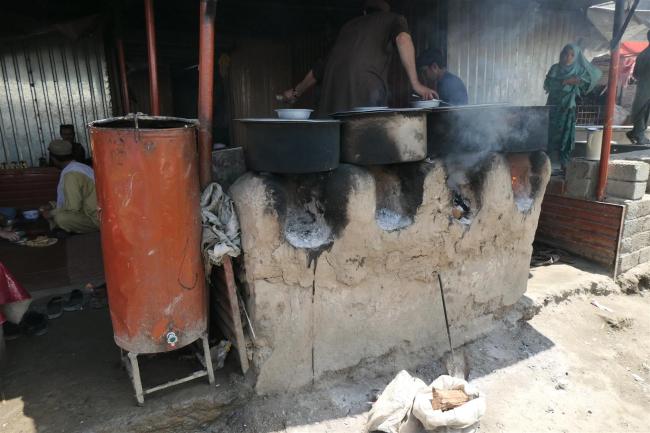
Made from clay, I’m guessing this way of cooking has been in use for thousands of years.
On the way back I stopped to look at an ancient Buddhist stupa and get photos. But it was attached to an old fort, still in use by the Pak military and they weren’t happy when I wanted to take photos of that. The road had several hilltop forts along it all from the heady days of the British Raj’s friction with Afghanistan, and all in use by the Pak military. An area of high alert against possible friction with tribal rulers across the border. It’s calm these days but hasn’t always been.

Old British hill top fort, overlooking the Khyber Pass.
On the way back through the city I stopped off to look at the Cunningham Clock Tower, built to commemorate a former Governer of the North West Province. It’s a nice building, in pink sandstone, with a clock at the top. Close by was Chowk Yadgar, an area which had a memorial in the middle of it. It’s dedicated to Colonel C Hastings, although I don’t know the reason for it. There was a very busy car/bike park beneath it. I put the bike in there and left it on the side stand. When I came back it was on the centre stand. They employ a guy whose job it is to do that so as to make room for more bikes. I wasn’t surprised really. Elsewhere I’d seen bike parking areas that were just a sea of red Hondas, parked almost on top of one another.
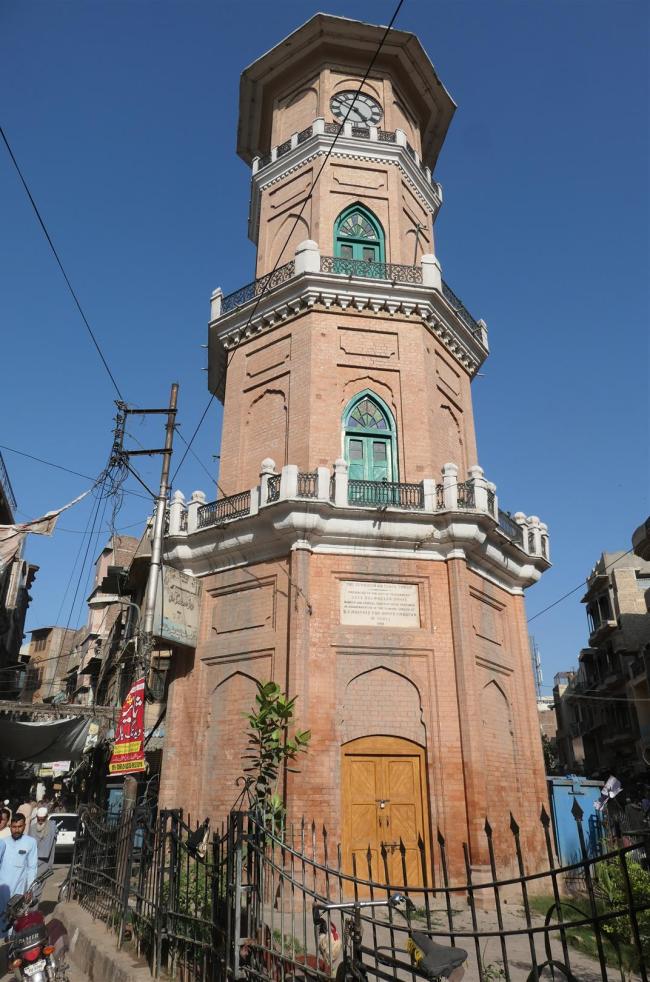
Cunningham Clock Tower.
Next day I headed north again. I’d been looking to get an oil change done on the bike. Pak cities often have Lube Centres, where all they do is change oil, but they’re more aimed at cars. As I headed out of the city I spotted a bike shop that advertised oil changes, so I pulled in. I was made to feel very welcome, was sat down on a chair while one of the lads was despatched to get some cold coke. As well as changing the oil he adjusted the chain, the clutch cable and the valve clearances. When I asked him how much, he refused to take any money. I have to admit my cynicism makes me wonder whether that’s just an act but I insisted he gave me a price and he asked for 1,300PKR. That’s less than £4, just to remind you. I gave him 1,500 and rode away very happy. The bike sounded much better now.

All commercial vehicles in Pak are heavily decorated. It’s all about warding off bad luck and evil spirits.
I went to visit Jamal Garhi, an ancient Buddhist monastery from the 1st century. I didn’t bother to pay the extra camera fee that’s often charged at these places, but excludes phones. But I had to use it in the end because my phone overheated and wouldn’t take photos. It had been overheating a lot lately, even when in the holder on the bike and therefore out in the fresh air. I was wondering if this indicated a battery problem or just reflected its three year age.
Once I’d climbed up the steps in the hot sun, accompanied by one of the attendants “for security”, I wandered around the mostly fallen down buildings and walls, getting a sense of how it used to be, but not much more. Only the base of the main stupa was still intact.
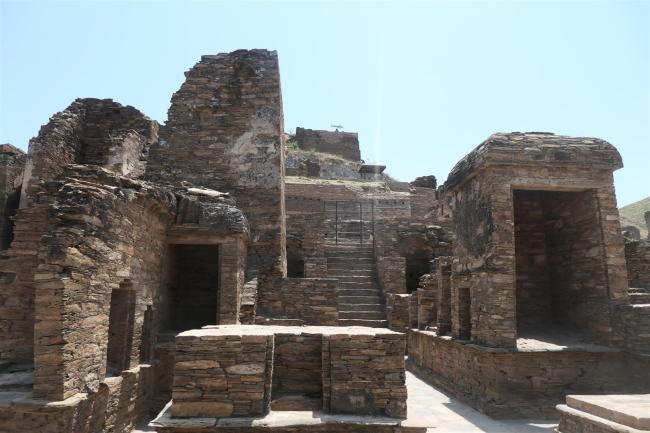
A lot of monastery buildings were still intact, albeit roofless.
Next day I visited another Buddhist site, Takht-I-Bahi. This one was much bigger, with 282 steps to climb to get to the top, in the noonday sun. Far too many little kids to pester me, and bigger ones wanting selfies, for my liking. I was still in a low mood and the heat was, unusually, getting to me. But at least the buildings at the top were worth seeing. There was an attendant up there who kindly showed me around the main points of interest. But when he walked me up the twelve steps to the base of the main stupa I thought I was going to faint. He showed me the underground meditation cells and then I found a shady place to sit down for a while and sip some water.
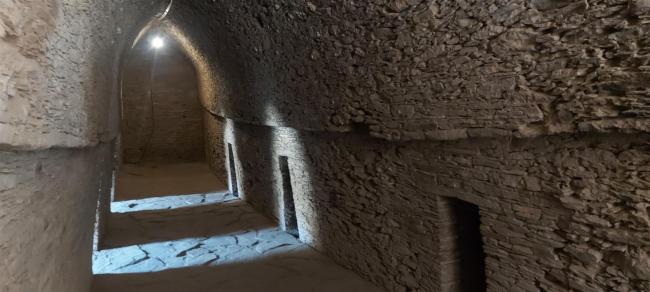
Underground meditation cells. Nice and cool here.
The monastery was started in the 1st century, same as yesterday’s place, during the time of the Gandaharan civilisation. It declined in the 7th century as the local economy declined. These monasteries rely on local sponsorship to survive and when that fades away the monks will move elsewhere. Despite the heat I enjoyed walking around it. It covered a big area and had plenty of buildings still standing, although none of them had roofs.

So this was how all those pesky kids got there!! Lovely school bus.
When I left I found a place on the main road where I could stop for a cold drink and biscuits. That made me feel a bit better but even so by the time I found a hotel all I wanted to do was sleep. I didn’t even have the energy to negotiate the price down. I managed to get some chai then, at about 6 p.m. I went to bed and to sleep. I woke about an hour later, lay there thinking of nothing for a while, then went to sleep properly. I finally woke up at 9.15 a.m., fifteen hours later. Did I feel better? A bit, but still not quite right. So I stayed another night and just rested.
I was now in the Hindu Kush mountains and these lower slopes are nice and green. Lots of paddies terraced into the hillsides plus lots of other crops growing. The road was following the Pajkora River through its wide valley.

The view across the valley.
When in the towns I noticed that many women wore the full burqa, mostly in a dark beige colour. It’s a Pashtun mode of dress and it seemed that things were a bit stricter around these parts, in some families at least. What’s unknown of course is whether or not the women choose to wear it rather than being told to. The Western assumption is that they do it because of cultural pressure but it ain’t necessarily so, as the song puts it. Either way, they did look uncomfortable in the hot temperatures.
In the town of Dir I found a nice hotel. I must have been feeling better because I talked the price down. The room had a balcony overlooking the busy river, also facing west, so I enjoyed a couple of hours sitting in the sun. They had hot water and supplied me with a nice chicken dinner. Things were looking up and I was feeling a bit better.
In the morning I went for a walk. There was a fort up in the town but when I got there it was closed. It seemed to be an army supply base so no entry into there.
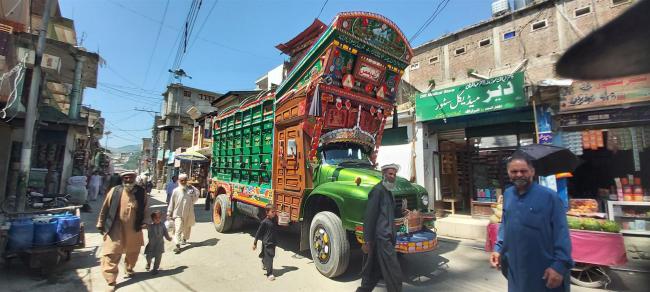
This Pak built truck, with the Bedford name and the Vauxhall badge, really takes the eye.
On the way along the busy street I saw an old Bedford truck parked up, making deliveries. It was a typical Pak style truck, highly decorated and with the uplifted front section of the load area that all trucks here have. I always think they look like the covered prarie schooner wagons from the Old West. I took some photos and the driver showed me inside the cab. Initially I thought it was probably a Tata truck, as found all over India, but with the Bedford name and a Vauxhall badge being used to hide its Indian identity. I looked it up later and I found I was wrong. Ghandhara Industries, based in Karachi, has had the franchise for Bedford trucks since the 1970s. Similarly, that franchise was held by Tata Motors in India, hence my confusion. Bedford was owned by General Motors years ago.
Among the shops and stalls on this street I saw a place selling holsters for guns. And I don’t mean toy ones either. This seemed very odd. Pakistan banned guns in 2005 but as I walked around I saw that security guards always wore them, especially outside banks and ATMs. When I was in Lahore I went to a baker’s across the street from the hostel and there was a guy with a rifle sitting outside it. Having also seen the street demonstrations in Rawalpindi I had an impression that there was an underlying edginess to life in Pakistan sometimes.

Gun holsters.
My next town along the route was Chitral, a place famous for its polo ground. It holds tournaments and competitions there on a regular basis. The route there from Dir includes the famous Lowari Tunnel. I’d heard that bikes had to be transported through it but then I found a video showing bikes being ridden through. But that was made only for show and when I got there I had to put the bike on a pick up.
As I watched some guys heave my little bike up a narrow plank onto the back I couldn’t help but think, “I bet those six guys are pleased I’m not riding my heavy Himalayan”. There’s two tunnels. The first is 8.5 kms long and cost me 800PKR to get through. At the other end the bike was easily off loaded by backing the truck up to a loading ramp. I was allowed to ride through the 1.9kms of the second tunnel. Lucky me.

Lowari Tunnel.
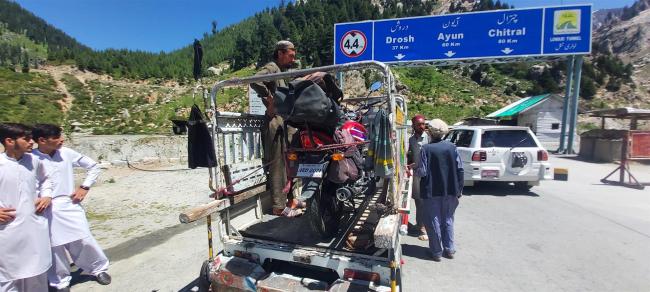
Lowari Tunnel bike transport.
At Chitral I found the polo ground and had a look in the museum next to it. It was a place that had two halls and each one was opened in turn for me to look in. There wasn’t very much there but the funeral carvings used by the local tribes were interesting.
I stuck around to watch the beginning of the polo match, just to see what it was all about. Men with sticks chasing a ball up and down a field on their horses, basically. But it was fast and very skilful. Polo started out as a way of training cavalry, in Persia, way back in the 6th century BCE, and it was easy to see how valuable the game would have been for that. The modern game developed in Manipur, way over in the eastern side of India.

Polo under way. Busy chasing the ball.
With the help of Google I managed to find a very nice hotel, up on the hillside overlooking the river down below. Sitting in the garden drinking tea, and chatting to a Bangladeshi civil engineer, who lives in Australia, was a very pleasant way to end the day.
For my ride out next day I’d decided to visit the Kalash Valley. It goes out into the tribal areas and has some good places to visit. I turned off the main road, crossed over the Kalash River via the bridge, and presented myself at the inevitable checkpoint. The road wound up through some small villages, with a road that had once been good. But after that it was just stones and dust, wandering its way through the hills. It’s easy to see how these places remained so isolated. The road was hard work on my little bike. Very rough in places. It would have taken a lot of effort to traverse it on foot or donkey.

Traditional dress.
Eventually I came to the village of Batrik, one of the main villages of the Kalash tribe. The women here all wore a distinct style of clothing, with decorative caps that included a tail piece, and a decorative bodice. I got some photos of the kids, who were happy to pose in the hope of some money. But the adults were less cooperative. And who can blame them, really.
I walked up into a village. Most of the buildings were of wood. There was a dancing square with a stand in the middle of it. I had hoped to see a graveyard, where bodies are left in open coffins to deteriorate naturally, but I didn’t find that. I had tea at a local café and the guy there told me they aren’t Muslim although they worship “god”. They have their own temples and ceremonies. What was most notable was their fair skin and that they often had fair hair. The Greek ancestry had travelled down the generations here.

Fair haired kids. Descendents of Greek armies.
A good place to visit for seeing an alternative culture. Looking at the map of the Kalsha valley, and the way the areas are separated by smaller rivers running down from the mountains, makes it easy to see how these different cultures develop. Isolated lives were just the way things were centuries ago, although they did come together at times for celebrations.
From Chitral I headed east, towards Gilgit again. But that was a long way off, with the road set to wander through many hills and valleys before it got there. The road turned into a stony challenge before I got very far and for about the next seventy kilometres. 20 kph and 2nd gear was the order of the day. Other bikes were bouncing past me, very often two up, but I was happy to be more careful. About 20kms before the town of Booni in became surfaced again. Not a metre too soon as far as I was concerned.
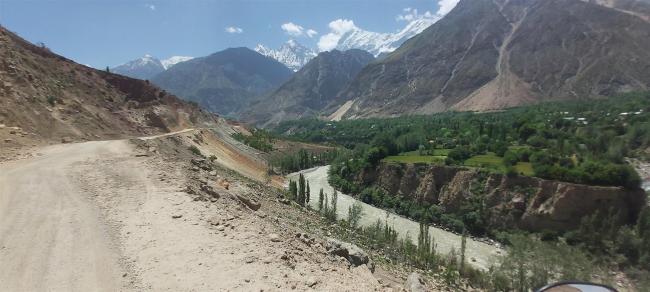
Bad road but nice views at times.
Malik had marked a homestay on the map, run by some bikers that he knew. I found it and got a room. Not a great room but it was OK. Its best feature was its garden. I sat out there drinking tea and as the afternoon became evening I was overwhelmed by the smell of the flowers. The garden had a section containing Jasmine, which is Pakistan’s national flower. It’s also know as The Evening Flower because the flowers of certain species open in the evening to release their glorious scent. I’d never smelt it before and was captivated. Painted on one of the walls, by an Aussie visitor, was a picture of a Markhor, sitting on a bike. It’s Pakistan’s national animal, with big curly horns, and it looked great. On its bike, living the dream.

The animal is the Markhor, one of Pak’s national symbols.
Before I left next morning they got me to appear in a short promo video, describing how wonderful the guest house is. Happy to oblige. As soon as I left Booni the road became stony hell again and stayed that way. Malik had warned me it was a bad road, and he was right. I stopped in a village for chai and was offered a chapati, warm out of the oven. It was delicious. But stony hell still awaited so I had to get on.
There were plenty of water crossings, from the streams flowing over the road, but they were all manageable. Until, that was, I came to The Big One. It was about four metres across and the fast flowing water was at least half a metre deep. But it had a base of concrete slabs. Normally I’d have walked a crossing like that first, to check the best way across. But those slabs lulled me into a false sense of security and in I went.
But the slabs had shifted slightly and there were gaps between them. The front wheel dropped into one and stopped the bike. But I was able to power it out. Then the rear wheel dropped into the gap and that was that. No amount of effort would get me out. The water was washing up against my pannier bag and I knew it would be soaking everything inside. It was also filling my trouser leg and then my boot, slowly but surely. I couldn’t dismount because the force of the water would push the bike over before I could do anything. I sat there for about twenty minutes until a guy came the other way and helped me out of my predicament. Thanks buddy, and I’m sorry about your waterlogged smart shoes!

I did the sensible thing at this one and walked across it first.
After some more water crossings, another one of them quite deep but safely negotiated, I arrived at Shandur lake, nestled down in a green valley. I was hoping to stay there but there wasn’t any accommodation. A guy at the checkpoint said there was somewhere at a little village called Teru, and he was right. I had to stop as it was getting late but I wasn’t at all impressed with the price or the lack of running water in the room. I think the old guy running the place was on his own and he did cook me some nice food.
It’s amazing what you can do in these tiny places. With the help of the locals I managed to find all the right people to buy some credit for my SCOM SIM and buy some data. But the 4G that had been there before had disappeared and I couldn’t understand why. It wasn’t until I went into a phone shop in a larger further down the line that they pointed out the mobile internet facility was switched off. Well I know I didn’t do that so the top up process must have done it.

The beautiful Phandar Valley.
The road to Phandar Valley was no better than what I’d just ridden but the valley itself was beautiful. It’s what draws tourists to these mountains. I was up at about 3,300 metres now, where the slopes were still green. The common tree in these mountains is the poplar, not the fir. The great thing about them is they’re often accompanied by larches, which have a lovely yellow colour.
At Phandar the Gilgit River widens right out and divides into three sections, which flow around two islands. They’re very green and look wonderful. The area attracts many tourists. To meet the tourists’ needs the road I was on, the Chilas to Gilgit Highway, was being upgraded to two lanes. Looking at it then I could imagine that being a lifetime’s work. It also meant that as well as stones to negotiate there were some stupidly difficult diversions to get round. A real challenge for me and my little bike.
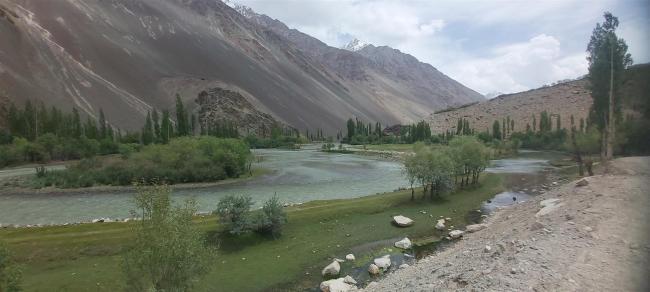
Slow river, green islands.
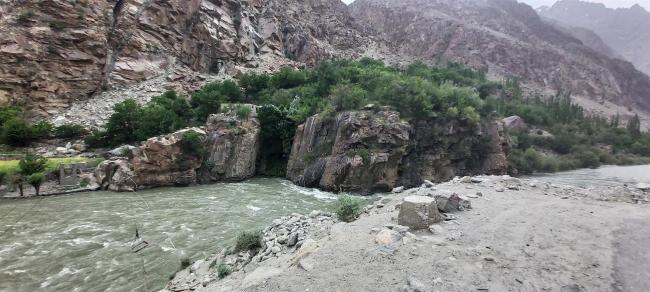
Fancy your chances crossing this roaring river on that puny looking seat? Me neither.
I stayed in the town of Gupis, where there’s an old fort. After breakfast I walked across to look at it. But I couldn’t find my way inside it. I found the gates but they seemed to be closed, so I just walked round it. Back at the hotel they offered to send someone across with me to show me the way but I couldn’t be bothered by then. It was British built so wasn’t very old anyway.
The road was good now, generally, so it was much better riding. Just outside a town I came to another road closure. It was due to open at 14.30, it was then 12.30. Lots of time to drink tea. A guy in a car, to whom I’d made that remark, to said to follow him. I thought has was going to show me a decent café to wait at but no, he went back into the town and crossed over the river. On the other side was a road that paralleled the closed one, but wasn’t marked on Google maps as a through road. After a while we came to another bridge and crossed back over, now on the farther side of the roadworks. Nice one!

Thick dust blowing our way. No fun.
I motored on but not for long. I came to another closure, where we had to wait for half an hour. There were a couple of bulldozers at work and unfortunately the wind was blowing their dust right in our faces. Horrible! But once I’d cleared that it was all good riding to Gilgit and into my usual hotel. That ride had been hard work!
 MOTOPANGAEA