
Sarajevo, Bosnia and Hertzegovina. Friday 4th October 2024.
I woke up to the sound of rain in Kremna, although it had stopped by the time I left. But being wise to the ways of the weather I wore my wet gear anyway. A good decision.
At the Serbian border they stamped my passport and noted my bike registration. At the Bosnian border they scanned my passport. Customs weren’t interested in me. It was a small border up in he hills and these things help.

Entering Bosnia by the mostly Serbian area of Srpska.
I headed to the nearest town where I drew out some Bosnian Marks. I got chatting to a guy who’d spotted my number plate and wanted to know if I’d really ridden that far. I assured him I had and then got him to change one of the big banknotes from the ATM into more manageable smaller ones.
It was a nice ride to Sarajevo but I was amazed by the number of tunnels the road went through, all different lengths. Thirty six, all in quick succession. As I got closer to the city I went through six more. Very odd, I thought, but necessary to deal with the rocky ridges..
I’d booked another apartment. This one was not good at all. Firstly, it was up the top of a very steep hill. Secondly, the apartment itself was a dangerous, shabby place. Most of the sockets didn’t work. All the switch boxes were loose in the wall. But the worse thing was the broken pane of glass in the door to the living room. It’s an appalling thing to have left for visitors to deal with. Booking.com asks you to leave feedback. I this instance I made a direct complaint.
There was no kettle and the stove was old and slow. I asked about heating and he pointed out the electric fire in the bedroom, which had to be plugged into the only working socket, which is next to the bed. Definitely not safe. There’s a gas heater in the living room but he said it can’t be used because it’s not safe to have it on at night. On the upside the settee is comfortable and the bed looks OK. I said in my last post that some apartments aren’t very good and this was one of them. The occasional result of doing things on the cheap, I suppose.

A real risk to life and limb.
Bosnia used to be part of Yugoslavia until that country broke up in 1991. It’s previous history is similar to most of this area. In the first millennium Slavic people emigrated south and settled there. Bosnia was recognized as a Kingdom in the 14th Century but then the Ottoman empire invaded and took it over, along with most of the Balkans. Many Bosnians converted to Islam and eventually did quite well under the regime, providing administrators and military leaders to the Ottoman Empire. The Serbians and Croations in the area did less well, mostly due to infighting between Orthodox and Catholic Christians.
The Ottomans wanted to rule their conquered nations but didn’t always want to oppress and convert their people. A demonstration of this was their willingness to allow Jews, who were fleeing persecution in Spain, to come and settle in Bosnia. It took a long time, but eventually they got full citizenship rights. They also encouraged Orthodox Serbs to build churches.
Hertzegovina? It’s the southern area of the country and was absorbed into Bosnia in the 14th century. That is something of an over simplification but the affairs and actions of the area’s local rulers are not the right fodder for this blog. Ther’s a link to the relevant Wikipedia page below.
In the late 19th century the Ottomans were pushed out of the Balkans, only to be replaced by the Austro-Hungarian Empire. But by that time the current borders of the country had been established. From then until the outbreak of WW1 Bosnia was in a state of flux. But when the war ended it became part of the Kingdom of Yugoslavia.
Enough history for now, but there’s more to come.

The Ottoman built Latin Bridge.
I walked down the very steep hill, into the town, thinking all the time about the steep walk back up. If ever a road needed a bus, this was it. I had a look at the Latin Bridge, across the river Miljacka in the centre of the city. A strange name for a Muslim built bridge but it was named after the Catholic area on the left bank.
It was here that the spark occurred that ignited the conflagration of WW1. On 28 June 1914, Gavrilo Princip, a Bosnian Serb member of the revolutionary movement Young Bosnia, assassinated the heir to the Austro-Hungarian throne, Archduke Franz Ferdinand. There’s a plaque on a building next to the bridge commemorating the event.

The plaque memorial to the assassination.
It was too late in the afternoon to visit anywhere else so I found a handy restaurant for a meal, and a handy shop for supplies, before hauling myself back up the steep hill.
The Turkish influence is very obvious here. Women in Burqas. Plenty of mosques. And Baclava for sale in the shops. Some warm Turkish weather would have been nice though.
I told the owner about the non working fire. He didn’t seem convinced. I told him not to worry about it for that night. Fortunately it wasn’t too cold.
I spent the next couple of days having a look around the city and, in particular, learning about it’s tragic recent history.
I have to confess that I was always very confused about the Bosnian war. I didn’t really understand what was going on there. It’s hard to know why because current affairs always interests me. I think it was a combination of not knowing much about the area, including the component countries of Yugoslavia, and having two babies arrive during the period of the war. So I was determined to find out what went on. Believe it or not, what follows is the short version, otherwise you’d be here all day.

Kids enjoying the pigeons.
I mentioned before that many of the Bosnians converted to Islam when the Ottomans arrived, and that the Serbs and Croats didn’t. This situation embedded ethnic and religious fault lines among the population, which lay dormant for centuries. Why? Because when the Ottomans left, the area became part of the Austro-Hungarian empire. And with their demise post WW1 the Yugoslav Kingdom was formed.
During the period up to the invasion by Germany in 1941, Yugoslav politics was in almost constant upheaval and the Bosniaks (Muslim Bosnians) had quite a bad time of things. During the German occupation the area was governed by the Ustase, a German puppet government of an ultra fascist nature. They recognised Croation Catholicism and Bosniak Islam as official religions. But they regarded Serbian Eastern Orthodox Christianity as an enemy. It was unfortunate that most Croats and some Bosniaks worked for this puppet state, further entrenching the hostility of the Serbs. Many of them joined the Chetniks, a Serbian nationalist group, and were involved in massacres of Bosniaks and Croats, wiping out whole villages at a time. Tens of thousands died. The descendants of the Jews who’d fled Spain were now being hunted by the Nazis although many of them joined Tito’s partisans.

Night time view of the Kovaci cemetery. Full of Muslim partisans.
Post WW2, Tito became president of Yugoslavia, within the Russian grouping, but as I mentioned before, he trod a different path to Stalin’s. Bosnia as a whole did well out of this, with it becoming a major centre for arms manufacture. People were well off, healthy and well educated. Frictions between the different factions no longer had a place. Until, that was, the break up of Yugoslavia post communism. It turned out that those faultlines were still there. So what happened next?
After the collapse of communism there was a parliament consisting of parties from the three ethnic groups, with representatives in proportion to their numbers. A vote was taken as to whether to declare independence from Yugoslavia. Bosniaks and Croats said Yes, Serbs said No. The Serbs split away and formed the Assembly of the Serb People of Bosnia and Herzegovina on 24 October 1991. Early in 1992 they formed the Serbian Republic of Bosnia and Herzegovina. It was renamed Republika Srpska in August 1992. The area still carries that name.
In March of that year Bosnia and Hertzegovina declared independence from Yugoslavia and the new state was internationally recognised. The Bosnian Serbs and the Croats had previously agreed to split the country up and create Greater Serbia and Greater Croatia. Not a very good beginning for this new country.
In response to the declaration Serbian militias mobilised in various parts of the country and the whole area soon descended into war. Concentration camps were established and housed Bosniaks and Croations. Ethnic cleansing was rife. There was a massacre of Bosniaks at Srebrenica and other places. But the main event of this war was at Sarajevo, which was subject to a four year siege, beginning in May 1992. The Serbs mounted a campaign of destruction of important buildings, starvation and sniper fire against the civilian population. This lasted until a peace deal was agreed in November 1995.
Although peace came to Bosnia, other countries in the region continued to suffer from Serb nationalism. These included Montenegro, Kosovo, Albania and Serbia itself. It wasn’t until 2006 that the current borders in that region were finally established.
I promised you the short version of this sad story. If you want the longer one here are two sites worth visiting: Wikipedia and Britannica .

The rebuilt City Hall is looking good now.
What about Sarajevo today? The damaged buildings were rebuilt. The city centre is busy with tourists and all the places they like to go to for spending money. I spent my time looking around the museums, most of which were dedicated to the war.
When I walked down into the city on my second day I called in at the Yellow Fort. It was just a tower that had been part of the city defences but had a good view over the city. A bit further down the hill was Kovaci Cemetery, where many of the victims of the siege of Sarajevo were buried. As far as I could see, all of them were Muslim. There’s a memorial in the middle of the cemetery as well.
The restored City Hall is a very lovely building, with a Moorish design to it and excellent internal decorations. Inside there were several exhibitions centred on the Bosnian war and the effects of the shelling. The history of the ethnic cleansing is covered and, if I’m honest, it upset me a lot. On the 3rd and 4th floors was an art exhibition, which I enjoyed very much.

This man was eventually convicted of murder.
After finding a dry place in the café area to eat lunch and drink tea, I sat and watched the rain come, then go, then come back again, before finally leaving.
I had a look at the exterior of the Sacred Heart cathedral but didn’t go it. Instead I was drawn to the Gallerija 11/07/95, just around the corner. It’s a memorial to the Srebenica Tragedy. The massacre of Muslims , in other words. There was a film running when I went up. Interviews with people who’d lost their husbands, brothers, sons to the genocide. Plenty of photos about it. And it, too, was very upsetting.
The upside of the day was that I managed to catch a bus going up that steep hill. Something to be pleased about.

Sacred Heart cathedral.
Next day I went back down to the city, aiming to take some photos. I took a few at Sebilj, which is a wooden fountain that looks like a kiosk. And of people enjoying the pigeons in the square.Then I went to see the Gazi Husrev-Beg Mosque. I went inside for a look-see. Some very nice decorations and stained glass. But I’ve been in better.
Next was the Museum of the Jews of Bosnia. An interesting place, which traced their history in the city. They fled Spain and Portugal during the Inquisition and were welcomed to the city by the Ottoman rulers.

Inside the Jewish Museum.
They were given land to build a hostel and a synagogue. This was in the 17th C. They didn’t have rights as citizens but were left pretty much to get on with their lives and they spread around Bosnia.
They tended to work as craftsmen – tailors, shoemakers, jewellery makers etc. In the mid 19th century they were given full citizenship rights, by the Ottomans. Many of them fought with the resistance in WW2, many more were murdered.
Then I jumped the tram down to the National Museum of Bosnia and, once I’d found my way in, wished I hadn’t bothered. It cost almost £9 – outrageous – and mostly repeated what I’d seen elsewhere, many times. Greek frescoes, stuffed birds and lumps of rock.
Across the way from that was a much better place, the History Museum of Bosnia. They had a major exhibition about the partisans of Yugoslavia, and of other parts of Europe. They not only fought the Germans but also Croat and Serb fascist groups. Tito was their leader and they became a proper army of resistance, well armed and well trained. Communists, yes, as were many other partisan groups in Europe. Britain supported them and most of the other groups too.
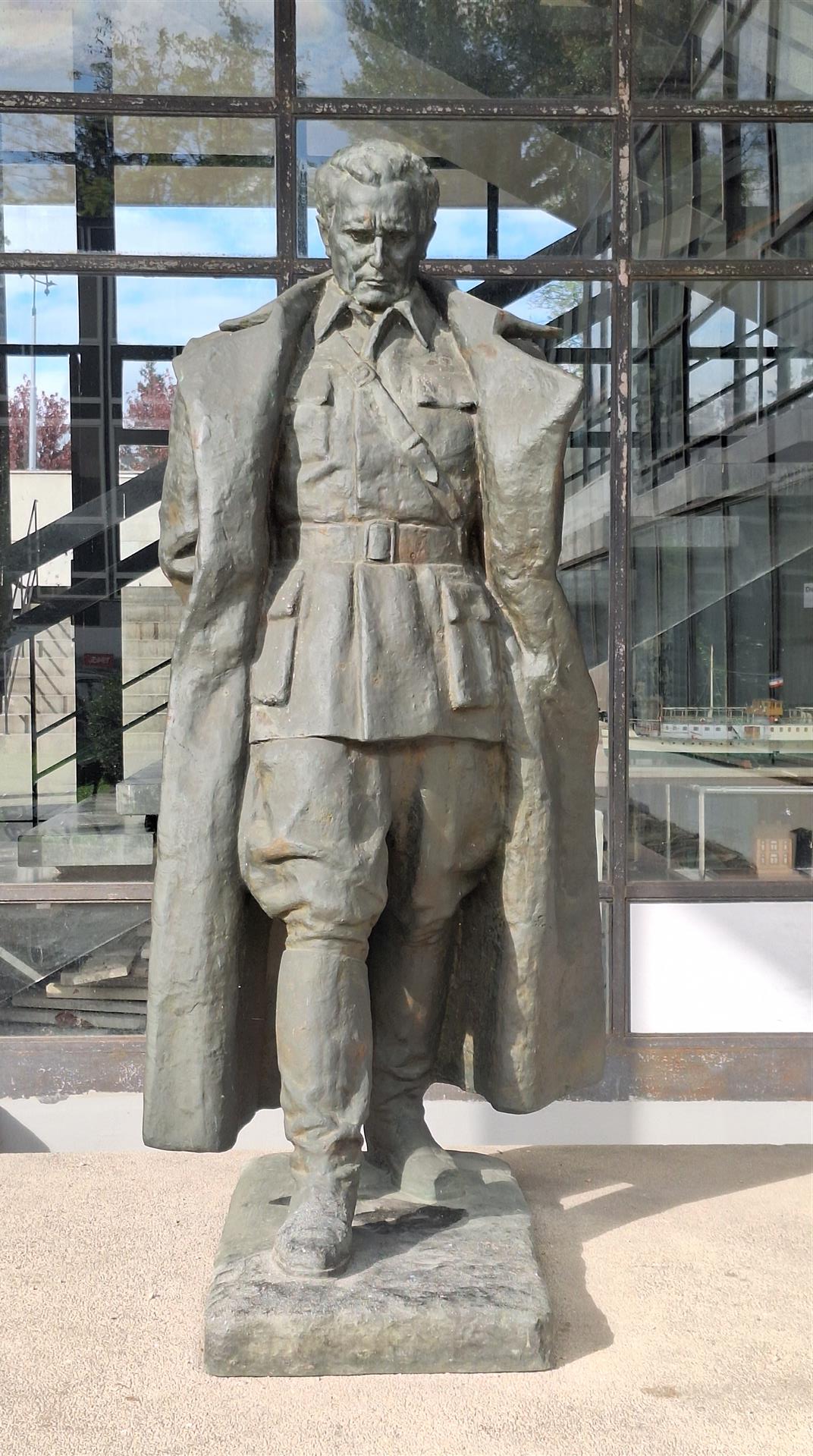
Marshall Tito.
One of the themes of the display was how complicated the issue was. They were fighting the Utasha (Croation puppet state of the Nazis), the NDH (Croation fascists) and Chetniks (Serb nationalists). The Bosnian Muslims fought separately from the partisans initially, but joined with them in the end.
Upstairs was a special exhibition about the Siege of Sarajevo. Some very moving testimony and photos. Outside were some of the artillery the partisans used, along with a display of posters from various European partisan groups. The Yugoslavian group was the largest.
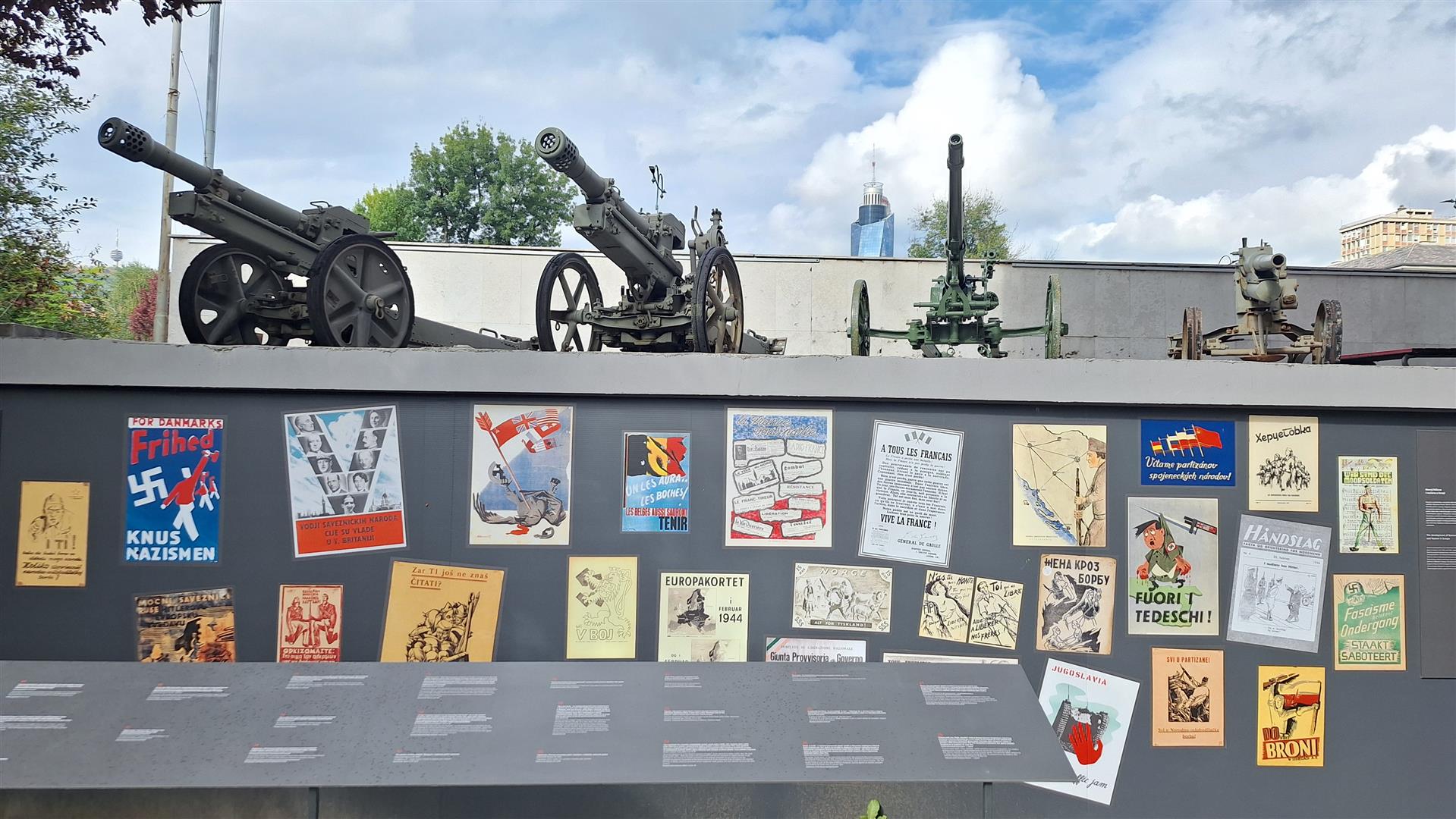
The posters, from all round Europe, were very interesting.
I jumped the tram again, back to the city centre to visit the Museum of Crimes Against Humanity. This was another expensive place but fortunately there was no-one on the desk so I bunked in.
There was a very moving film of archive footage, with talking heads. It covered how the people managed to deal with life during a four year siege, showing the things they had to do to survive. There was some graphic footage of the aftermath of shelling and sniper fire. Not fun at all. Lots of other photos as well, but I skimmed those. I was starting to get affected by it all again and needed to escape.

Scenes from the conentration camps.
Walking back up through Bascarsija, I spotted a fast food place and had a chicken burger with some chips inside it, with a coke to wash it down. Nice and cheap and it brought me back to normality. You might wonder why I visit these places if they upset me. But I like to know what happened during these events and I think we all need to be reminded how awful people can be to each other, especially under the name of nationalism. Gaza and the recent riots in the UK spring to mind.
No bus back up the hill this time. I’d missed the last one.
Next day I put the sad history of Sarajevo behind me and rode to the town of Mostar. The road went up into the hills and was a pleasure to ride.

Up in the hills, where the air is cleaner than the city.
Google took me away from the main road because of closures caused by the recent floods. Nice roads for a while but eventually the road turned to dirt. I stopped to check the map for an alternative. There wasn’t one. While I was waiting a few cars came past from both directions, telling me that the road was relatively easy to use. So I took it. I had no choice anyway.
It twisted and wound up through the hills, with a steep, ravine like drop into the valley below. I could see a lake down there, surrounded by a town. The road was narrow and two cars passing would have struggled. In fact, they did. But I was OK. To my amazement there was a motor home coming towards me at one point. If nothing else, that convinced me that the road was a viable alternative to bypass the floods.
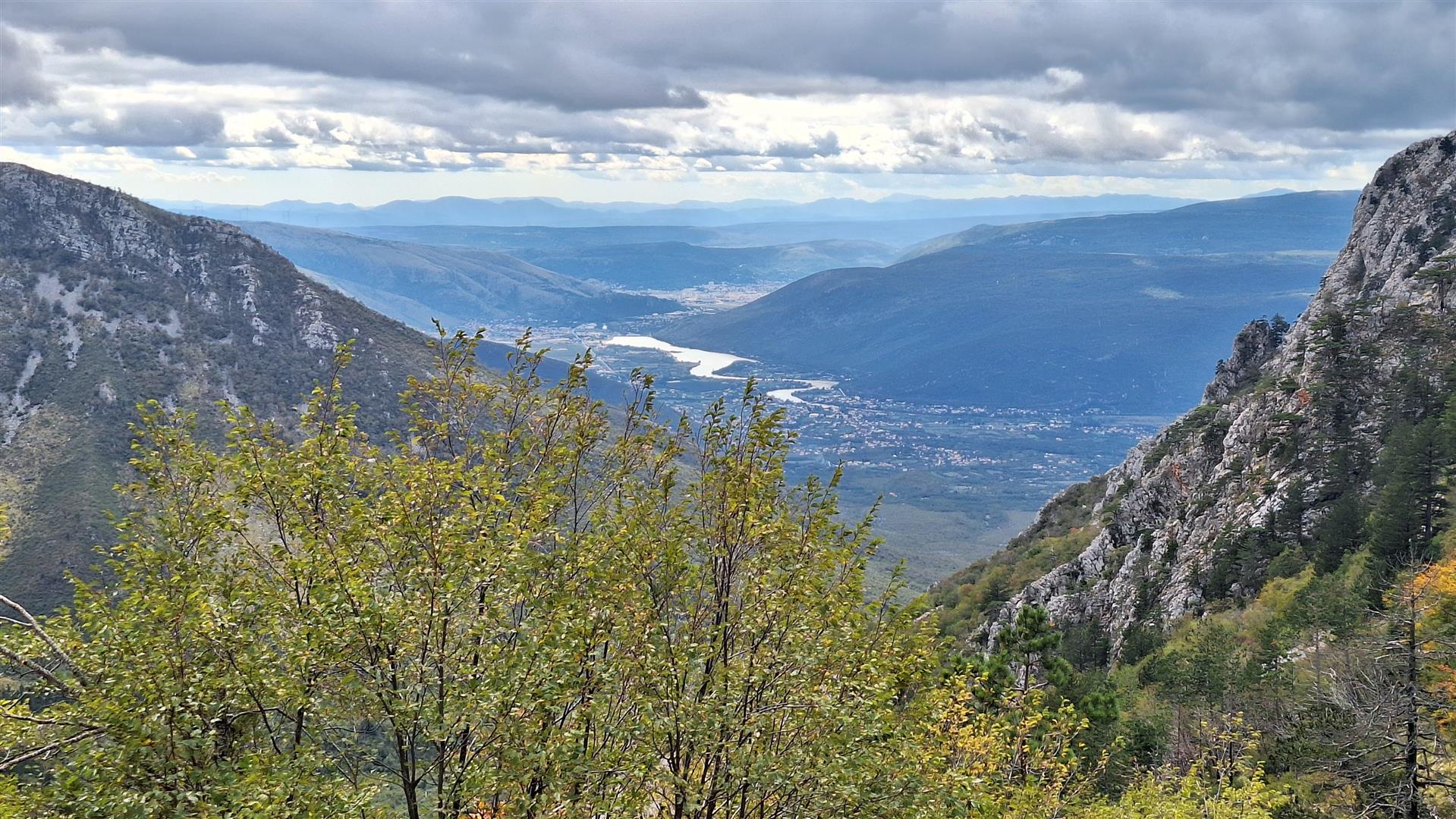
Nice views of the river valley.
I took it steady in the lower gears. The surface was firm but with lots of rocky sections among the compressed dirt. I enjoyed it. It was 20kms before I came back to asphalt. I got up to 1200 metres. Quite the mountain road!
The road went back downhill on a decent surface and was an enjoyable ride. At the bottom it rejoined the main E73 and I quickly found a filling station to get a coffee and eat lunch.
Three guys came in on trail bikes, to refuel and get some food. One was on a Yamaha Tenere, one on a Voge 300 and one was on a Moto 450. They all had a good look at my bike. One of them spoke good English so we chatted. They’d been riding the Trans European Trail for a couple of days and it seems the track I was on is part of it.

Good bikes for going off road.

Three friendly guys riding them.
I left them to it and cracked on. It wasn’t too much further to the Tekija Blagaj monastery, which is a Dervish House. It’s a small building with a few prayer rooms in it. But it has some history. It sits at the source of the Buna river and has been rebuilt several times because of the destructive effect of rocks falling from the cliffs above. You may have heard of the phrase, Whirling Dervishes. These don’t whirl, they chant, two or three nights a week, in praise of Allah. It’s a pilgrimage site so gets plenty of visitors.
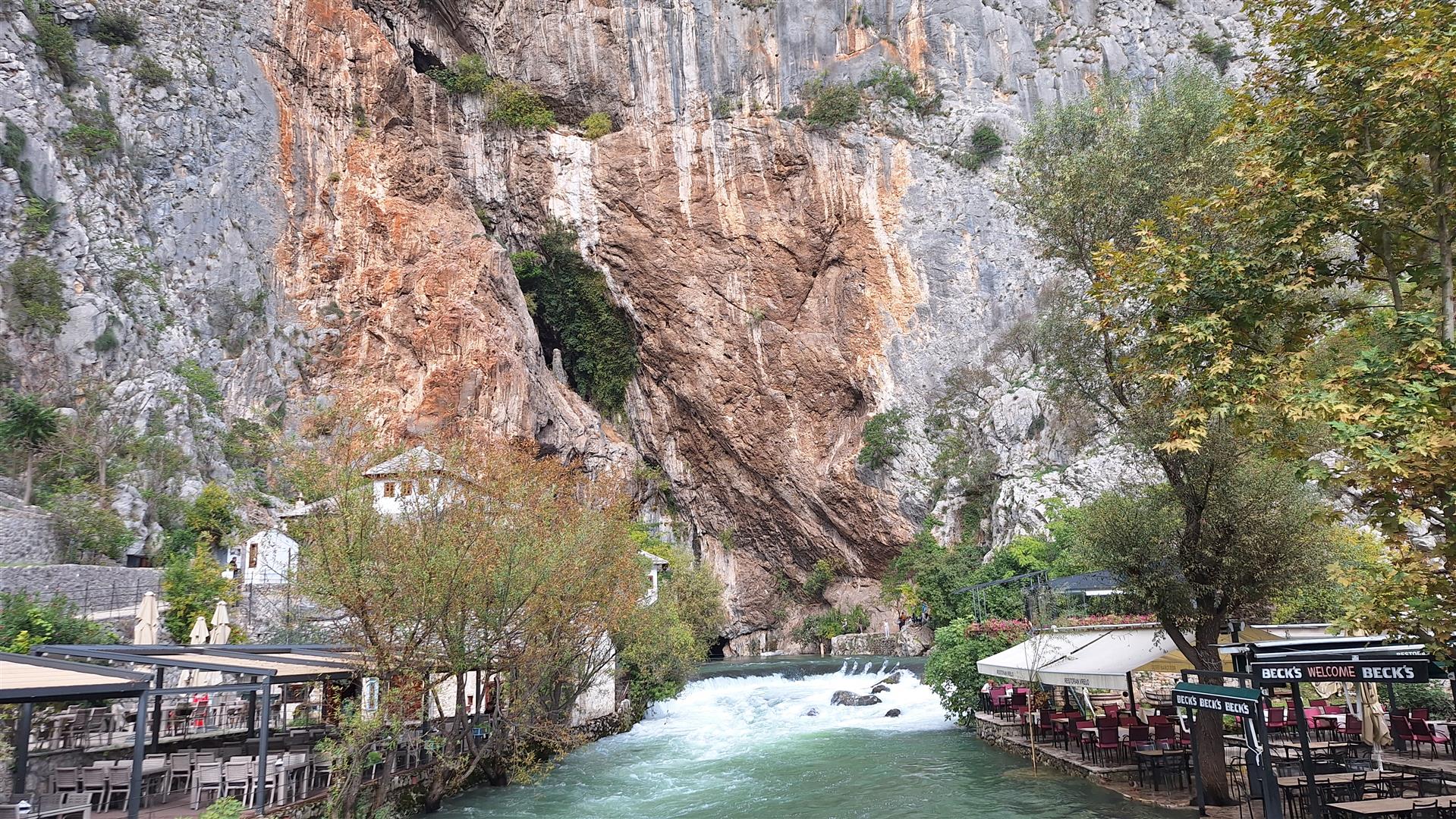
The Dervish House, at the source of the Buna River.
I’d booked an apartment in Mostar, which I found very easily thanks to the good instructions. It was very comfortable and well equipped. I contacted the owner and asked him for another night, which he was happy with.
Mostar is an old town with plenty of places to see. The first visit was to the Partisan Memorial Cemetery. A place with a big memorial sculpture., another of Titos’ Spomeniks There were plaques on the ground with names on them, very much scattered around. But no info boards, which was a shame.
Then I went across to the Old Bridge. This was originally built in the 17th century by an extremely clever Ottoman engineer. He had to use varied techniques to get it set up properly because of the different height of the bases on each side of the river.
It replaced a previous wooden bridge and used the same bases. He studied the difficulties over a period of 8 years, and then built it within one season – about 8-9 months. His challenge was the winter and spring flood waters. But then the Croats destroyed it during the Bosnian war. In the early 2000s it was decided to rebuild it back to its original state, using as much of the original material as possible.

The Old Bridge.
They set up a steel scaffold to support the work as it progressed. Because it was UNESCO listed they insisted the construction method should match the original. In particular this related to using the same method to hold the stone blocks together as was used originally. Steel cramps were utilised, held in with molten lead. It took several years to do the job but it was finished in 2004 and reopened. It looks fantastic. There’s marble stones laid across the width of it to act as a pavement.
One of the events that delights tourists is when a young man jumps off the bridge into the river below. It’s a twenty four metre drop. One guy goes round collecting money from the watching tourists (not from me tho). Then the other one jumps off. It seems they have to be licensed to be allowed to do it and there’s a training platform a bit further down the river.

“I’ll do anything for money.”
The original guard towers, one each side of the river, got damaged too and they’ve been restored also. I went up in one of them, which is a museum to the building of the original bridge. I was able to go up 5 floors to the viewing gallery over the city
In the basement was archaeological information, garnered during the rebuild process. That’s when they found the original wooden bridge foundations. There was also a very, very detailed technical display about the rebuild process. Far too complex for me to understand. But I really enjoyed the film they showed. The effort and care that went into it was amazing.

View of the bridge from the support tower.
Coffee was the next stop but after that I went to visit Biscevic House, which is an Ottoman style town house, with some original furniture and decorations in it. It used to be even better but it too was damaged in the war. It was laid out as it used to be, with rugs and expensive looking furniture. It overlooked the river and would have been a great place to live for its businessman owner.

Ottoman style furnishings in this restored house.
I was very pleased to have visited Mostar. It redressed the balance from Bosnia’s tragedy back to it’s history and natural beauty. It cheered me back up.
 MOTOPANGAEA
Thanks Geoff. Very Interesting. Stay Safe and don’t be tempted to jump of that bridge.
LikeLike
Thanks Bob. Glad you enjoyed it.
LikeLike