
Esfahan, Iran. 19th December 2024
Getting into Esfahan, and finding the hostel, was easy enough. I was allowed to manoeuvre the bike into the back garden, making it nice and secure.
This was a nice place. A big and comfortable indoor lounge, plus tables and chairs outside for those with better internal heating than I have. Once I’d settled in I ordered a coffee from the small café in the corner of the garden and was promptly invited to join in the birthday celebrations of one of the staff.
Cake was cut and shared. A bit of dancing ensued. When I showed one of the girls a photo of me in my twenties she told me I was handsome . Other jokes were also made. A very nice introduction to hostel life in Esfahan.
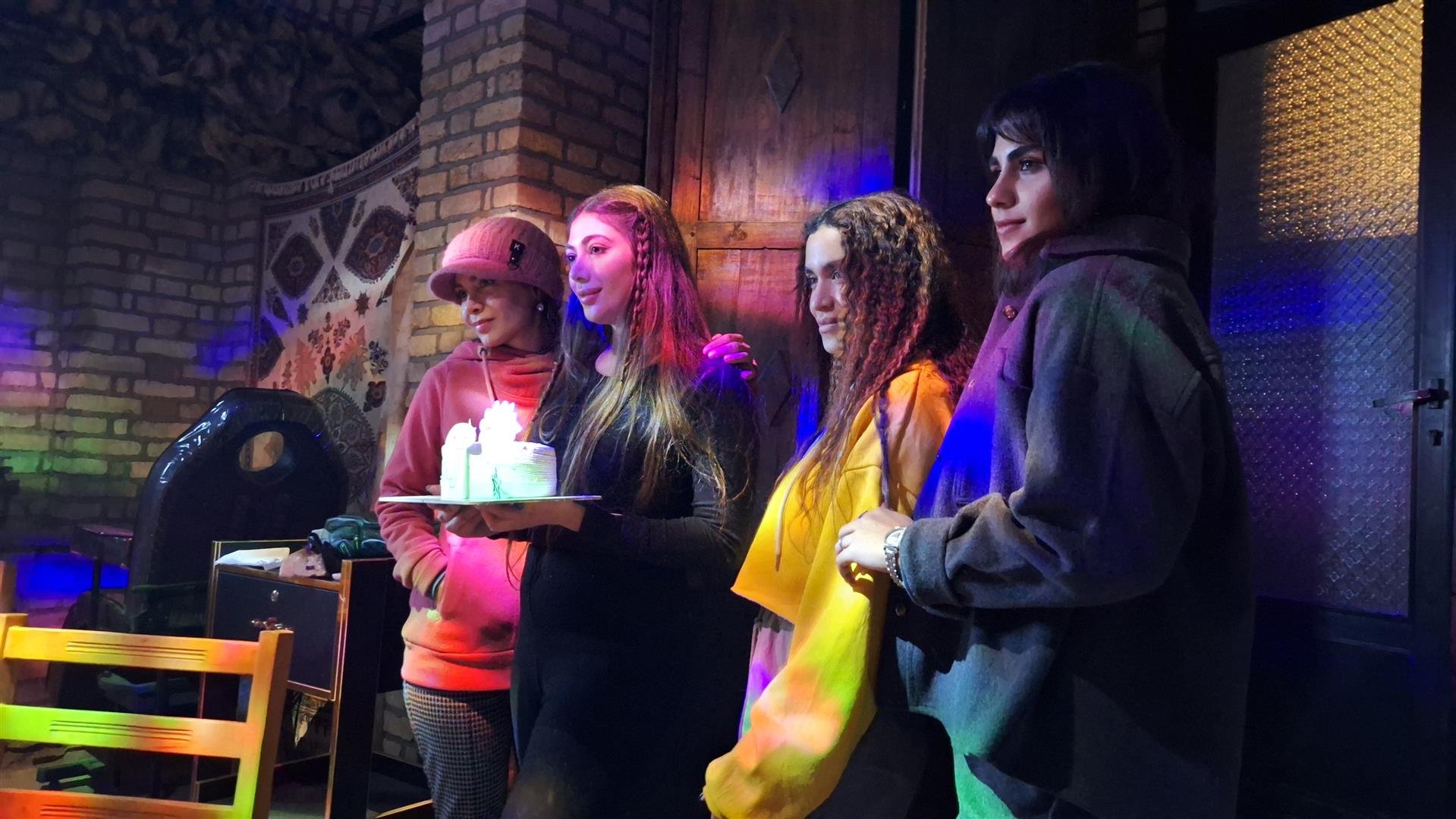
Hostel girls at the party.
This city is one of Iran’s largest and is renowned for it’s history and architecture. It’s also a major industrial base, focusing on steel, cement, oil refining and nuclear development.. It has a very active crafts trade as well. Time to go and have a look, I thought.
Close by the hostel was the Naqshe-e Jahan Square. It’s immense, being 510 metres long by 165 metres wide. There’s a water feature in the middle, surrounded by cultivated small trees, walkways and shops. It’s been a part of the city since the 17th century, when the city was in its heyday.
Around the square were sited three notable buildings. At one end was the Masjid e-Emam, dating from 1611. On the eastern side was the Sheik Lotfollah Mosque, the private mosque for the Shah who built it. Opposite that is the Ali Qapu (Lofty Gate), which is a high arched gateway with a covered balcony above. Events taking place below could be watched from here by the Shah and his guests.

Naqshe-e Jahan Square.
I went to have a look at the Masjid e- Emam. It’s very beautiful but I was disappointed because there was no inside area. Lots of open space to wander around. It’s still used as a mosque but I didn’t have to take my shoes off. I wondered if there may be an interior area that was closed off. Howeever, I came to realise later that many Iranian mosques were designed this way.
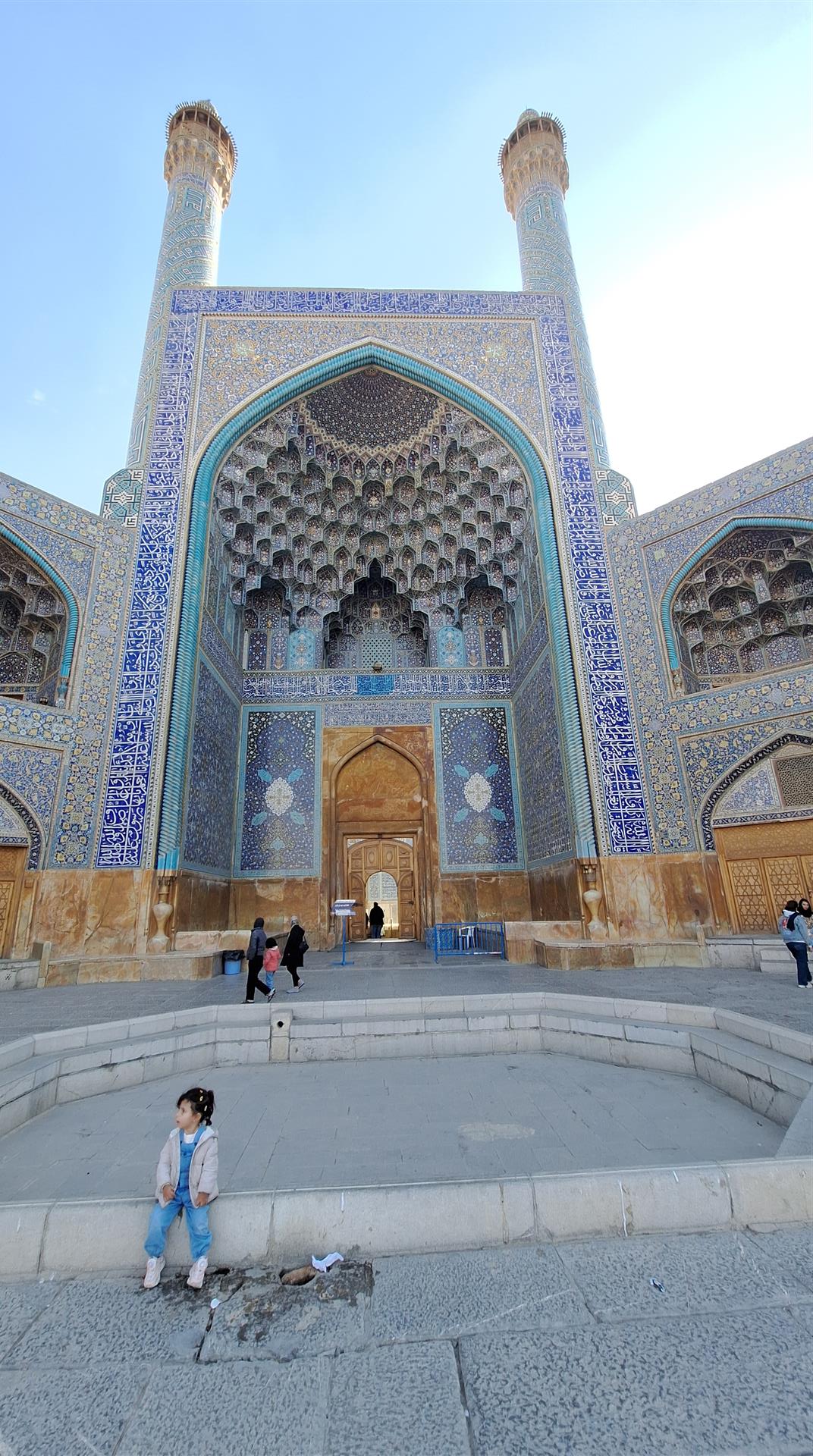
Masjid e- Emam.
Then I went to the Ali Qapu Palace. A big place that had been built and added to over the centuries. It wasn’t very spectacular and seemed to be very business like. On the 3rd floor there’s a large meeting and audience area. It has a very high roof held up by wooden supports. Some interesting decorations but that was about all. It’s key attraction the great view over the plaza below.
Back at the hostel I met a young Slovenian couple who were travelling in an old Renault Traffic camper van. They were trying to source a clutch. I rather thought they might stand a chance in Iran, given how many old vehicles there were there. I apologised for not visiting their country on the way down. They forgave me.
Next morning my watch strap broke as I was getting out of bed. I have a Casio G Shock and its one fault is that the strap is too inflexible and tends to break close to a hole. Google took me to where there were several watch shops and eventually I found one that had a replacement. I was directed there by a guy in one of the other shops. He rang his mother who acted as interpreter to give me directions. And she wasn’t even in Iran. I was highly amused by that.
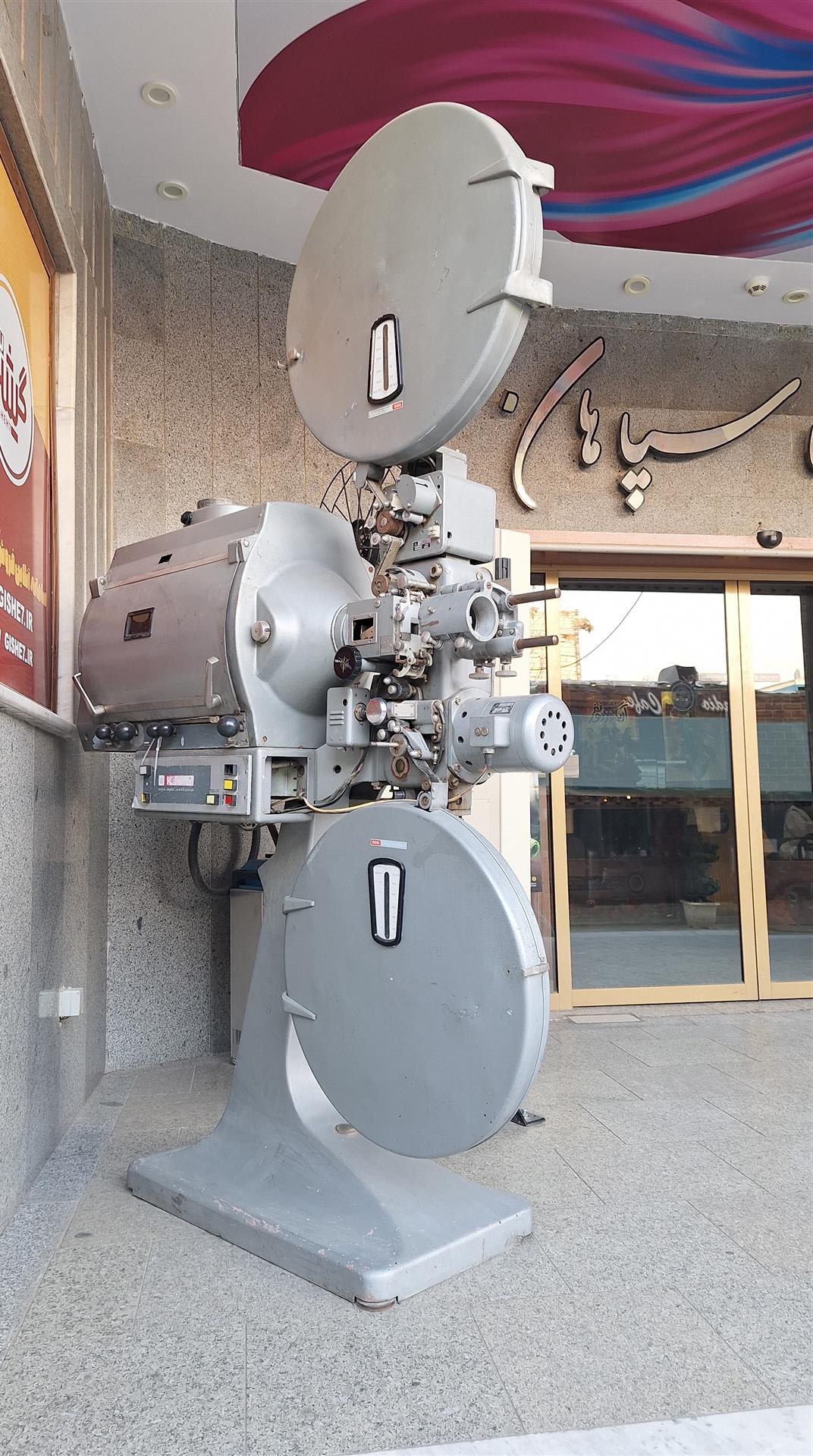
A curious item. Unsurprisingly it was outside a cinema.
I’d been put in touch with a local guy named Mohsen, who was going to act as tour guide. I met him and he said that it was actually his cousin who would do it. We went to meet her and Shirin quoted €50 per day, for two days, plus any fares we had to pay. That was a good quote, I felt, so we agreed to meet in a couple of days time.
I’d told Mohsen about my SIM card problems and he thought he could offer a solution. My original SIM was about to run out and it’s difficult for foreigners to obtain one.
I needed a new chain for the bike and while I was with them I rang up a local bike shop. Shirin translated for me. I arranged to go there next day. Unfortunately I couldn’t find it at the location on Google maps. Fortunately I’d located a second one, so I went there instead.
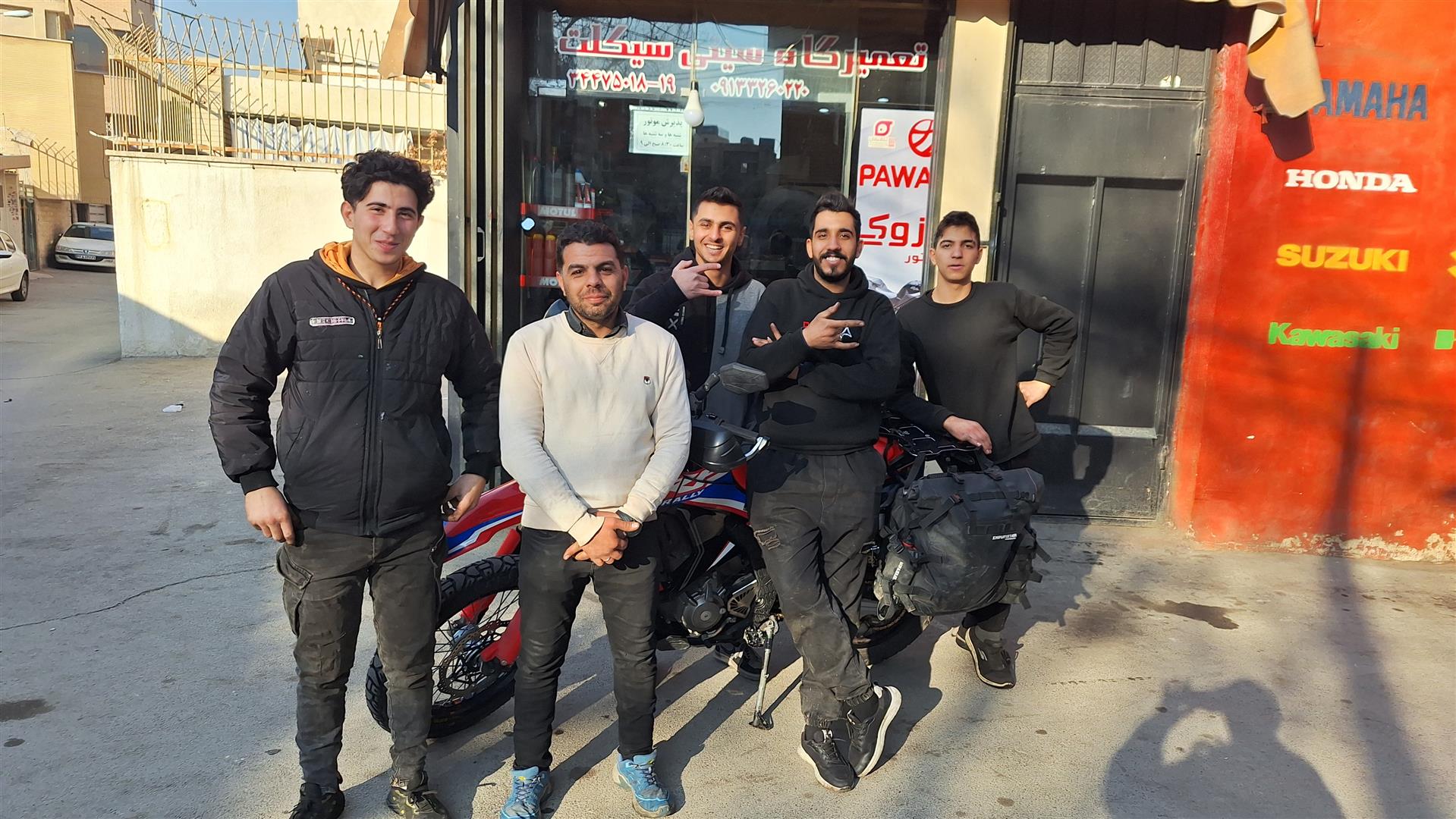
Chain and wash crew.
They were brilliant. One of the guys made a phone call then shot off to collect the chain. Meanwhile one of the younger guys set to and washed the bike. The chain he came back with was a high quality DID X-Link, one of the best around. I was more than happy to pay the 5.7 million Toman, around £60, for supply and fit.
Then I met Mohsen in ‘Mobile phone’ street, where he hoped to sort out a secondhand Iranian phone, or to get my phone registered on the Iranian system. Neither of these options worked in the end. £30 to register my phone, plus lots of hassle. Given that I’d already paid Erfan £45 for the mini router, I decided it just wasn’t worth the trouble. Very frustrating, especially given that the whole problem was my own fault! We arranged to meet next morning for a tour of the city.
When we met for the tour Shirin wasn’t with him. He said she already had work for that day so he’d be my guide. But he did bring me a SIM, which was very useful and very timely. He’s a friendly and helpful guy so I wasn’t too worried that she wasn’t available.

The palace was famous for this portico, with its twenty columns.
Our first visit was to the Chehel Sotoon Palace. A big place whose main attraction was an open portico area with a roof held up by twenty pillars. They’re made of wood which is covered by thin decorative material. They had carvings of lions at the base. There was some amazing artwork inside. A big pond, surrounded by trees and plants, filled the grounds.

Palace artwork.
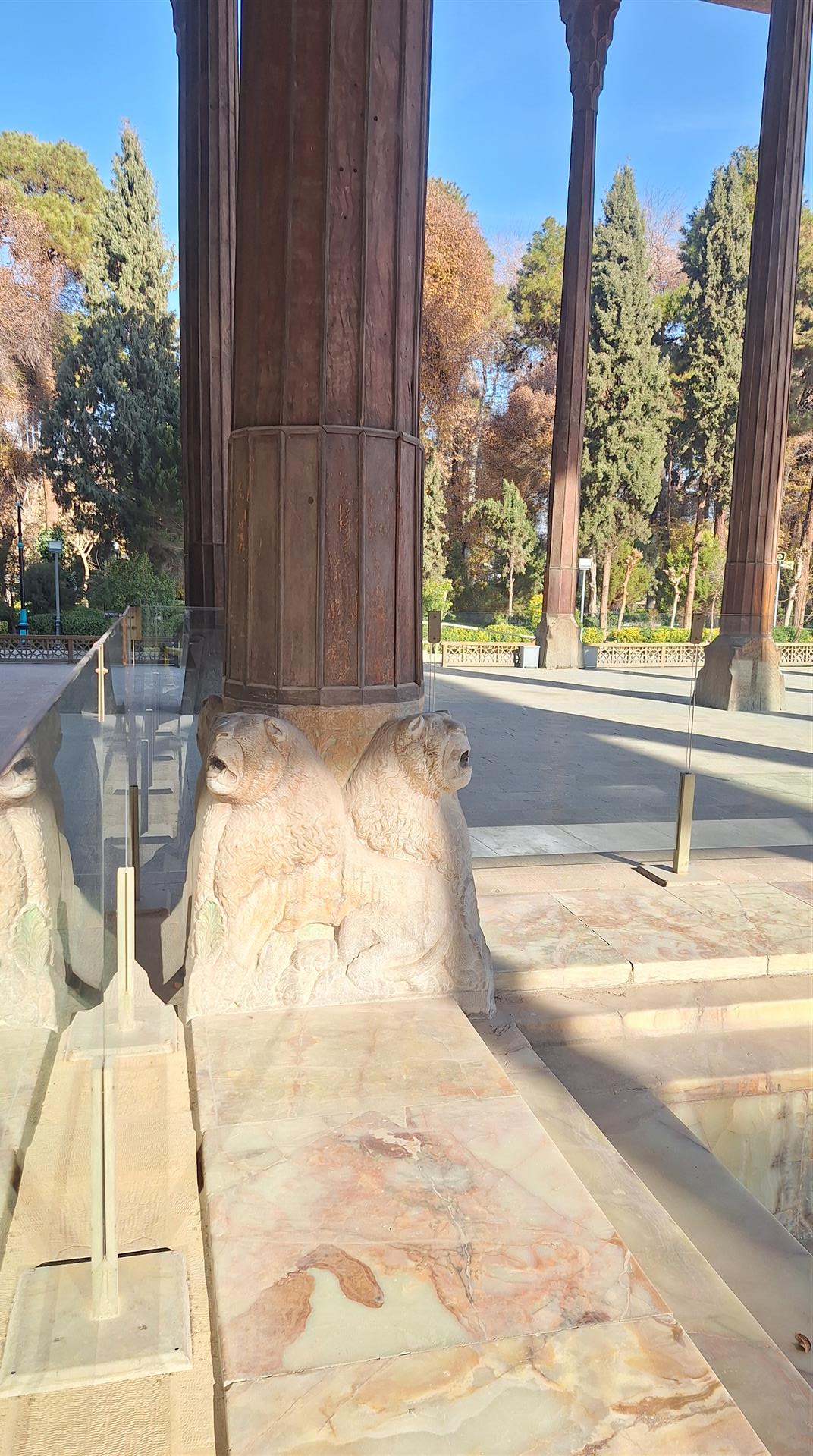
carved lions atthe base of the columns.
Then I insisted we went to the Hasht Behesht Palace. Mohsen said it’s probably not very good and he was right. Not much to see, especially as it was under refurbishment. But it was on my list!
After that we had a very long walk up to the Jame Mosque of Isfahan. We stopped for coffee on the way. When we got there we couldn’t get in to the important bits. Closed for lunch.
So we went to have ours. Mohsen was talking about traditional Iranian food and talking up the place he suggested a lot. The ambiance was very nice and the food was OK. But nothing special. And they were trying to get me to sit on one of those low down platforms. I quickly vetoed that idea and went to a table.
Chicken kebab and a meat paste on bread, with meat paste on the side. Nice enough. He suggested leaving a tip, which I queried as it’s not usual. But then I had to laugh when he realised they’d overcharged us for a drink and rushed back in to get the 6p it cost back from them.
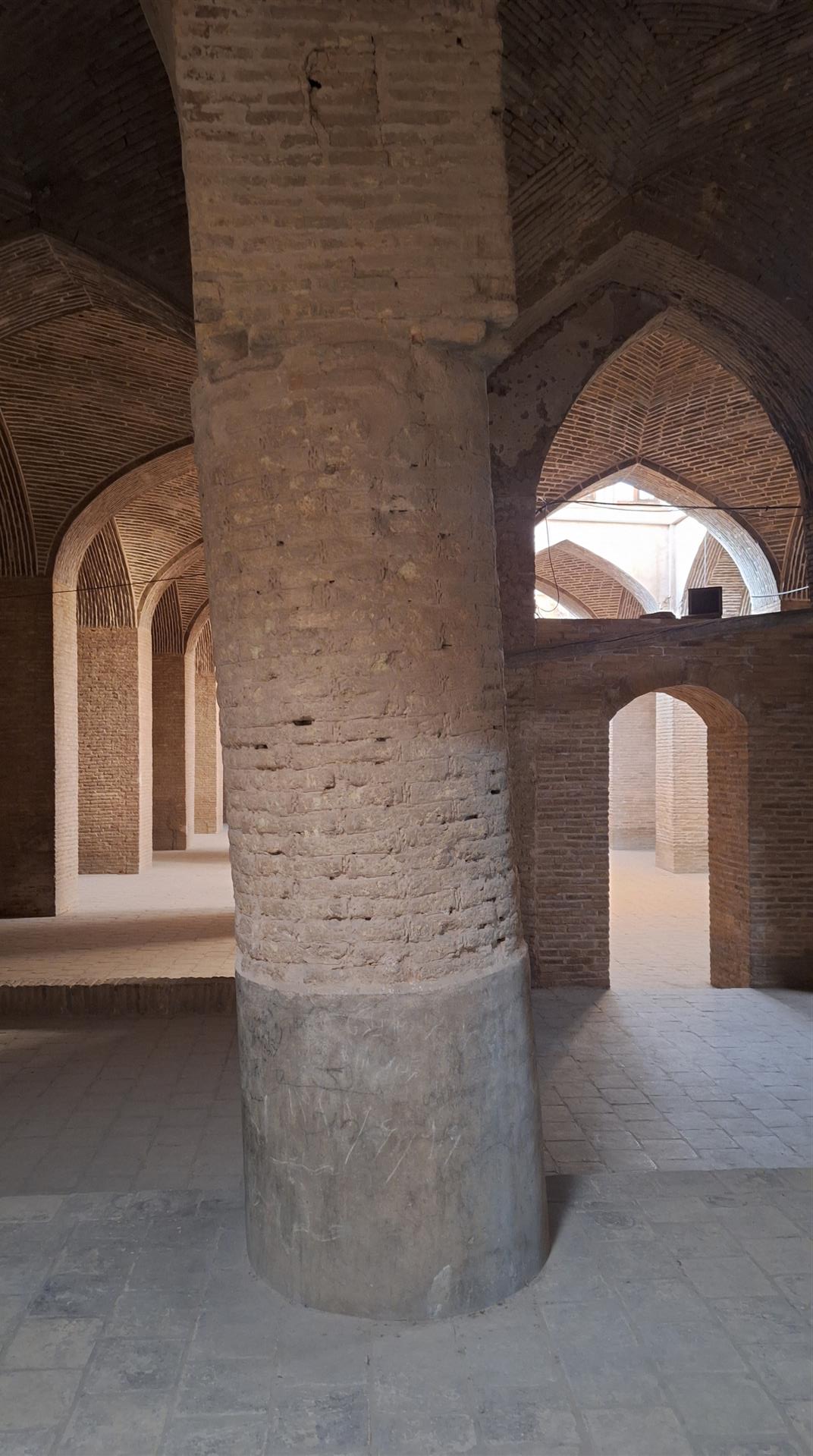
Wonky pillars, and lots of them.
The inner parts of the mosque were now open so we had a wander round. The dome is very impressive and it has inlaid writing on the bricks up inside it. But what fascinated me most were the wonky pillars, leaning in or out. I speculated it was earthquake damage but we came to the conclusion it was probably just settlement, as suggested by a crack running down one wall. Maybe it’s a bit of both. It had a very medieval atmosphere, with dark corners and very little by way of decoration inside.
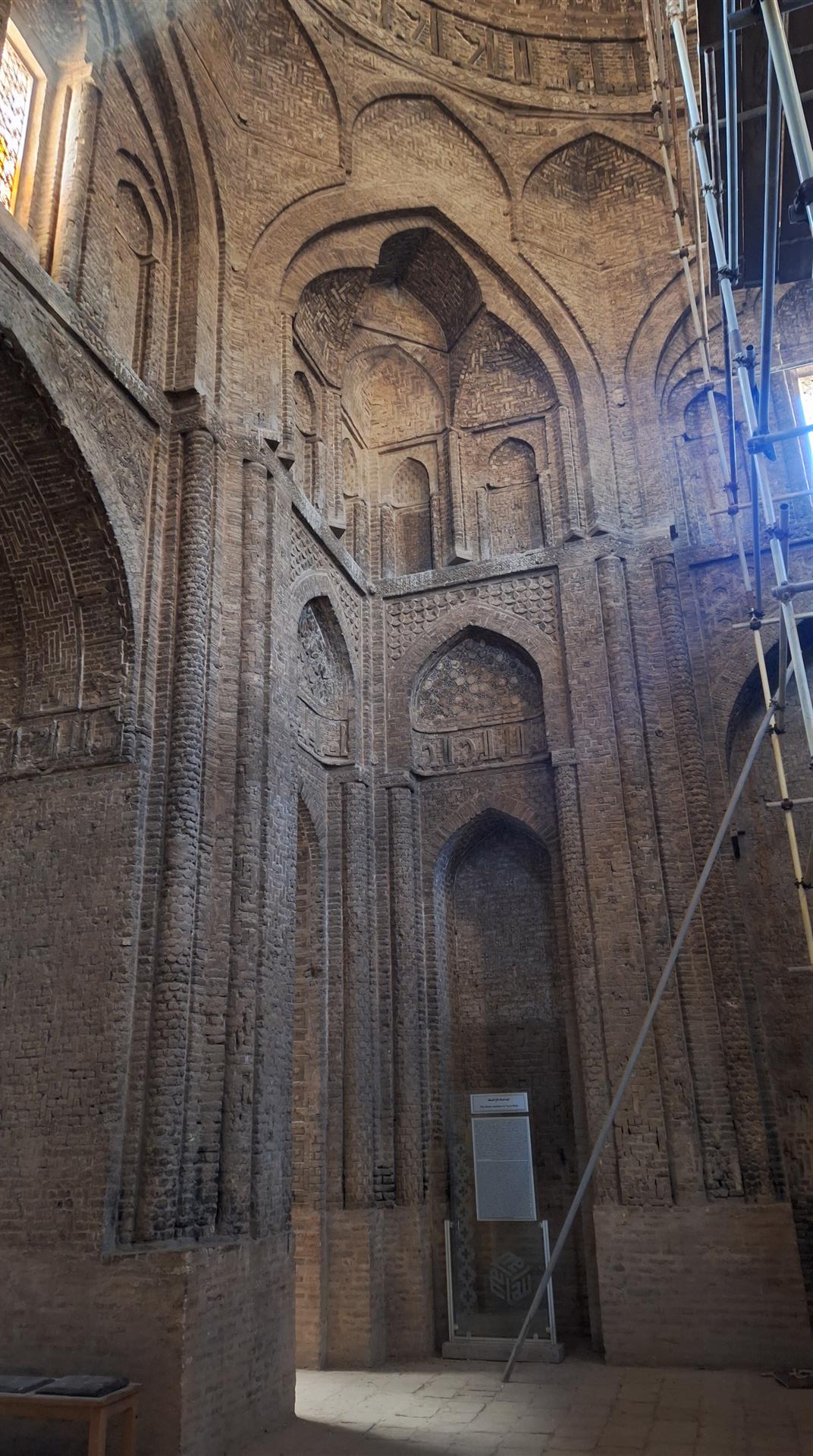
Medieval and moody.
That was it for the day but we met again next morning. We went in his car as the sites were all a bit too far to walk. It was my first experience of car ownership in Iran. His was a bit of a wreck. A 1990’s-ish Toyota, with an interior to suit its years and likely multi driver ownership. But I’m not really being critical. Cars are extremely expensive in Iran and it drove well enough.
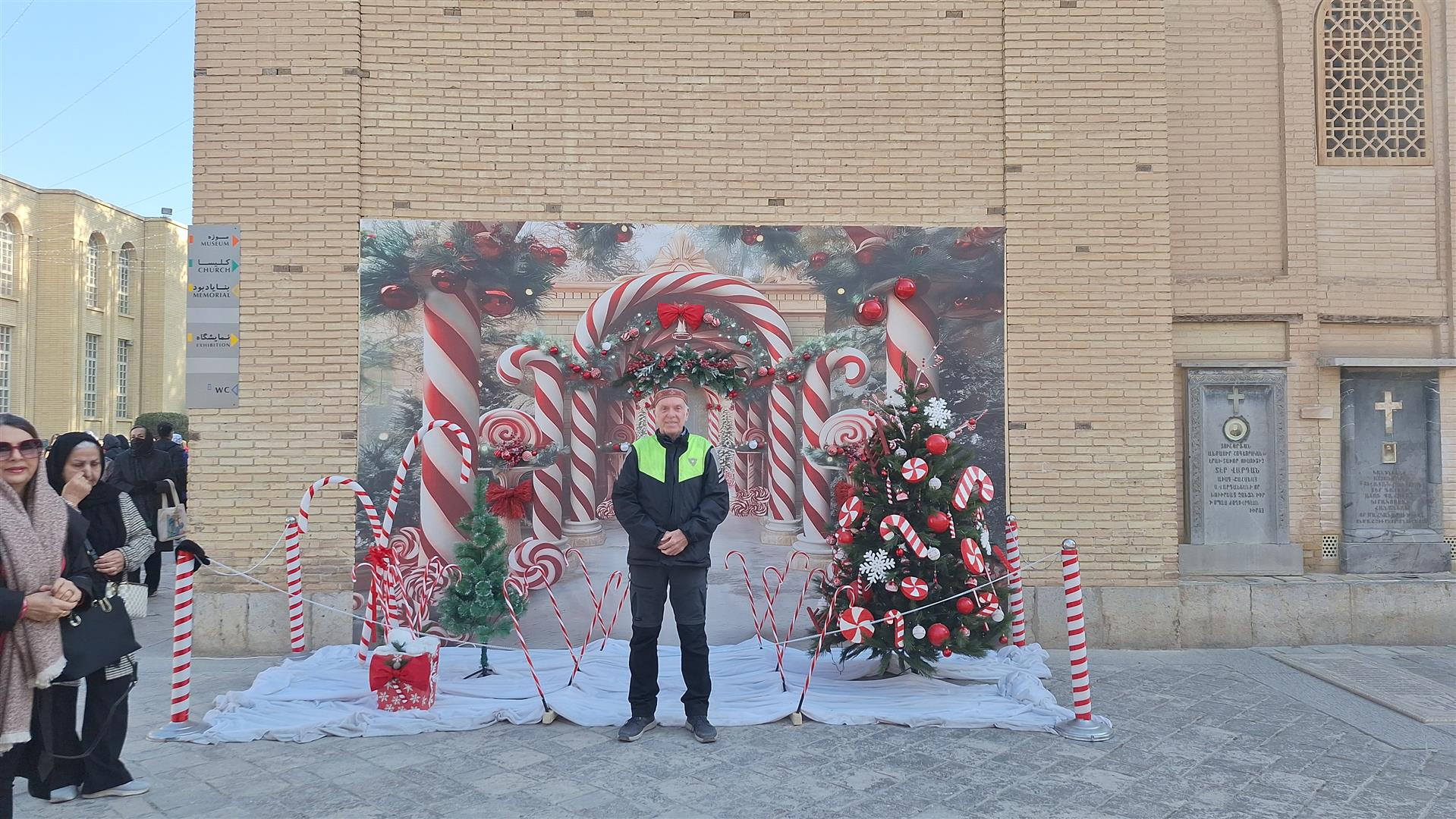
Christmas at the Vank.
First port of call was the Armenian Vank Cathedral. The courtyard had loads of Christmas decorations in it, including a huge Christmas tree. And they looked very festive too. But it was the interior that was pretty amazing.
The pictures of the biblical scenes were simply incredible! The colours were so bright and fresh and most of the pictures were quite big. But the faces looked different to what I’d seen elsewhere and so did the clothes. The artists were Armenian and brought a slightly different interpretation with them. I really enjoyed looking at them.

Incredibly detailed murals.
Armenia’s main religion is Eastern Christian Orthodox. Heavily persecuted by the Turks, many of them fled to Iran where they were able to practice their religion freely.
Mohsen became a bit of a pain. He kept trying to explain things to me that were written in English on the info boards. He also couldn’t quite grasp the idea that I was very familiar with the Jesus stories. But he was only trying to help.

I thought this painting was fabulous, although I’m uncertain as to which characters I identified with.
From there we walked to the Holy Bethlehem church, also Armenian. That was a far smaller building and the paintings, many of them the same as those in the cathedral, weren’t as good. So we didn’t stay long.
I spotted a coffee shop and suggested coffee and cake. Mohsen wasn’t too happy with that and wanted a proper lunch, albeit small. There was a fast food place next to the café so we went in there and had a small pizza each. Then we went in for the coffee. The guy there spoke good English and immediately latched on to what I wanted as soon as I mentioned Americano. And it was very good indeed.
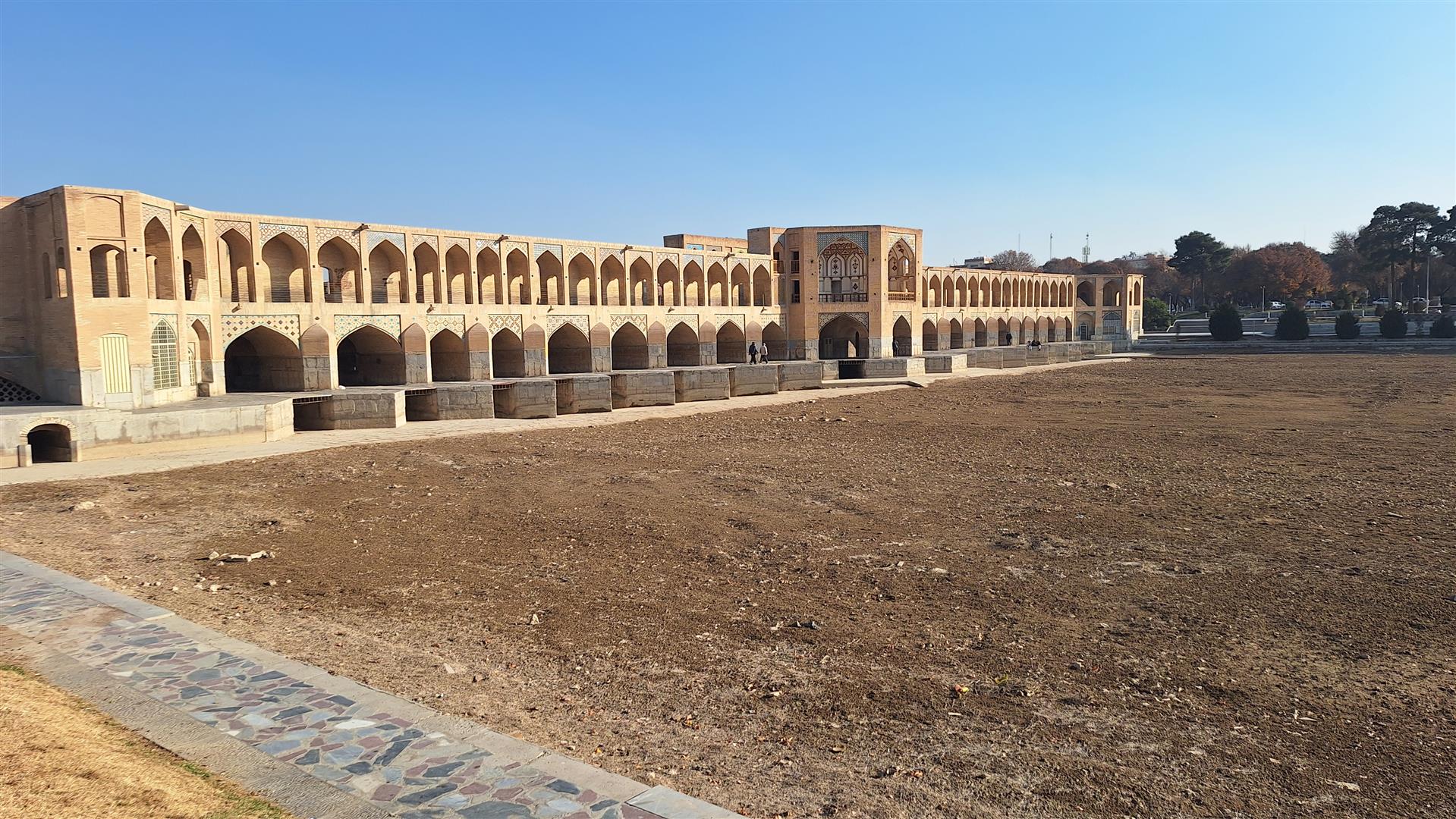
Now that’s a bridge! The Shah’s viewing balcony is in the middle.
Next stop was the Khajoo Bridge. The river Zayandeh Rud is very wide at this point but also very dry. The bridge goes across in sections, with a pier, a gap, a pier etc. Above the piers are arched viewing areas, with a special one in the middle for the Shah. They had boat races on the river to entertain the populace.
Then we went to the Si-o-Se Pol Bridge. This one is even longer than the other one, also double tiered, but without the Shah’s viewing points. The base of the structure, down at river level, is higher than the other one, so boat races probably wouldn’t work here. Both bridges were hugely impressive.

Longer and less decorative. Impressive just the same.
When I got back to the hostel I met a young Aussie woman, Rebecca. Very chatty and friendly. We hit it off straight away. Along with her was a young Iranian woman, Sharifah. It was good to have company and to share things.
I met Mohsen again in the morning and we went to see Monar Jonban, on the bus this time. It’s a mausoleum to Sufi master Amu Abdollah Soqla and is famous for the mystery of its shaking minarets. They’re built with wooden sections at the base and the top which help protect them from earthquakes.
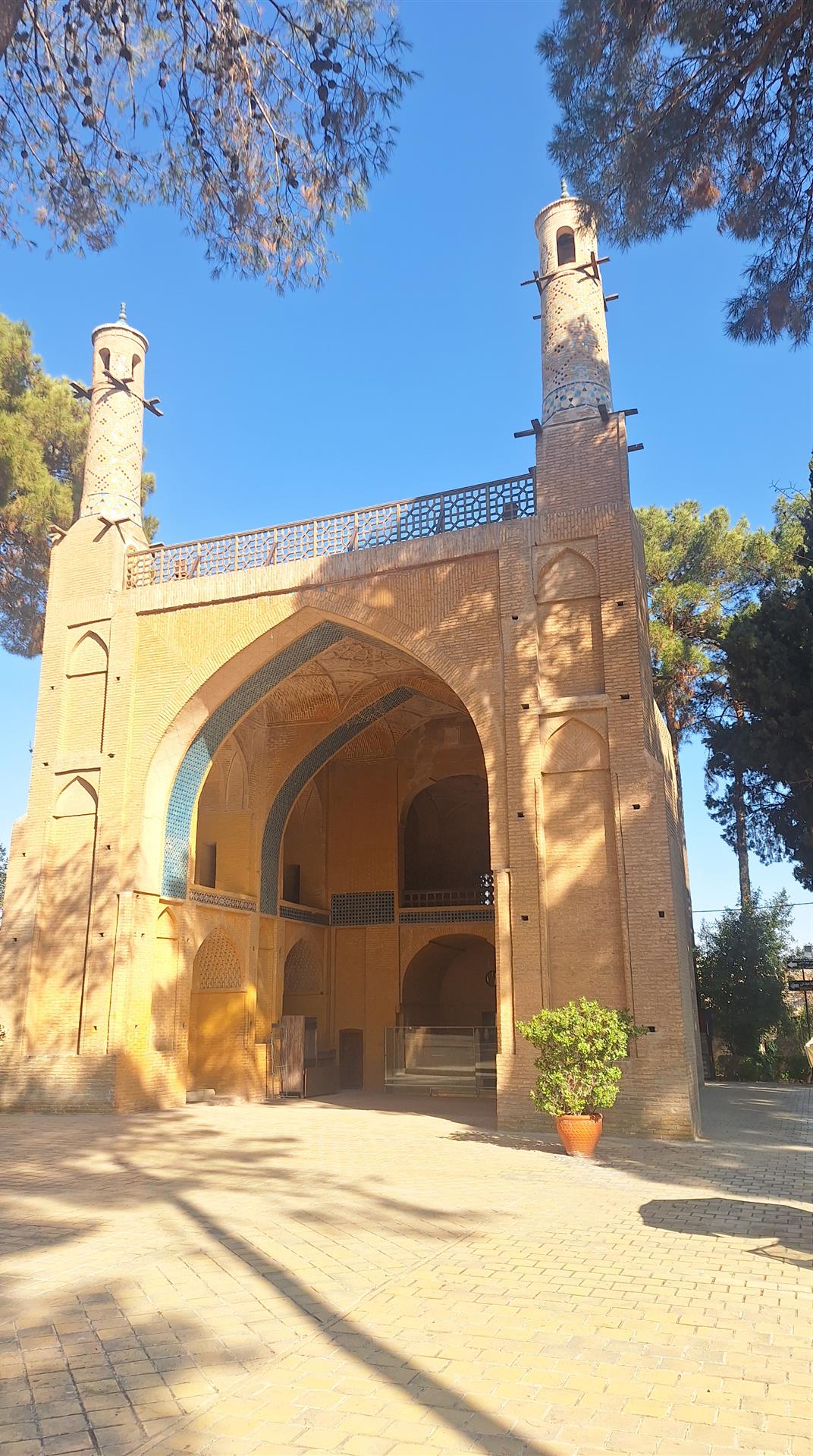
Monar Jonban and its shaking minaret.
We waited outside until a guy got up into the right hand minaret and started to shake it by pushing against the wall and, lo and behold, the left hand minaret started moving too, albeit not to the same extent. I read that the motion is transmitted through the roof although I couldn’t see that move. Weirdly, the effect only works in one direction.
The building itself is of the typical design and only stands out because of the colour of the bricks, an unusual beige colour.
We jumped a bus again and went further along the same road to see the Fire Temple. It looked more like a fort and was on top of a steep hill. We walked around, looking for a way up there, but there wasn’t a proper path and neither of us fancied scrambling up the hill.

Too high, too far. So the view is from below.
I was feeling very tired next morning so was happy to not do much. I felt a cold coming on. We were all just loafing around and I suddenly realised that Max had turned up, the guy I’d first met in Tabriz. He’d arrived on the bus at 4am.
Later we all went out for coffee and cake. I enjoyed a long conversation with Sharifeh about how life was for women in Iran. I learned a lot. She told me how girls are considered to be adults at 9 years old and can there fore be held accountable for crimes and also get married. For boys it’s 15. And if a young girl marries, sex is likely to happen. Appalling! She did say that it’s very rare for that to happen. But it goes to show the damage caused by theocratic regimes.
She is well educated, with a degree. She was making her way to Tehran to take up a new position. She said that professional women are as well respected as the men are.

Protest or support? Sharifeh said it was support.
I had planned to leave next day but still wasn’t feeling up to it. Mohsen came round again, clutching ten million rial in cash. He’d also put thirty million onto my bank card, in exchange for €50. Very useful indeed. He probably got a good exchange rate from me but it was cheaper that transferring it to Erfan from my UK bank. I said goodbye to him as I would definitely be leaving next day. Rebecca and Sharifeh had both moved on but we planned to meet up in Shiraz in time for new year’s eve.
After refueling I hit the road. It was colder than I’d expected but, well, December and all that. I stopped off at a place called Noushabad Underground City. It was very intriguing. There’s 4 sq kilometres of it, all narrow passages and small rooms. It’s 2000 years old and goes down 3 levels. The entrance took me down some steep stairs into a circular, domed room that used to be a cistern. They’d knocked a hole through the wall to give access.

This cistern is big! How many litres capacity? Impossible to say.
A woman guided me around the small part that was open to the public. She spoke English but not all that well. She was explaining to me about the construction but I only got the gist of it. The passageways were very narrow, only wide and high enough for a standard man to fit through. The rooms people lived in were very small, less then 2 metres square.
It’s main purpose was protection. Persia was constantly suffering from invasions and living underground offered security. The complex is riddled with narrow passageways, constantly going up and down. It would be easy for defenders to hold off invaders because of the lack of space. It saved many people from the ravages of the Mongol invaders, as well as Arabs in earlier times.
The passages were designed to aid airflow and there was plenty of water. There were a multitude of entrances which were carefully hidden, such as in the back of the houses above ground. Clever and effective.
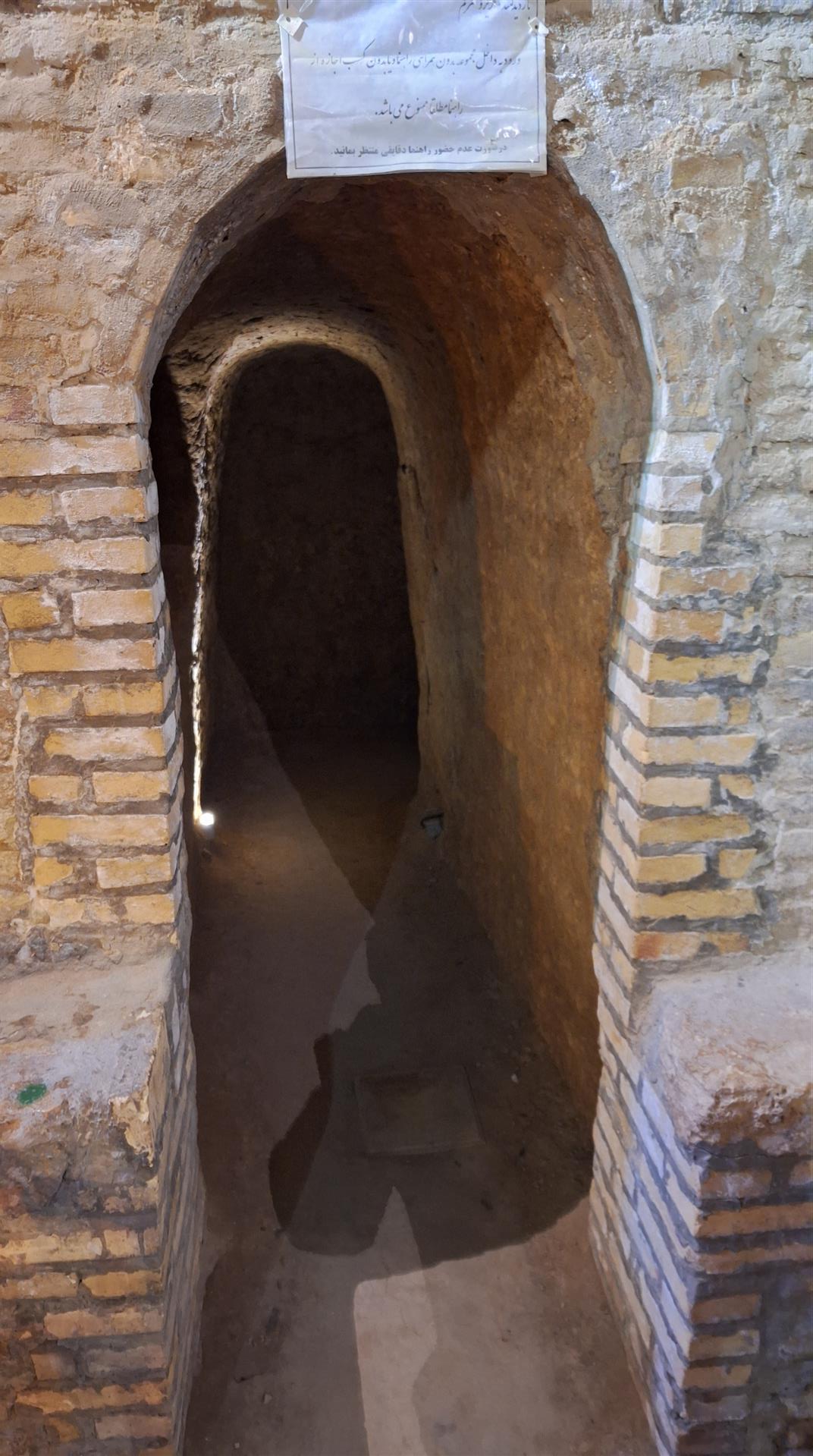
Narrow and easily defended.
I booked into a hotel in Kashan for a couple of nights then went for a walk. I found the Aminaddole Caravanserai. It was in the middle of the bazaar and wasn’t very big. But the decorations were good. Towns used to have dozens of these places, necessary to house traders and their camels. It seems that the only surviving ones are mostly those attached to other buildings.
Then I went to the Agha Bozorg Mosque, just up from the hotel. A big place, of typical Iranian style, being open sided with lots of arches. There were a couple of nice panels to photograph. Unusually it was on three levels.

Agha Bozorg Mosque. Note the wind towers.
Next day I went to look at an ice house. These buildings where very effective in keeping food etc cold. The ice is collected in the winter and is covered with straw or sacking. The deep pit helps to insulate it. As you’d expect, they look very functional. It was attached to what looked like a small fort.

Ice house. Dull but important.
I was aiming to visit some historical houses in the town. These are homes, now museums, that were built by rich merchants in the nineteenth century. The first one was Tabatabaei Historical House but en route I came across another one, Borujerdi House. It wasn’t all that big but had good decorations.
Then I went to Tabatabaei House, which was bigger and better. It had a mirror room, opular in Iran, and was on several levels, with summer and winter quarters. The decorations in the rooms were equally good.

I bet none of you have an entrance like this one.
The house had an air tower, designed to get air flowing through the rooms via grills in walls. That also had a dehumidifying effect. The air is drawn up from the bottom and gets ‘conditioned’ as it rises.
The last one was Abbasian house. This one was much bigger and had four levels and several courtyards. It also had a mirror hall in the business rooms. There was plenty to see, with a real risk of getting lost inside among the many levels and rooms. Fortunately the signs to the exit worked.

Not a bad view from your back garden, is it.
All three of them had excellent decorations, some with stained glass windows. They’re very Islamic in their interior design styles. The richer the merchant the better the decorations.
They were divided into different sections: for business; entertaining; a women’s room and the family area. All of them were interesting because of the insight they gave into Iranian life – albeit just for the rich.
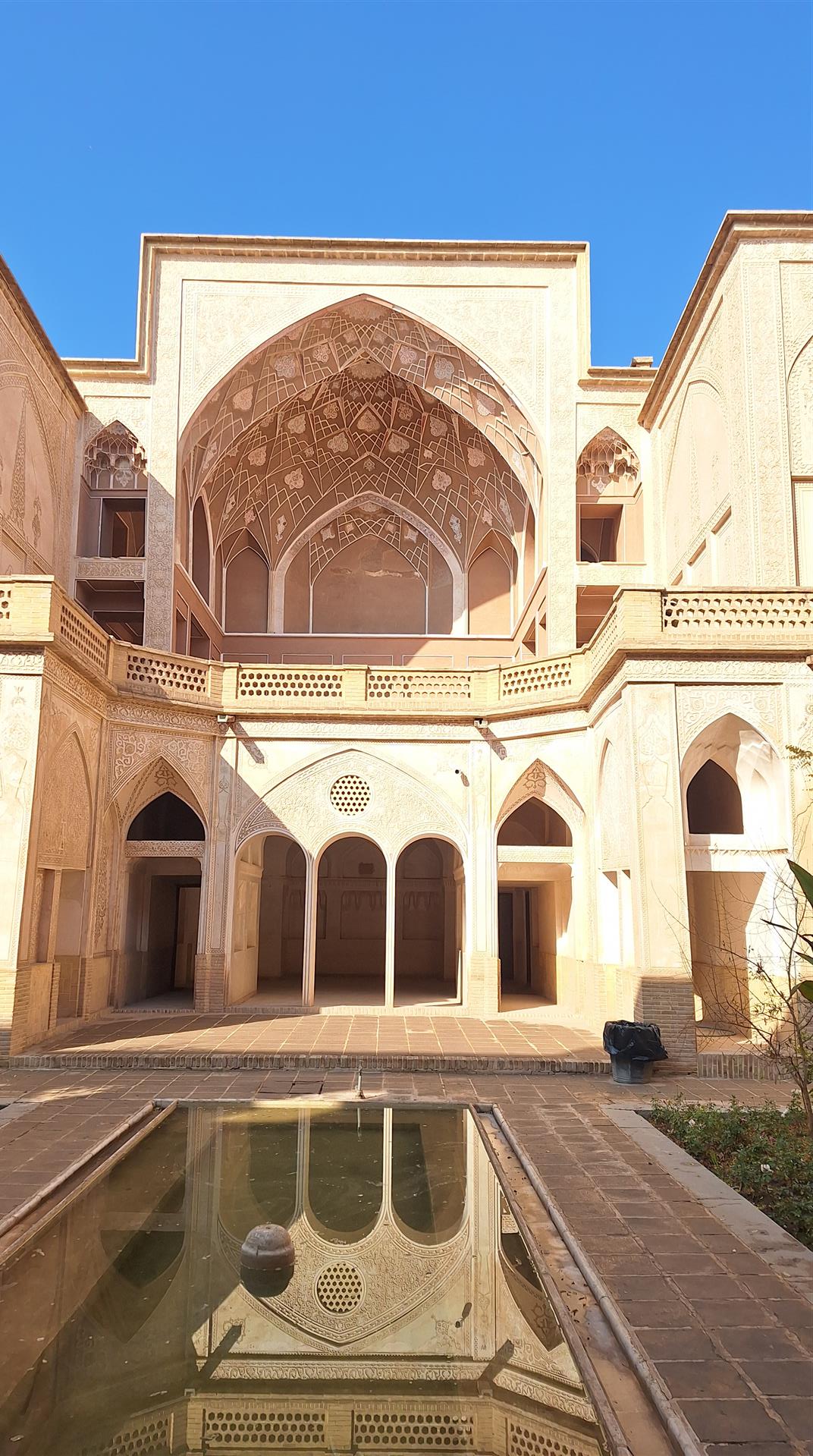
Abbasian House. Rich man’s privilege.
I contacted Rebecca who spoke to the hostel in Shiraz. Fortunately they had a bed for me. Good. I was looking forward to partying.
The next day was nothing other than riding. While I was sorting out he bike a young lad came past and we chatted. He had fun fiddling with the controls and I let him start the bike for me. He displayed his pleasure by blipping the throttle. I was on the road by 9.30. Not early, but early for me.
I wanted to fill up but the only place I passed had long queues. I expected there to be another place further along but Google turned me off onto a side road. It followed the route of the railway but twisted and wound round quite a lot. Narrow but a good ride.
The bike eventually began to run out of petrol so I filled it from the spare can with just over four litres. I was surprised when, within a few kilometres, the fuel gauge dropped to one bar. But I suppose it was because the tank was pretty much empty anyway. Once back on the main road it didn’t take long to find a filling station.
The road began to rise and pretty soon got to over 2,000 metres, where it stayed pretty much the rest of the day. The max elevation was over 2,500m.
After another refuel the road went up again and the clouds came in. Some light rain on and off. As I started to come down off the high plateau the rain began in earnest and stayed with me all the way to the hostel. I was feeling very unsafe once I hit the traffic, a bit scared even, knowing what the Iranian drivers are like. But I survived and found the hostel OK. 635 kilometres. One of the longest rides I’d had so far.
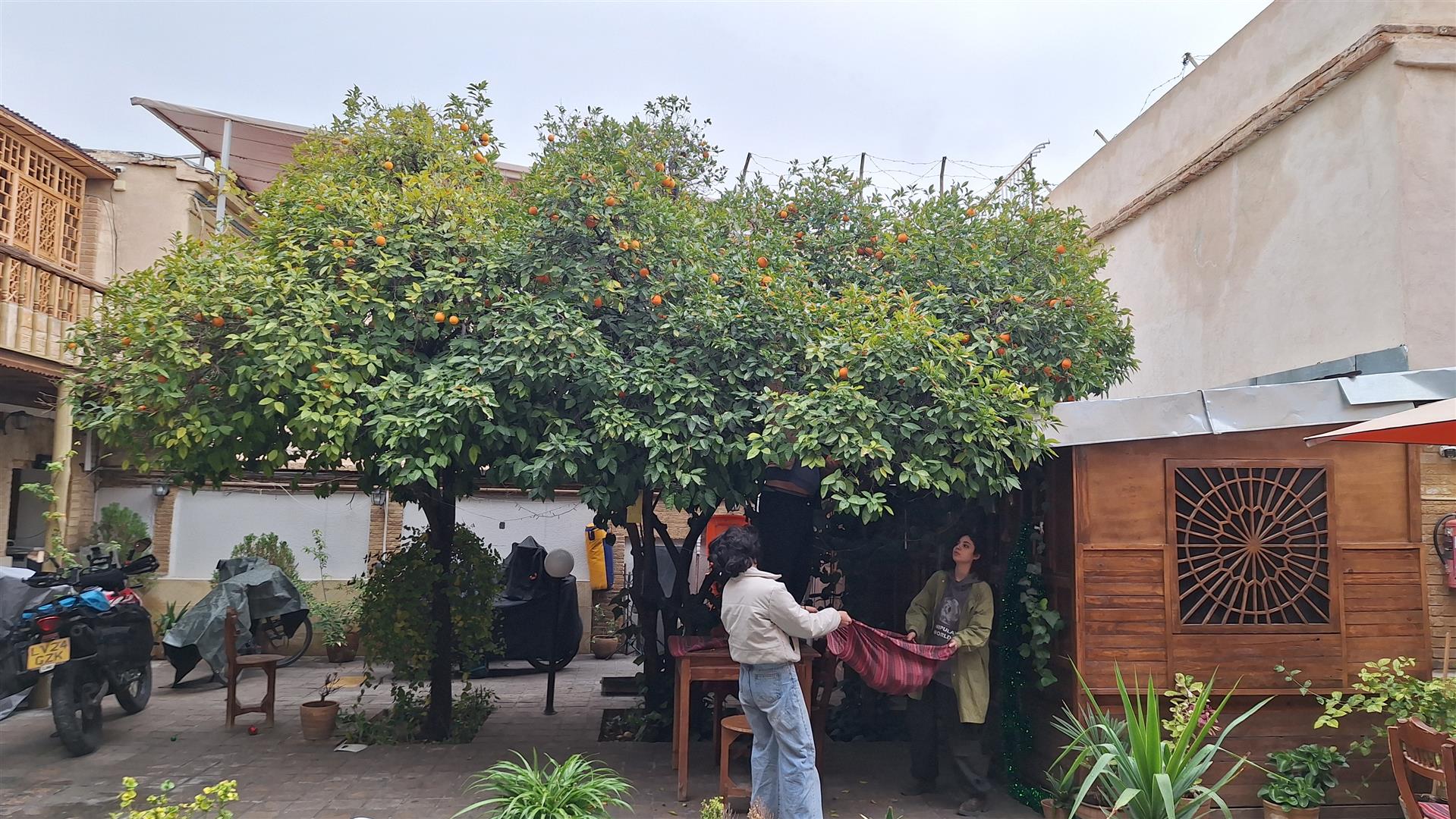
Bike safely in the hostel garden. Oranges to ate as and when I felt like it.
The hostel wasn’t all that good really, although I was happy to be able to get my bike into the garden. Some of the beds were falling apart but the biggest issue was that the common area was outside, in the cold. Fortunately the bedroom was warm.
Three of the cyclists I met in Tabriz were there, as was the Slovenian couple I saw at Esfahan. Rebecca, Sarifeh and Max were there as well. Things were shaping up nicely for a new year’s eve party.
 MOTOPANGAEA