
Tehran, Iran. 10th December 2024.
I left the city at around midday, having stopped for fuel. Departure was delayed by having difficulty paying and then by mislaying my keys. The Iranian debit card wouldn’t work. Eventually the hostel guys realised there was a very low payment limit on it. I asked Erfan to sort it out but in the meantime paid cash. The keys were found eventually, underneath something I’d put down.

The lovely people at Zee Hostel.
My next destination was the city of Mashad, quite an important place from the religious point of view. But it was a two day ride on a cold day. The terrain I crossed was changing. Sand and scrub as far as the eye could see, with low hills in the background. But somehow still interesting.
I stopped in the town of Damghan, at a hotel the hostel had booked for me. The desk jockey insisted I bring my bike in to the space between the two sets of entrance doors. The room was nice but I wasn’t happy about it having a squat toilet.

My bike was in a good place, between the doors.
I went out for a walk to see the Tarikhaneh Mosque. It was closed but I photoed the outside. I was near the hotel and stopped to look at my phone when a woman sitting on the wall behind me, wearing Islamic clothes, started talking to me. She lives in Sheffield and had come back to visit her family.
I’d taken a photo of what looked to me to be Christmas decorations hanging across the street and asked her if that’s what they were. She said no, just general purpose decorations used on most celebrations. I decided they must have heard of my upcoming birthday. I thought it was nice of her to chat to me though.

Had they heard it was my birthday?
I wandered into a shopping centre and found a coffee shop. As usual I had to explain what I wanted. They nearly got it right. I was amused by the sign on the door that said hair must be covered.
I had a meal in the hotel restaurant. Soup and chicken kebab. A guy came over and talked to me. It turned out he was Russian and a biker too. He rides a Harley. He was was impressed by my trip. I asked why he was there. Just a holiday, he said.
The next day was a long ride on a good road over flat desert. Nothing much to grab the attention. Two refueling stops, with coffee. I had discovered one interesting and convenient thing. While riding through towns I would often see electric urns on stands outside small shops. When I stopped at one I discovered they were full of hot water. The trick was to buy a sachet of coffee,or whatever, in the shop. They’d supply you with a cup and a stirrer, which you filled up from the urn.
The downside was finding that the coffee was that awful 3-in-1 garbage. Coffee, creamer and sugar. It’s seriously horrible. When I could find 2-in-1 it would be minus the creamer. It was better to drink Cappucino, tea or chocolate drink. But it was better than nothing on a cold ride. Small towns had no coffee bars that I could see.
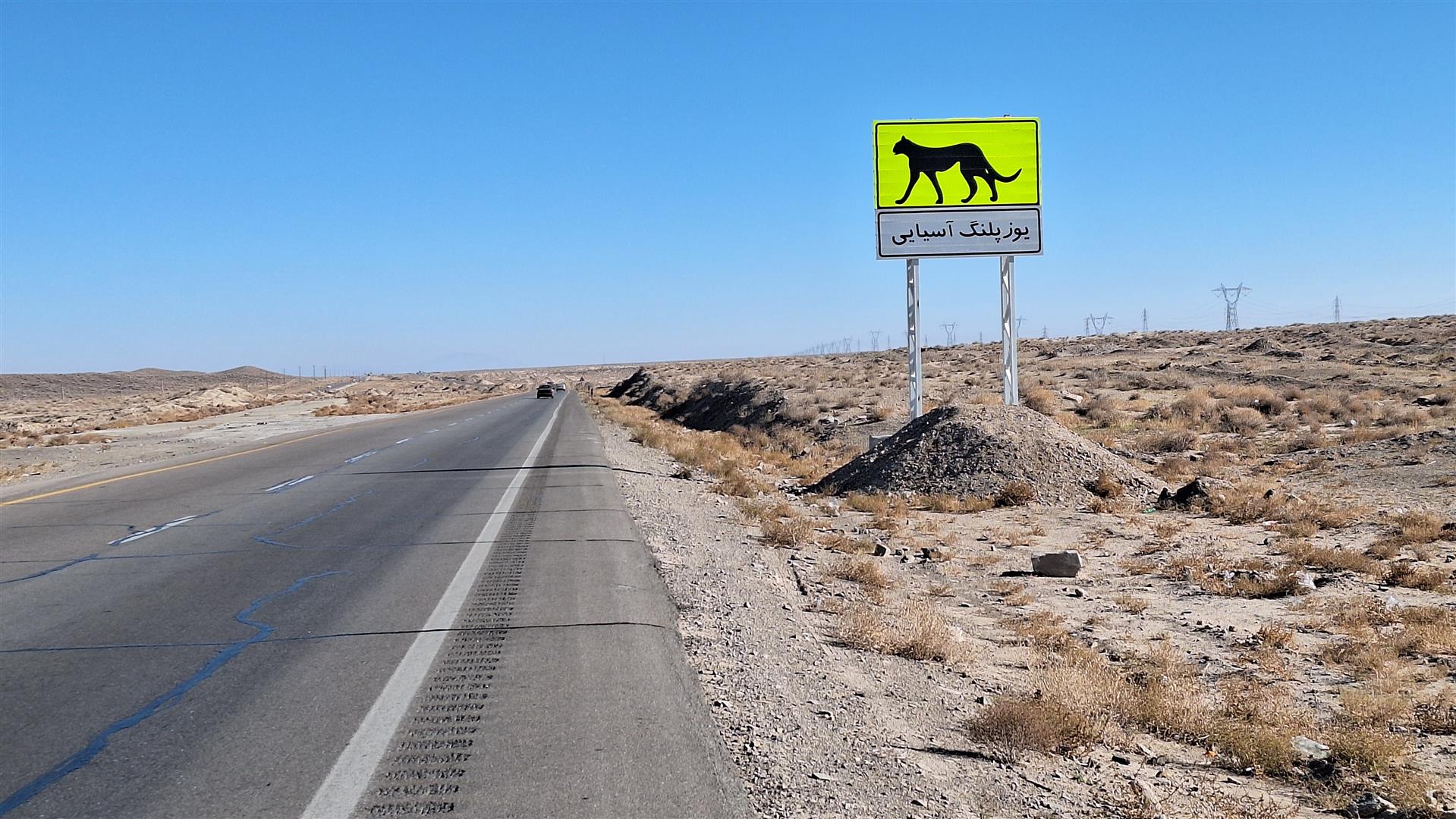
Sadly, I didn’t see any real ones.
At one point I became highly amused by the antics of a couple of lads on their 150cc bikes. They both came flying past me, laying down over the tanks with their legs along the seat, like junior drag racers, fully stretching the wire. After a bit they turned round and did the same thing again. Great fun, seemingly just for my entertainment..
I’d passed by some old buildings along the way, including a large fort, a dilapidated caravanserai and some random mud brick structures. Just sitting out there in the desert, unmarked on the map. No time to stop to look though.
Once in Mashad I met up with a guy who’d contacted me before I came to Iran. Jalal had booked us rooms in a hotel for two nights. He took me out for a nice meal, once I’d warmed up and cleaned up. Lamb pieces on a skewer, with rice and salad. Typical Iranian food and very tasty.
Next day we went out sightseeing. Jalal needed fuel and the first place we went to had very long queues, probably an hour long. I was surprised at this until I remembered seeing a similar thing in Tehran. We found another place then went to see Imam Reza’s Tomb, via an ice cream shop.
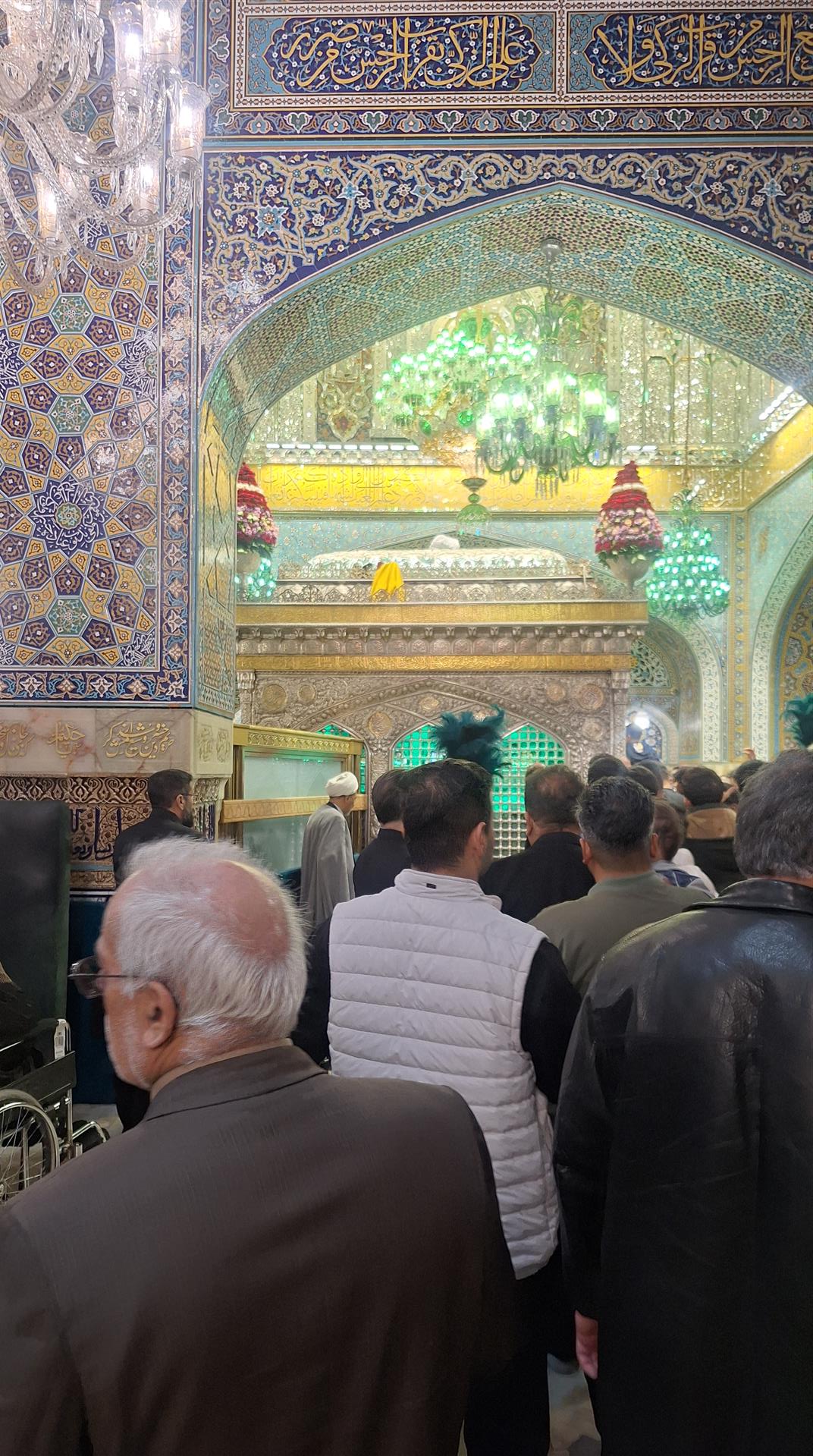
Imam Reza’s tomb. A very popular religious shrine.
So who’s Imam Reza? He was the 8th Imam as followed by Shia Islam. This needs a bit of explaining.
Prophet Mohammed died without a son, so he had no natural successor. Shia Islam (the name comes from the Arabic for Followers of Ali, the’ Shiat Ali’) decided that the correct successor was his son in law, and cousin, Ali. There ended up being twelve Imams, all related to Mohammed by blood or marriage. Some branches of Shia Islam only recognise as few as four. The Shia branch of Islam is in the minority, and holds sway in countries such as Iran, Iraq and a few others.
Sunni Islam, on the other hand, believes that leaders should be appointed by their followers, and chose Abu Bakhr, Mohammed’s close friend. Sunna translates as Tradition.
So that’s a brief overview of what the arguments are all about. As far as I’m concerned it’s still ‘two bald men fighting over a comb’.
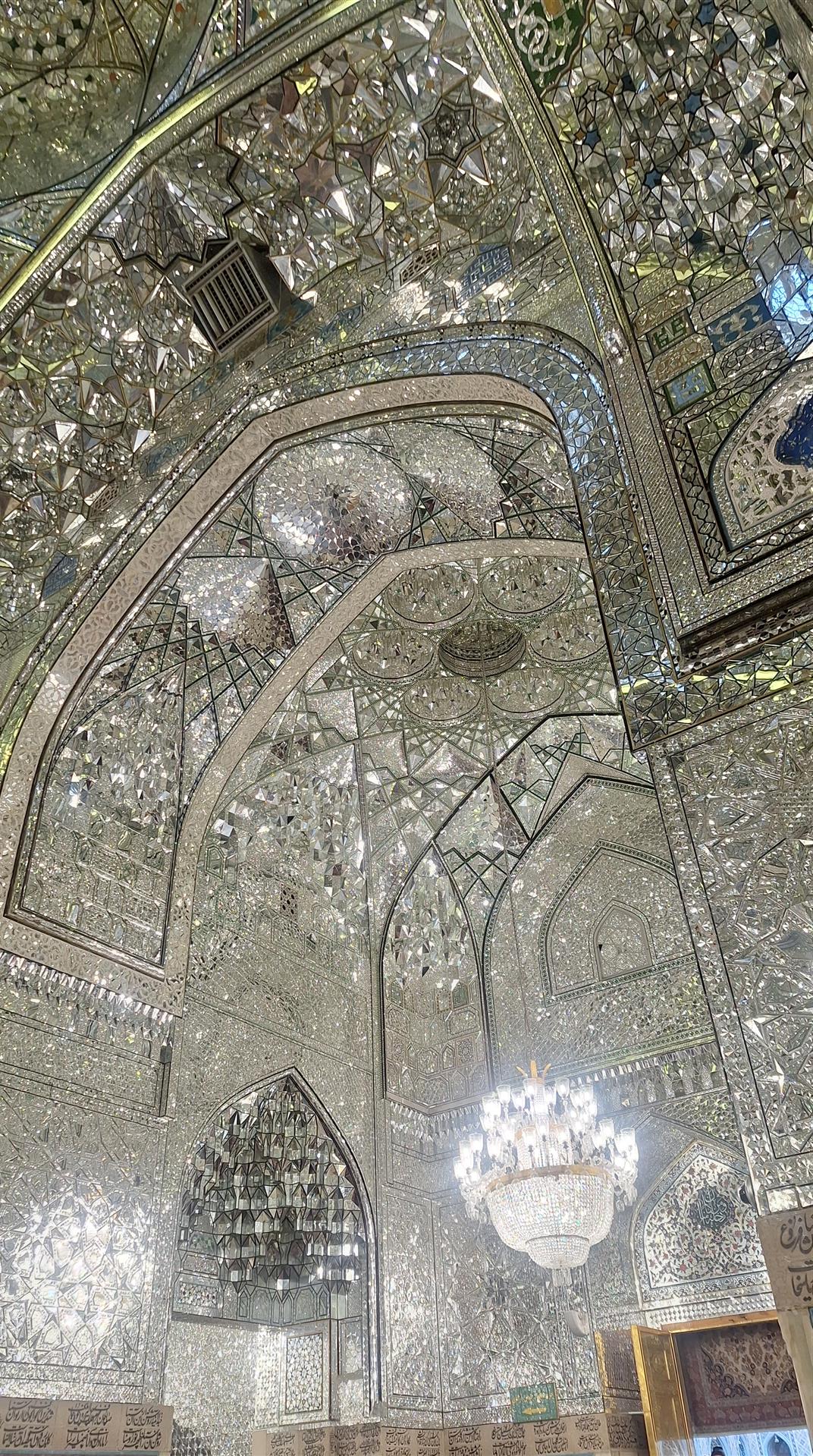
Mirrors seem to be a common theme in Iranian mosques.
The building is huge and is magnificent. Completely covered in mirrors inside, it’s quite spectacular. There were lots of people doing their supplications. He was a very important man to the Shias. I was able to get some photos of the tomb, as were many others.
We went and had some lunch then visited a museum and tomb dedicated to Nadar Shah. He was an 18th century ruler who fought many wars for Iran. He was a great military leader and built an empire which encompassed several of the surrounding countries, including some of Turkey. One of his claims to fame is removing the Koh-I-Nor Diamond from the Mughal leader of Delhi. But he was assassinated, after which his empire quickly fell apart, with Iran falling into civil war

Nadar Shah.
Next day I headed towards the Radkan Tower and then to see Omar Khayam’s tomb. The tower’s purpose is something a mystery, although the latest theory is that it was used for astronomical purposes. It’s twenty five metres tall, built from smooth bricks, with a conical roof. Its doors line up with the sun on the summer and winter solstices. It was built in the 13th century and was thought to be used by an astronomer from that time.

Radkan astronomer’s tower.
I was disappointed with Ohmar Khayyam’s tomb. He was one of Persia’s most famous scholars, responsible for poetry, mathematics and philosophical contributions. The Rubaiyat of Omar Khayyam is well known in the Western world. But there was no information about him on display, as far as I could see. Very annoying.

Iranian family wearing traditional dress, in front of Omar Kayyam’s tomb.
I was heading south and the terrain was getting greener, with more crops and less sand. The road went up, and then down. I became cold, them warmer again. I was riding into a strong, dusty wind, which hammered my fuel consumption somewhat.
My destination was the town of Nashtifan, famous for its windmills. I’d booked a night in a homestay and, with the help of a local, I found the owner at a car workshop just beneath the windmills. He took me over to his place and settled me in. It was an old, traditional house, built of mud bricks and rendered with mud that had been strengthened with straw. It occurred to me to wonder where the straw came from as I hadn’t seen any rice or wheat growing anywhere. The owner was fairly old and didn’t actually live on the premises.
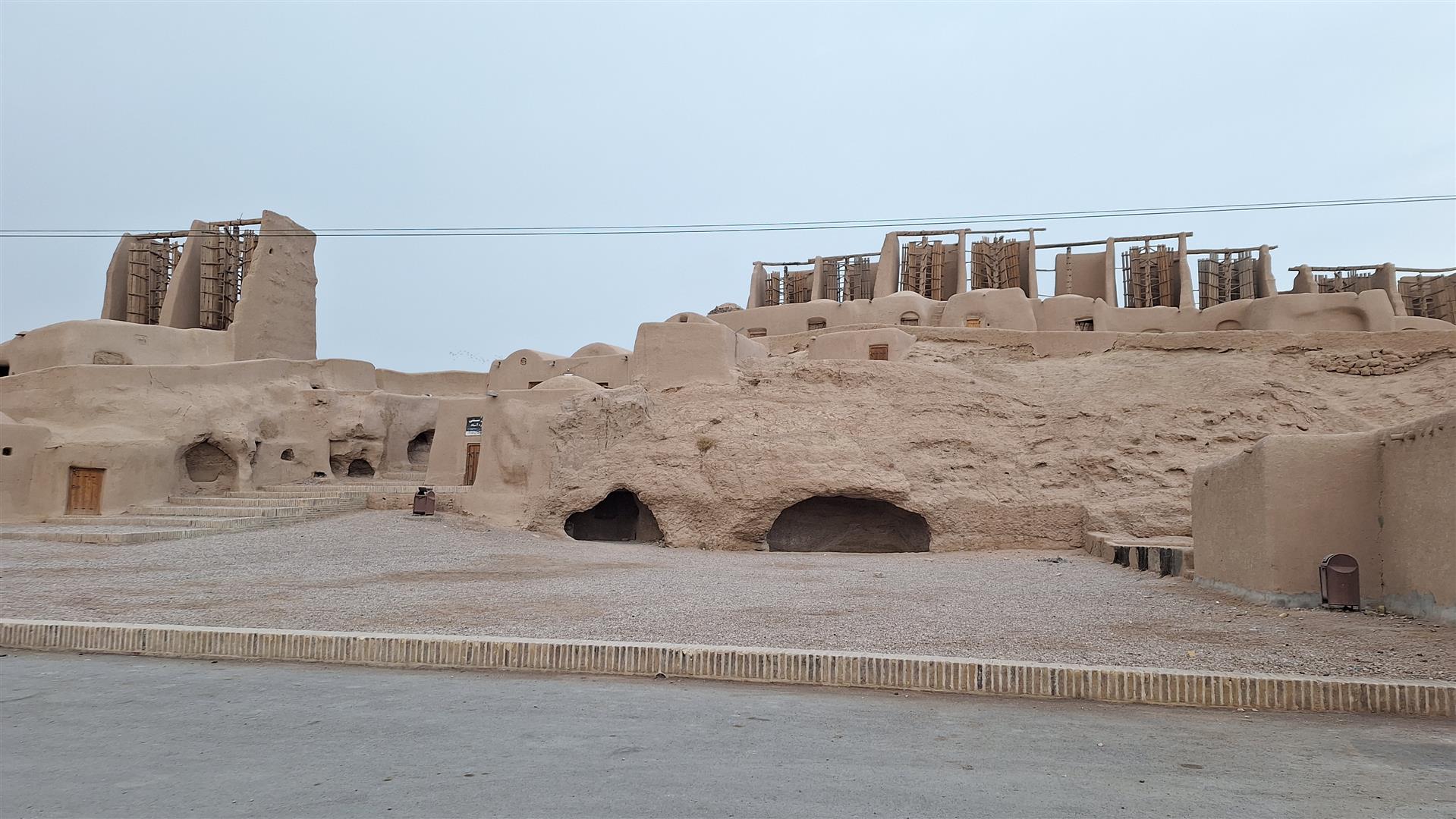
The windmills at Nashtifan. On top of a wall to catch the wind.
The accommodation was basic but managed to be warm, which was the most important thing. I was planning to walk over to the windmills but food arrived before I had a chance. Then a guy took me over there in his car and waited while I walked around. After a short while I went back to him and told him I’d walk back, giving me more time there..
The windmills are fascinating. There’s 33 of them, with 5 still working, just for tourism’s sake. The wind whips across the vast plain and the windmills were built on top of a shield wall to catch it. It’s directed onto the windmill blades by the funnel shape of the wall that surrounds each one.
It consists of a vertical shaft – essentially a tree trunk – which has horizontal spars attached to it. Vertical planks are nailed onto the spars and they catch the wind. There is a room below each one although they were all locked.
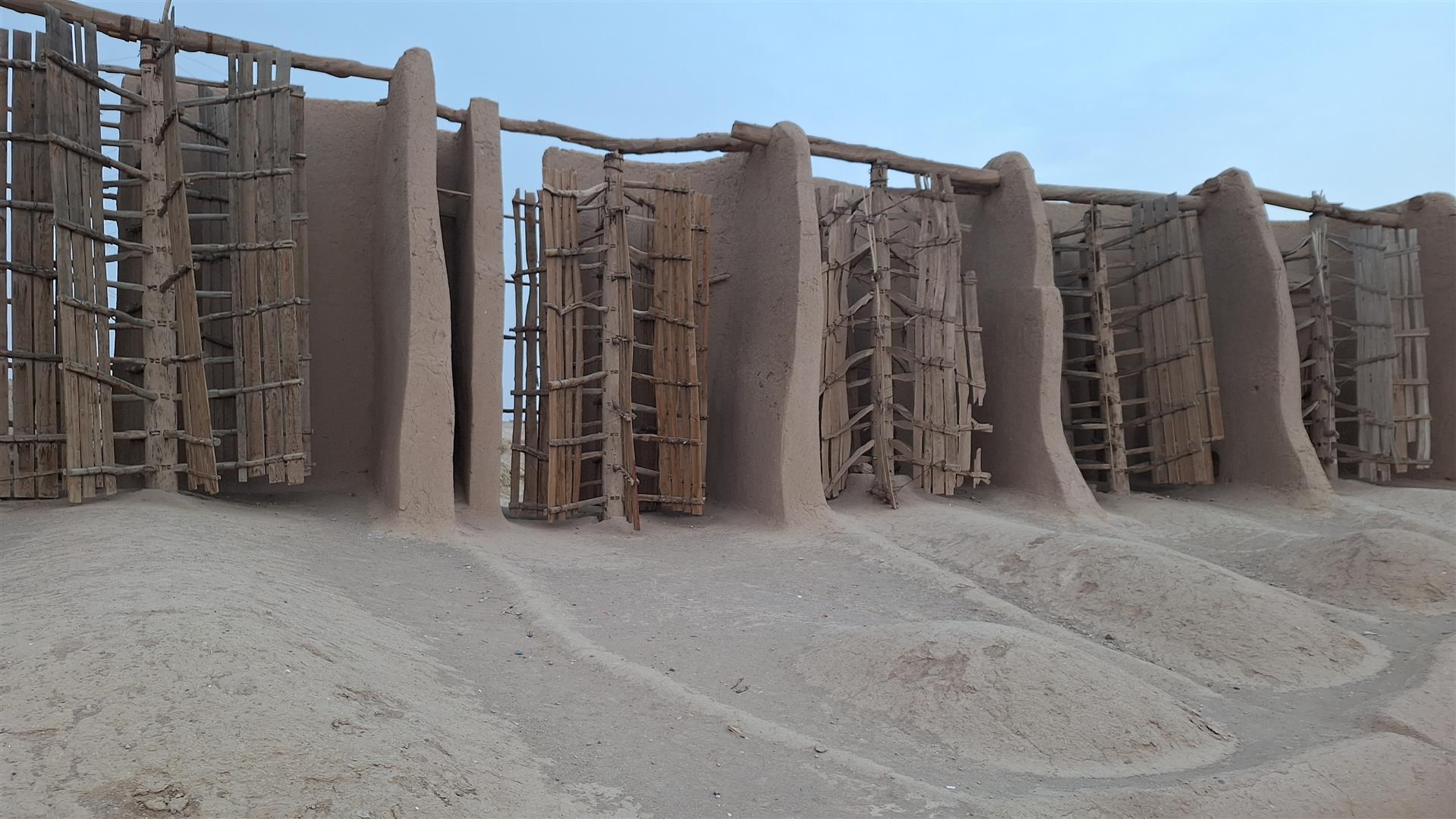
Simple materials and design did an effective job.
Just behind the main row of them is a cemetery, which looks quite old. It has stone covered burial pits and also headstones. All the buildings are of traditional, mud covered construction, as is the whole village. I was able to see part of a wall, showing that it’s filled with small stones, then covered with mud mixed with straw.
Back at base a young guy came to see me who’s a tour guide (part time), name of Hooman. He said he can take me up to see what sits beneath the windmills. I very much wanted to do that. He said he’d come back at 8. He also said he had a younger brother who played one of those small stringed instruments that are common in the middle east. And he had a band as well. He was showing me the videos. Another guy came with one of the instruments and plucked away at it until his phone rang and he suddenly went. That was fine by me.

The wind is directed in by design.
More food arrived. A lamb kofte, rice, a bit of salad. Preceded by that rather nice rice porridge that I’d had before. The old fella joined me for some of the meal then left me to it.
Hooman finally came back at about 8.30 and we went back to the windmills. He opened one of the rooms so I could see the workings. The shaft turns a flat grindstone and drops the flour out below. There’s a tunnel that allows the wind to blow in, designed to allow the chaff to be blown off the wheat before grinding. All clever stuff. And it explains where the straw for the building comes from.
I asked him how often the mud walls have to be re-plastered. Thirty years, he said. This place has been in operation for 1,000 years or so. It used to grind the wheat from farms up to 200 kms away. It must have been very busy in its day.
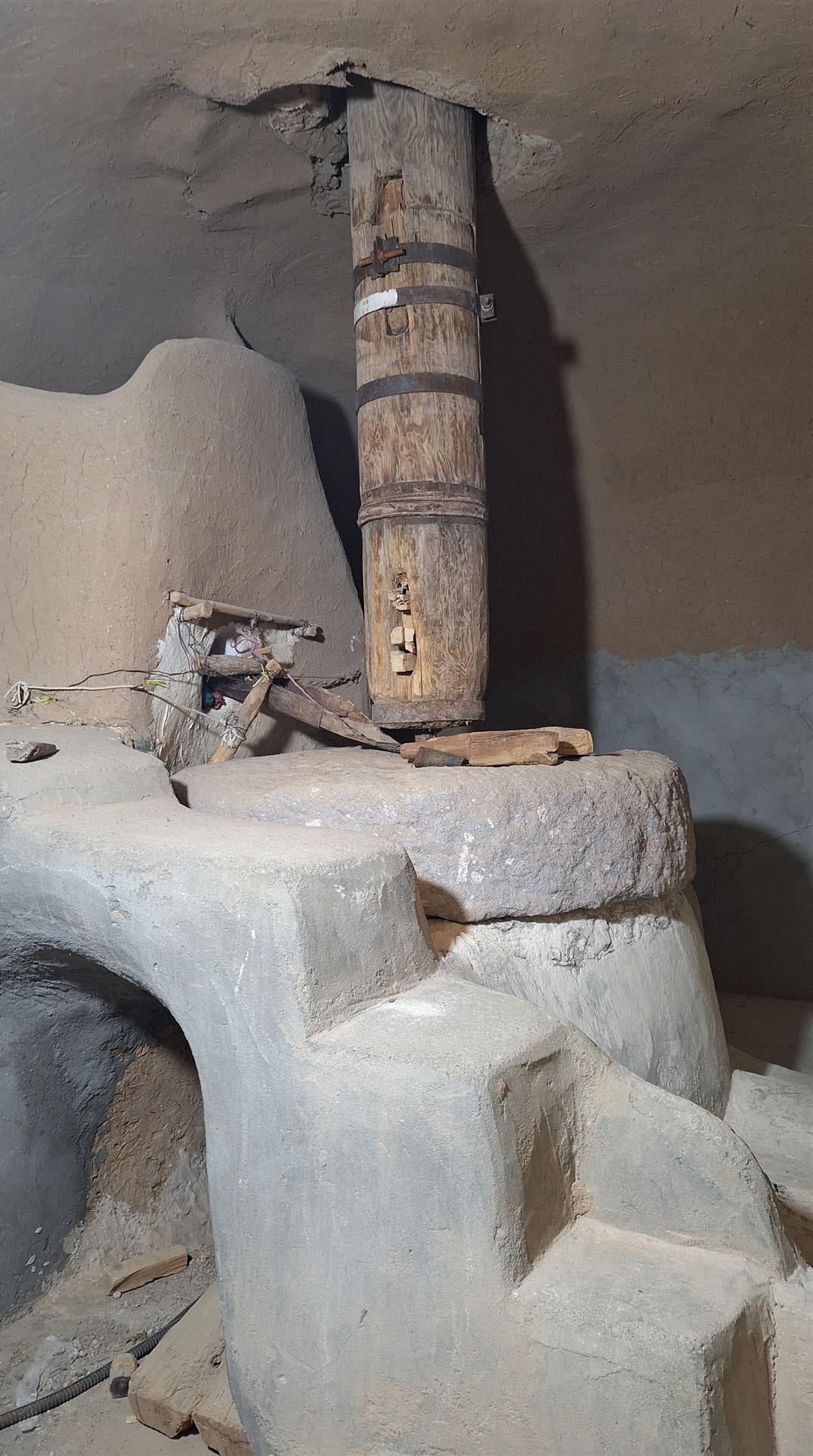
The workings underneath.
He showed me the wheat museum, which just shows all the different Iranian wheats from the area. Then he showed me a little shop, where embroidered things are sold. I said I wasn’t bothered to buy anything. “You’ll be helping local women”, he said. Still not bothered. “My young brother is available to play for you.” Definitely not bothered.
I asked him If I owed him anything for the tour and he basically said, “Up to you.” So I gave him 10€. He seemed delighted.
Back in my room he became the man whose job it was to deal with the finances. He wanted 20€ for the room and 15€ for the food, tea etc. I immediately told him that was far too much and he knocked it down to 25€. But when I told him I’d want to pay it with my card he said he can’t do that. So I knocked him down to 20€ and I’d pay him in cash. He agreed to that.
The next day was not a good one. After breakfast I got myself organised and got away at 10.30. A couple of old guys had come round to see me and look at the bike. They were pointing out how cold it was but one of them did a little dance when I got him to put his hand on my heated grips. Very funny.

Not the best weather for riding.
There was snow around and about. None on the road, at first anyway. And the sun had been warm enough to melt a lot of it. None of the puddles were frozen. I obviously took it easy at junctions etc.
But then the road turned north and the amount of snow increased. Then it started snowing. The driver of a tractor I’d met had waved his hand up towards the sky, as if to say, “Look, snow, what are you doing out here!”. In the end I went back. The conditions were not at all user friendly. But I really regretted not examining the map more closely. Two to three hours south west was a town called Birjand, which I could have got to and would have taken me away from the snow.
I was lucky the owner was still around when I got back as he was just about to go home. I settled in again and had a lazy day. The old fella said he wanted 2.5 million Toman – about £25. I walked up to the nearby ATM but could only draw out 2 million. Less than £20 and not enough. Erfan later told me that 2 million was the ATM limit. Crazy!
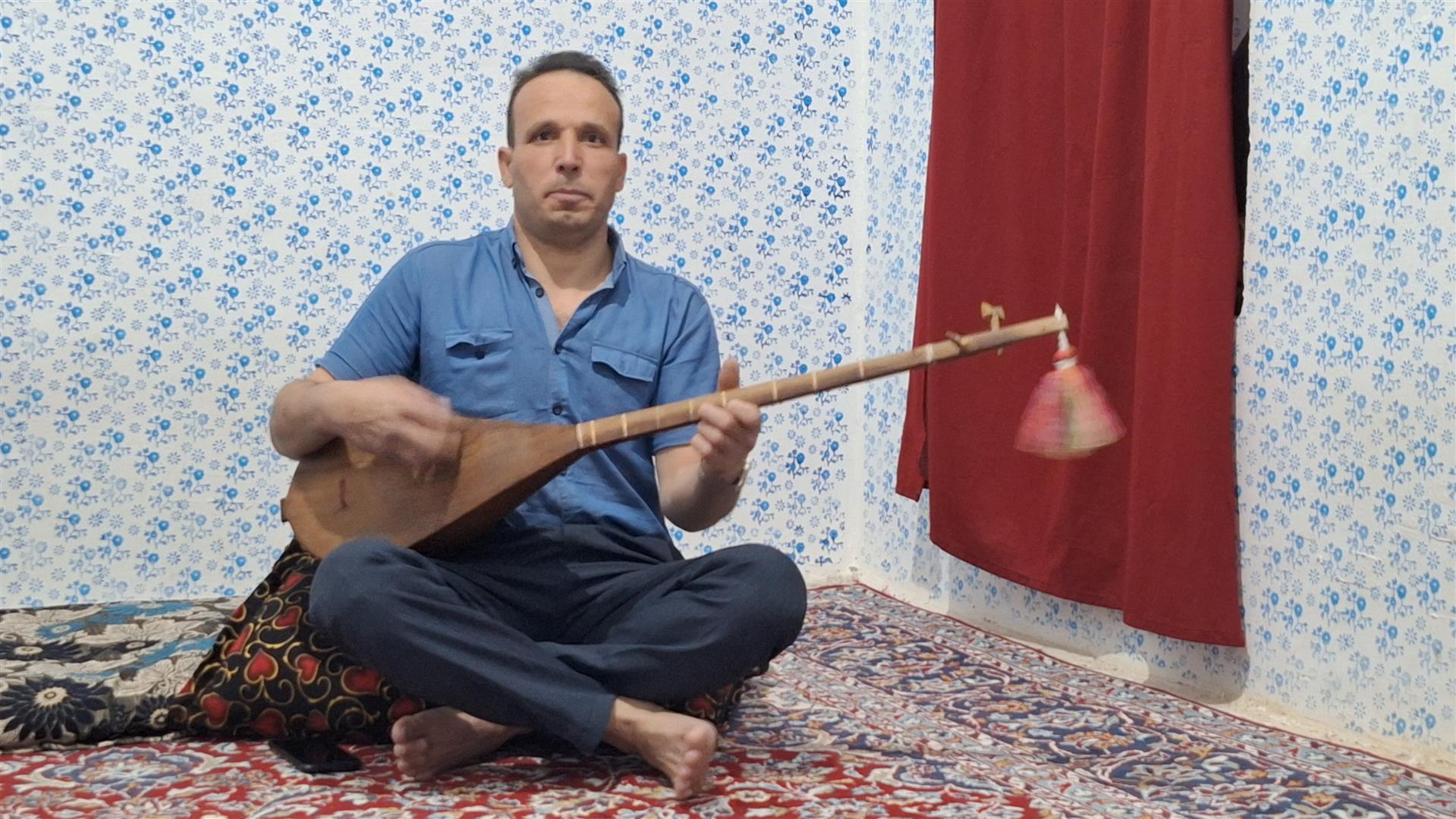
Hooman’s younger brother, plus instrument.
Hooman came round once more. His English is very good so we could chat. He and his friends work at a factory connected with the local iron ore mining operation. Biggest on the Arabian peninsular, he reckoned. Who was I to argue? But it was interesting to know there was something useful under all that rock and sand.
The discussion about payment came up again. Hooman was able to change some Euros for Rial and he suggested 20€ again as payment. But the old fella wasn’t happy with that as we’d agreed on closer to 30€. So I said to give me back the twenty I’d given him yesterday and replaced it with a fifty. Everyone seemed happy with that.
When I left next morning the old fella put the door key in a little cubbyhole in the wall, making sure I knew where it was in case I came back. Oh ye of little faith! I had no plans to be doing that.

Eco homestay. Mud and straw.
There was still a bit of snow around and, somewhat to my consternation, it increased as I travelled west. But the road was clear and the occasional patches of water weren’t frozen. So I counted my blessings and pressed on.
The hillsides looked beautiful in their coating of white, which enhanced the folded shape of the rocks. I wished I’d taken some photos.
The road started gently climbing, as I knew it surely would. I could see it rising up in the distance, eventually taking me up to 2,100 metres. The bike dealt with it well. But the fuel consumption wasn’t looking wonderful. It had been a bit high over the last day or two. Headwinds don’t help at all.
I didn’t feel too cold, except for my fingers. They were really suffering and I kept knocking the finger tips against the grips to encourage some circulation.
Once up over the top of the pass the snow disappeared. The sun had always felt warm as I rode along but now its strength seemed to increase a bit. Maybe it was psychological. Even so, I was still happy when I came to what looked like a cafe at a junction. I was only an hour from Birjand but I really needed a warm up.
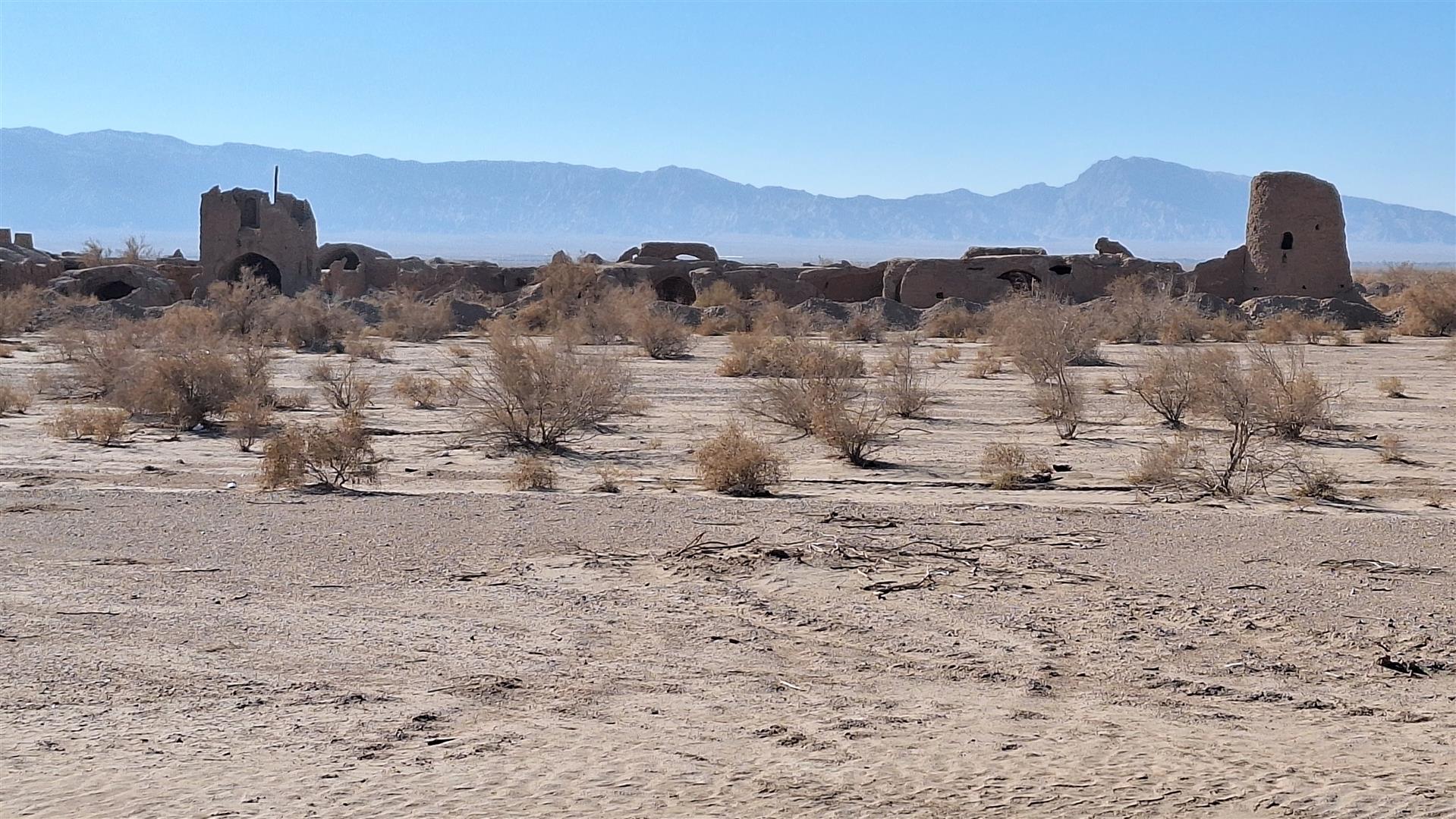
One of the many sets of crumbling ruins I rode past.
The youngsters inside were happy to provide me with tea and I slowly warmed up as I drank it. One of the guys had a little English, which helped.
When I left I was just getting onto the bike when a police car turned up. The driver got out and came towards me. “Damn!”, I thought, what does he want? He started talking to me but I told him “No Farsi, only English”.
He went over to a nearby car and asked them something: whether or not they spoke English, I surmised. Then he told me to wait and went into the café. The young guy came out with him and asked me, via Google Translate, if I needed any food. Then he asked me if I needed anything at all. When I said no, the policeman was satisfied and left me to it. So he wasn’t interested in my papers or asking me questions. He just wanted to know that I was OK in this difficult weather. How very, very kind.
In Birjand I got to Mountain View hotel, which Hooman had recommended, booked in to a very nice room, then stood under the lovely warm shower until the cold of Nashtifan had been driven out. I booked in for a second night, feeling the need for a rest. The restaurant delivered a very tasty meal for a very low price. I was happy.
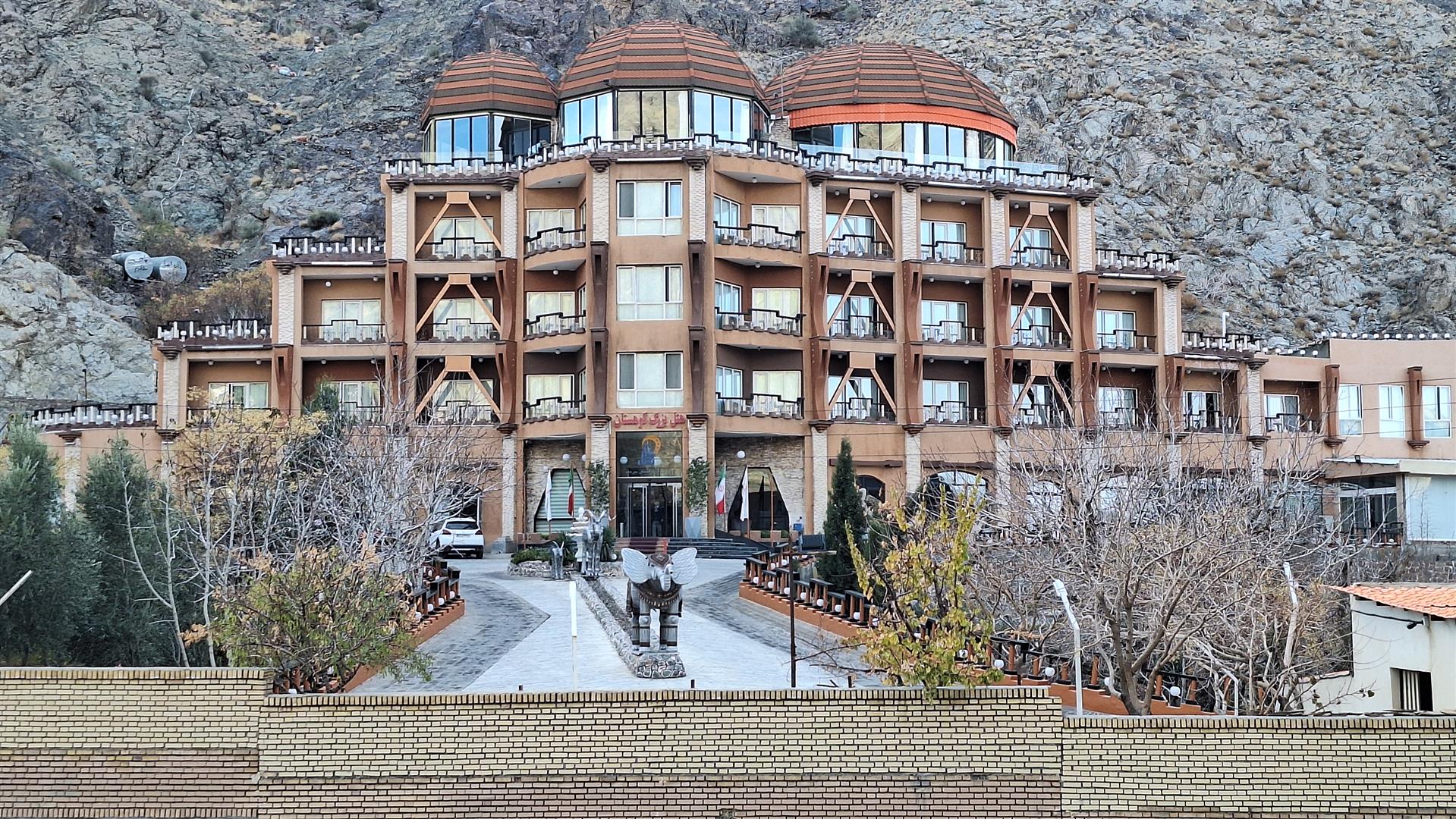
A really lovely building. Surprisingly cheap, although probably less so in the high season.
The next day was a lazy one, although I went out for a walk after lunch, to see what there was to see. Which turned out to be very little as I was nowhere near the town.
I was now heading towards Esfahan, a big city in Central Iran. With a drop in altitude the terrain had changed and I was riding on long, straight sections of road, disappearing into the distance. Substitute American flatlands and ruined adobe houses for Iran’s sandy, scrubby Tabas plain and abandoned mud built villages. But unlike US films about road journeys, my real life ride had camels, standing near to a ‘Beware of Camels’ sign.
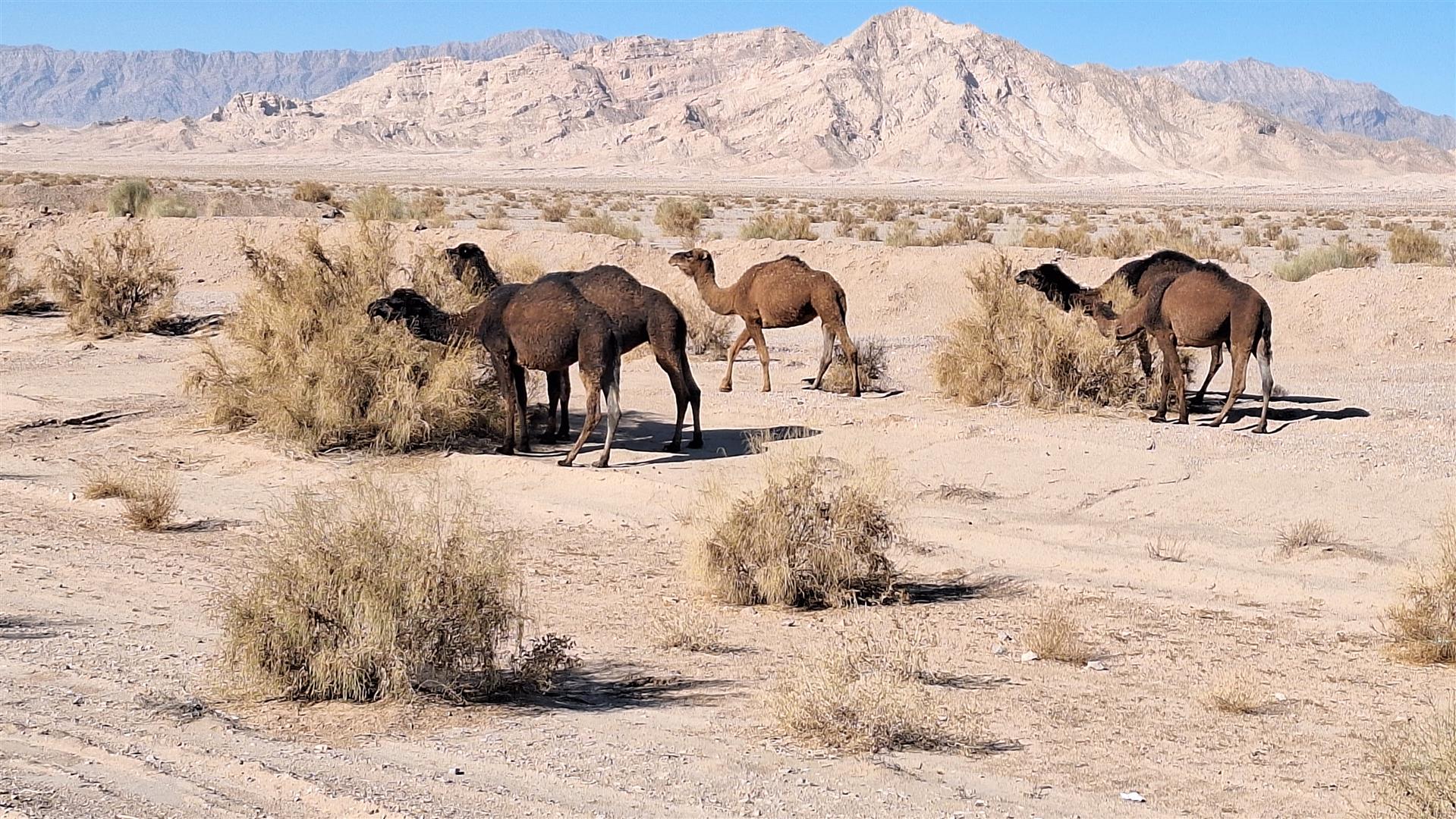
Camels. No real surprise in the desert tho.
I came to the ancient Esfahak Village after several hours of riding. A mud built village, with lots of intact buildings and many more in ruins. It’s an Eco village and offers accommodation to tourists. It was was destroyed by an earthquake in 1978 and the people moved to a new village nearby, abandoning their ancestral home of 1,000 years..
But in 2008 the younger population realised the tourist value of the old village and reconstructed many of the original buildings, with guidance from research institutions. It has accommodation for tourists as well as houses occupied by those who are restoring it. Because of its location out on the plains, it has become a centre of astronomy tourism. To that end methods of reducing light pollution were adopted.

The effects of the 1978 earthquake.
I had a good walk around and was impressed by the quality of the rebuilding. They established a clay workshop, using the principles of sustainable architecture to preserve the cultural heritage of the parents and grandparents who used to live there. Their work has become a model for turning similar natural disasters into opportunities for tourist development, and the economic benefits that brings.

Rebuilding with a purpose. Still plenty to do.
There was a café next to the village where I had a couple of cups of chai and ate my lunch. Then I carried on, but only after an Iranian couple had persuaded their young son to talk to me. He had asked them if he could but then became very shy. But we got there in the end. These little moments are great.
But time was now pressing so I ramped the speed up to 100kph. I had to stop again for fuel, and then to photo the sunset.
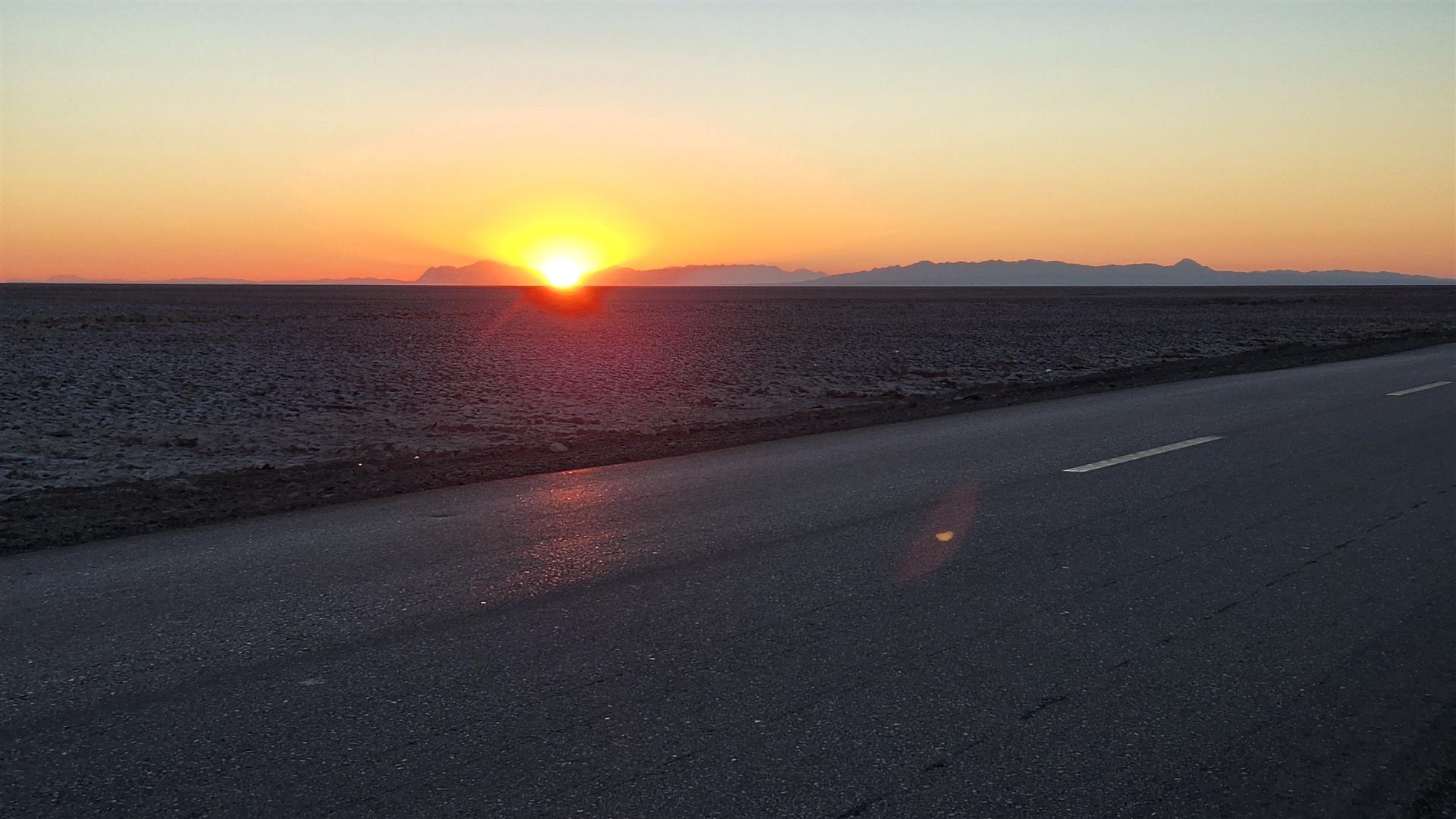
Yeah, nice.
I reached my hotel in the dark and thought I’d missed out because it didn’t seem to be open. I knocked on the knocker and a guy came and welcomed me into the warm. He organised me chicken and rice for tea and provided a choice between Coke or a 0% beer. I had the beer and decided it was drinkable without alcohol, but only just.
Breakfast was good and I was on the road by 10.30, with almost 400kms to ride to reach Esfahan. More long straight roads. More collections of mud huts, crumbling away on the plain. I arrived at the hostel I’d selected in the early evening and booked in for two nights although I thought I might stay longer. Esfahan promised to be very interesting, with lots of places to visit.
And I promise I’ll tell you all about it very soon.

A very neat little Trail Bike I saw. Presumed to be Chinese made.
 MOTOPANGAEA