
Mosul, Iraq. 5th February 2025.
A fascinating day in Mosul. I walked down to meet Saif at the Traveller Café. He was late. A group of people stopped to chat while I was waiting. My thigh was OK today but my right knee was aching up a bit by the end of the day. Am I falling apart, I wondered?
Saif took me for a walk through the bazaar. Bombing had destroyed a lot of it but it had been rebuilt. In the older part it was just the roof that needed replacing.
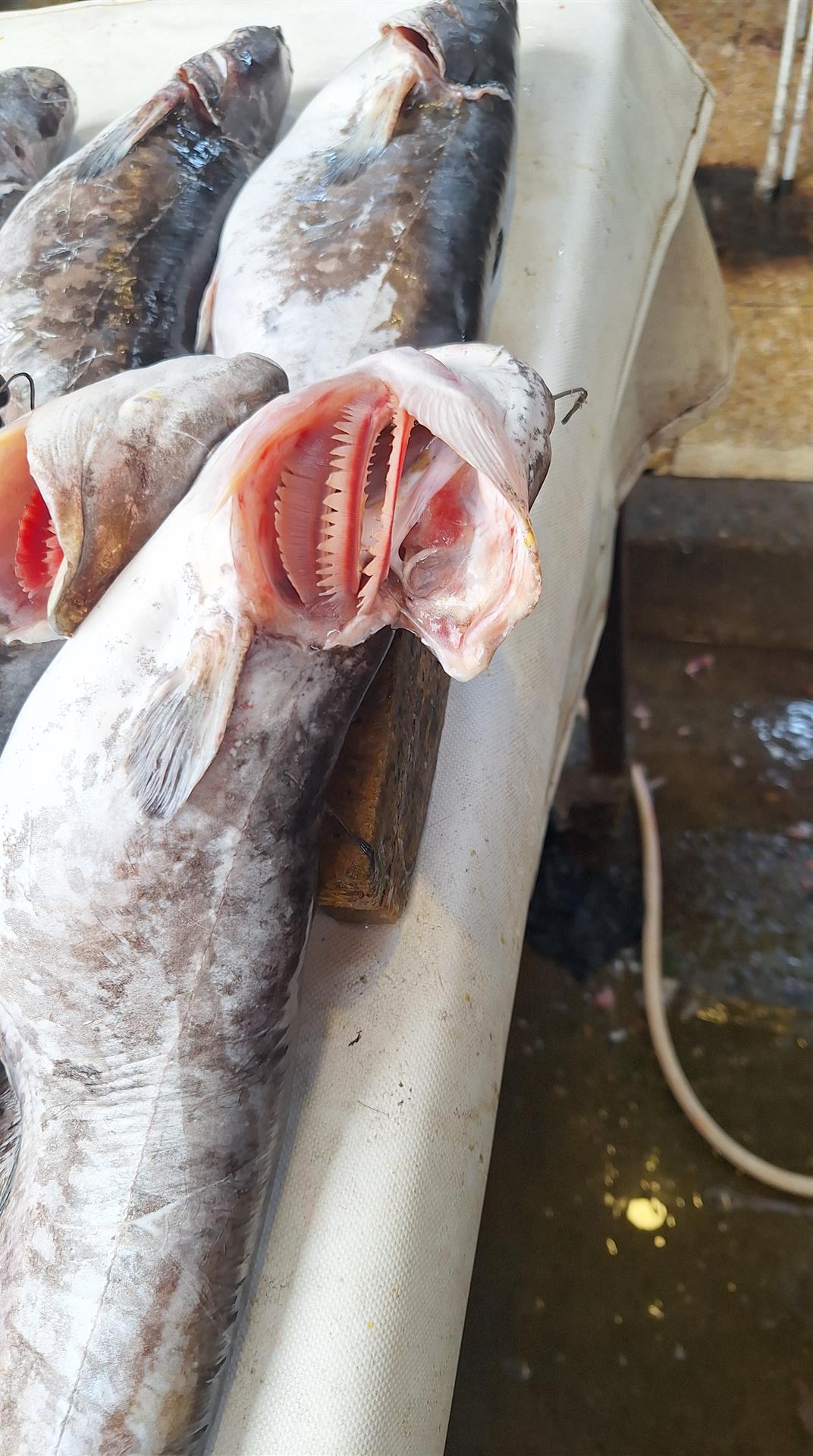
A very odd looking fish.
Spices, meat and fish. The fish came from farms or the river. There were a few weird ones there. But most interesting were the small businesses that produced small tools and maintained other equipment. The premises were usually only a few metres square.
One guy maintains the tools used by the nearby butchers, sharpening and so on. Another one makes wooden handles for tools such as picks etc. The next shop makes the tools, using a forge and an anvil. It was like stepping back to pre-war days, before factories took over this work. Absolutely fascinating to see.

Making tools the old fashioned way.
He took me through the ruins and explained to me what had happened there. ISIS were effectively trapped in Mosul old town by the Iraqi and US armies. The streets were too narrow for troops to go in. Too dangerous. So their solution was to bomb and shell the hell out of the place. In the end this killed or led to the capture of ISIS. It also killed many civilians but I forgot to ask Saif how many that was.
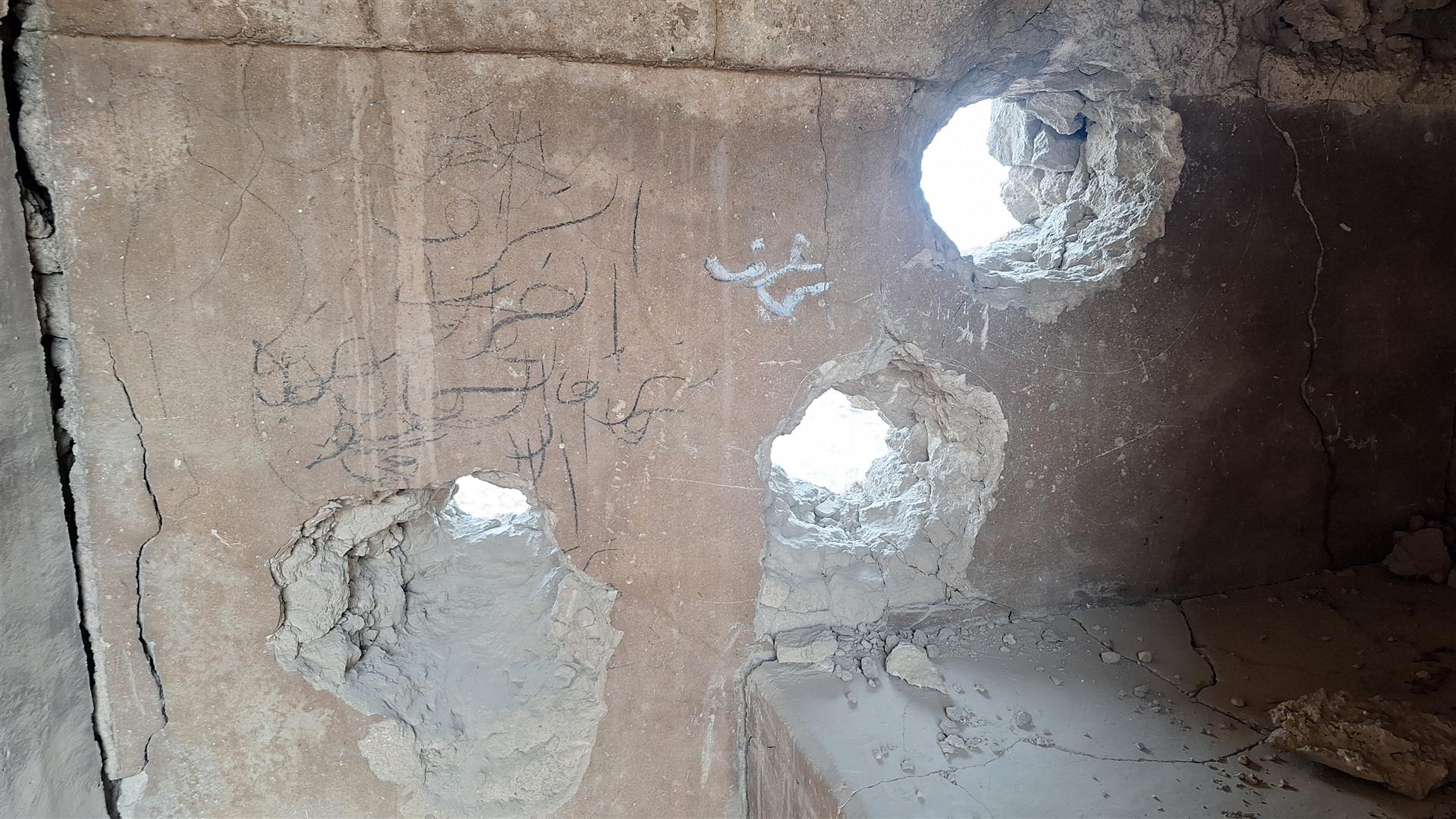
Sniper holes in the walls.
The civilians were the captives of ISIS, who ruled the area on an extreme Islamic basis. People who broke the rules were imprisoned. A local church was the prison.
As the army closed in they forced householders to knock holes through their walls to provide escape routes for them. Some smaller ones were for snipers to use. As we walked around he pointed out some expired mortar shells on the floor of a building. Many buildings had the legend ‘SAFE’ stencilled on the walls. Meaning they had been cleared of any ordnance.

A building marked safe from UXO.

An unused mortar shell.
It was a scene of devastation. Most of the buildings in that area were over 300 years old. They’ll all be demolished eventually. Saif lost friends here during that time.
We chatted about Syria and the guy who drove out Assad. He used to be from ISIS and Saif doesn’t trust him. I voiced my opinion that if, in the fullness of time, he does good things there then maybe his ISIS past can be put to one side, if not actually forgiven. Saif seemed doubtful.
We visited an ancient mosque which had suffered at the hands of ISIS. Is was only a small one. The outside had been shot up, with bullet marks on the marble. ISIS had tried to destroy it by pouring oil on the floor and setting it alight. The marble on the interior columns had been proved to date from the 14th century. This kind of thing leads me to believe that the metality of ISIS, and similar groups, is impossible for sane people to understand.

ISIS failed to destry this mosque.
He showed me the premises of the NGO he runs. Newly refurbed but not yet kitted out.
Talking of refurbished, we walked up through an area were houses and other buildings had been restored. They looked very good. There were stalls run by women who sold home produced crafts.
I got a bit confused about the history of the area. I wasn’t sure if it been ruined in the fighting and had been rebuilt or if it hadn’t been damaged but had been restored anyway.
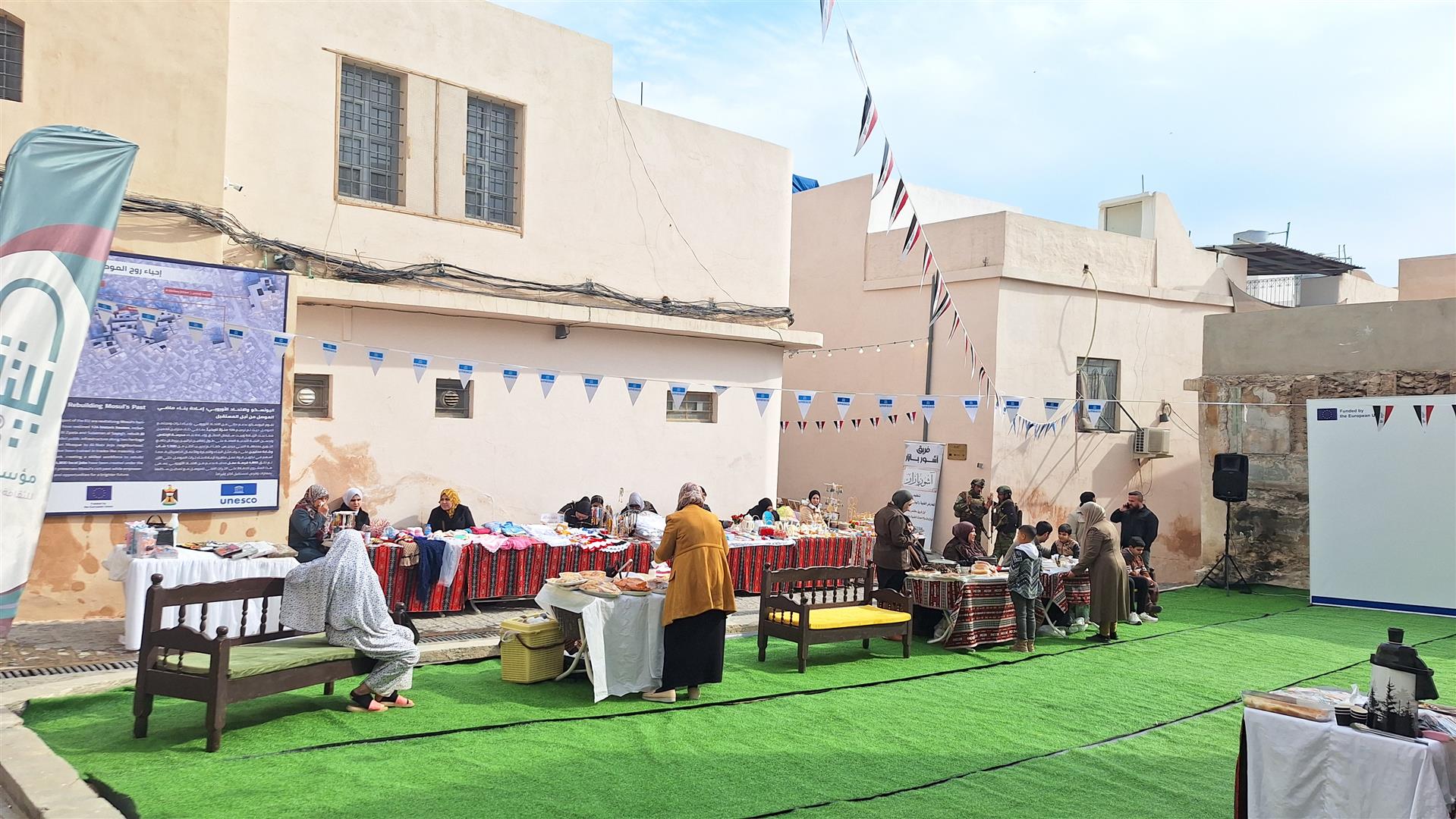
Women running stalls. A sign of growing normalisation.

Special Tactical Unit. A sign that nomalisation has yet to be achieved.
There were loads of soldiers around, plus Special Tactics Unit (STU) vehicles. Small armoured cars with a machine gun on the back. Far more than were normally seen.
The reason for this became clear as we walked round to a heritage area which was being visited by Iraq’s Cultural minister and a bigwig from UNESCO. Most of the refurbishment work had been organised by them, using money from the EU, Saudi Arabia and others.
Saif managed to talk us in past the guards so I met some of the people there who’d been meeting the VIPs. Some young girls in traditional costume and some musicians who’d been providing entertainment, plus people from the university.
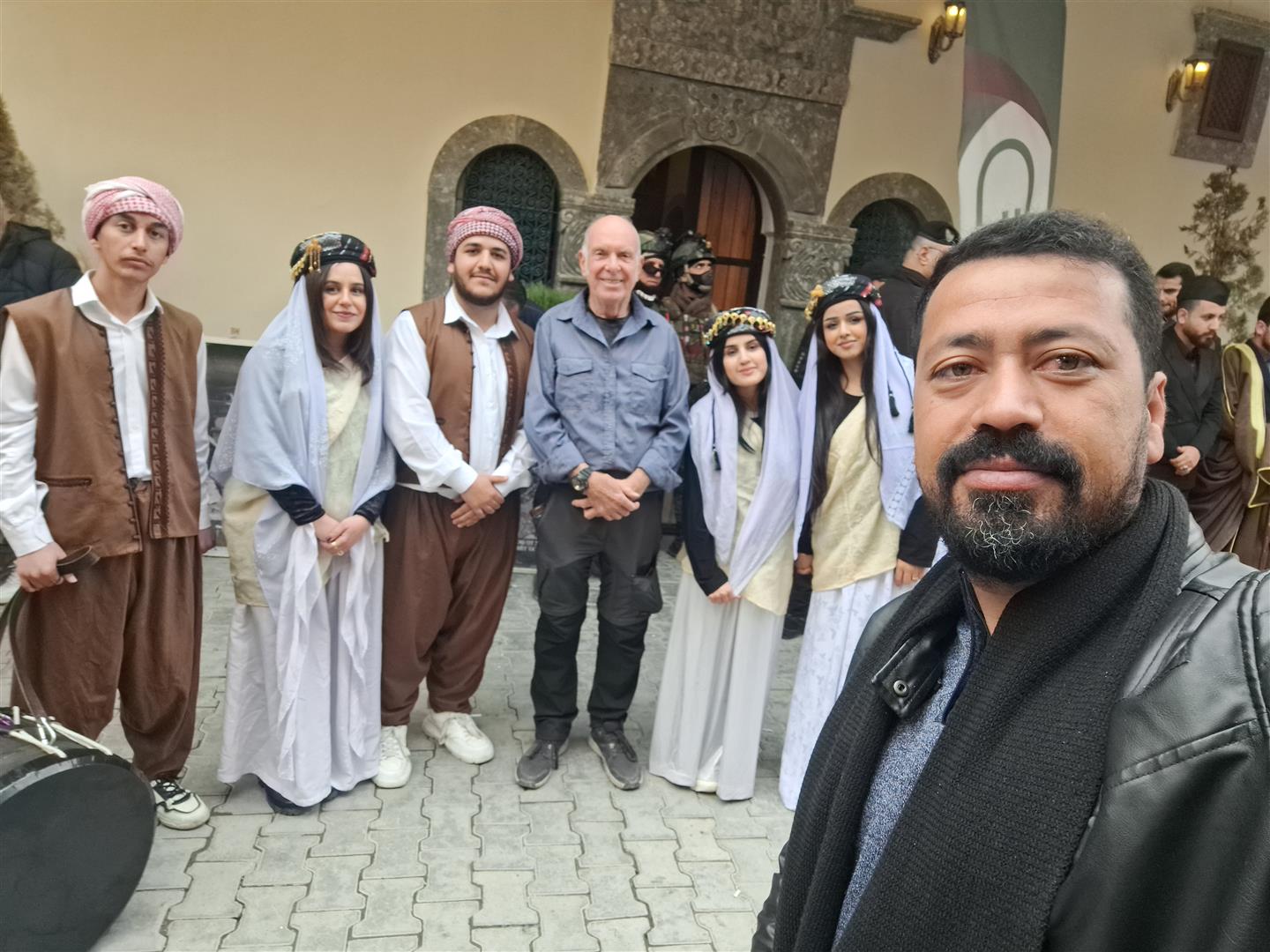
Saif, and some of the people who entertained the visitors.
Saif pointed out a big church that had been refurbished and also an old mosque that had been damaged. It had had a bendy minaret which had been rebuilt to still be bendy.
Saif got a phone call saying that his friend at the café was unwell so we had to leave. He dropped me off near the hotel on the way.
That had been a truly fascinating tour. His pain, as a native of the city, was easy to detect beneath his matter of fact narrative style.

The absolute devastation of the old part of Mosul.
A rest day came next. And by that I’m really saying ‘stationary’. My knee needed a rest. I messaged Saif and we were to meet next day to look at the church and the wobbly minaret.
Thinking ahead to my departure from Iraq, I’d been looking into getting a Jordan Pass. It gave free entry to 40 tourist sites and included the visa fee. But it was only for a single entry. I’d decided by then that I wanted to visit Syria and Lebanon, which would have meant two entries into Jordan.
I’d been looking at the possibility of going back into Turkey then crossing into Syria from there. Borders were open as far as I could work out. Otherwise I’d need to go to Jordan first, then to Syria, then back again.
Saif had said there were no borders open between Iraq and Syria but I’ve just joined a FB page which includes an article suggesting this is about to change. It needed thought and then a plan.
I spent time researching the best way into Syria. It turned out that Saif was right. The borders with Turkey were for refugees only. In a way I’m pleased about that because it’s really cold up there and I didn’t fancy going back north.
There was an article on the internet talking about a border due to be opening soon at Al Qaim. But it was all a bit indefinite. It did look as if going via Jordan was going to be the only viable entry point. There was a well organised border between the two countries and I could take my bike, as others had done already.
And when I thought about it I decided it might work out OK. The Jordan Pass is only valid for two weeks, with forty sites to visit. I couldn’t see me achieving that. So paying for another pass might not be so bad. So having made a decision, I went online and bought one.
Syria had fuel but no ATMs. That’s not a surprise. So I needed to preserve my dollars, although I imagine Jordanian Dinars might be easily exchangeable. I’ve joined a couple of Syria WhatsApp groups and hope to be able to find out.
Answers to my questions on the group revealed that it’s not possible to change JOD for Syrian pounds. Bank of Jordan ATMs don’t charge fees so the answer would be to draw out lots of JOD and buy USD. Getting a SIM card is easy, somebody said. Another site did say that fuel is plentiful.
After that I did some writing. So a productive day without moving anywhere further than the nearest food outlet.
Next afternoon I went to the café to meet Saif. I had a cup of tea while I waited then we went in his car to to the restored Catholic church. Oddly, this was funded by the United Arab Emirates. A Muslim country rebuilding a Catholic church struck me as very odd. But I suppose they did it for the people of Mosul. I said to Saif that the Catholic church is one of the richest organisations in the world and had absolutely no need for outside funding. It makes me angry because the money could have been used elsewhere.
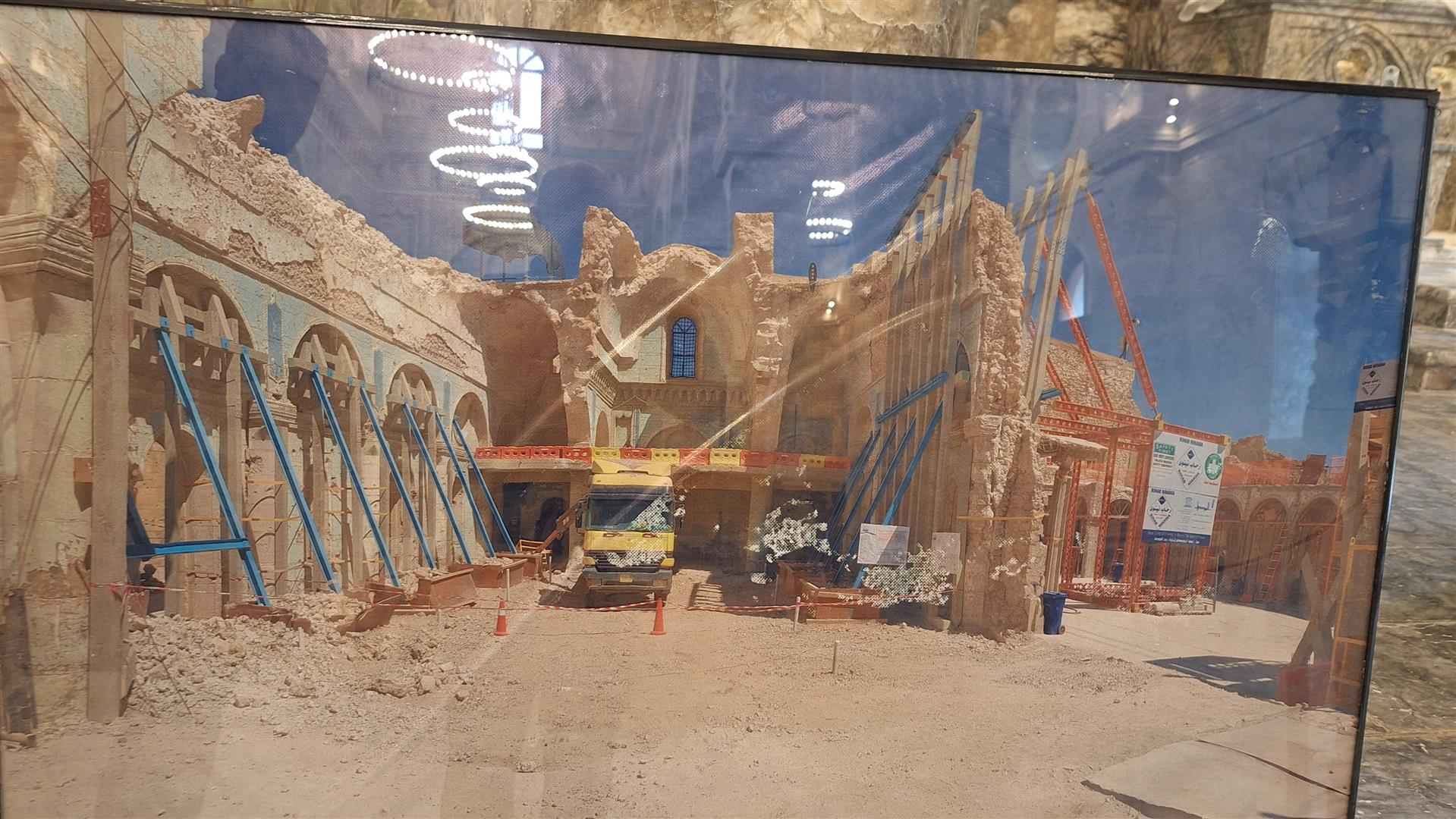
Before.
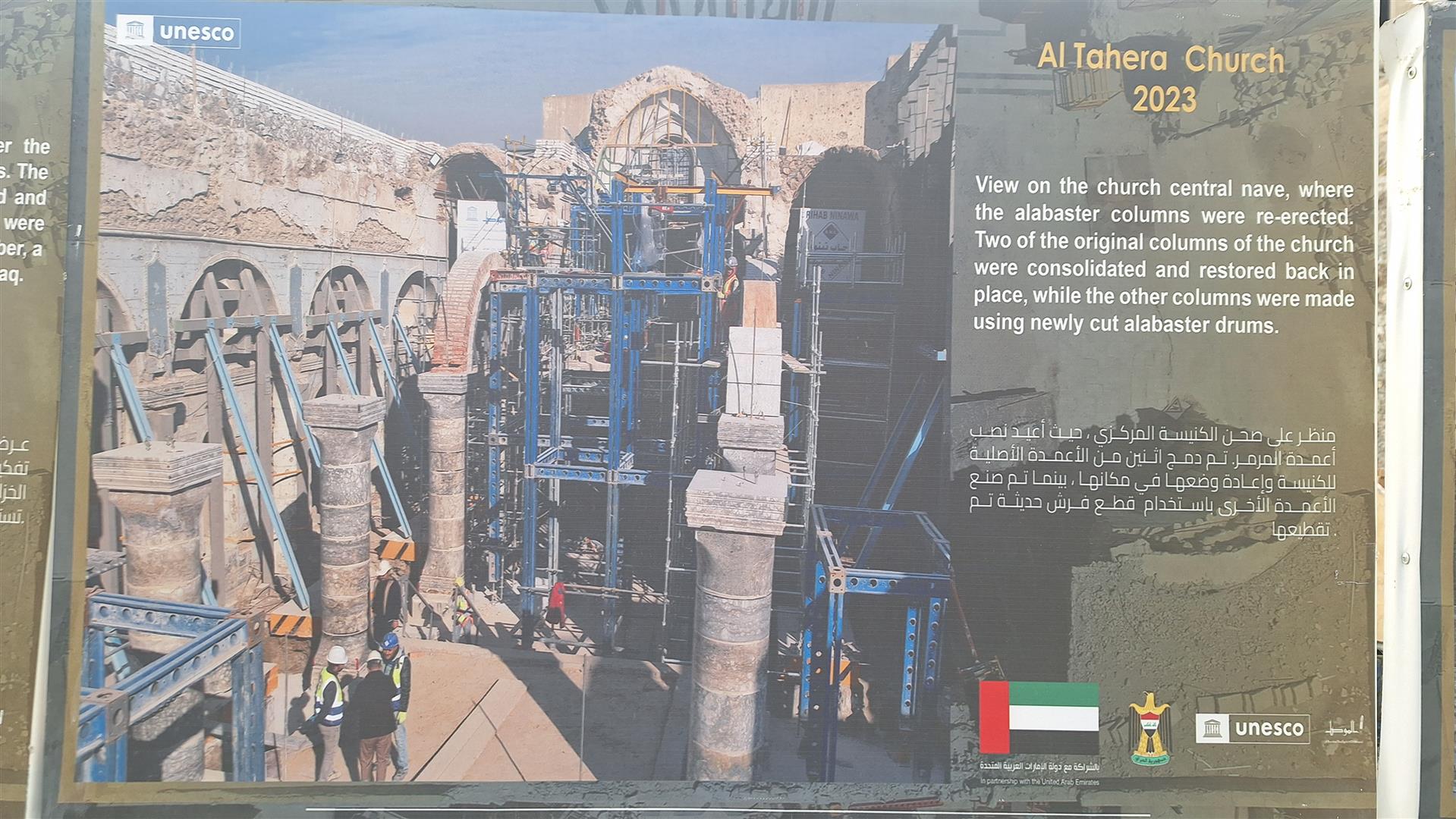
During.

And the very impressive final result.
But an excellent job had been done, especially looking at the photos of the damage and how it looked now. Right next to that church is a Syriac church and an Armenian church. Christian corner, I dubbed it. They’re waiting for their own restorations. Perhaps they should ask the Pope.

The rebuilt wobbly minaret.
We drove to another area to visit a heritage centre. It was in a large house that had also been rebuilt after being damaged. It reflected local heritage, with plenty of donated artifacts on display, mostly household items from the early 20th century.
There was a very good painting, by a local artist, depicting what had happened to Mosul. We met one of Saif’s friends who stuck a virtual reality helmet on me. It was very good and enabled me to look inside some of the buildings as they had been. But it was also quite disorientating.
Lastly we walked across to where I could get a good view of the wobbly minaret, looking good with its night time lights.
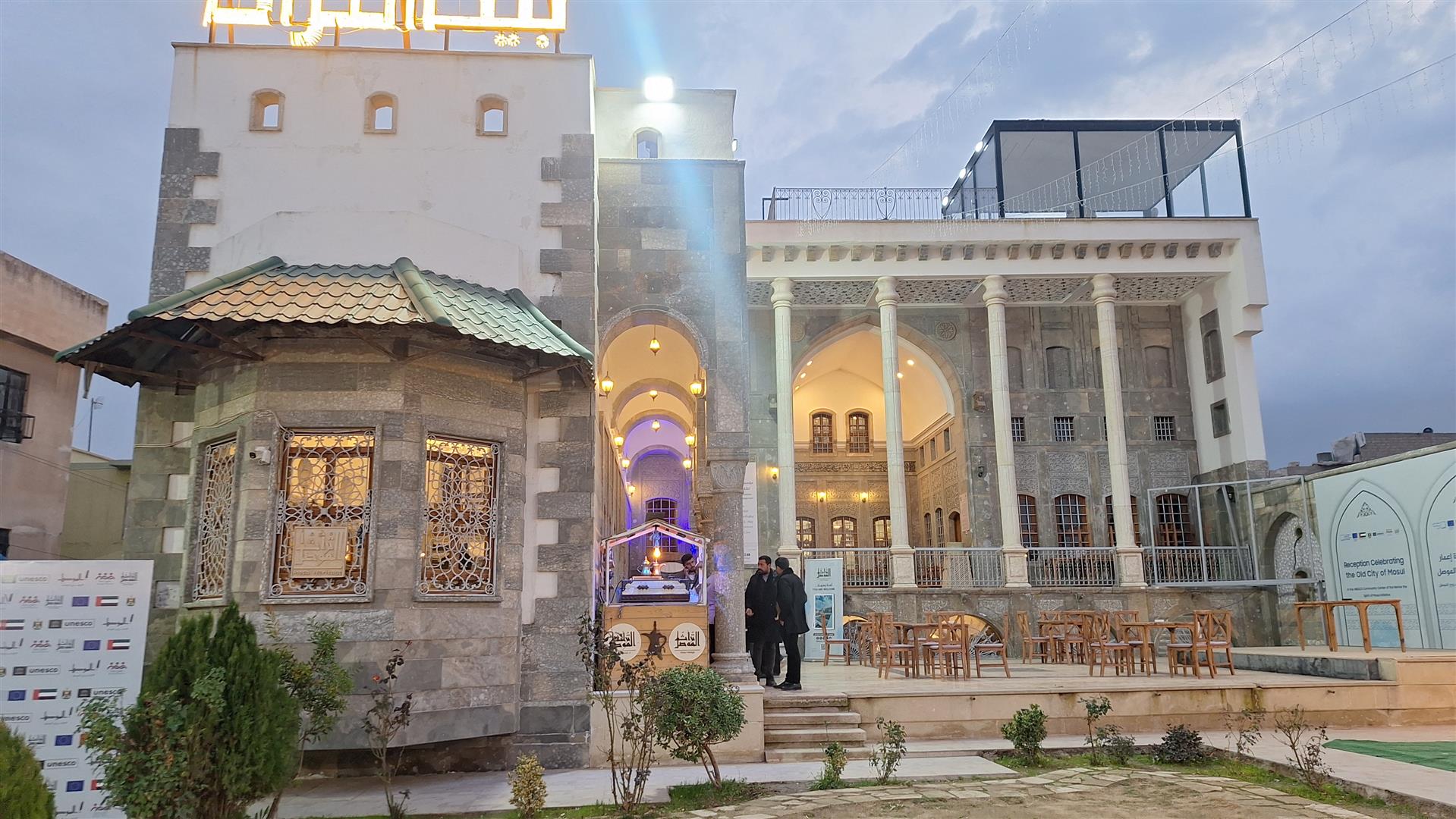
The Heritage Centre.
Saif took me back to the hotel, which I was glad of because it was getting really cold. Then I noticed that my little kebab shop was closed. What could I do?
Well what I did was to go across the road to a very busy shop where I was going to get a couple of those bread pouches, filled with meat, onion and tomato, to bring back to the hotel. But the crowd at the counter suddenly cleared so that I could sit down. The advantage of that was that I got a bowl of broth to go with it. And it was all very nice indeed.
After I came out of the café I went into the biscuit shop. I was having a nice banter with the young guy in there about football.. He supports Manchester City and I was amused to find that when I made the ‘wanker ‘ sign about them he understood it. So did his laughing mate.
Back at the hotel I asked at the desk about changing dollars. They called the boss over (he sits in the lobby most of the time) but when he saw that I only had a fifty and some tens, he became unsure about the rate. He made it clear it would be a lower rate. I asked him to do it anyway. I ended getting 1475 Dinar per dollar. It would have to do because I needed cash.
The morning was cold but sunny. It was ‘Goodbye’ to the sad and sorry city of Mosul. But I was pleased to see that it had friends in the right places who were trying to heal it.
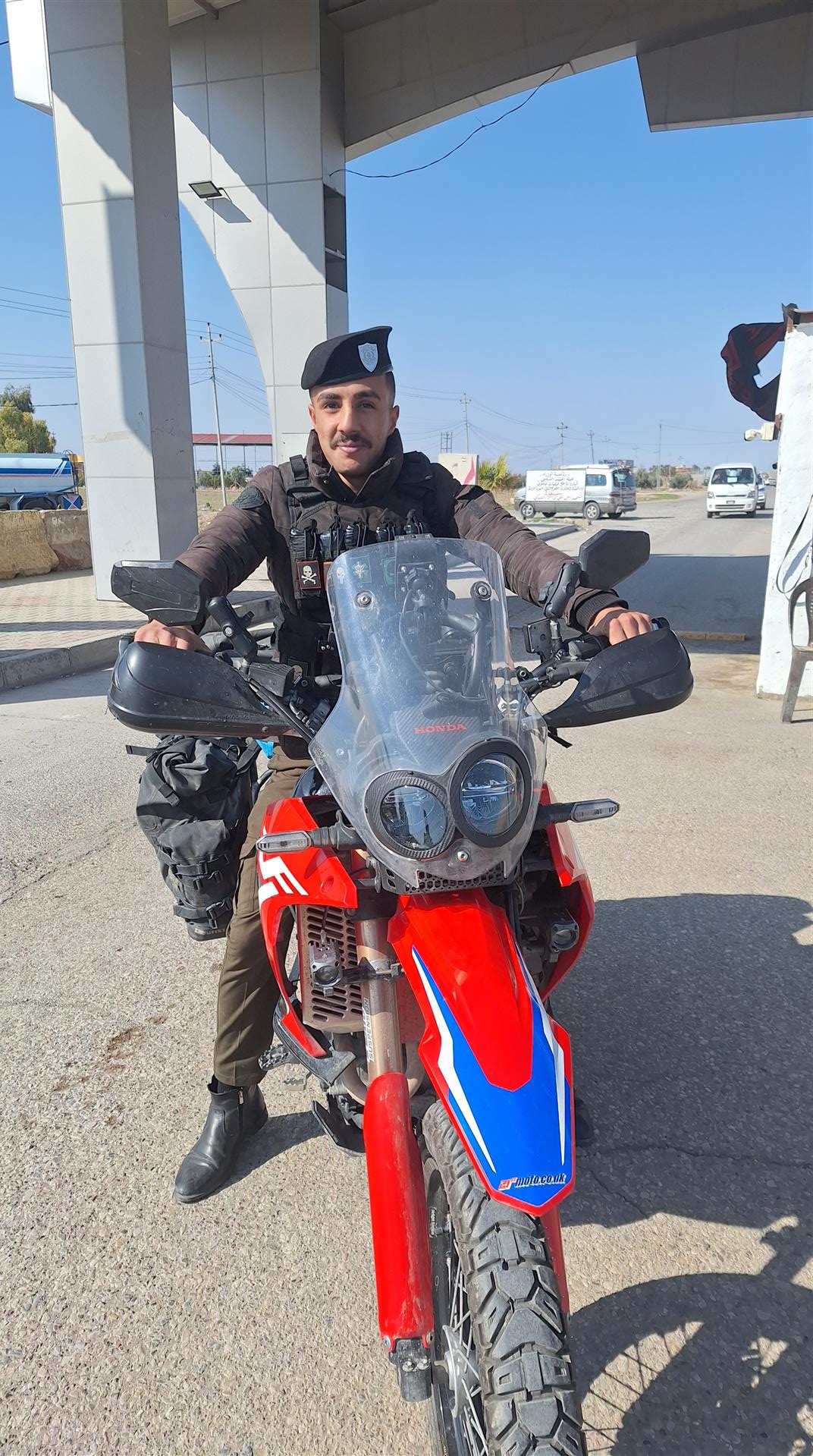
A soldier at one of the checkpoints admired my biike.
I headed to my first destination, Dur Sharrukin, a little way north of Mosul. The name means “Sargon’s fortress” and it was built by order of Sargon II of Assyria (721-705 BCE). It was meant as a monument to his reign, but was abandoned after his death. Its discovery in 1843 revealed the magnitude of his endeavours. But I couldn’t find it. Neither Waze nor Google seemed to have an accurate location for it. I wandered up and down some tracks but with no success.
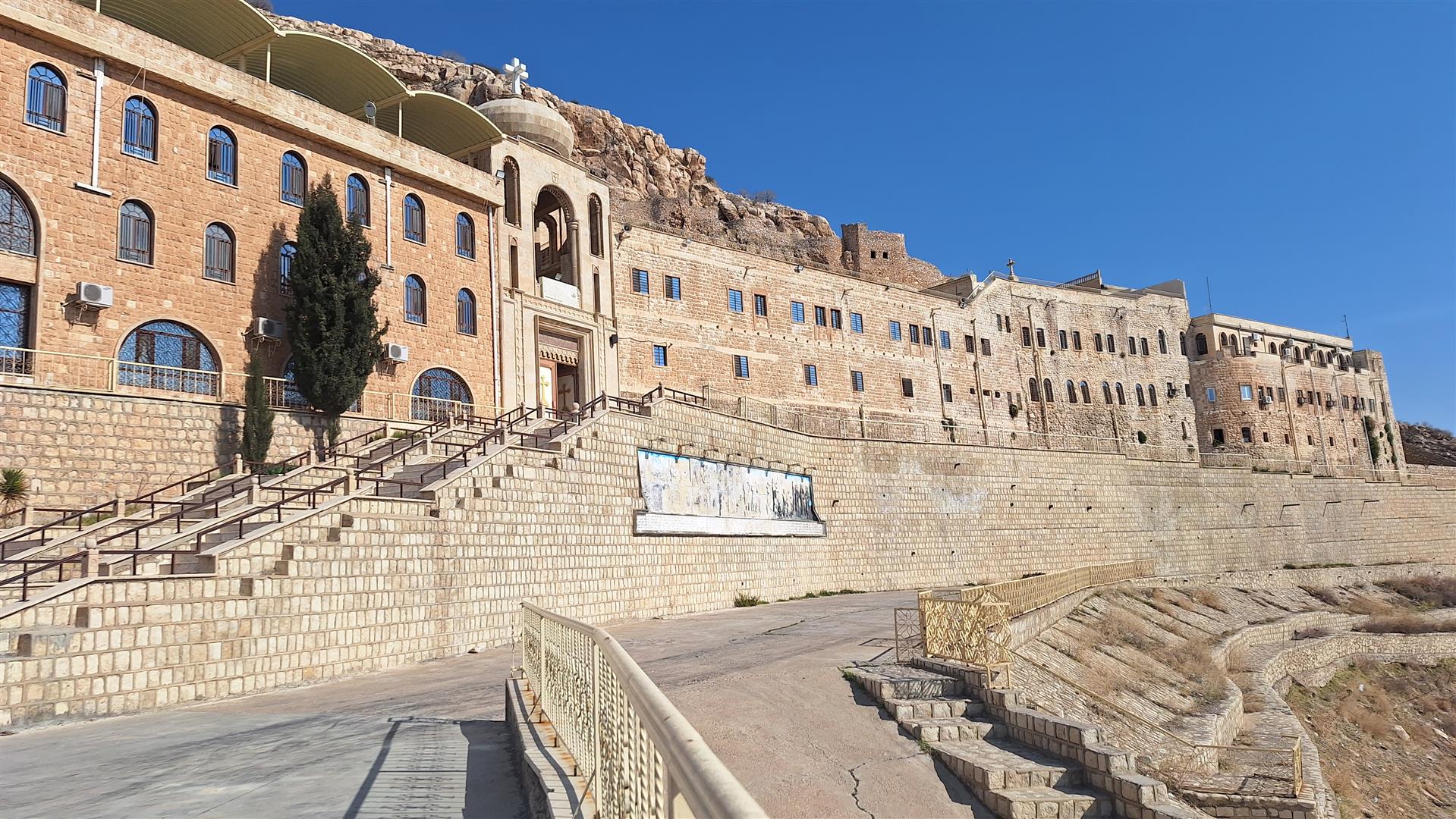
The Mar Mattai Monastery.
The next place was the Mar Mattai Monastery. And here’s where things got VERY frustrating. I was held up at 3 checkpoints within 5kms. The second one kept me sitting around for 20 minutes while some waster bothered himself to show up. All he did was photograph my passport. ANY of the soldiers could have done that! It’s the complete lack of co-ordination that hacked me off.
The monastery was on top of Mount Alfaf, at 820 metres, and was a very striking building. I was able to wander around the building and look in some of the rooms. But I wasn’t sure if the wards were occupied or not so I didn’t delve too deeply. It’s recognised as one of the oldest Christian monasteries in the world and is the oldest Syriac Orthodox monastery.
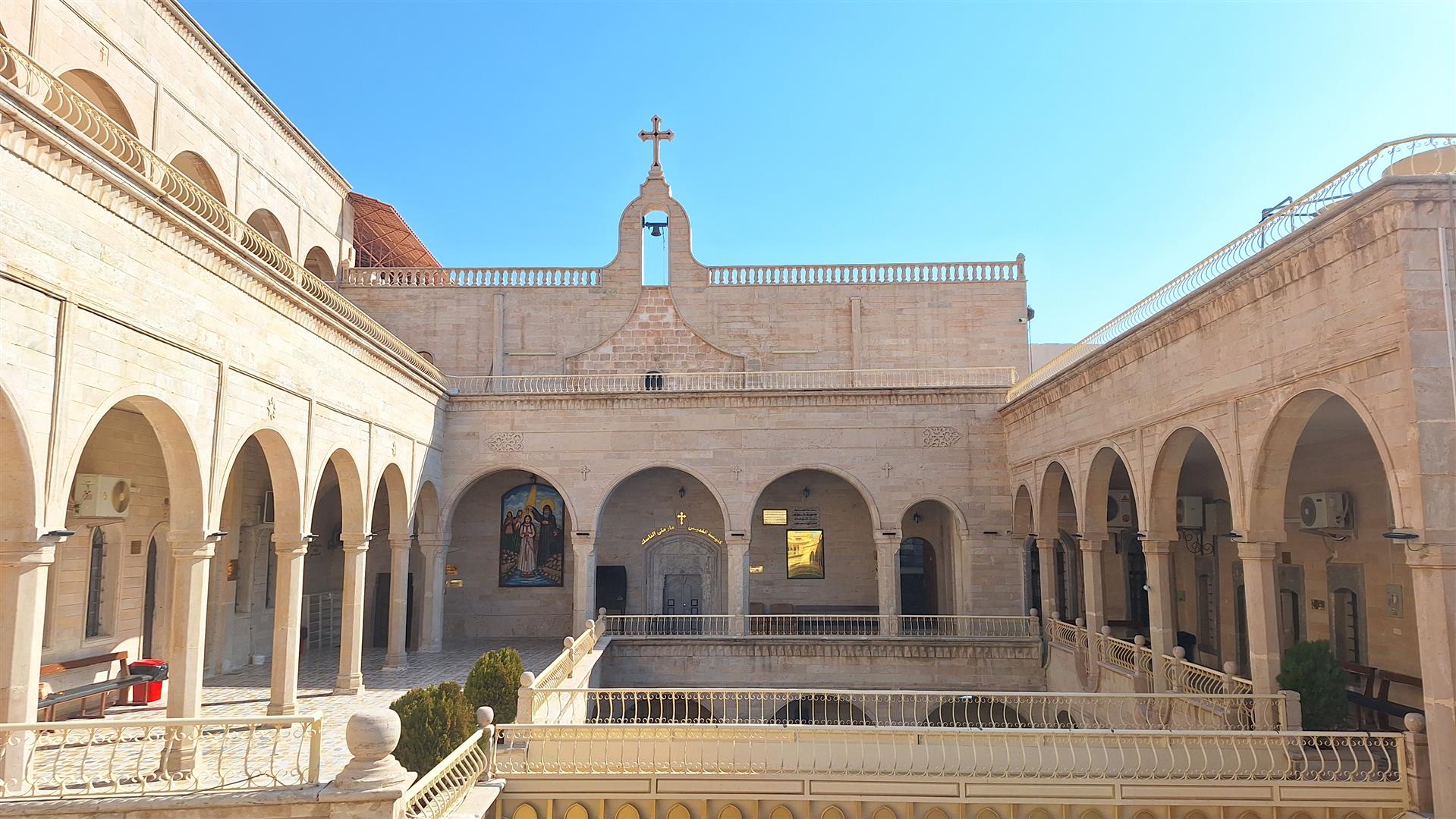
The monastery had a very fine interior.
Back down to the main road and on to Bakhdida. Only one more checkpoint this time, and quite quick.
This town is home to Assyrians, so most people are Christian. Most women weren’t wering a hijab, which looked quite strange after so long. There were two big churches in the town.
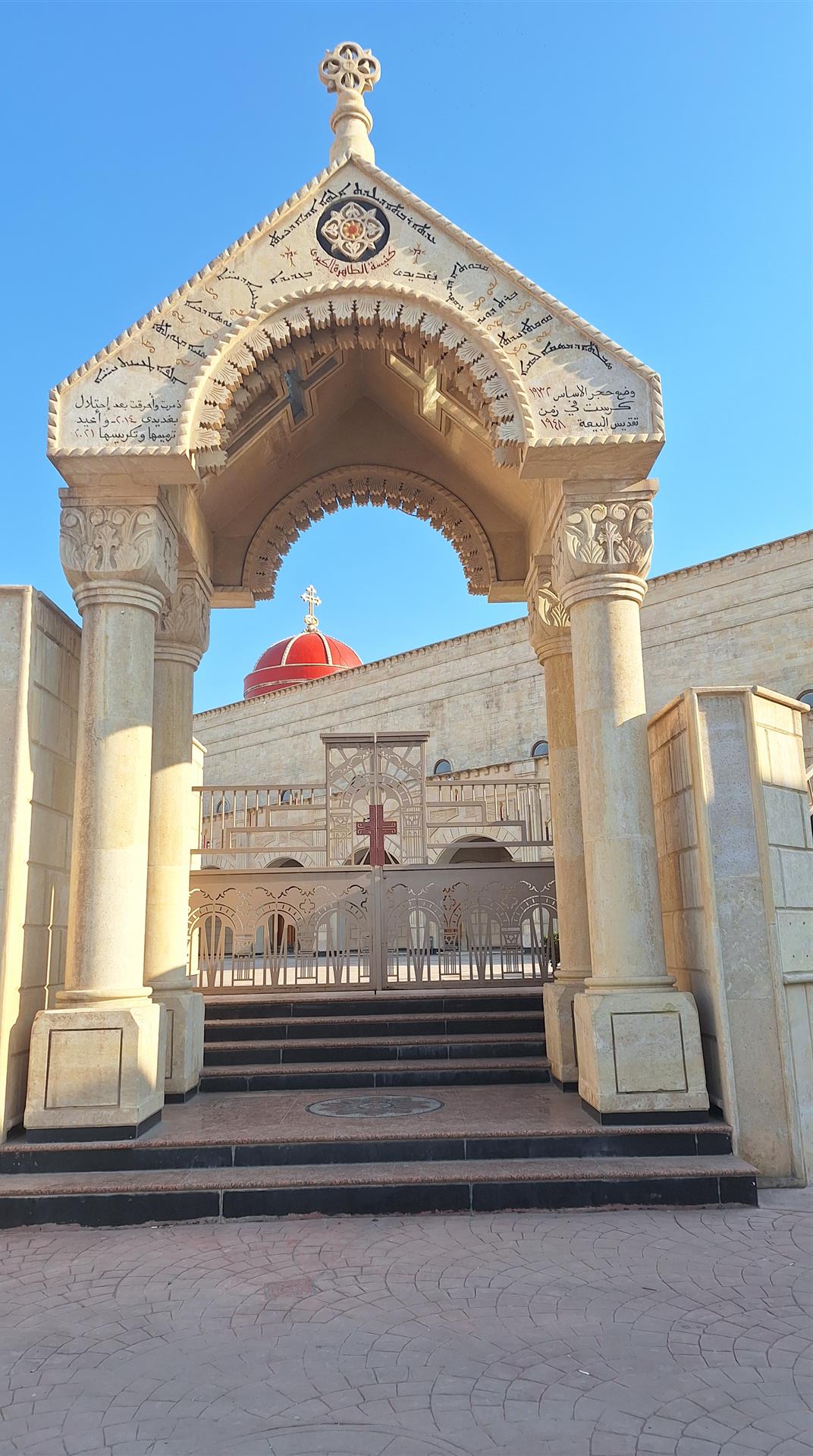
Entranceway into the Immaculate Church.
The first was The Immaculate Church. A nice place and busy too. I’d forgotten it was Sunday. I went into one area and it was full of women and girls. They smiled at me and told me to come in, which I did, but only for a quick look at the room. The main church was next door and was empty, so I took more photos.
Then I went up to the Catholic church at the other end of town. This was a very modern place, with some very different design aspects. The shape of the church reminded me of a samosa and there was a lot of pink in the external colouring. It also had a free standing bell tower that had broken in the middle and fallen over. ISIS?
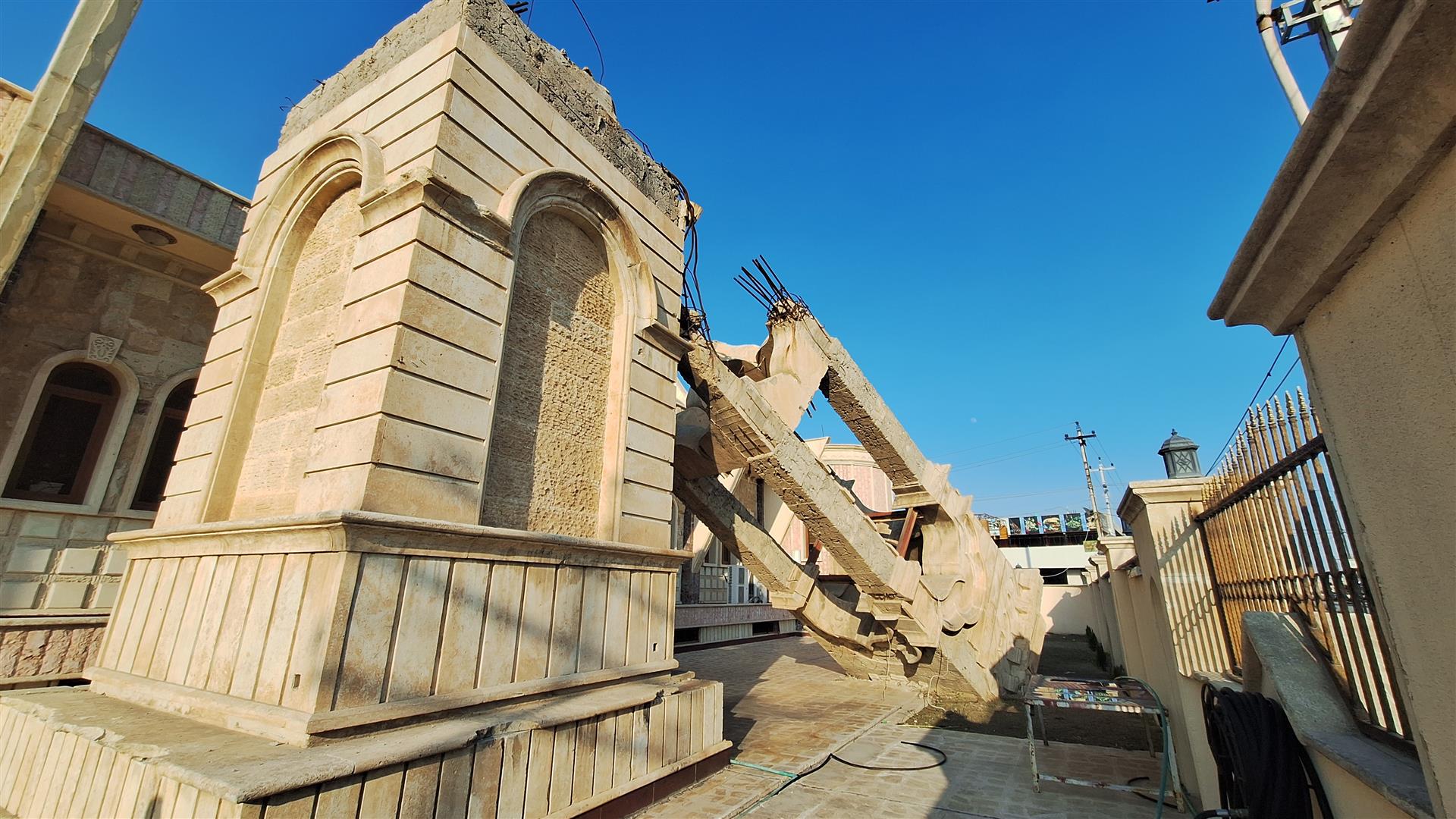
Broken bell tower.
Inside, the design of the main area was really good. It had arches across it, built into the walls. They led down to the alter area and looked different and therefore interesting.

A very good design, I thought.
Moving on, back to the main road. I was looking for fuel but none of those on Google actually seemed to exist. I came to a big and busy checkpoint, where I had to take my passport to an office.
Soon after that I came to a small service station and was able to fill the tank at the pump. But the price was 930 Dinar instead of 450. Double! 50p per litre! Welcome to Kurdistan.
A little way further I came to the proper entry point where I had to take my passport to a window. The guy there gave me a piece of paper with a stamp on it.

The logo of Kurdish Iraq.
The difference between the two Iraqs was immediate. A service station almost every kilometre, looking very modern, with illuminated signs at the edge showing the prices. Everything looked more modern and well organised, although the road surface was pretty bad.
I found the hotel I’d selected easily and managed to talk the price down from 105k to 90k for two nights. The desk jockey was a biker, so had some sympathy. The room was small but was OK. It had twin beds but two people would have struggled in there.
I went out for some food and found a fish restaurant. It was a place where I had to select the one I wanted from a tank. Then I had to wait for about 30 mins, or more, while they cooked it.
When it arrived it was massive! It filled a 15” plate. There was a piece of thin bread with it about the same size. I got salad and all sorts of other bits to go with it. It was really nice although I couldn’t finish it all. Then came the shock of the price. £16! Good God, I thought, that’s a week’s food budget.
Erbil is an interesting city. It’s the capital of Kurdish Iraq. It suffered some bomb and shell attacks, but very little. So the city escaped the damage that Mosul, and others, suffered. I did see a couple of damaged buildings, but that was all.
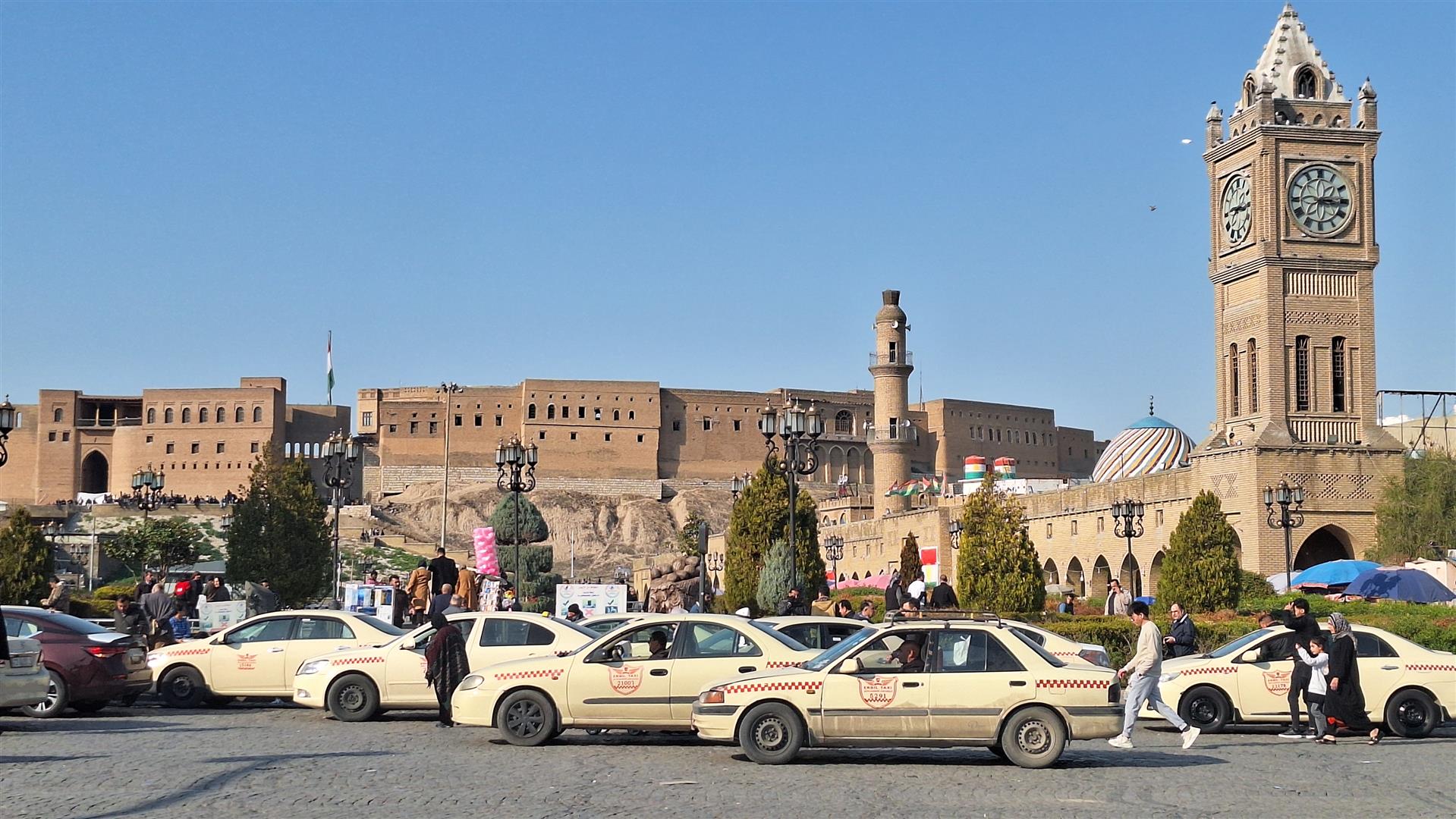
Erbil’s Citadel, plus other city centre buildings.
It had a lot of skyscrapers and other modern buildings, especially shopping malls. The roads were laid out in concentric circles, six in total. The smallest is around the citadel, which sat on top of a hill called a Tell – a man made hill.
I walked down to look at the Mudhafaria Minaret, which was on its own in a small park. It dated from the 12th century. It’s part of a mosque and madrassa complex. There was no access to the park, which was annoying.
Then I walked the longer part of the circle to get to the citadel, just to see what was on the streets. What I found, once I’d got past all the metal workshops, was a street with dozens of shops and stalls selling tools and equipment of all kinds. These ranged from a small shop filled with extremely worn 2nd hand power tools, to those selling brand new equipment. I kept an eye out for a fuel bottle, of course, but with no luck.

View of the square, from the citadel.
At the bottom of the citadel sits an oblong square, with lots of seats in and around it, and filled with people. The sun was nice and warm by now, which I enjoyed while eating my snack.
There were guys walking round selling tea from flasks but the most interesting were two guys walking around with massive samovars on their backs. I took some photos then bought a drink. It wasn’t tea but a soft drink of some kind, possibly root beer.
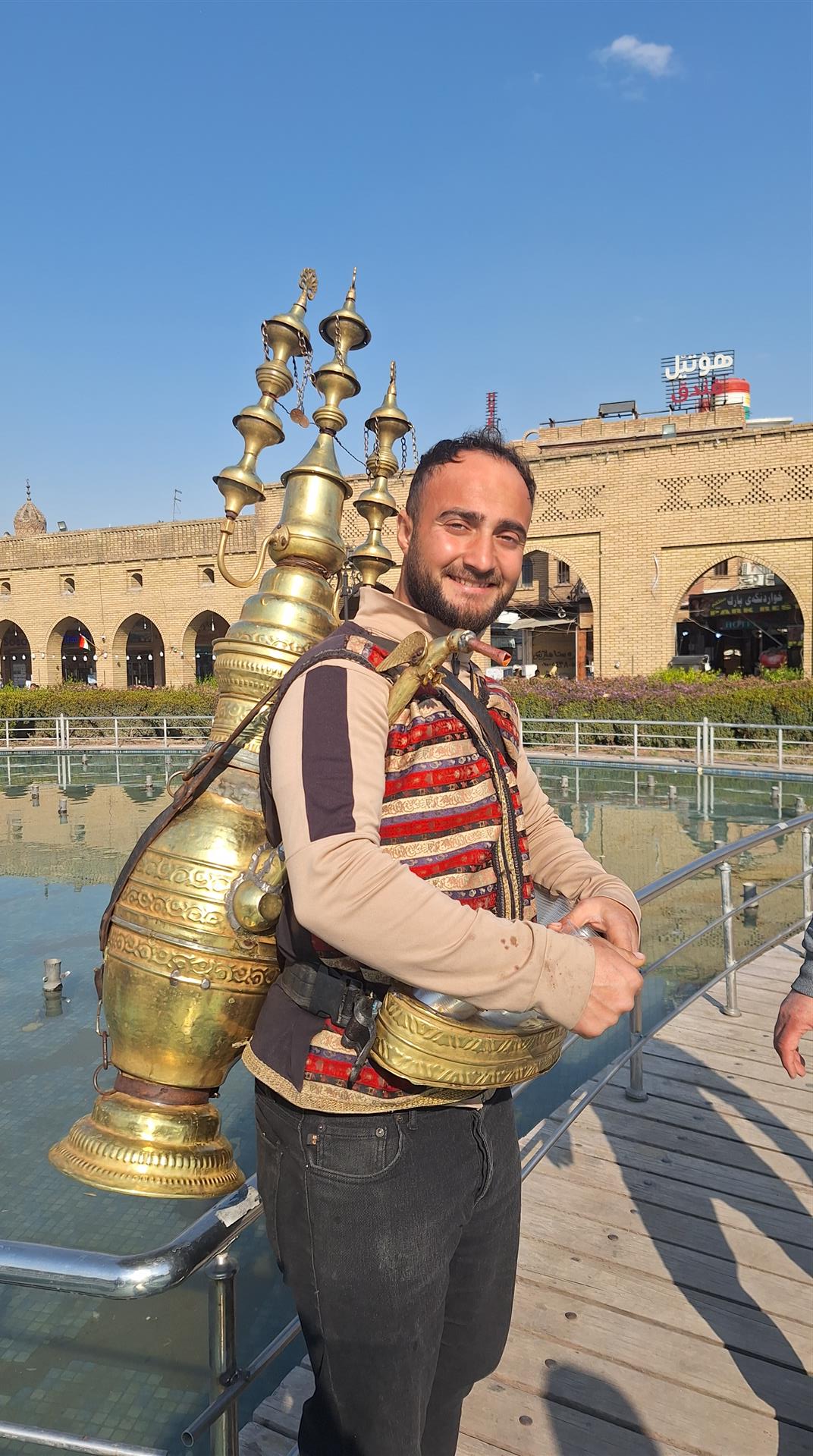
A man and his Samovar.
There was a path that led up to the citadel, with a view point at the top. The citadel was closed for renovation but there was a very good view of the square.
I went back down then went into the bazaar. Nothing much in there really, apart from a much needed toilet! Then I wandered through the market stalls just to see what there was. Clothing, mostly.
I walked back to the famous Machko Café, which is below the citadel, and had a cup of tea. People inside were smoking hookahs while they enjoyed theirs. I sat outside where there were rows of chairs, with small tables in front, and lots of people enjoying the sunshine.
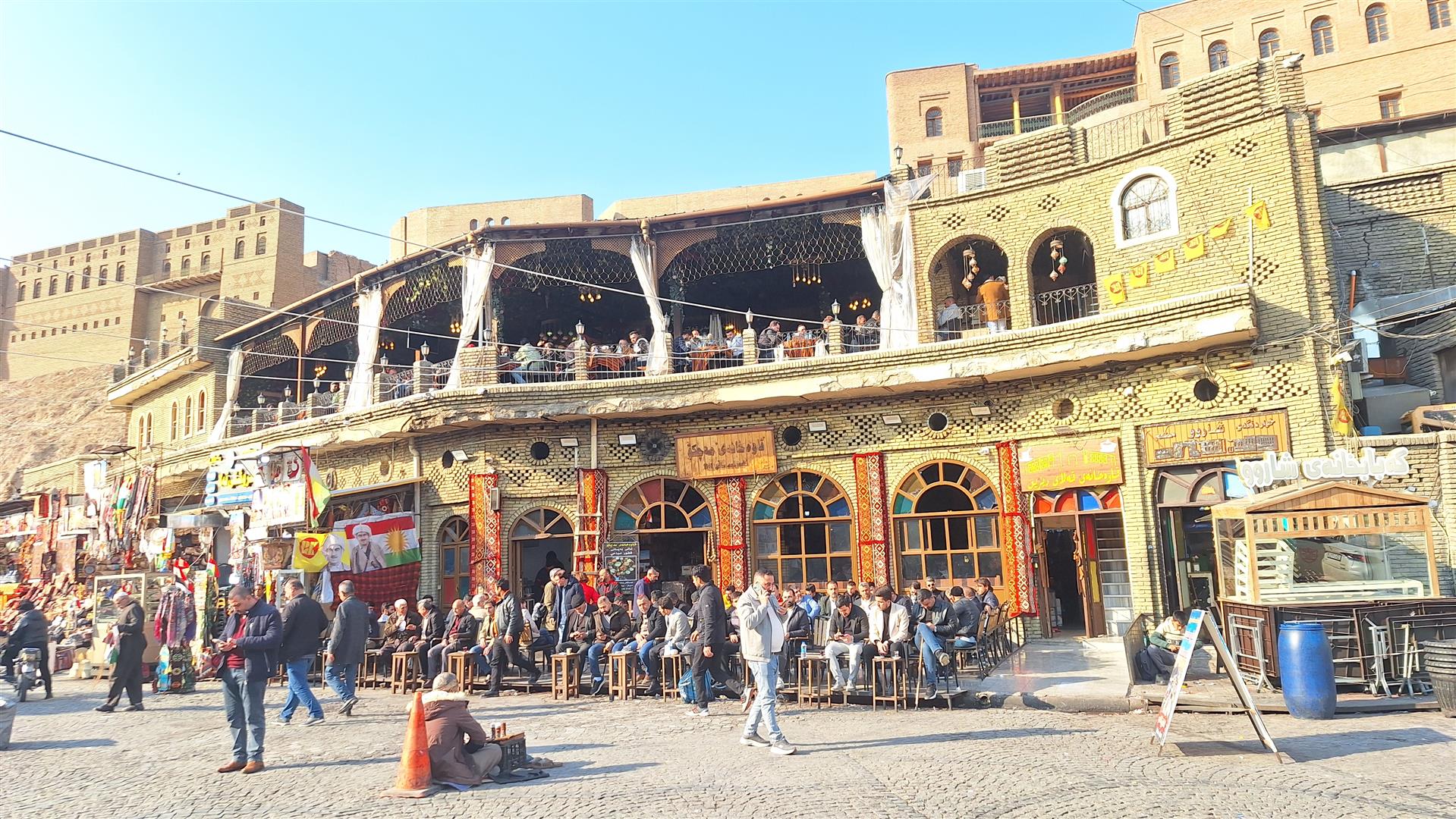
Machko Café.
On the way back to the hotel I stopped at a beer shop and bought two cans of Iraqi lager. Any good? Nope, just as bad as all other lagers.
I left Erbil and headed to Khanzad. It was nice little town. It had a mini fortress up on a low hill. I walked up there but there was no access to the inside. A guy was there with his kids and wanted his and their photo taken with me. Always happy to oblige.

A long walk up only to find it closed.
Next target was Akre Castle. This was odd. As I came into the town a sign said turn right. But I went left as per the map. I could find what I thought was the castle very easily but it looked to be in use. When I found the entrance it turned out to be refugee accommodation. I chatted to some kids outside but I wasn’t allowed inside – which is fair enough.
I went looking for the castle that the sign I’d seen referred to but I couldn’t find it, or the sign either. Some research shows that there’s a castle and a citadel, with the castle being much newer. The citadel is pretty ancient and is mostly ruins. So I think I found the castle, now the refugee camp.

Akre Castle, now a refugee camp.
I moved on, with the sky in front of me clouded over and looking pretty gloomy. I headed up into the hills, trying to get to Lalish, a valley with an ancient temple in it, belonging to the Yazidis. But I couldn’t get there. The road up the hill had mega roadworks and the access road to Lalish was closed. I had seen a sign at the bottom of the turning with a no through road symbol on it, but I couldn’t read the writing on the sign.
Fortunately the road I’d come up went on to Duhok, my destination for the night. And it was a lovely ride. A nice, twisty mountain road with almost no traffic on it. Just the job. As I came into Duhok I found a service station, jumped the long queue of cars and got the tank filled at the pump. The price was a bit lower than last time at 750 Dinar.
I selected a hotel off iOverlander but didn’t quite find it. Waze took me to another place. 20K Dinar and a private car park. No breakfast and I had to ask for a towel. The whole building was freezing cold and the AC heater slowly warmed up my room.

A very beautiful mosque, in Dohuk.
I went out and found a café. I was going to get a pouch to take away but decided to sit in and have chicken skewer with tomatoes. As soon as I sat down I got a bowl of slightly spicy tomato soup and lots of little dishes to go with the meal. One of these was sliced cabbage in a vanilla sauce. Really lovely! When the chicken arrived, so did another bowl of soup. Onion, this time. All for 4K.
The time had come to get myself to the border with Jordan. The only route was via Baghdad so after breakfast I headed south.
I’d been given a piece of paper when I entered Kurdish Iraq but had lost it, somehow. So I was a bit worried about not having it. I needn’t have concerned myself. Nobody asked for it. I passed through a checkpoint and only had to show my passport. Was that the end of Kurdistan? I didn’t know for sure. A bit further down the road I was stopped at a checkpoint and had to go into the office. They told me I was back in Federal Iraq.
Then it was a case of keeping on riding. I stopped to refuel and had to use a can. I ate lunch. I got stopped a few more times but nothing serious.
Finally I reached the hotel I’d been in before. Still 35K. I wasn’t sure whether or not to give him some dollars but I took a chance and used up my dinars. I had enough for another hotel provided it was no more than 25K, plus some fuel and some food.
I went out for a meal and got a chicken kebab and salad. The desk jockey printed off my Jordan Pass. Then I relaxed until bedtime, reflecting on my Iraq journey.
I had been impressed by Kurdistan. Very well organised. A lot of agriculture around. Much better towns. Women looking more Western and loads of people able to speak English. One of the reasons for this is that it didn’t get sucked into the wider Iraqi conflict when Saddam was deposed. Their area didn’t have different factions battling each other.
Iraqi Kurdistan is only a part of what Kurds want. Their desire is a complete Kurdish homeland, which would mean Turkey, Syria and Iran giving up some of their lands, those currently occupied by Kurdish people. How likely it is that will happen is anybody’s guess, especially given that Kurds are still fighting against Turkish forces. Only time will tell. I hope they achieve all their ambitions.
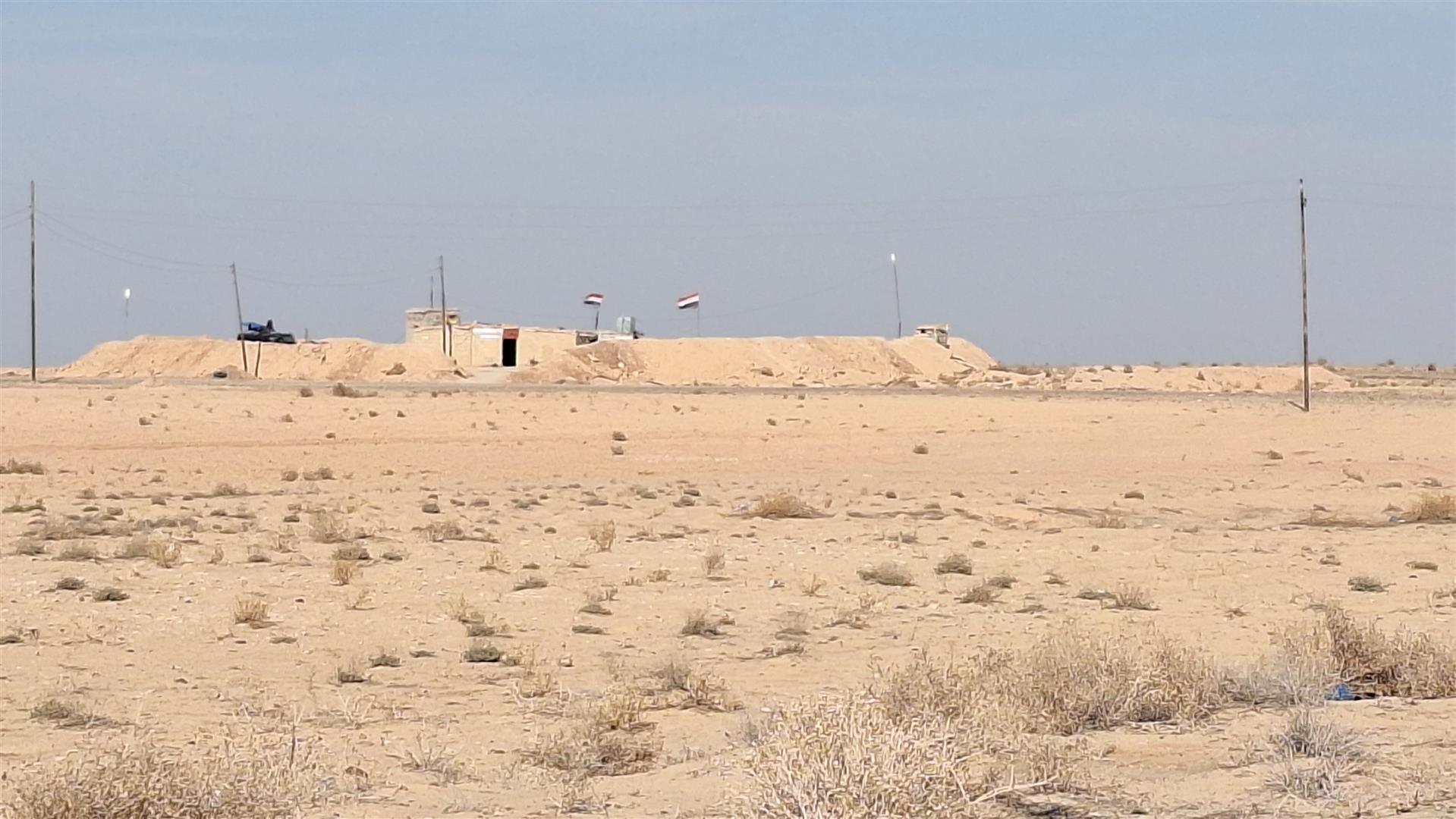
Small army bases, such as this one, could be seen eveywhere.
The next day was ‘The Big One’! I hoped to get to the border and into Jordan. Or at least, to be able to knock on the door. But I’d heard stories of the army insisting on accompanying travellers going that way. I wasn’t sure, so I just headed out of the city, found the motorway and opened the throttle.
I stopped to fill up and I stopped for lunch. Otherwise I just rode. It was a real delight to be able to cover hundreds of kilometres with no military checks! I did get two before the motorway but that was all.
But eventually I came to a big checkpoint. I had to go into the office but the guy seemed in no hurry to let me go. I asked him what the hold up was and he gave me the bad news that I had to wait for an escort to the border. This was the hassle I’d read about.
Somebody turned up and took me along a bit. Then somebody else took me a bit further. I had four escorts to cover 100 Kms. It was dark when the last guy gave me back my passport and waved me goodbye. Some of the vehicles had been armoured cars. Able to drive at about 40 Kph.
I wasn’t sure what to do about a hotel. But I had no choice other than to keep going and try to find one. After a while I got waved in again. I only just saw the guy and his torch. They took me to their barracks and fed me.

Another military admirer of my bike. It was very rare for a soldier to allow a photograph.
I thought I’d be staying there but they told me I’d be staying at the RHQ and someone would take me there. Which was what happened. Except that I wasn’t staying there after all. I was going to be taken to a ‘travellers’ rest’, where I’d be put up courtesy of the army. Fine by me.
While waiting I was chatting (via Google) to one of the officers. He rides a Harley and is in Bond MC, which he said was an international motorcycle club. I asked him which regiment he was – 5th regiment, 2nd division. I also asked him what the danger to me was that necessitated an escort, and he said that Da’esh were still active around there. Only occasionally, but enough for the army to take the threat seriously and to look after travellers, who are at risk of kidnapping. He said there had been quite a lot coming through, including on bikes.
They finally brought me to a big house. It looked like a former mansion, judging by the big foyer and wide staircase. I had a big room to myself. It had three beds in it and I chose the most comfortable one. The toilet was western. It had a shower but it was all a bit ropey. So the shower I ought to have taken had to wait.
AIt had been a very different day.
I woke up at 8 and the soldiers arrived at the same time. They left me to get ready and I was outside at 8.45, ready to roll. I refuelled on the way out, getting 5 litres.
Off we went, for about 7kms, then changed escort. Two more escorts, then I was told to go by myself but would be stopped at a bridge. Exactly this happened. Then It was a straight run to the border. They took all of my details at the checkpoint there, including of the bike, then I went into the border area.
I managed to find customs, after being directed there. Once at the right office the minion in there told me the manager was on break and would be back at 2.00. Current time was 12.20.
He pointed me vaguely towards a restaurant, which was also where the toilets were. I had some chicken and rice, with some soup, which I later realised was actually gravy for the rice. I was thoroughly overcharged for that. I sat in the sheesha room, drinking tea, until 1.50, then walked back over to customs.
The manager didn’t show up until 2.40. Then he moaned because the paperwork I gave him was only a copy. He wanted the originals. I think I gave them to the guy on the gate when I entered the border area so there was nothing I could do.
There was a huge amount of messing about, with my papers going all over the place, including back over to the immigration, where they’d already stamped my passport. The minion who was doing this made me walk over there with him, then sent me back to get my bike for someone to look at.
Then it was back to the main office. I sat down outside and waited, for absolutely ages. Eventually I went into the office to see what was happening. The manager picked up my papers, which were sitting on his desk being ignored. He looked at them and said there was a signature missing. So he sent his minion scurrying back to get it. He came back and …… nothing!
I went back into the office after a while and the papers were sitting on a desk, all ready to go, or so it seemed. I picked them up and asked if they were finished, the manager said yes. So I stomped out, making sure to check them first.
How much of this delay was down to me not having the original papers, I didn’t know. But I’ve never come across a load of couldn’t care less, ‘sod you mate’ tossers at any border, ever. I rode around trying to find the way out to Jordon. Nobody was around to ask. I eventually found a place on the Jordan side where there was a person to talk to. “Border closed”, he said. This was at 16.50. I couldn’t believe it! Another bunch of lazy people, was my opinion. Google had said it was a 24 hours border.

Bandar helped take care of me.
I plotted myself up in the sheesha room again and made my self comfortable. I asked the young guy in charge if I could sleep there and he said he’d have to ask the owner. Later on a young guy named Bandar was chatting to me. He’d been a student in Brighton and spoke good English.
He took me over to the mosque to see if I could stay there but there was nobody there. I think because of that the restaurant owner said it was Ok for me to sleep in there. It was open late, occupied by truckers, mostly. But it closed up eventually and the young guy in charge even found me a mattress and bed roll to sleep on. There was no charge so I felt I’d recouped the high cost of the meal.
It was very cold outside so leaving in the morning would not be any fun! But at least I should have enough time to get to Amman, in Jordan, Inshallah.
Some thoughts on Iraq. It’s not a very safe place, according to the UK government. So travel insurance won’t give you cover. I invariably ignore such advice because I want to find out for myself. How does that translate to on the ground?
Based on the number of checkpoints, the Iraqi government take the risks seriously, which helped make me feel safe, despite all the hassle thay bring. The soldiers were heavily armed and had several spare ammo clips and hand grenades in the pockets of their bullet proof vests. There were always armoured cars at the checkpoints too. They clearly take the risks seriously.
The country is slowly pulling itself out of the effects of its internal fighting. Not everything works, such as some ATMs. But there’s always a way of getting money, finding somewhere to stay, getting food and fuel. Apart from the occasional unhelpful desk jockey at a hotel, everyone was friendly and welcoming.
They’re keen to welcome tourists and I’m pretty sure that more historical sites will open up as time goes by.
My travel advice? Go there!
 MOTOPANGAEA