
Beirut, Lebanon. 9th March 2025.
Beirut is one of the oldest continuously occupied cities in the Levant, dating back to antiquity. Unfortunately it has earned a reputation as a centre of rebellion and inter cultural warfare. Post WWI it was occupied by the French until the end of WWII. The city expanded rapidly during that time. After WWII the tensions between the Christian and Muslim populations flared up, often becoming outright war between the Eastern and Western halves of the city. Civil war took hold between 1975 and 1990. None of this was helped by the war between Israel and the Palestine Liberation Organisation (PLO), which devastated West Beirut.
The rebuilding efforts that followed the war brought back some of the international community which had formerly given Beirut its rich cultural life. But the interference of Hezbollah interrupted this work when they occupied half of the city, until a deal brokered by Qatar persuaded them to leave. Things have gradually improved since then, despite the massive explosion down at the port in August 2020.
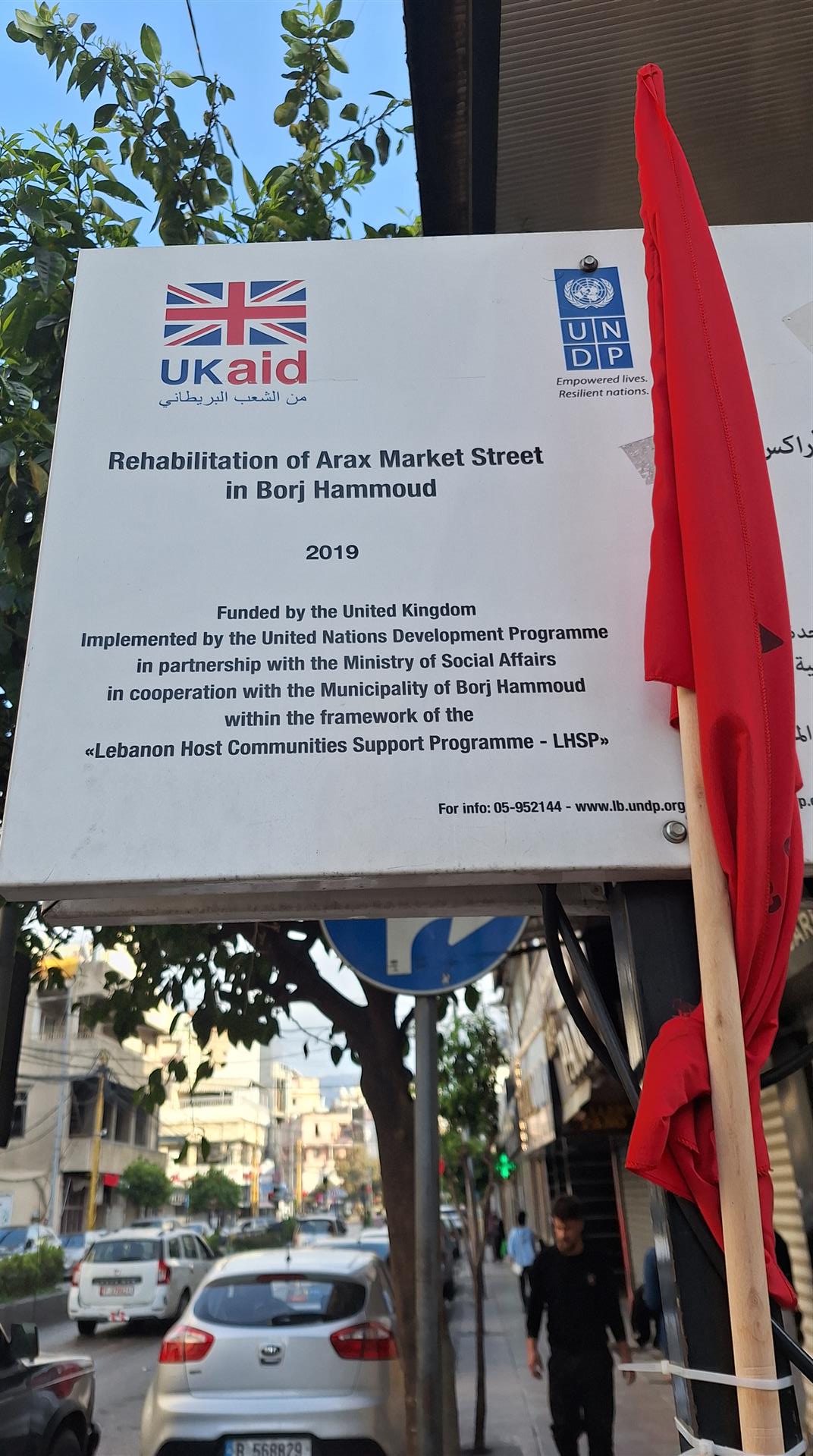
UK Aid helping with the rebuilding activity.
Once I was out of the border area I could see there were lots of shops, and I looked for telecoms and coffee. I spotted a currency shop and changed up 413,900 of Syrian money into Lebanese pounds, at a rate of 7.9 Syrian to 1 Lebanese – about £3. I quickly realised that the USD was king there.
The most interesting thing I saw while close to the border were lots of petrol stations and cars with Syrian number plates. Their boots were stuffed full of 10 litre water bottles which were being filled up with fuel, mostly petrol. As I’d worked out when in Syria, it was a real industry and based on Lebanese fuel being cheaper. I wondered how long that might last once the new regime has got fully into gear
Eventually I spotted a phone shop and stopped. The guy there said that to get a SIM, with 10GB, would cost me $40. I declined!
I rode on to Beirut. The road went up a huge hill, with mist at the top. Then it came down, down, down, going around a series of very sharp bends. Traffic was busy but I made it to the hostel OK. TLebanese time was an hour earlier. The hostel was alright. A bit run down and not very warm.
I met an English guy there, name of Jonathan. He lived there and worked remotely as a building costs estimator. He, and one of the other guys helped me get my bike into the lobby of the building. The hostel is up on the 2nd floor, with separate business on the 1st. Then they showed me where the local shop was and I got some supplies
The guy who manages the hostel is called Lord, and the three of us went out for a beer down the main entertainment street, to a bar called The Plub. The place next door to that had a big TV and we watched Man Utd play Arsenal. They sold IPA so I had a litre, saving my self $5 compared to 2×0.5L. It was very enjoyable. A good first day in Lebanon.
Everything there was priced in dollars, apart from in small shops. Most people spoke English, which was very handy. I couldn’t get a SIM because shops weren’t open on a Sunday. How very Western.
The first thing I had to do in the morning was to move my bike out of the lobby. The guy from the business on the first floor was a bit negative about it being there. I had a chat with the guys about a SIM card and it looked like it was going to be expensive because I had to buy the card, then airtime then data. Anything up to $30! One of them told me of a place nearby.
I went out to get one and to visit some tourist sites. The museums weren’t open on a Monday though.
At the nearby place I’d been told about, the guy wasn’t there so I walked on down to another place I’d found on Google. The guy there didn’t have a physical SIM and wanted to sell me an e-SIM. When I declined he said he could send out for one and was explaining how the pricing worked. In the end he suggested I go down to the Touch shop as they’re the main supplier for Lebanon.
After another 30 minute walk I found the place and did the business. It cost me $17.40 (£13) for one month and 6GB. That should do nicely. The women behind the counter were dressed very smartly but in a Western style. It was the same when I was out last night, with very few hijabs in view. But big cities are always relaxed. It was likely to be different elsewhere.
I was now not far from some of the things I’d marked to go and see. There was Mohammad Al Amin mosque, very nice looking. I went in there and took photos of the beautiful interior.
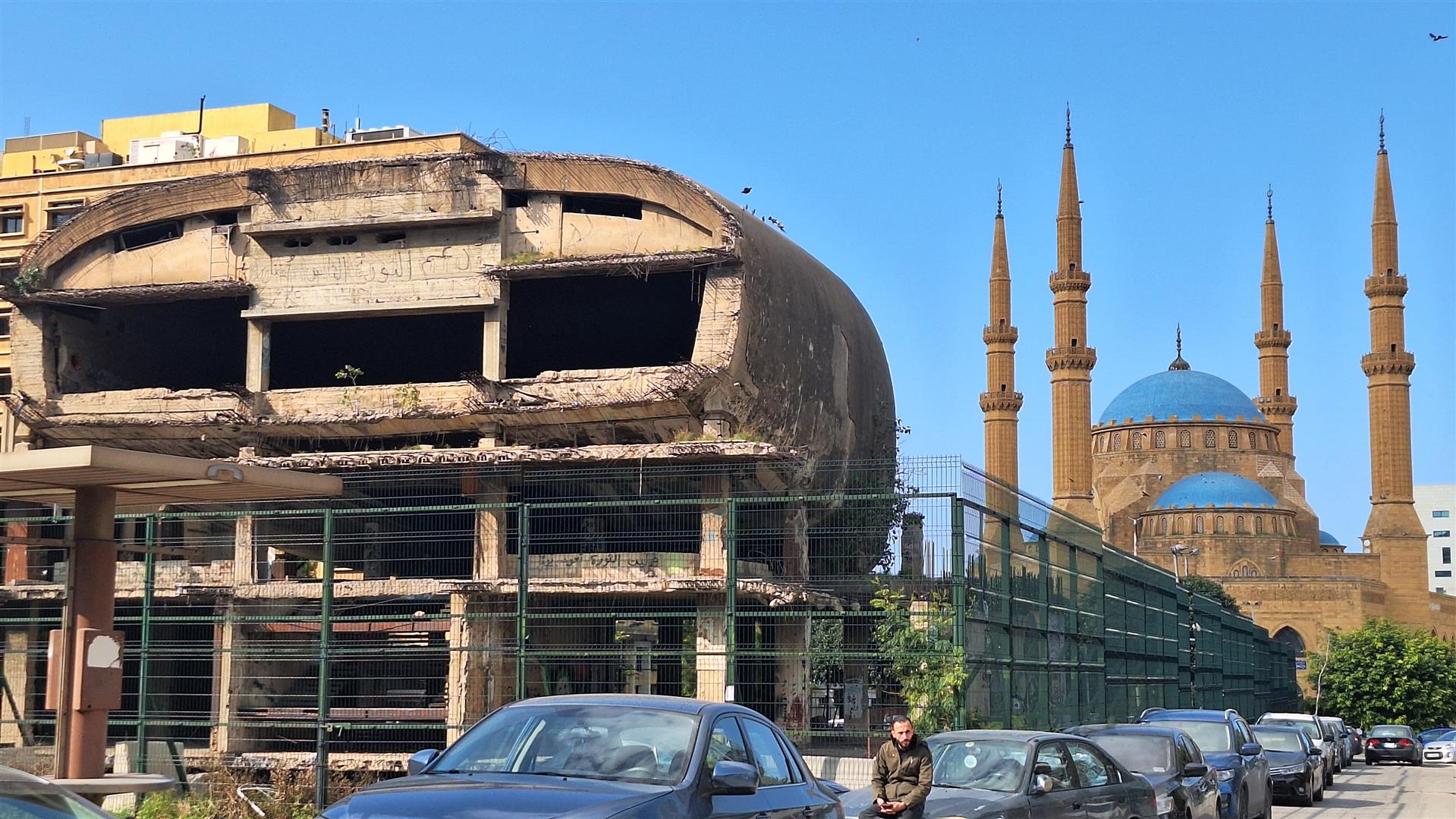
Mohammad Al Amin mosque, looking better than its neighbouring building.

I always like these interiors.
St George Greek Cathedral was across the way but I couldn’t get in so just took a picture of the outside. This is a common theme, with Islamic buildings open to all and the Christian ones locked up. Not at all welcoming. But I suppose, in this region, it might be because of security.
I took a couple of photos of a smaller mosque but without going in. In Martyrs Square there’s a statue to some nationalists whom the Ottomans executed in 1916. Ironically, the figures are full of bullet holes.
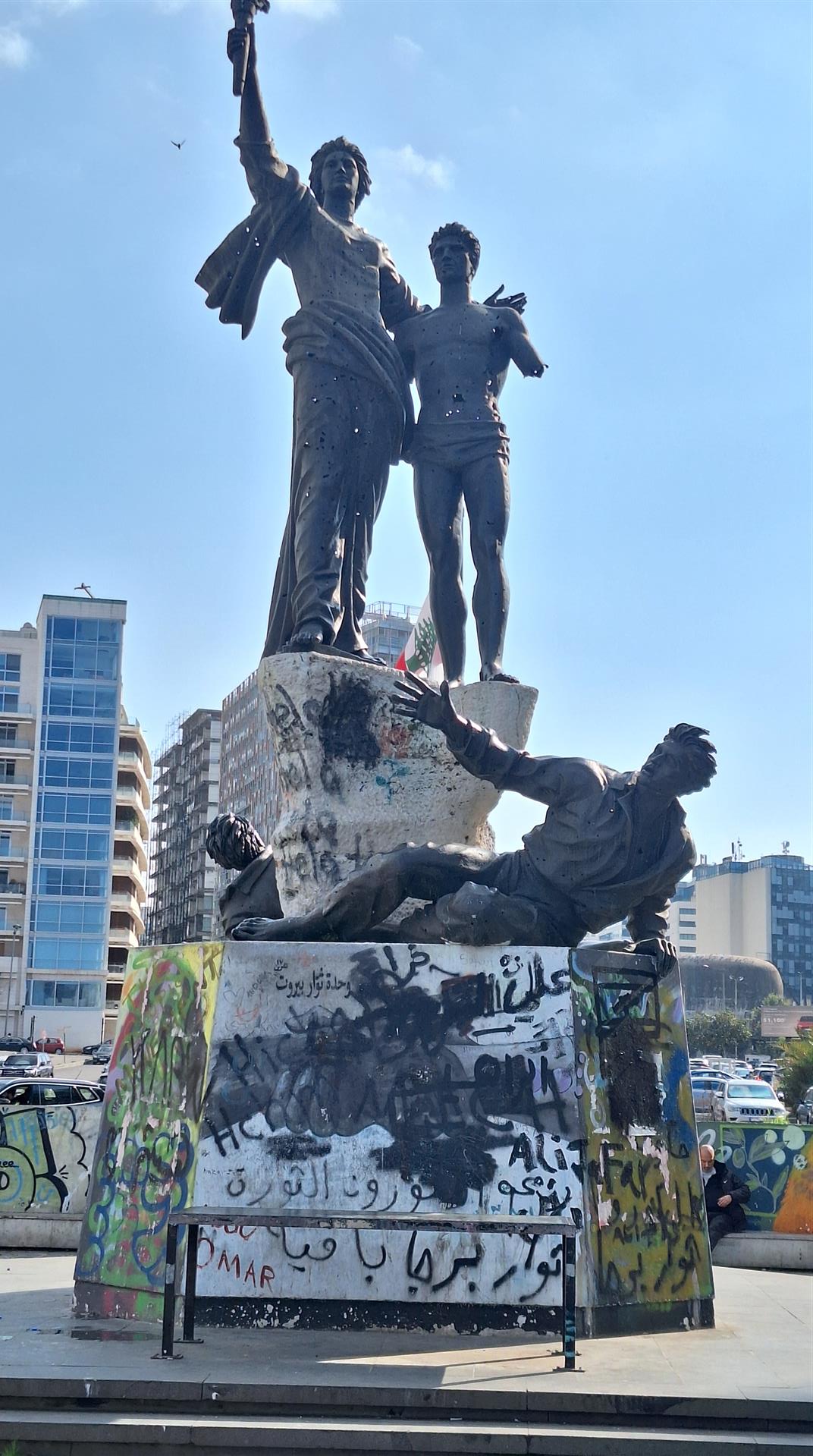
The light shines through the bullet holes.

The iconic clock tower in Nejmeh Square, near the parliament building.
Then I went looking for coffee. Google said there was a Dunkin Donuts inside a brand new mall. I couldn’t find it. The mall was full of expensive shops, with fashionable names and nobody in them. I finally found a Grab and Go, where I got coffee and a roll that cost about £6.
Back at the hostel one of the guys cooked up chicken and rice for everyone. A big salad too. Followed by a chill evening chatting.
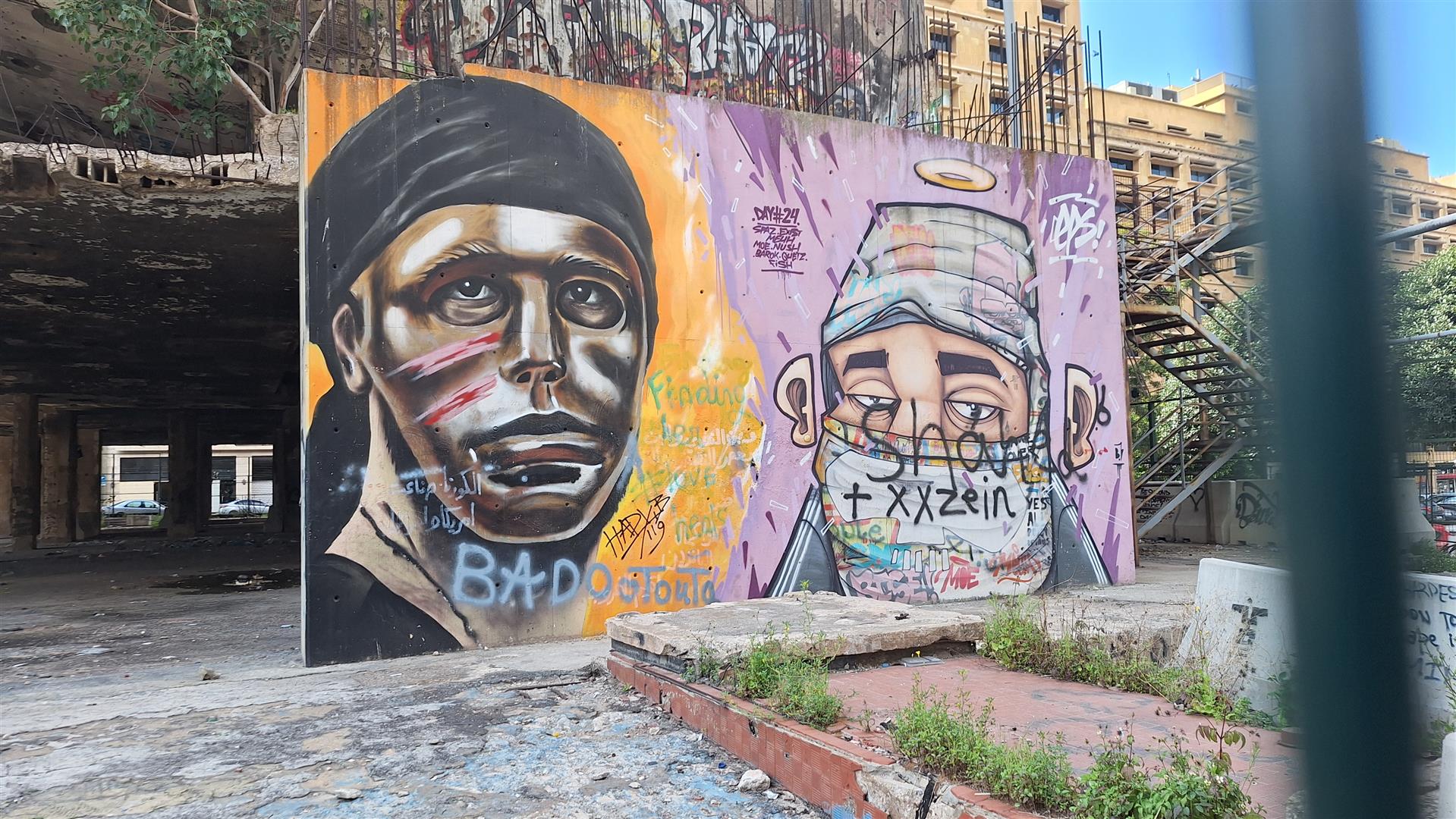
Seen in the city. Very striking but the message was unknown to me.
When I went down to move the bike the guy from yesterday helped me rather than telling me off. What a difference a day makes. After some breakfast I went out to the National museum. Foreigners had to pay 1,000,000 LBP (£8.30). I managed to swerve that by being over 64. Hence, 60,000 LBP (50p). Being older isn’t always bad.
An interesting place, full of items from Greek/Roman times. Lots of very nicely decorated sarcophagi. Some good mosaics and statues too.

Amazingly detailed sarcophogus.
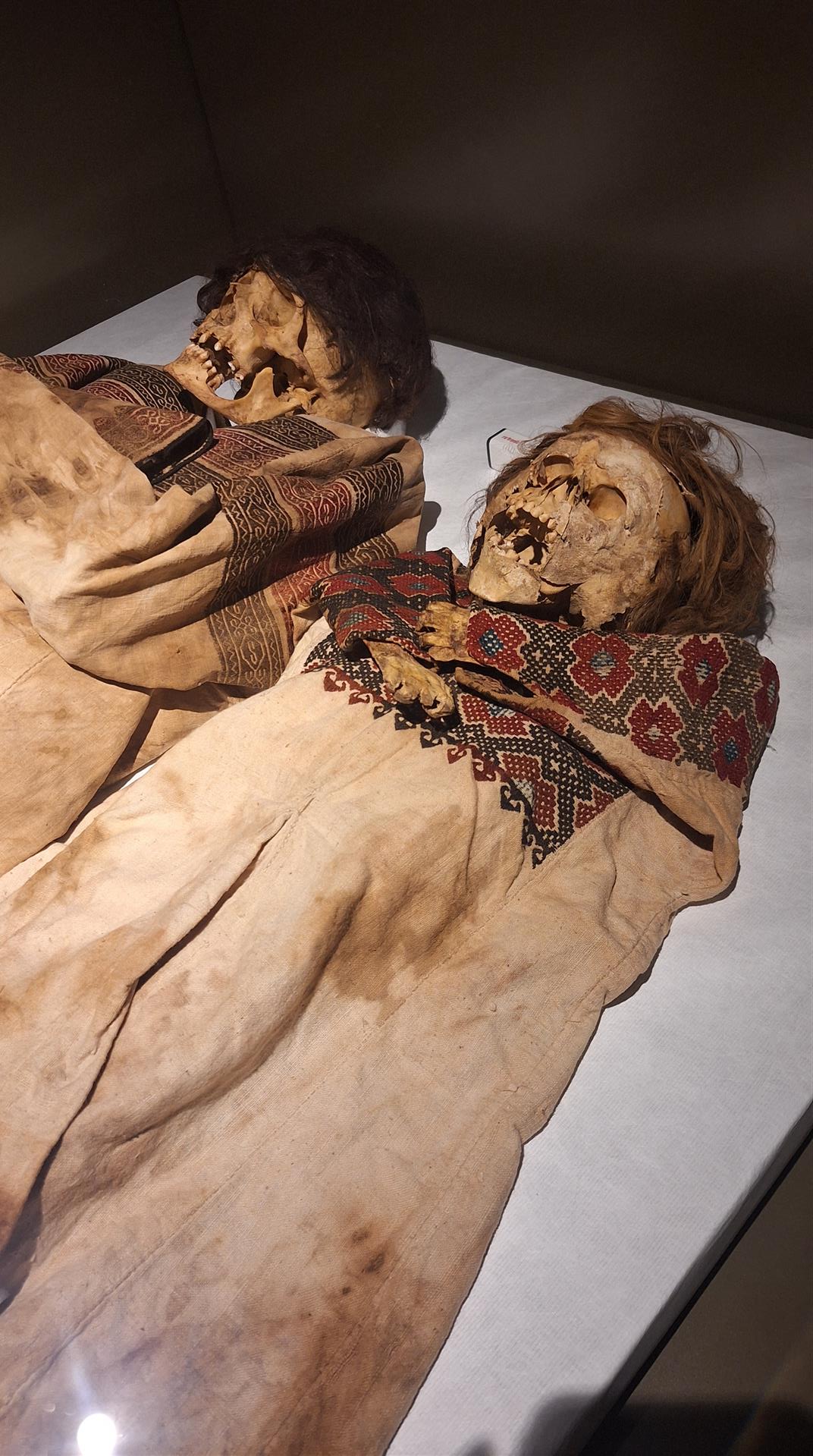
It’s extremely rare to find remains this well preserved.
The Nicolas Sursock Museum, displaying contemporary art was closed. So it was a long walk back to the hostel, fortunately going down the steps I’d climbed up. There were a lot of them. I was intrigued by the way they’d built seats onto the steps themselves. A great idea for the weary of limb.
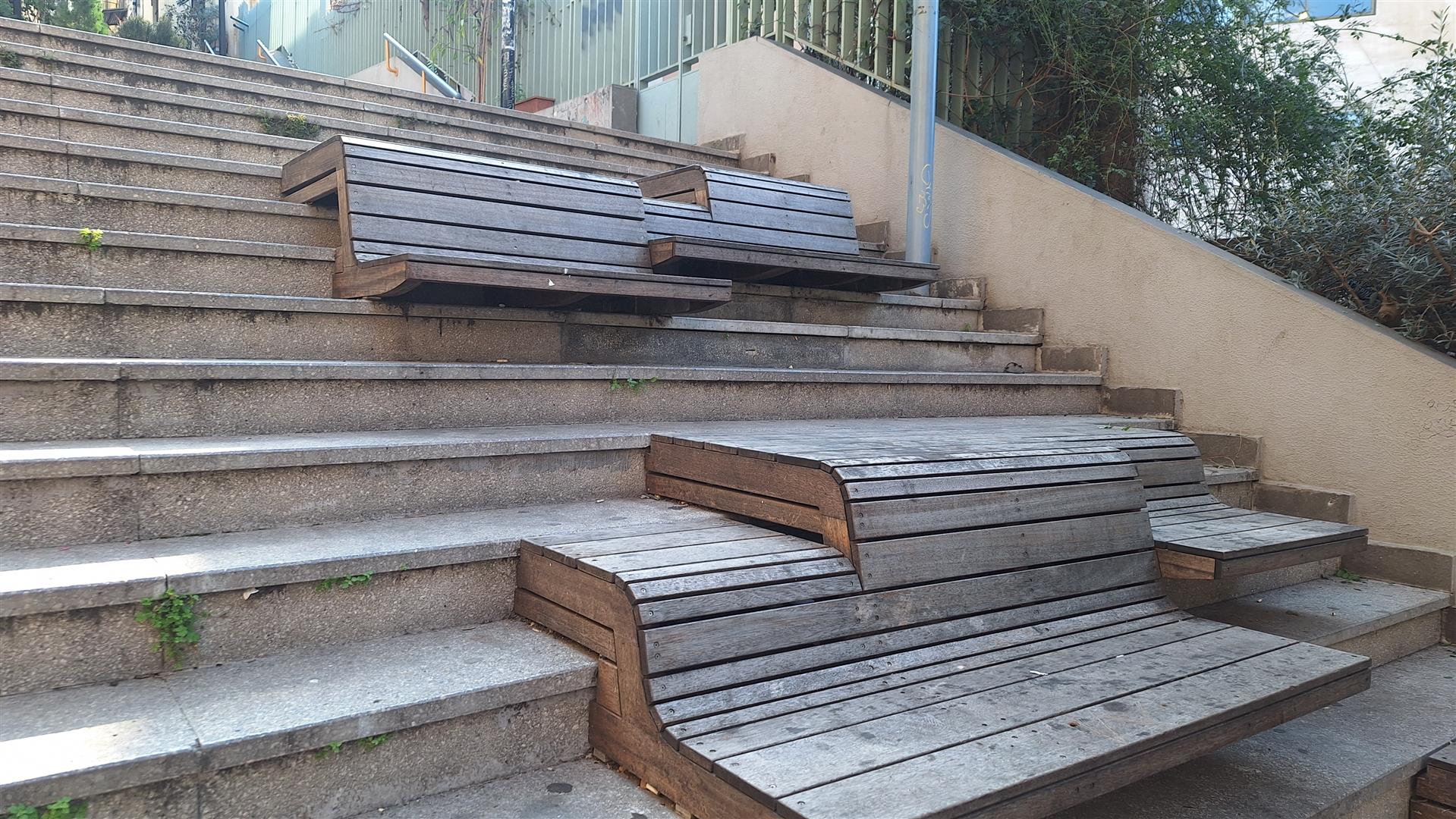
A brilliant idea.
Back at base I did a few jobs on the bike. Amir came past and helped me put the bike inside. We had a good chat, with him saying he wanted to know “what I was about”. I did my best to tell him, but remembering that I don’t necessarily know myself!
I was planning to leave Beirut the next day. It had been a very interesting place to visit, especially the city centre. A nice mix of old and new, which is always a good sign of progress.
In the morning I headed out of the city, destination Byblos. On the way out of town I stopped to photo the site of the massive dockside explosion from 2020. From the highway that ran higher up on the hillside, I could see where it had been but it’s not as obvious as it once was. The photos I took don’t really show much. It was the kind of thing where a drone would have been very useful.

The site of the 2020 explosion.
I wanted to visit Jeita Grotto, but it was closed. It has two interconnected karst limestone caves, with about 9kms of tunnels. They’re on the Valley of the Dog River – what a great name. So I carried on to see the Our Lady of Lebanon statue.
But on the way I spotted St Paul’s Greek Cathedral. A very large and beautiful building, built soon after WWII, by the Greek-Catholic Harissa Society. There were lots of domes on the roof, rising up in steps. A big tower and all sorts of other features were on the outside. Inside was absolutely gorgeous. There were some mosaics to see, but also lots of wonderful murals. They were very well drawn and with marvellous colours. It was a wonderful example of the variety of religious organisations that have existed in Lebanon for many centuries.

Such a striking building.

And the murals inside were equally good.
Then I went to see the statue. It looks amazing. It sits on top of a high, conical pedestal and the statue is tall and white. I was able to go up a walkway as far as the base of the statue and get a great view over the bay. There is also a very modern basilica there but it was closed to the public.
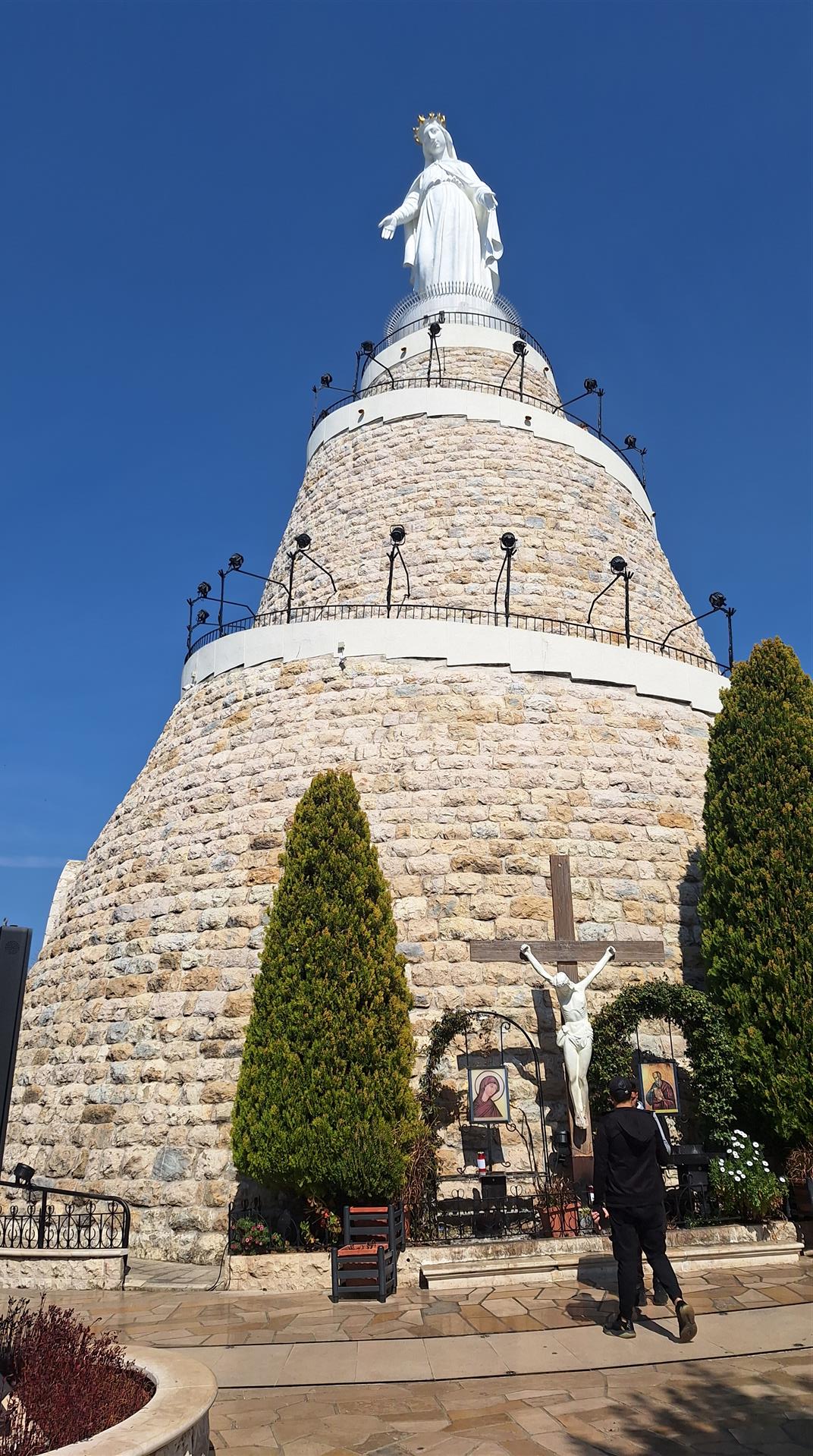
Our Lady of Lebanon.

It was a great view over the bay.
I carried on to Byblos and found an ATM. But I made a big mistake and only drew out 1 million LBP. I should have got 10 times that amount as it was only £9. I did try to get a larger amount at another ATM but it didn’t like it. I got the impression that 4 million will be the maximum withdrawal.
Everybody wanted payment in $$$, which is a real nuisance. After trying to find a cheaper place to stay, I ended up in a very expensive hotel. $85, with breakfast. Cash only. So I had to use one of my $100 bills. But that hurt. It was way above my normal budget. A sign of things to come in Lebanon? I hoped not. But at least they had a garage, so the bike was secure.

The peaceful marina, with its medieval entrance.
I went out for a walk around the old town. There were some lovely buildings to see. But some of them were inaccessible because the citadel was closed. A job for tomorrow morning then. I did get down to the marina and admired the boats. Usefully, it didn’t take long to walk around the area.
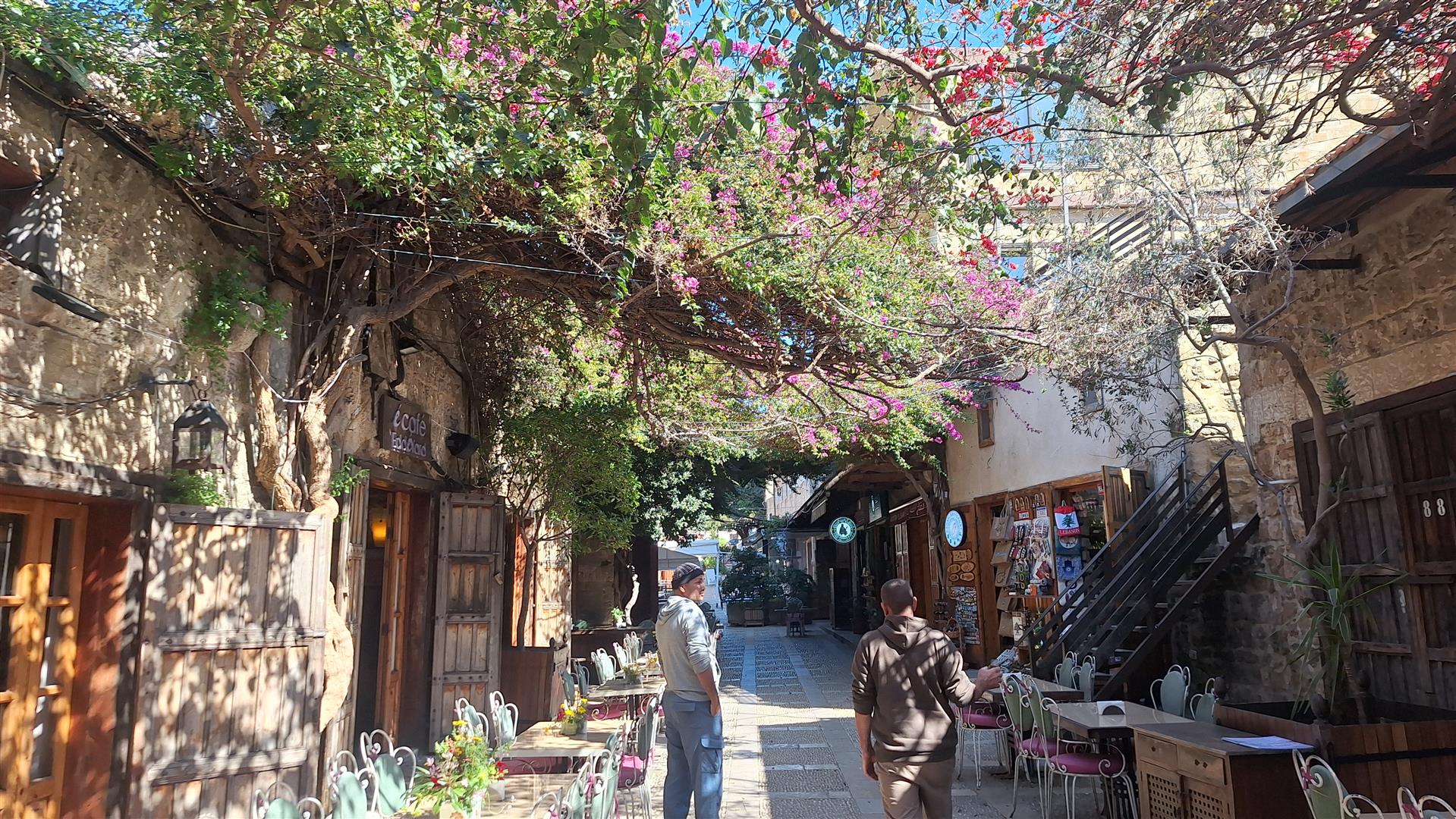
Pretty street in the heritage area.
In the morning I walked down to the citadel and, to my surprise, spent two hours there. The first ‘town’ on the site was built around 2,900 BCE. It became a Phoenician city, then Greek/Roman. It was also Byzantine and Muslim. But most of this coast was captured and occupied by the Crusaders in the 12th century. It was them that built the citadel.
The whole site was very big and had lots of very informative info boards all around it. It had been developed over several millennia, and there was lots of evidence discovered to support this. The archaeologists were mostly French and they’d done a very good job. But it’s reckoned there’s lots more yet to be discovered.
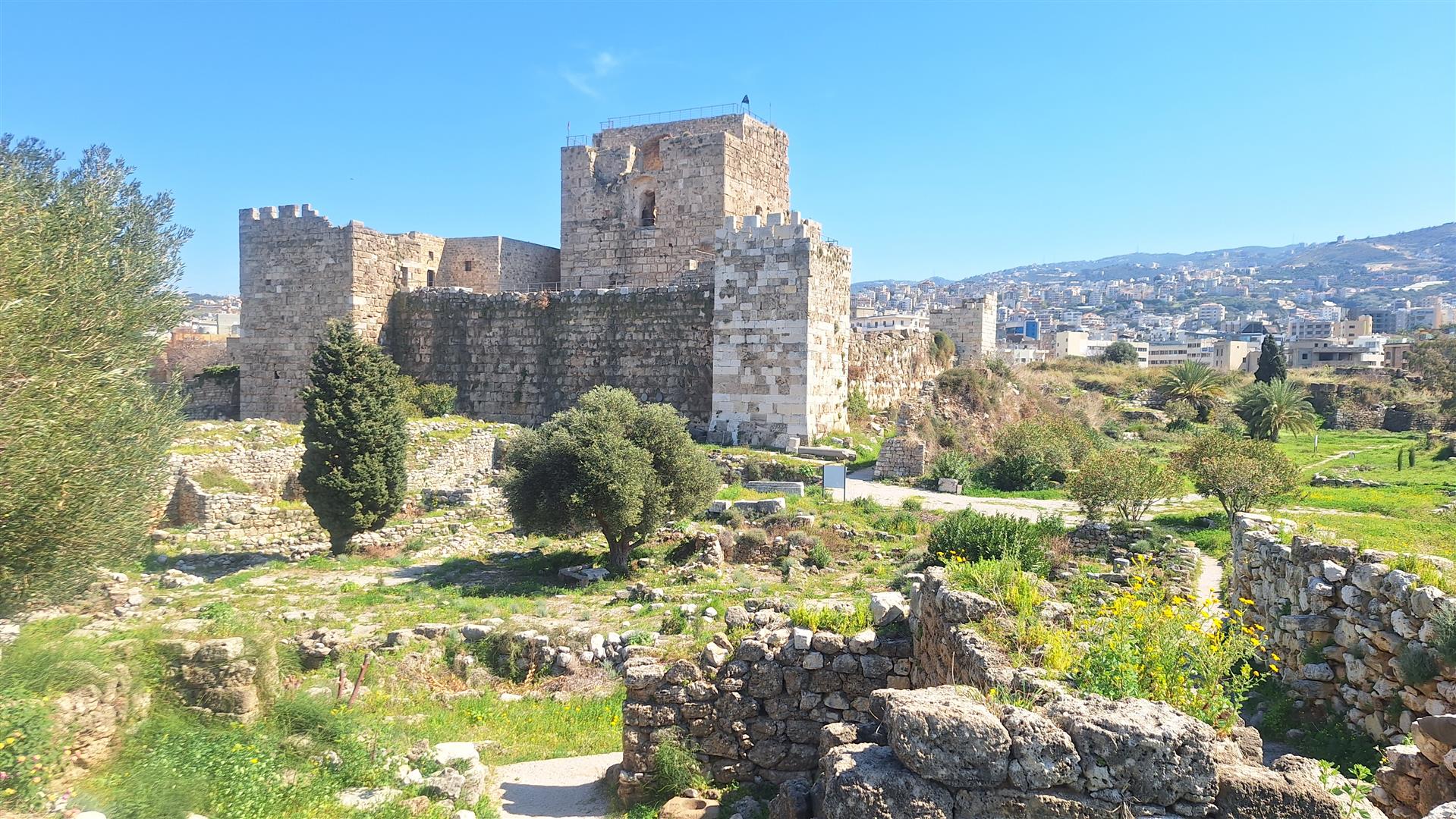
The well preserved citadel.

The buttresses of a much older wall, with Roman remains in the background.
I was able to wander round the keep and it had a couple of rooms dedicated to a display of info boards and artifacts. It had been very well done.
I went to the ATM and got 8m LBP. Then I tried to get dollars. I got some out and was surprised to find that Starling Bank gave me a very good exchange rate. The ATM charged 1%. So I got more out and will get yet more tomorrow. It makes sense to only use local money for small purchases, given how easy it is to get, and use, $$$.
I rode up into the hills, deliberately choosing a very wiggly route. It was great to ride, even though I found myself above the snow line. That was at 1750 metres. I ended up going higher than that in the end. My target was the Cedars of God Bsharri. There are various cedar plantations around and they’re protected. Despite the snow I didn’t really feel cold. The warm sun helped with that.
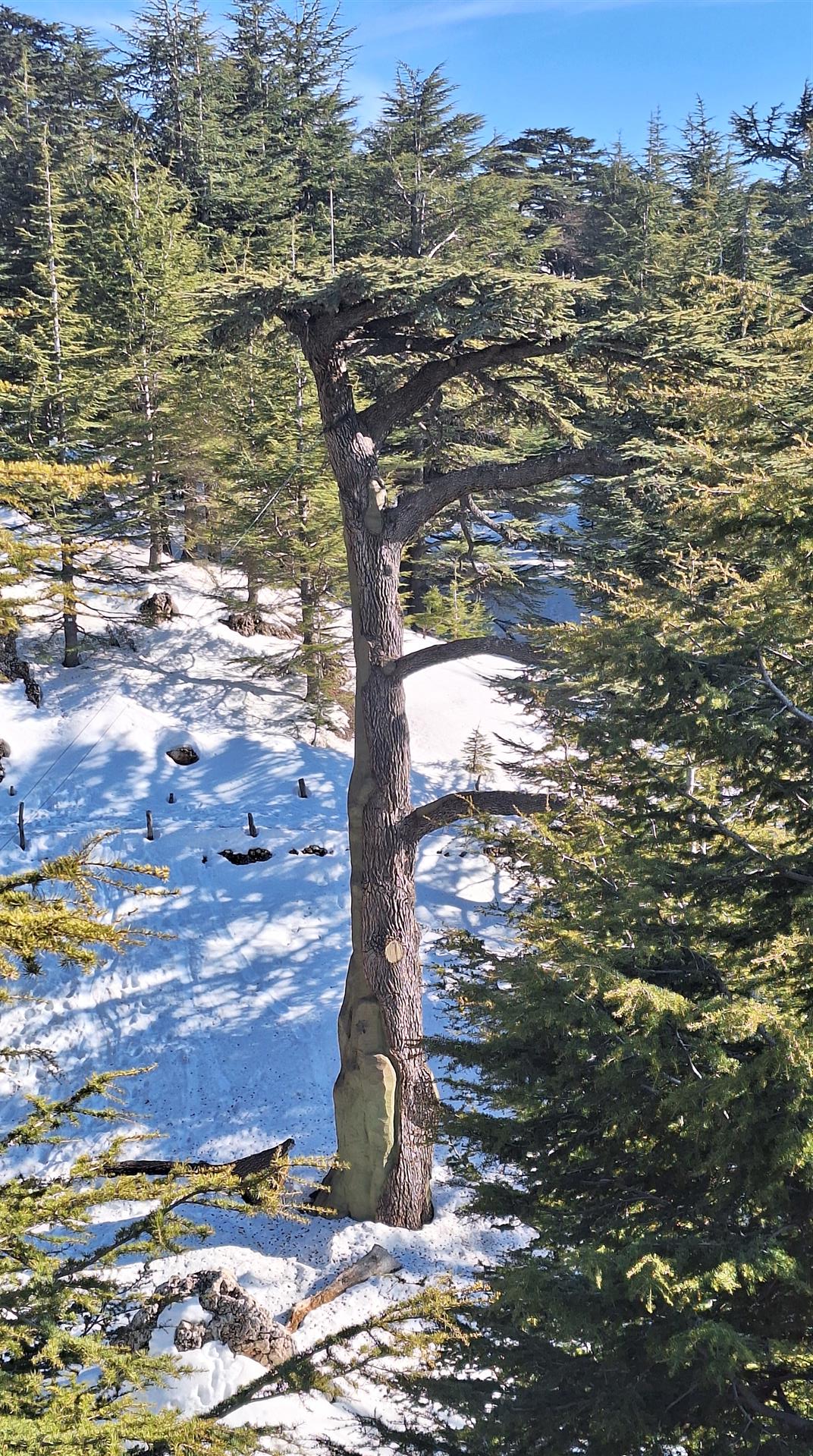
Cedar plantations.
It was lovely to see the cedars climbing up the hillside, surrounded by thick snow. They used to be Lebanon’s main export and the Lebanese flag has one on it.
It had been a long and steep ride up and it was a long and steep ride down to Tripoli. I stopped for some photos here and there, especially when I saw the vertical side of a ravine, looking like it had been scooped out by a massive rocky hand. It had certainly left its mark. Really weird.

I’d love to know what geological action scoured out this ravine.
I went to look at a hostel but it was in a crappy part of town, with no secure parking. A quick search got me a hotel. It was still over £50, but not as dear as yesterday’s. There was parking for the bike in a secure car park around the corner.
Once I’d got settled in I went for a walk down to the sea. There were some restaurants there but none that I fancied. I went looking for a pizza but didn’t find one. So I went into a bar, only thinking of a beer. But I saw that they did food too so I had a chicken and mushroom sandwich. The beer was a local brew called Red Beer and it was reasonably OK. The guy in the bar gave me some suggestions of places to visit. A firm plan would be made in the morning.
I went to an ATM and drew out $300. But it cost me an extra $15. I decided I could manage until I got back to Jordan. I didn’t want any more of that silly nonsense!

Tripoli citadel.

An odd place to park military vehicles, right next to the citadel.
Next morning the first port of call was the citadel. It was big! It had also been built by the crusaders, to protect the town from raiders, and Muslims looking to take it back. Which, eventually, they did. The builders were French and it was added to during the 150 years they occupied it. It was a good place to see.
The second target was the Maronite Monastery of St Anthony. As anticipated, it was a very nice ride up there. There was still quite a bit of snow on the roads. But I didn’t bother going in. I’d seen enough of those places by then.
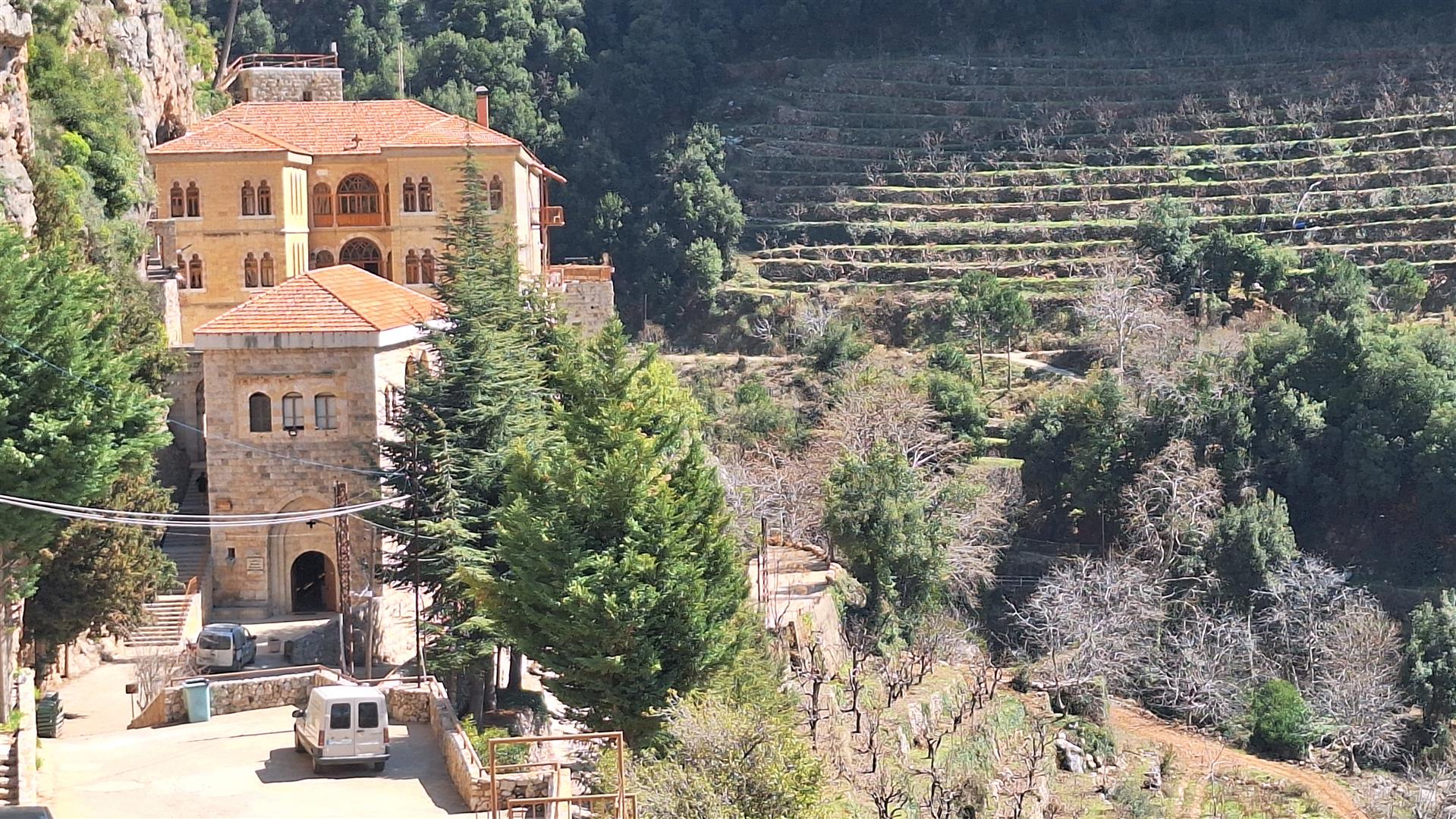
Maronite Monastery of St Anthony. Typical terraced farming along side it.
Then I headed to Baalbek, but the tiny road Google took me along was blocked. So I went a different way round and ended up back in the snow, at 2,000 metres. Then I found that the road to Baalbek that went over the mountain was blocked by snow. I’d booked a hotel there but was able to cancel that, fortunately. The only way there was via Byblos so I booked a hotel there.
It was up on the hill this time and was much cheaper than the other one. It was a struggle to find the entrance as it was hidden by trees. It was a nice place with a big room. I must say the hotels in Lebanon are of a good standard. All the rooms have kettles and some have a mini kitchen. But then, they ain’t cheap!
Next day I left around 10.30. Outside, I bumped into a couple of guys who were on a small bike. A Yamaha WR155. Salem was the name of one of them. He said it cost $3200 and that a 250cc would have been $6,000! We had a nice chat about travelling. He works for a company in Dubai but comes to Lebanon also. A nice meeting.
It was a very enjoyable ride up into the hills, to Mashnaka Roman temple.
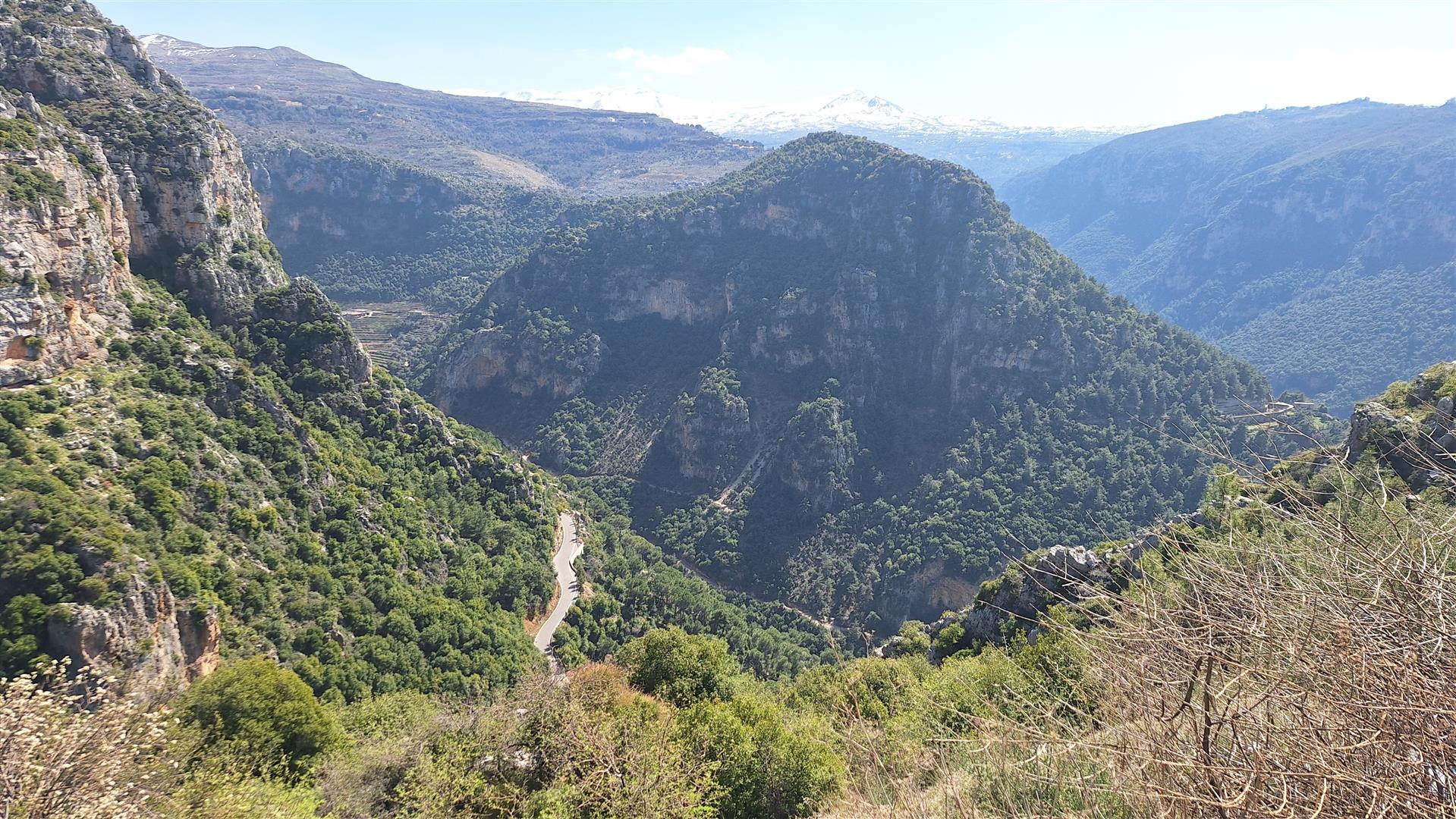
The Lebanese coastal area quickly rises up into the mountains.
It was free to enter but was only small. I took a few photos and then moved on. Up to nearly 2000M on the road to Baalbek. Some great views over the valleys. The way they cultivate these hillsides is amazing. I’d already noticed they’re planted with small trees. A guy told me yesterday that they’re for apples and pears. I had no reason to disbelieve him but it struck me that they’re almighty small compared to what I’m used to seeing.

The temple to Bacchus, mostly complete.
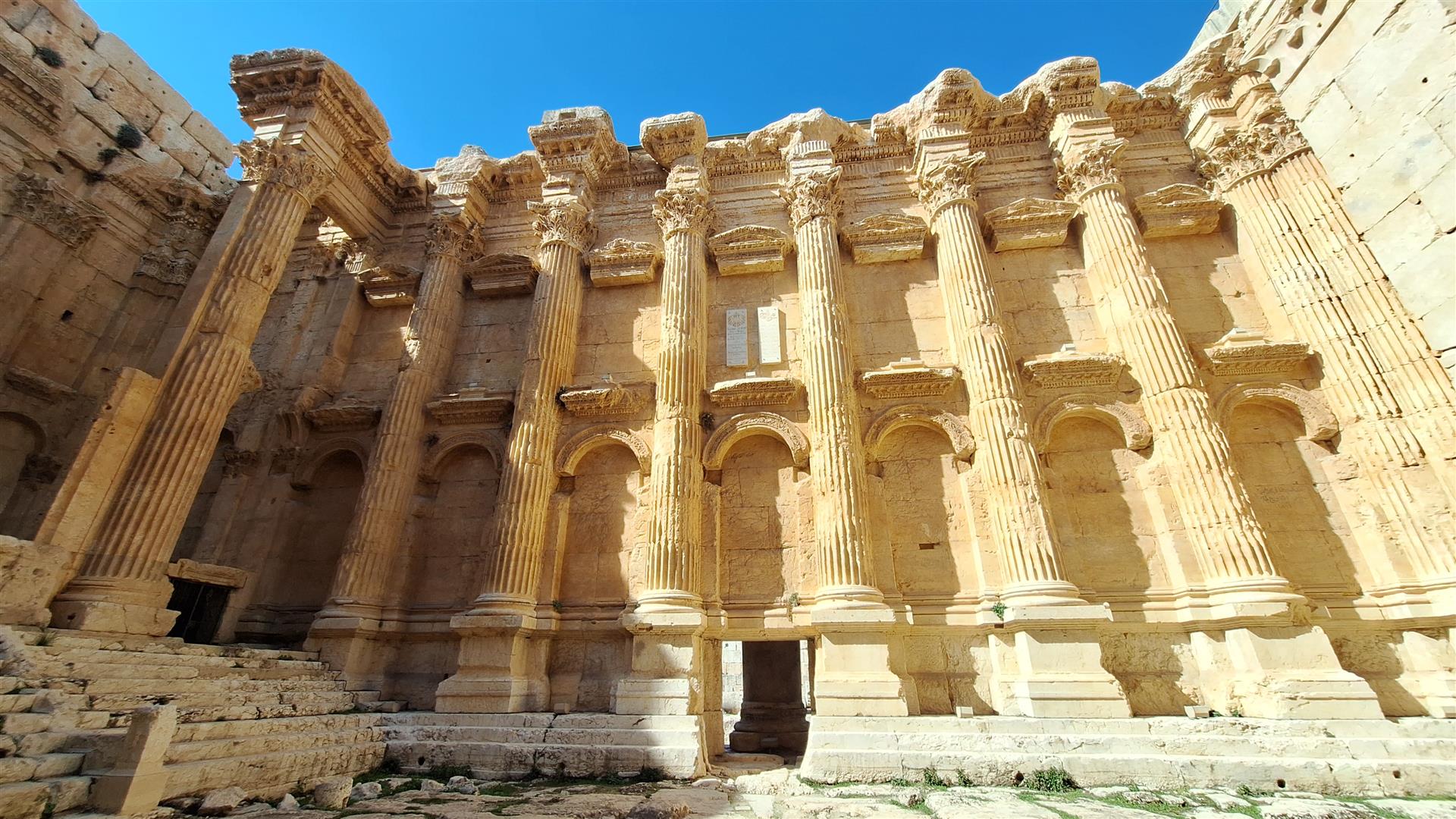
Inside the temple.
I arrived in Baalbek and found the Roman temple complex. A $12 entry fee. But it was actually worth it. The place was huge and had three temples, to Bacchus, Zeus and Jupiter. The key thing here was that there was a lot of stuff to see and the Bacchus temple was mostly intact. There’s some wonderful detail work to be seen, including some Latin writing on some of the stones. Lots of the pillars were still upright, giving a very good sense of scale.

Very well preserved bas relief carvings.
I’d seen many ruins but the notable thing about these was that there wasn’t a town there, just the temples. Which made their size even more impressive.
While I was there Thomas messaged me to say he was there too. So we found each other – well met, at last. He’d already got a hotel room, which had three beds in it, so we went there to see what the deal was with sharing. Thomas had paid $25, the guy wanted another $15 from me. I tried to talk it down but nothing doing. The place was a hovel but at least it was cheap-ish, and it was only for one night.
Once I’d changed we went out and came across a nice coffee shop. We were able to sit down and have a chat. Thomas comes from Kerry, has an understanding girlfriend, and helps his Dad run a restaurant/B&B. He’d come up from Africa and through Arabia, on his bicycle, and he showed me some places to visit.
He had been in contact with a local guy, a friend of a friend, who’d invited him to stay. Unfortunately he’d already booked the hotel so had to decline. But we went round there for something to eat, and that was fascinating.
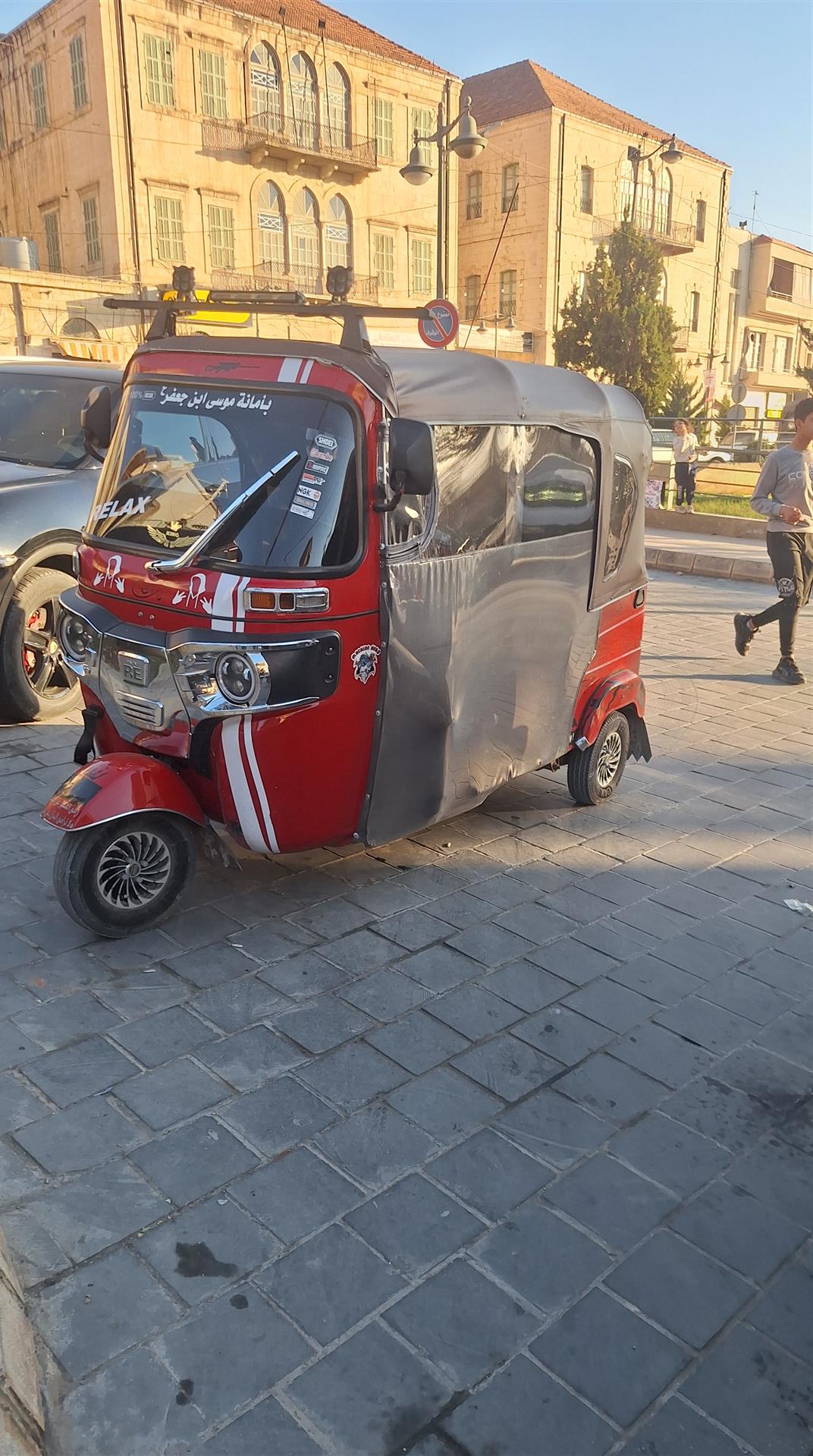
The pestilence of Tuk Tuks has reached Lebanon.
Hassan gave us a wheat and tomato based mix, plus some bread to eat it with. Then later, some cheesy stuff and more bread. But it was the conversation that was so good. He seems to know everything about all the troubles in the area.
He was explaining how many factions there were active in Syria – at least 18. How on earth will HTS manage to satisfy all of them remains to be seen. He was telling us about some of the things that happened in the refugee camps in Lebanon and how the Christian Lebanese Army were involved in murdering the people there, while Israeli troops stood guard. This was back in 1982.
Israel bombed this town recently and he and his family decamped to their village home. Israel were targeting a Hezbollah Command and Control centre, apparently. The local people went to the temple ruins for safety, hoping Israel wouldn’t bomb a UNESCO site.

Israel’s bomb site.
It was all very interesting, but also made me feel both sad and angry. We planned on going back there for breakfast next day so I was sure we’d learn more.
We went back to the hotel and I had a shower, but no shave as there wasn’t a sink. I used the family shower because although our room was en suite, there wasn’t a light or proper water in it. Did I mention this place was a dump? I got the guy there to make me some tea, so that was something.
A very interesting day followed. We went back to Hassan’s for breakfast. The food was fairly ordinary, but the conversation was, as before, very interesting. I was very impressed by how knowledgeable Hassan was. He showed us a couple of the books he’s read. One covers Israeli/Middle East history. Unfortunately I forgot to make a note of the title.
He was talking about Druze Christians being used by Israel to cause trouble. All sorts of other groups being used too. Often paid money, and sometimes funded by Russia. I forget a lot of it because there’s just so much.

The cause of all these problems? To be fair, I’m not sure who they were.
When we left there we walked up to where the Israeli air strikes had happened. It was easy to see the damage. I wasn’t impressed by this at all!
During one of our chats I was telling Thomas about my visits to Ballyferriter, Ireland, in 1976 & 1979. He was amazed, mostly because that’s where he lives! I told him about the clock that ran backwards in the one of the pubs. He’d never heard of it but he said he’d ask his Dad. But what an amazing coincidence. A good reason to go back sometime.
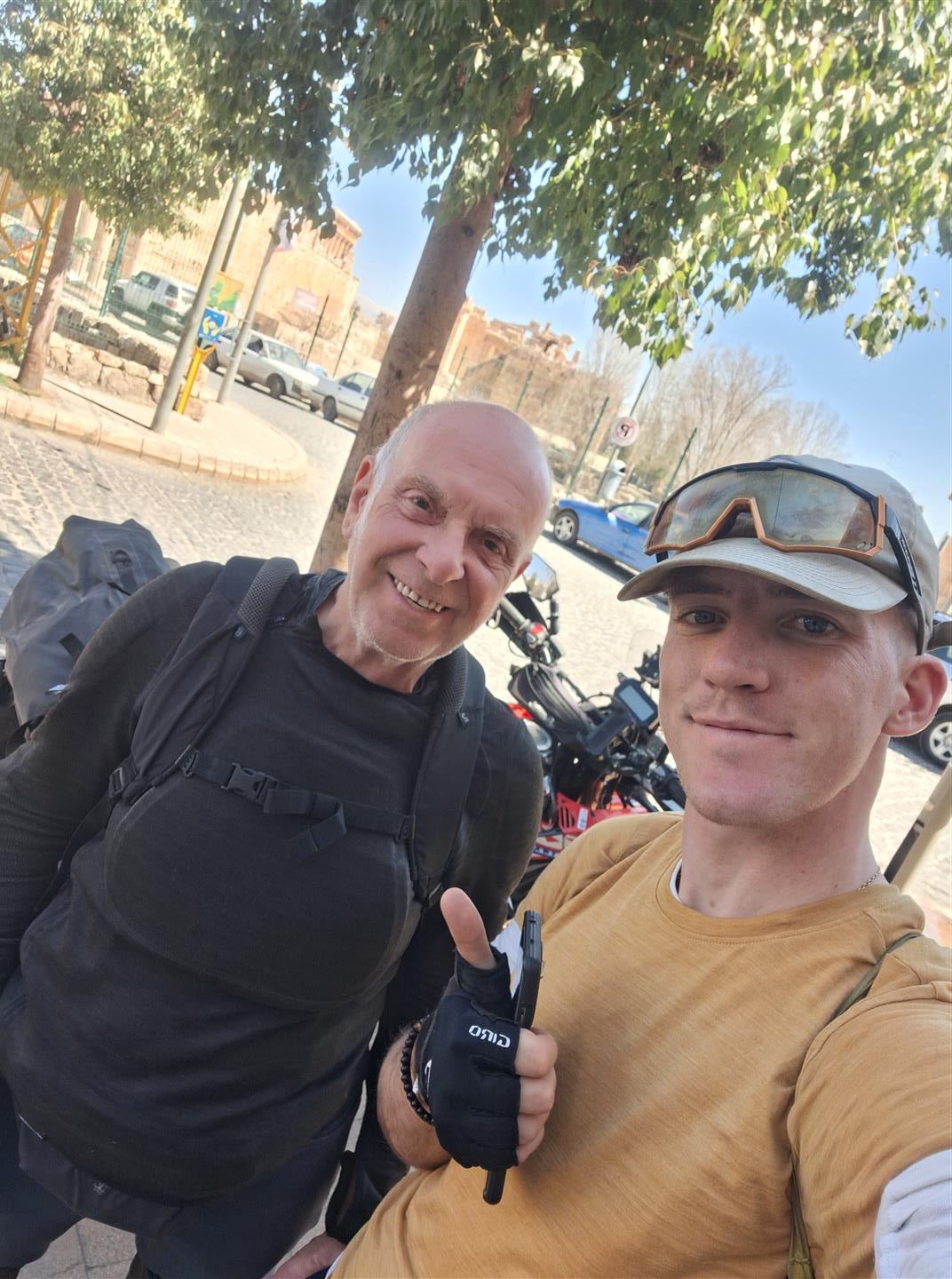
Thomas the Cyclist.
In the morning we both left, going our separate ways. I passed him later on the road. I headed down to Aanjar, to visit Umayyad City ruins. It’s a good place. A different style of brickwork, as the pictures show. Fairly large, and it’s quite easy to see the layout of the streets. It was built in the 8th century, despite looking Romanesque. That accounts for the different style. My one criticism was that there were no info boards.

Inside Baalbeck
I had planned to take a particular road but was warned off it because it went too close to the Syrian border. Another route was suggested, that went by a lake. So I got myself onto that road and wandered around the hills. Eventually I came to a turning that took me down a small track, then up to another road. That one had a barrier across it, so no way through. I messed about with different routes but all the other options went nowhere.
So I turned back the way I had come and when I was back up near the village there was a barrier across the road. It definitely hadn’t been there before! I managed to open it and go through.

That barrier was definitely open when I went down that road.
Up at the top of the road I stopped to re-plan the route. Then a young guy came up on a scooter, got off it, and asked me what I was doing. I switched the engine off and he snatched the keys out of the bike! Then he demanded to see my passport. I said to give me my keys back. He asked for my passport again. I asked him who he was. He asked for my passport. I asked him for ID and he asked me for my passport. I told him he wasn’t getting it until he explained who he was and what he wanted. He asked me if I was filming and I gave him my phone to look at to prove that I wasn’t.
He got on his phone and after a couple of minutes an older guy arrived in a car. I felt happy to give him my passport and he was asking me the usual questions, about where I was going and had been etc. Then another guy arrived in a car and tried to ask me questions but his English wasn’t very good.
So, after more questions and answers they gave me my passport, phone and keys back and the young guy led me to the road for Tyre. None of them had guns, uniform or were aggressive. At no time did I feel threatened. I asked the young guy if they were Hezbollah and he said yes. I’d obviously wandered into the part of Lebanon they control. I’m pleased to say that the rest of the ride to Tyre was uneventful. Perhaps I should have gone on the road near the border after all.
I scouted around for hotels and ended up in an apartment, up in the back streets, which was very well equipped. They were able to put my bike in a garage. The woman there had suggested I try one of the local fish restaurants. I said they tended to be expensive but she said they wouldn’t be. Ha!
I went out to one of them. $23! Two small fish, some chips, some halloumi and a salad. All of it was very nice. I had a beer to go with it. But I definitely wouldn’t be doing that again.
It seemed to be a very nice town, and there were a couple of places to see there. So I decided to treat myself to another night.
Towns in this part of the world very often have good bakeries. I went to one that Jorge, the apartment owner, had suggested and got something for breakfast. And it was very nice. I was talking to Thomas again, on the internet, and he was saying him and a friend were going to stay in a place up in the hills, if I wanted to meet them there. But I declined. I wanted to move on. Initially I had thought to go to Beirut that day but in the end I decided to stay in Tyre another night. I’d go to Beirut, via Sidon, next morning.
I walked down to the nearby Roman site. There was very little to be seen. Just some columns, and stones on the ground. I didn’t go in, just took photos.
Google took me to the other place, the Tyre Al Bass Roman site. It included Hadrian’s Gate, a Hippodrome and some streets. The route there took me across a field which, once I’d pushed through some undergrowth, turned out to be an obvious Roman path/road. I could see that the stone flags on the ground were ancient.

Walking down to Hadrian’s Gate.
I came to where there was a row of arches on one side, with Hadrian’s gate ahead. It was pretty big and looked well preserved. Once through it there were remains of buildings along the right hand side. What surprised me was the large number of sarcophagi laying around. Dozens of them. The area is a necropolis so I suppose it shouldn’t be a surprise.
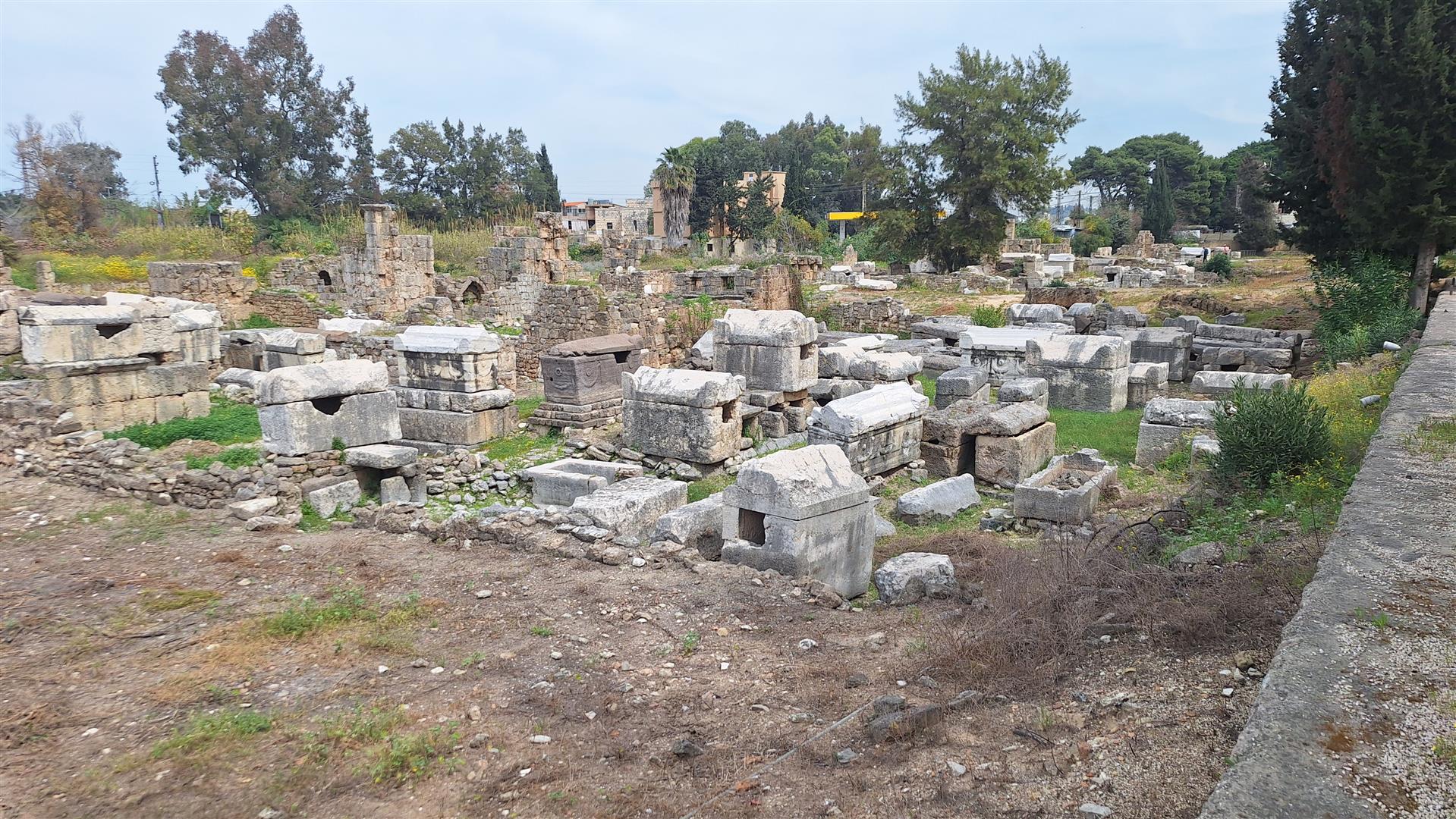
Sarcophigi as far as the eye could see.
I walked round to the Hippodrome. There’s a big building there, purpose unknown, plus a main seating area, with two others down the far end. It was probably used for chariot racing, judging by it’s large area.
An interesting place, although there weren’t any info boards around. There may have had something at the entrance, at the other end of the complex, but I didn’t go there because they may have asked me to pay. I’d obviously managed to sneak in by the back way.
Next day I planned go to Sidon but, it being a Monday, the places I wanted to visit would very likely be closed. I decided to go anyway, hoping to get some photos. Then would l go to Beirut.
I had an easy ride to Sidon and found the Sea Castle. I parked next to the entrance but walked into a restaurant next to it so I could take some photos from the shore.

Sidon Sea Castle.
The manager came out and invited me in to see the interior. It was all set up, ready for a Ramadan meal but the main thing he wanted to show me was the building itself. It used to be a Jewish school and had a very attractive interior design. It had symbols on the wall from that era, including the Star of David. Very interesting. It wasn’t really a surprise that the Jews had left.
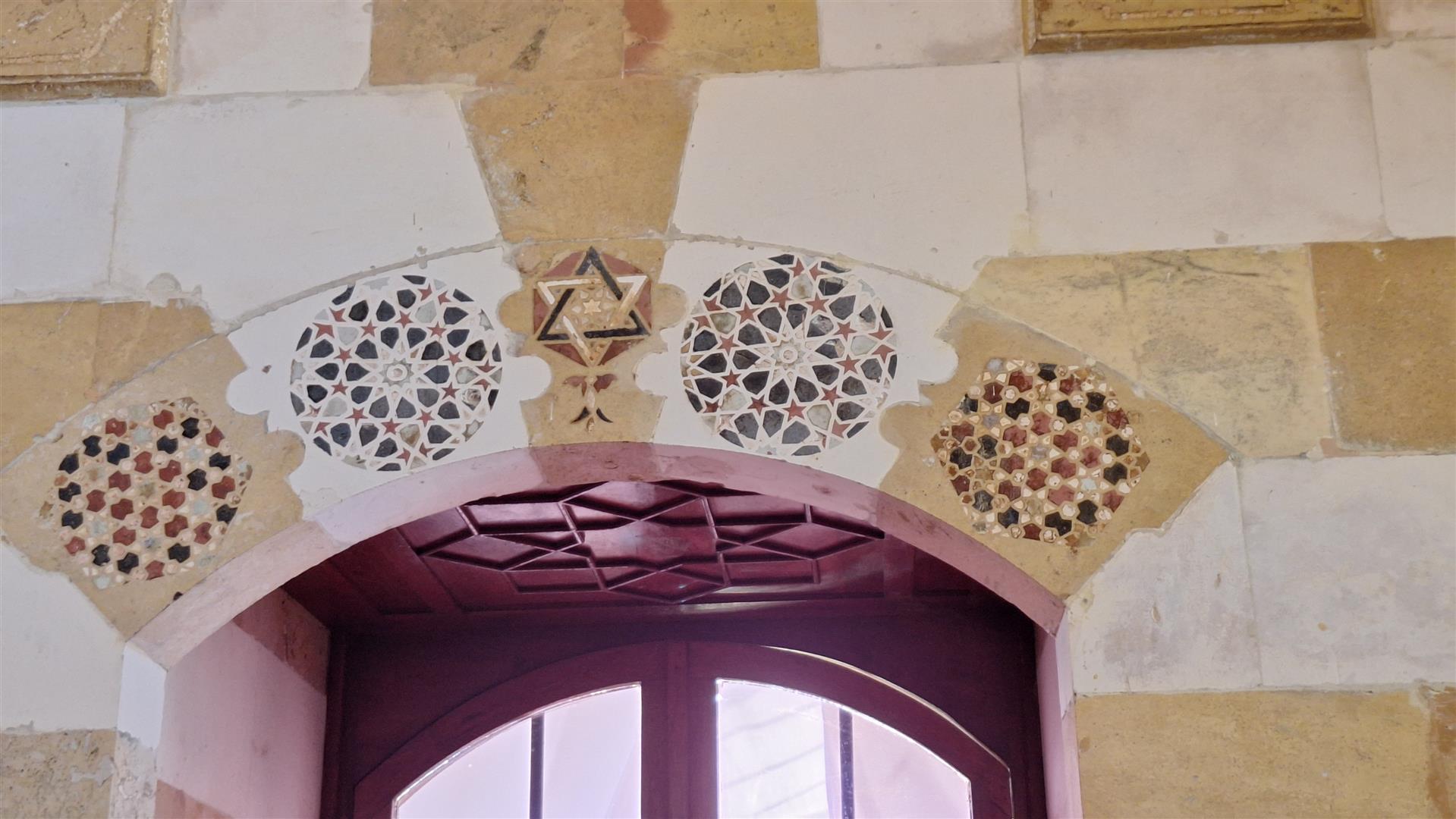
Inside the former Jewish School.
I went into the castle, which was open, for a look around. Not a big place but mostly intact. It was another one built by the Crusaders.
Then I wandered around to St Luke’s Castle, another French Crusader one, and correctly called St Loius Castle. I took some photos but there wasn’t a lot to see from the outside.
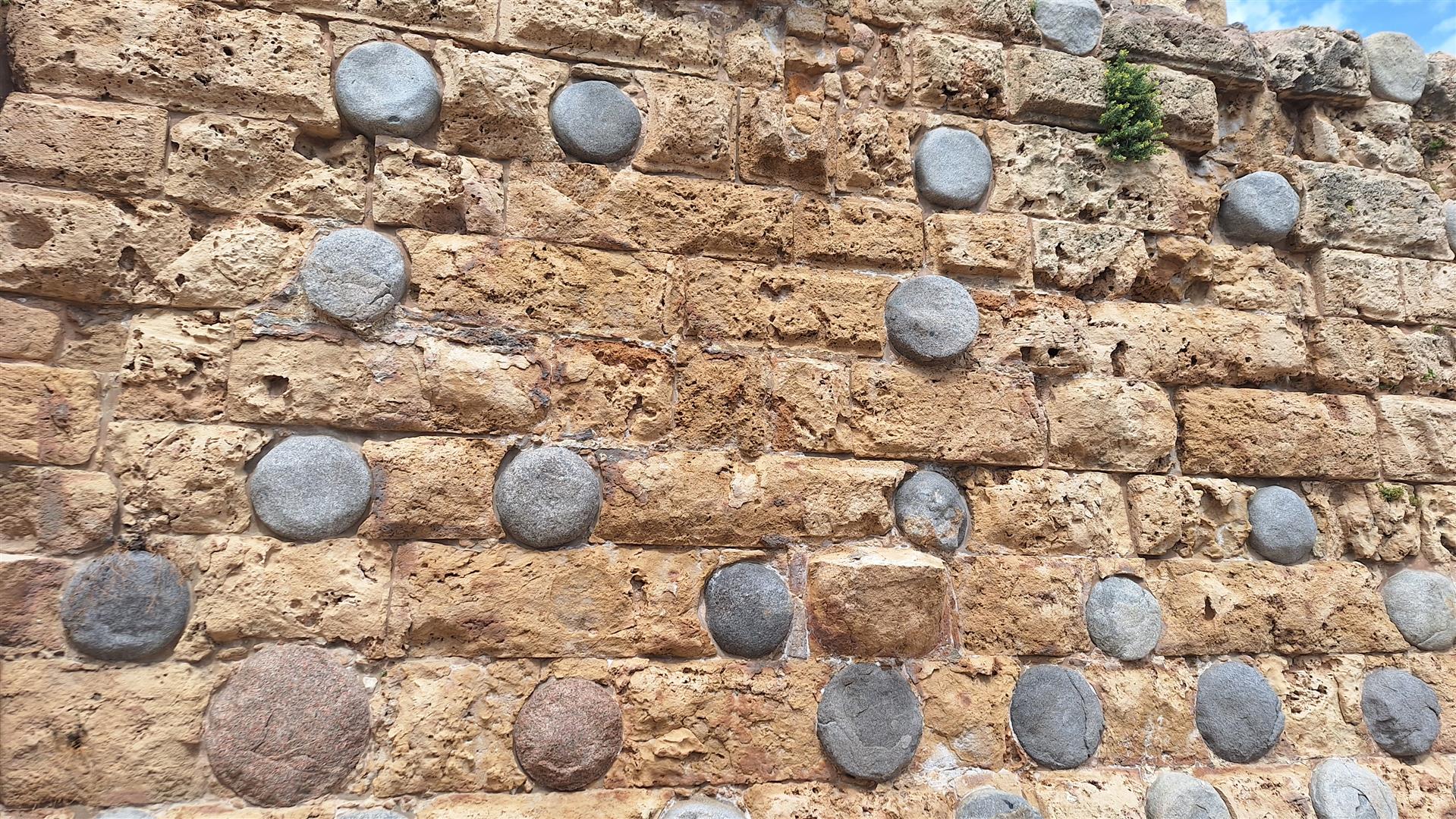
Crusader castles often had stone balls built into the walls to add strength.
I headed up the coast to Beirut, having selected Hostel Mishmash from the Hostel World website. I didn’t want to go back to the other place. It was close to the town centre but not too expensive. Google took me to the top of a steep set of steps, where I could have parked the bike, but the hostel was too far down them. So I found my way to the bottom of the steps and found the entrance.
I had planned to get a dorm bed but was tempted by the relatively low price of a private room. Jad, on reception, told me how to get my bike round to the back of the hostel, which was safe and secure. He and his partner own BMW 800s and they were both interested to see my bike. They said I should stay a couple of days and go for a ride with them. But I had no time for that. I needed to keep moving because of the approaching hot season further south.
I walked down to Plub, which was just down the road. I got a litre of IPA again and sat watching football and reading. A very pleasant evening. The plan for the next day was to cross through Syria and get to Irdib, in Jordan. I hoped to make it in one day.
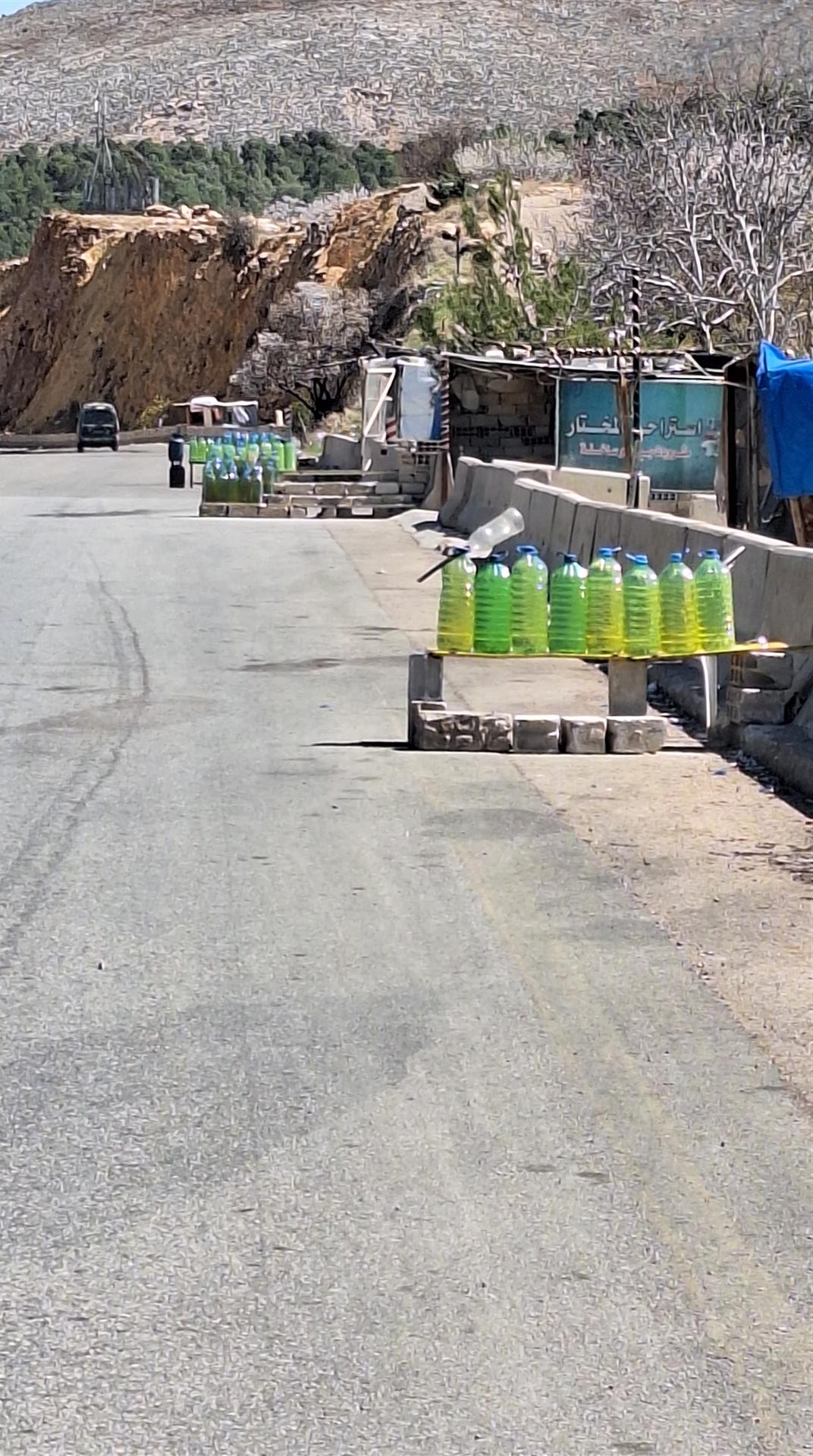
Petrol for sale. A very common sight.
I enjoyed Lebanon very much. It was a laid back place with a friendly atmosphere. Fuel was cheap and reasonably priced accommodation and food could be found if I looked hard enough. I really enjoyed going up in the beautiful mountains, riding some great roads and seeing the snow. Some of the terrain was quite stunning. The sad part, needless to say, is that the presence of Hezbollah is dragging the country into Israel’s war orbit. These things mostly affect the innocent. Why can’t they recognise the futility of what they’re doing?
 MOTOPANGAEA