
Damascus, Syria. 27th February 2025.
Syria awaited and I had a day of achievment. I headed for the border at Ar Ramtha. About 5kms away I topped up the tank. It wasn’t so much about Syrian prices unknown, more about availabilty unknown. The crossing out of Jordan was annoying and took an hour and a half. I arrived at the gate about 12.30. Once through, I queued up at immigration only to be told to go to customs first.
When I went there I had to pay 10 JOD fee for me, and 25 JOD fee for the bike. Then I went back to immigration and they stamped me out.
I rode down to the gate only to be told that I needed two stamps on the piece of paper I’d been given by customs. One from a customs office and one from the police.
I finally found the customs office. They told me where the police office was. I got the stamp from them, and was finally free to go. Out of Jordan, only Syria to deal with.
Syria was much easier. I parked outside a modern building marked Arrivals. I joined the queue for a long wait. When I was eventually seen I had a good result, I hoped. But firstly I had to deal with the guy behind me, who was standing right next to me, looking over my shoulder. I pushed him back and told him to keep away. I was absolutely NOT in the mood for that.
The guy at the computer seemed to be having a big problem reading my name. He kept asking me it. I think it’s the layout on the passport because this happens quite often. He asked another guy to look and he spoke some English. So I told him of my plans to go to Lebanon and then return to Syria, and asked if I could have a double entry visa? He seemed quite agreeable and when I got my passport back the entry stamp had 2 printed on it. I presumed that means I got what I wanted.
No fee to pay for that. I rode further down. A helpful guy came over, told me to park the bike and said to go into the nearby building. There were no signs, so I joined a queue and waited. After a while the same guy came in and took me over to another window, where I handed over my driving licence. It was put in a stack of others but my new best friend said something to him and he dealt with it straight away. $50 later I had it back and an A4 piece of paper with the licence details on it and a stamp. Free to go! It took 1 hour. I said thank you to my friend. Welcome to Syria.

Welcome to Syria. It looks OK so far.
The highway was good. There was nowhere to get a SIM but there were several service stations. The land was under cultivation but I didn’t know what was growing. I did see lots of wrecked army trucks. I also passed an abandoned fairground. Assad was clearly a party pooper.
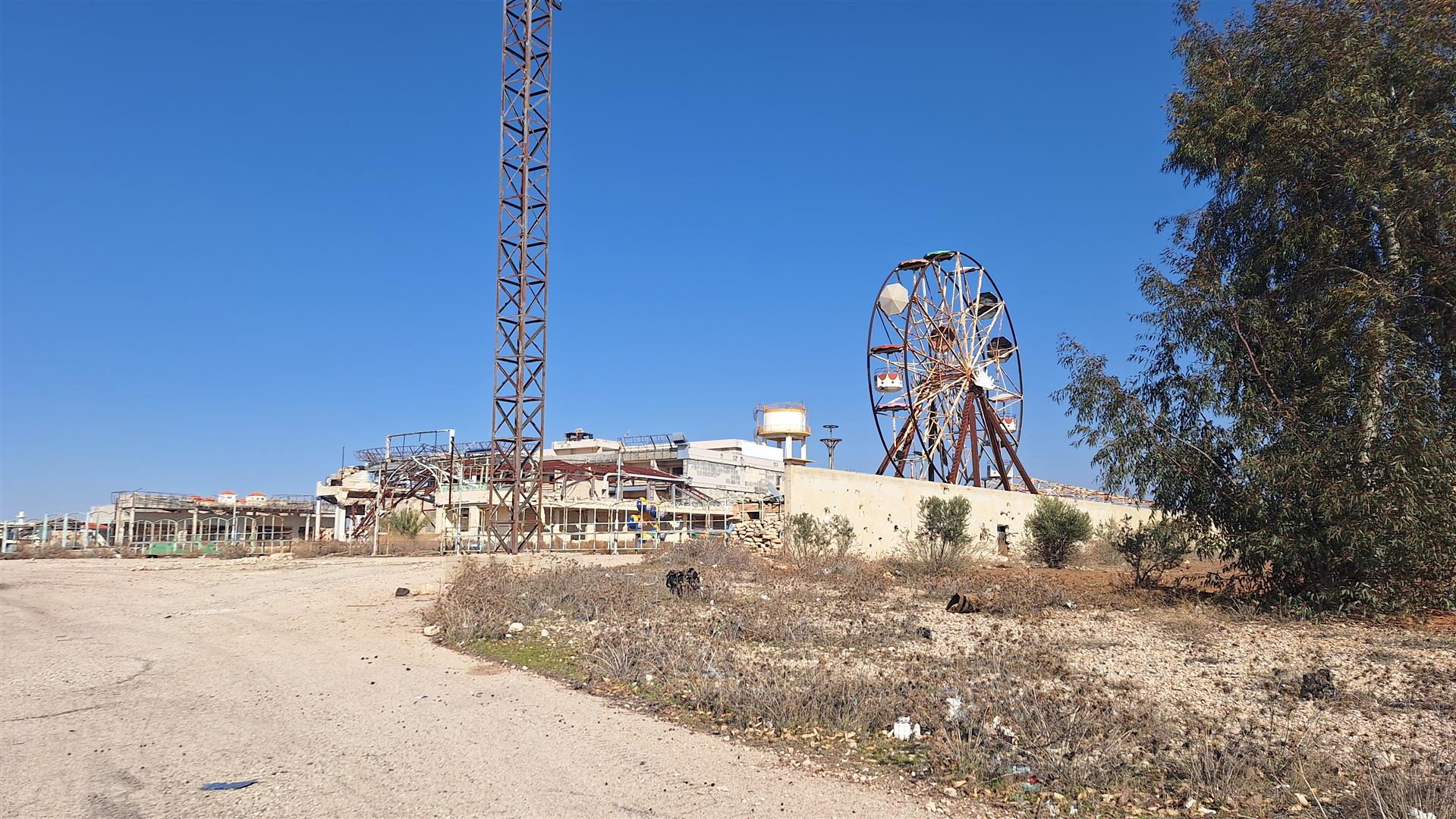
No fun to be had under Assad’s regime.
I had no maps because of not having a SIM card. I’d been recommended the Brazil Hotel, in Damascus, which I found with a bit of help from a guy in the café next door, in which I’m now sitting.
The hotel was OK but there was only enough electricity to run the heater in my room for about 1 hour per day. For lights and hot water they had their own power supply, based around batteries. My room is absolutely freezing! To be fair, I wasn’t expecting much from a country with Syria’s recent history.
While I was waiting for warmth I went out looking for a SIM. But by the time I’d found out that I had to go to Syriatel to get one they were closed. Next day was Friday, so no SIM until Saturday.
The hotel wi-fi was pretty useless. I could just about get emails but FB wouldn’t load properly. WhatsApp was OK.
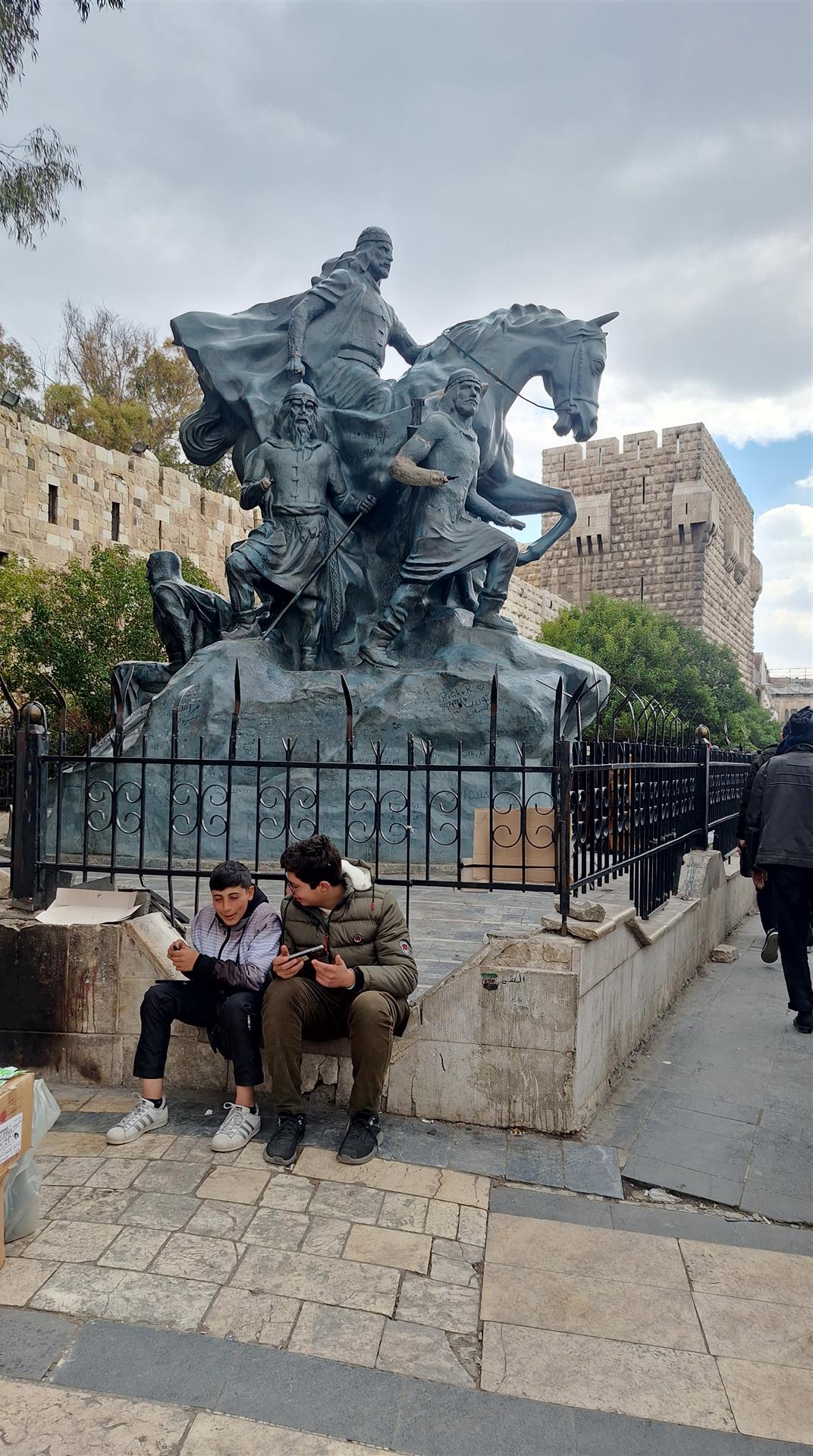
Man on a horse, with friends. Outside the citadel.
In the morning, after a reasonable night, despite the cold, I went out walking. The first place I went to was the Jordan Citadel. A big building and it looked good, but I couldn’t get in. So I just took photos. Then I generally walked around, through the bazaar and around the streets.
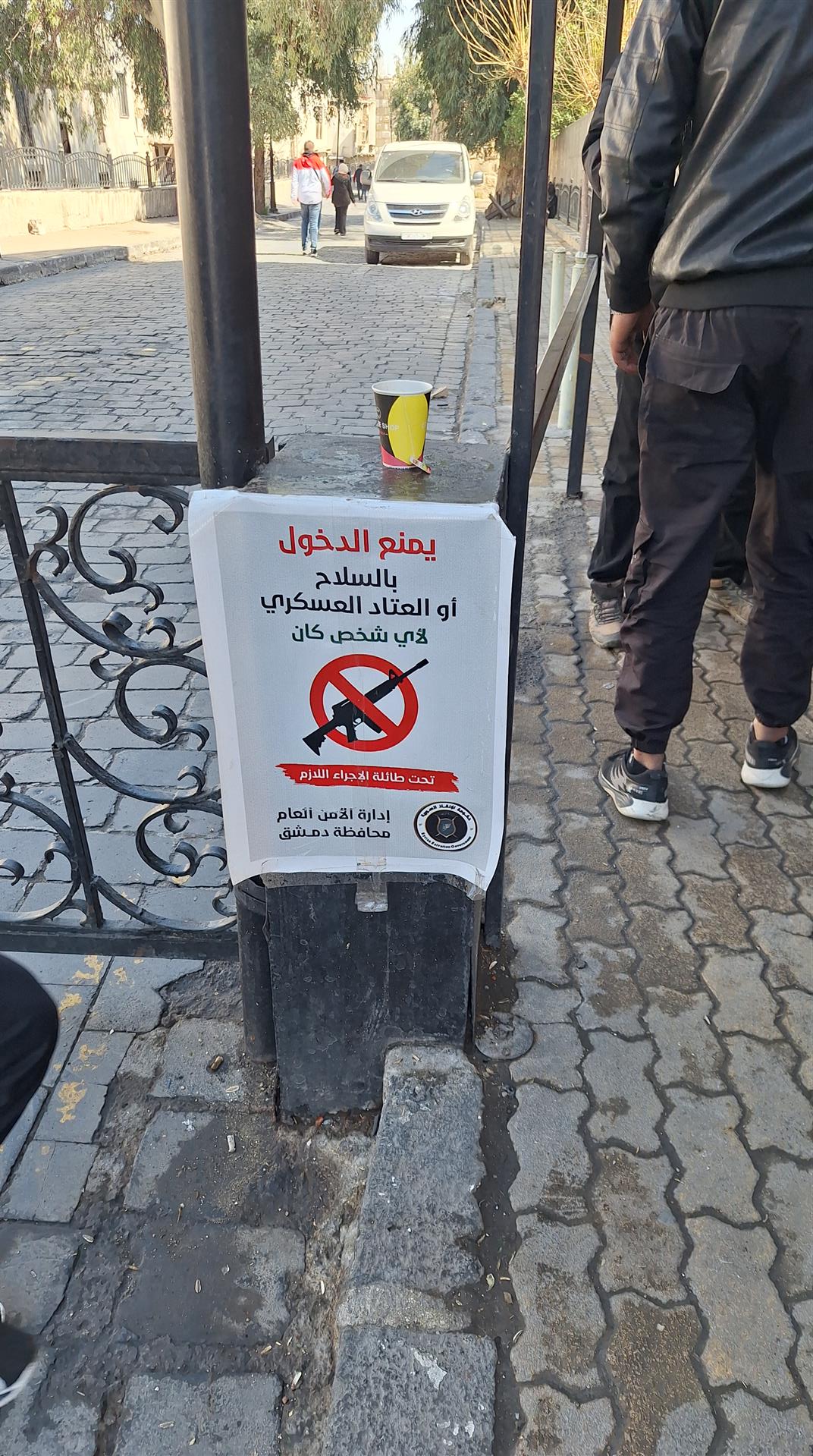
Unable to translate but the meaning was clear.
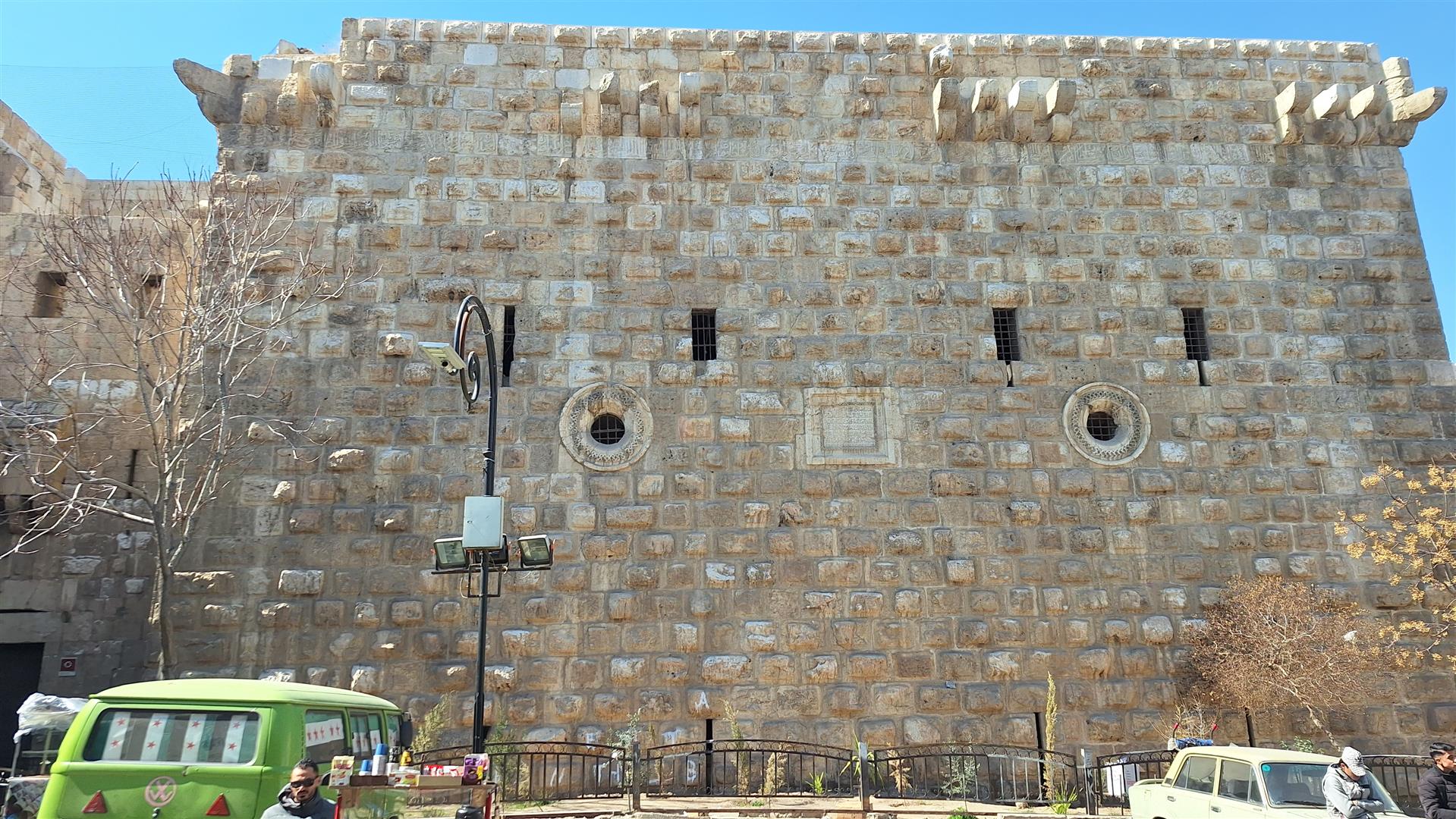
It was annoying that I couldn’t get into the citadel.
I walked my way round to the Khan As’ad Pasha Al-Azem. A former caravanserai with beautiful interior architecture and design. It was right next to the souk. Damascus sat on important trade routes and was also a gathering point for pilgrims going to Mecca.
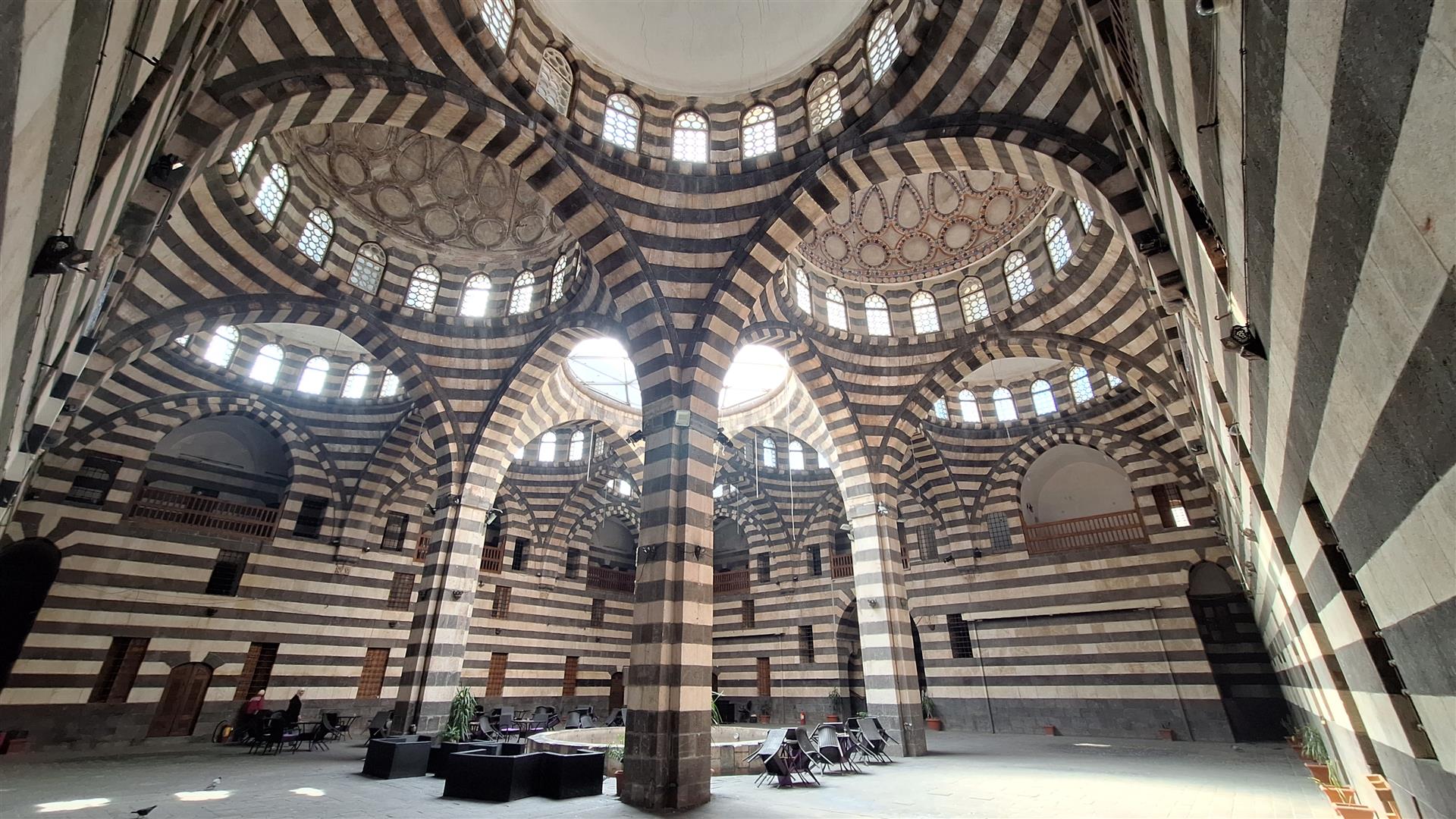
Caravanserais are for goods and camels. And yet such amazing architecture.
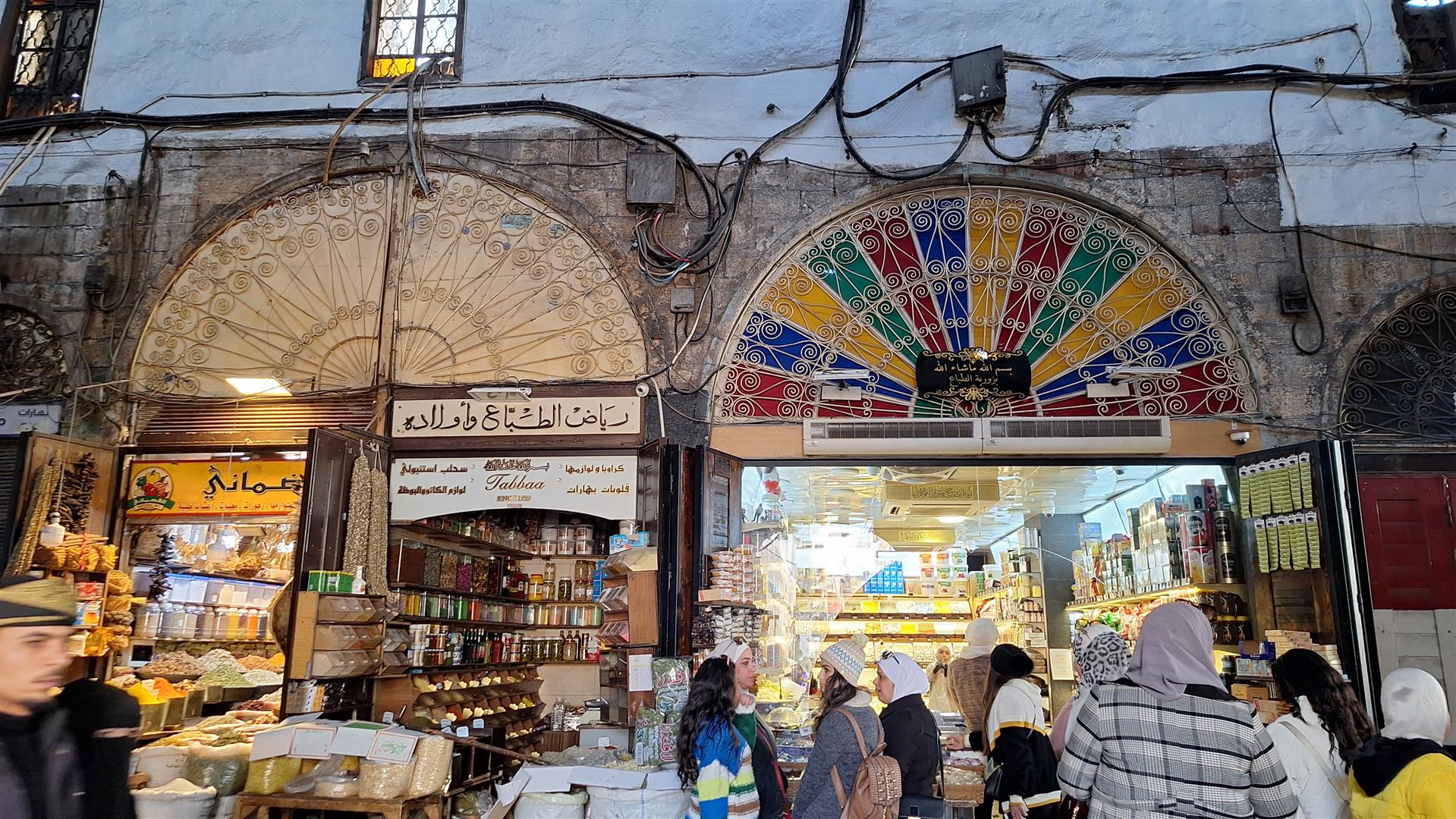
Walking through the bazaar.
Then I went to Al Azem Palace. What a fabulous place. It was the home of the local administrator (Pasha) for the Ottomans and is big and beautiful.
This guy kept his job for 37 years, which shows his diplomatic skills and his ability to do what was required of him. Nobody else is known to have held that position for that long. There were lots of rooms to look in and I was able to learn how these houses were laid out; how they give priority to the family rooms and separated the business rooms away from them to maintain privacy.
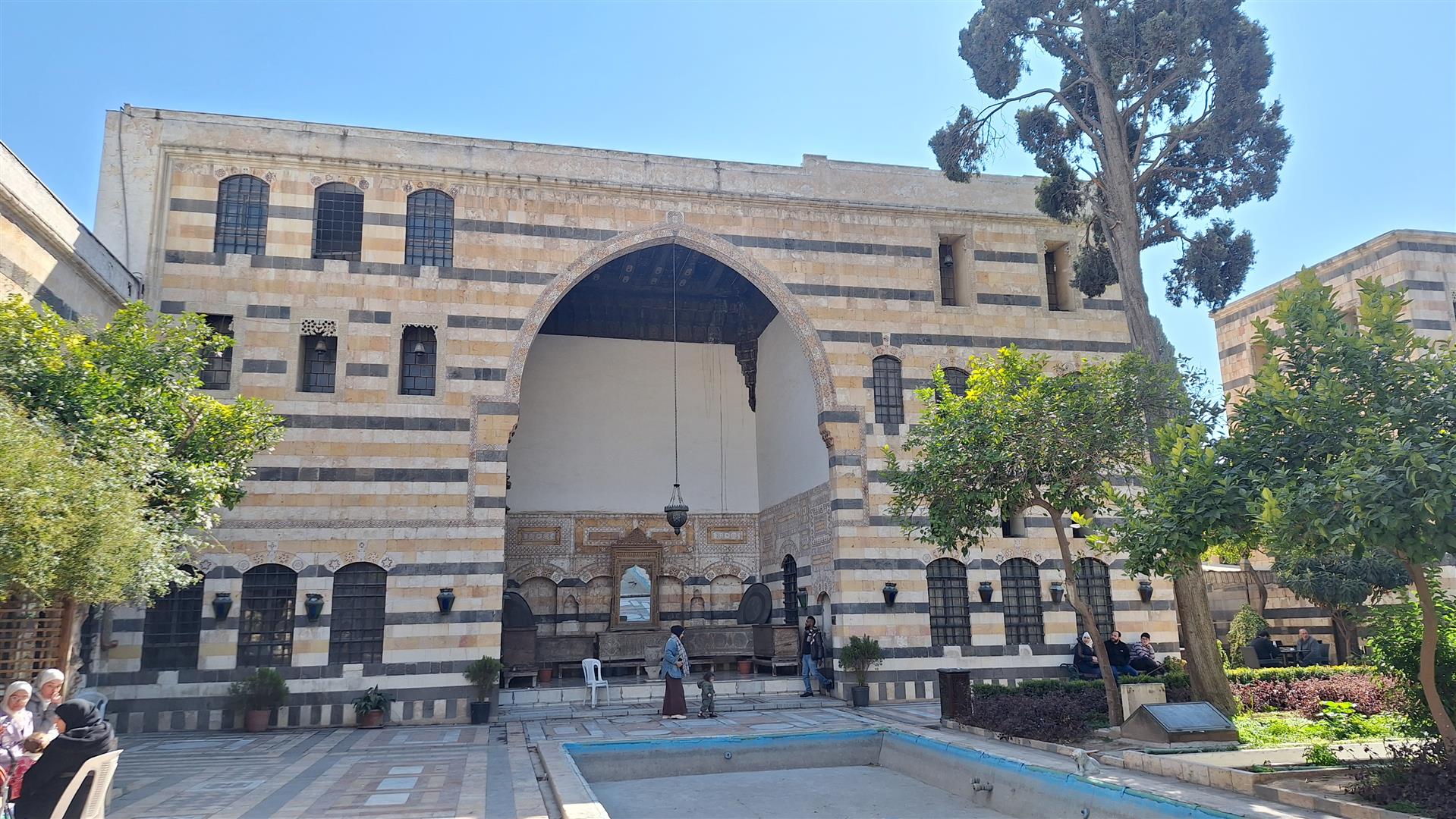
Rear view of this fabulous house.
The various rooms were beautifully decorated, with excellent designs. They were all spaced around a central courtyard, with large trees and fountains.

I sat in this lovely room for a while. But nobody brought me tea.
I’d had two conversations with people at the palace and they were both hopeful for the future of Syria but not exuberant just yet. Life hadn’t improved very much, if at all. The longest and most informative chat I had was with a guy in the café by the hotel, who is part owner.
Firstly he explained about the electricity and why I could only get heating at certain times. Most people run off batteries or generators. The mains electric only comes on at certain times. The batteries will get charged up and units too big for battery power, such as AC or heating, can then run. This situation had existed for many years.
We chatted about politics and what was happening. Like the other guys, he’s very happy that Assad has gone and he pointed out that had he still been in power, he and I would not be having this conversation. There was too much fear.
We talked about how things might pan out. He said it’s great that the whole world seems to be batting for Syria. They still need to resolve their differences with the Kurdish region. That’s where all the oil is so it’s all about how to govern that area and how to divide up the oil revenues. Syria also has natural gas.
There’s still pockets of Assad resistance, which are causing some problems. So that still needs clearing up. But progress is being made. Elections? Maybe in about two years. All the internally and externally displaced people need to get settled back down first, and for an interim government to be put in place. What they have at the moment is an emergency administration.
Fascinating stuff. I assured him the world is on his side. He was pleased that the UK was helping them. He said they still have an influence in these matters.
The other thing I discovered is that the exchange rate is nothing like as good as XE Currency suggests it is. It says 13K to the dollar but it’s 9.3K at best. So everything is about 30% more expensive than I thought. Boo!
Eventually I went back up to my freezing hotel room. The heating finally came on at about 11pm.
In the morning I went out to get a SIM card. I ended up paying £10 for one month and 10GB. I could have got three months but may not have needed it, so I decided it wasn’t worth it. I could top up if needed. The only problem was that there was no 4G there, so internet was slow on the phone too. I’d been hoping for an improvement.
Then I went along the road to a very swank café and spent almost £15 on a breakfast. I must be mad! I also spent a fair bit more on coffee and cakes at another expensive place later on, but they were for next day’s breakfast. The café down below was closed until about 6pm because it was the first day of Ramadan.

I bought some sweets of these young lads.
I spent the day walking around various places. Chauk, my friend from Pakistan, contacted me wanting photos of the tombs of a couple of famous people, including Saladin. I was glad he did that otherwise I would have missed going there. I took some and sent them to him. I didn’t find the second guy but he wasn’t quite so important.
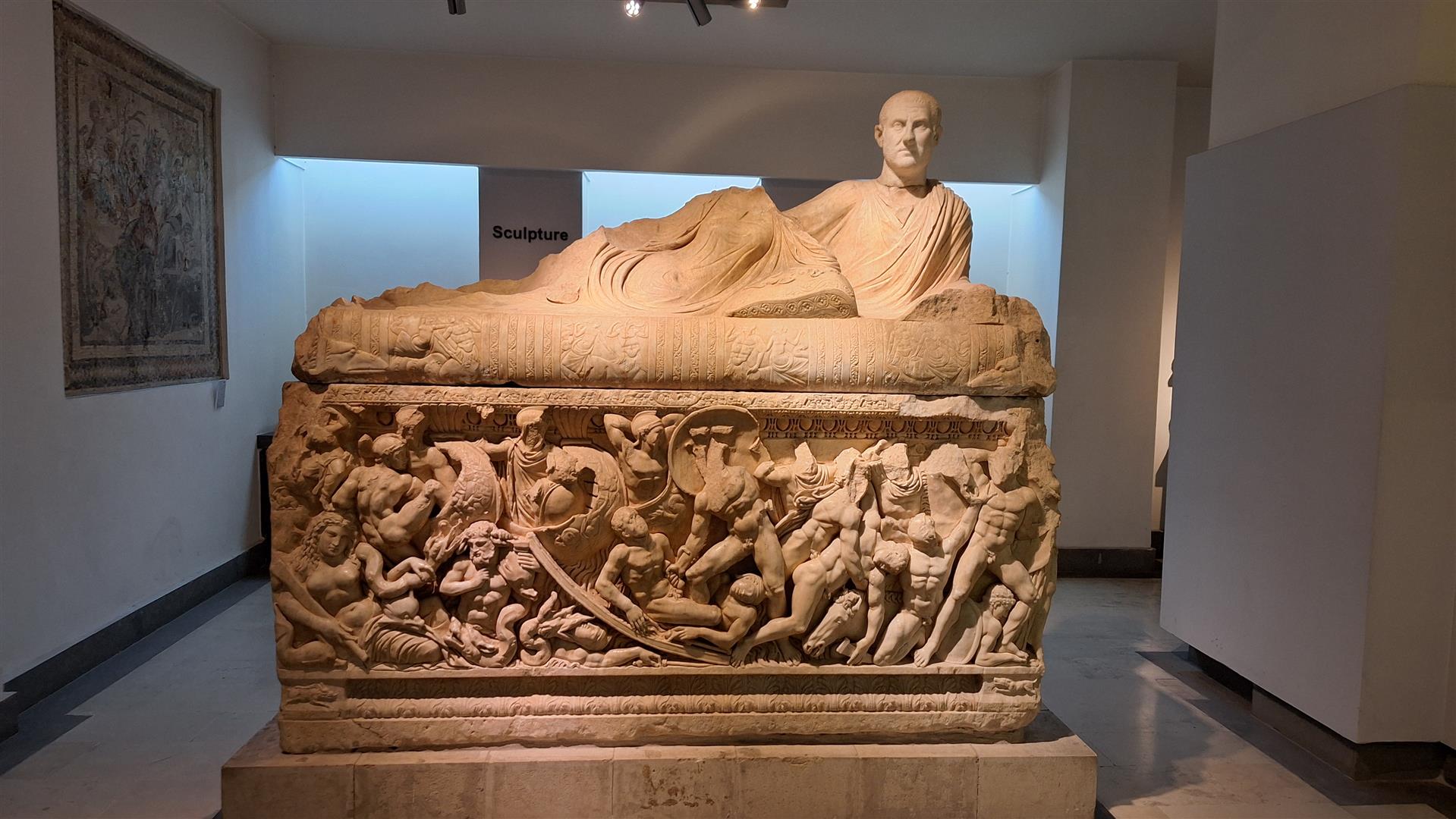
Incredible detail on this sarcophogus.
I went to the National Museum first. Quite good, mostly filled with ancient artwork and mosaics. Also an exhibition by a modern artist named Sara Sharmer. Very interesting paintings. When I went in the guy on the door said no photos. Then he decided to lead me around, encouraging me to take photos! But all he did was to tell me the name of the statues and busts. He spoke no English so couldn’t tell me any more abut them. He got quite annoying after a while but he did let me go down into a closed section that seemed to be an area of an ancient building. I gave him 10K when I left. I think he expected more.

I like this kind of modern art.
I went to the citadel again. It was still closed. Then to the Saladin Mausoleum, for Chauk’s photos. I went into Darbaar-e-Shaam, a big mosque area with some impressive buildings. I found the tomb for Nur al-Din Mahmoud Zenki, also for photos for Chauk.

Tomb of Sala Aldin Al-Atoubi (black), plus friends.

In the grounds of the mosque. But I don’t know its purpose.
That was that for sightseeing. I walked back to the hotel, via the food place I’d gone to the day before. A kid came up and asked for some food so the guy gave him a small bread with cheese on it. I gave the guy 5k extra, telling him to use it to feed another kid. But when I think about it, 5k is very little money so I don’t think he was massively impressed. I’d given 5k to a beggar previously and did so again.
I ate my food then went up the road and found a café that was open and had good connectivity. I sat in there for a good while, catching up on the internet, and enjoying a coffee. Ramadan was keeping most places closed.
I went back to the hotel about 8pm, hoping for a shower. There was no hot water. Maybe in the morning. I went to the café downstairs, where it was reasonably warm, for the rest of the evening. I did some research on where to go. It looked like I’d be heading north, to Homs.
The promised hot water was there in the morning. I finally left at 11.15, feeling much cleaner.

The Monastery of St George.
It was an easy ride to my first stop, the Monastery of St George. A good building to wander round and to photograph. It was a Greek Orthodox Monastery, located in the ‘Valley of the Christians’.
Nearby was the Convent of Our Lady of Sednaya. Both of these buildings were around 400 years old. A guy attached himself to me. I kept trying to lose him as I thought he was going to want money. In the end he wandered off. I saw him again when I left and he just said goodbye. No hint at wanting money after all. Maybe I’m too suspicious.
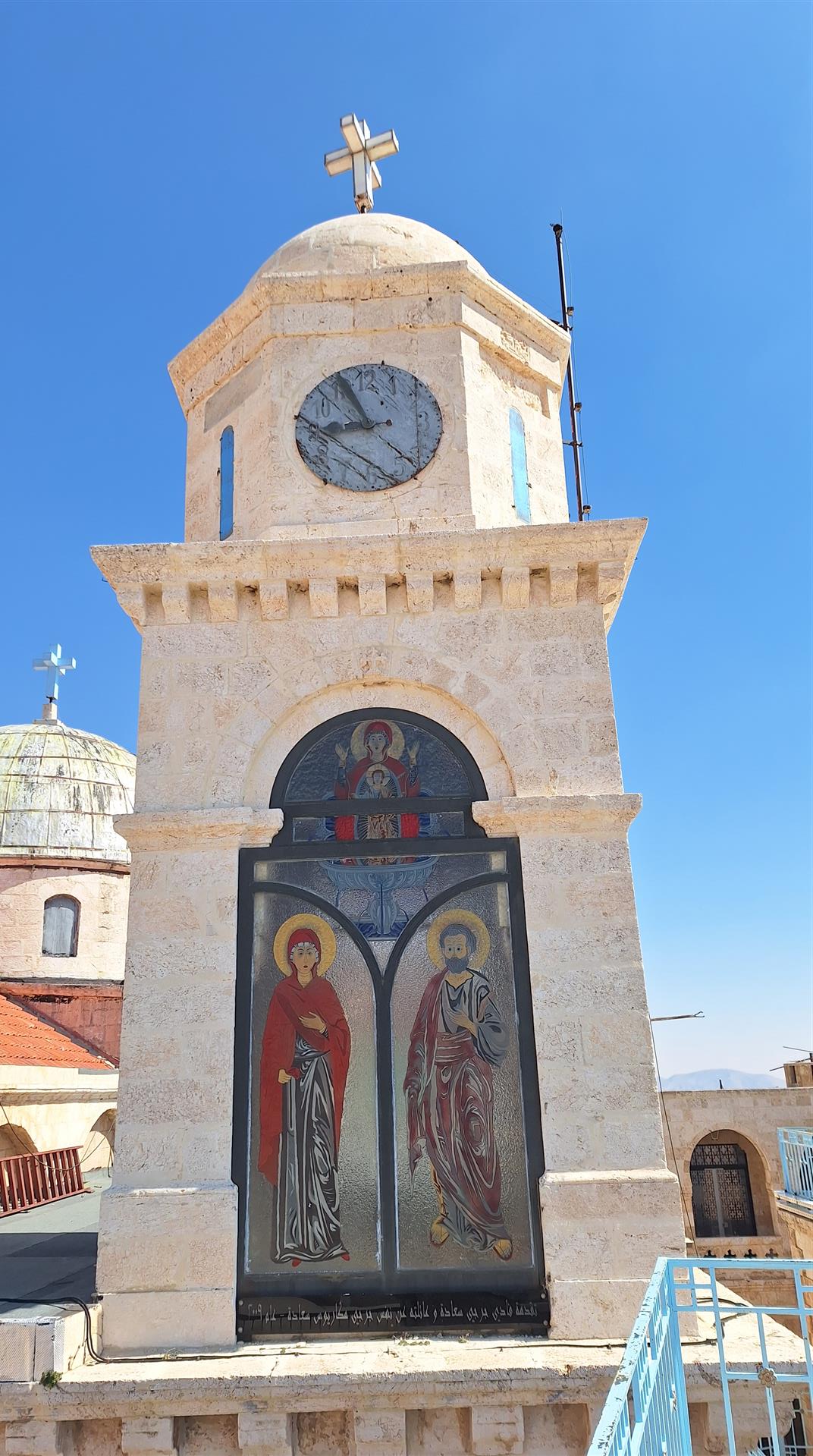
A rather nice looking clock tower in the convent.
I spoke to a nun while I was in there. It was her that told me about the age of the building. I asked her how long she’d been there. She either said 45 years, or since she was 45. One or t’other.
The ride up there had been really good. The main roads were in pretty good condition and the terrain was dry and stony, but there was plenty of agriculture among it. It looked attractive under the sun, as if it was reflecting the hope of the nation.
I rode on to the town of Maaloula. This is one of three remaining places in Syria that still speak the Aramaic language. The same one as Jesus spoke. It is, unfortunately, slowly dying out. The town is largely Christian.

Town of Maaloula, nestling under a high ridge.
As I parked the bike I heard a band playing. Just around the corner was a group of people playing drums and trumpets. It sounded good, but not a chart topper. There was a little shop just across the way and I was able to get some tea and a couple of chocolate bars.

And the band played on.
I had a nice, long chat with the owner, who spoke good English. He said the band marches every Sunday but their next big event was in the Easter parade, not very far ahead. It was him that told me about the language.
We chatted about Syria. Many young people, once they’d got degrees, left for places such as Canada and Europe and, in some cases, married locally. Many people were returning but he wondered whether those people would? What would it take to persuade them, he wondered? We both agreed that Syria would need such people.
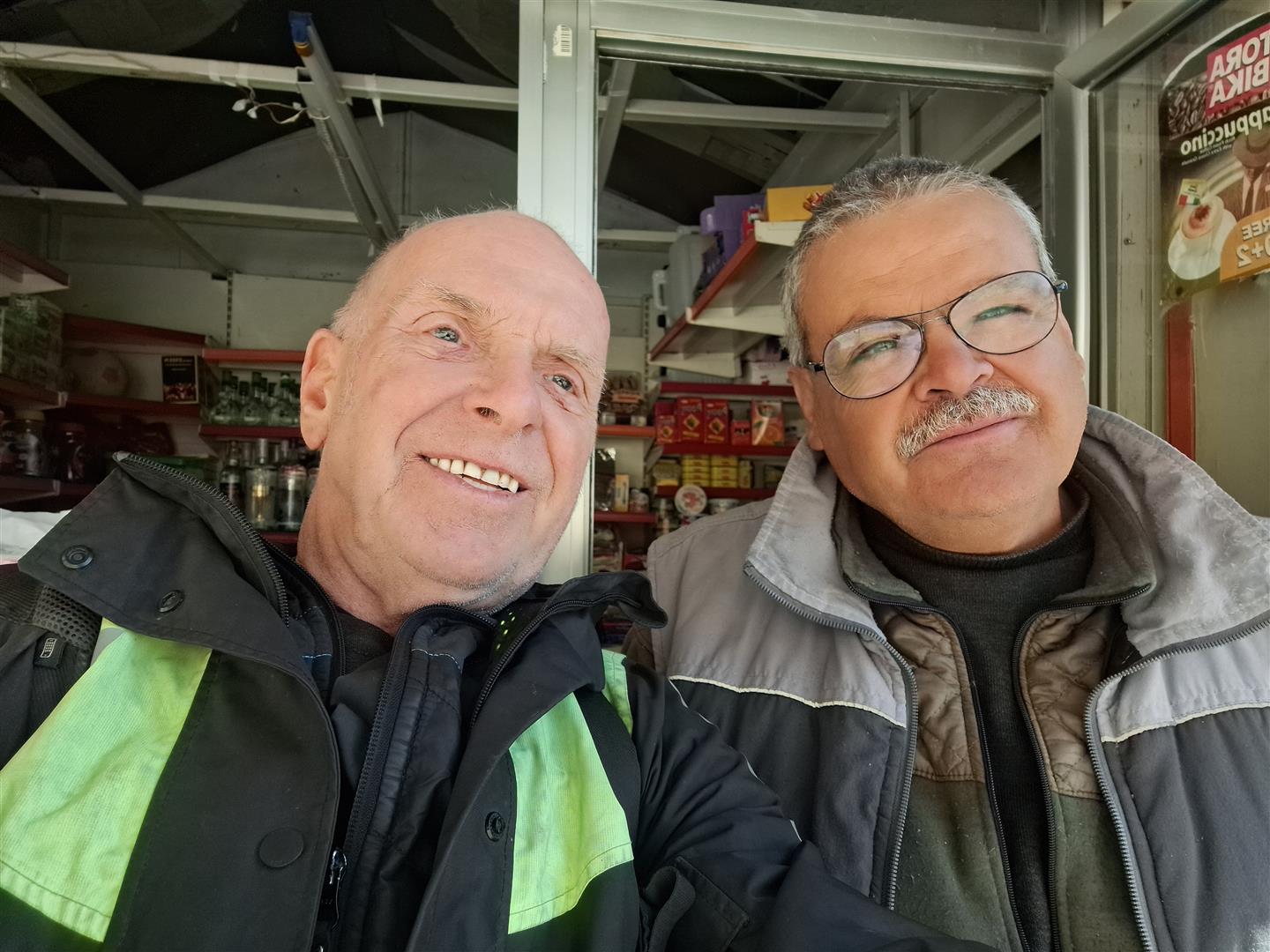
Supplier of tea, chocolate and a very interesting conversation.
We were talking about Assad and his mafia. In practical terms what this meant was that when someone wanted to buy a Chinese made solar system, for example, to give them the electricity that Assad didn’t, it cost them 2 million SYP instead of 200K. What was clear was that whatever happened next, people were really happy that Assad had gone.
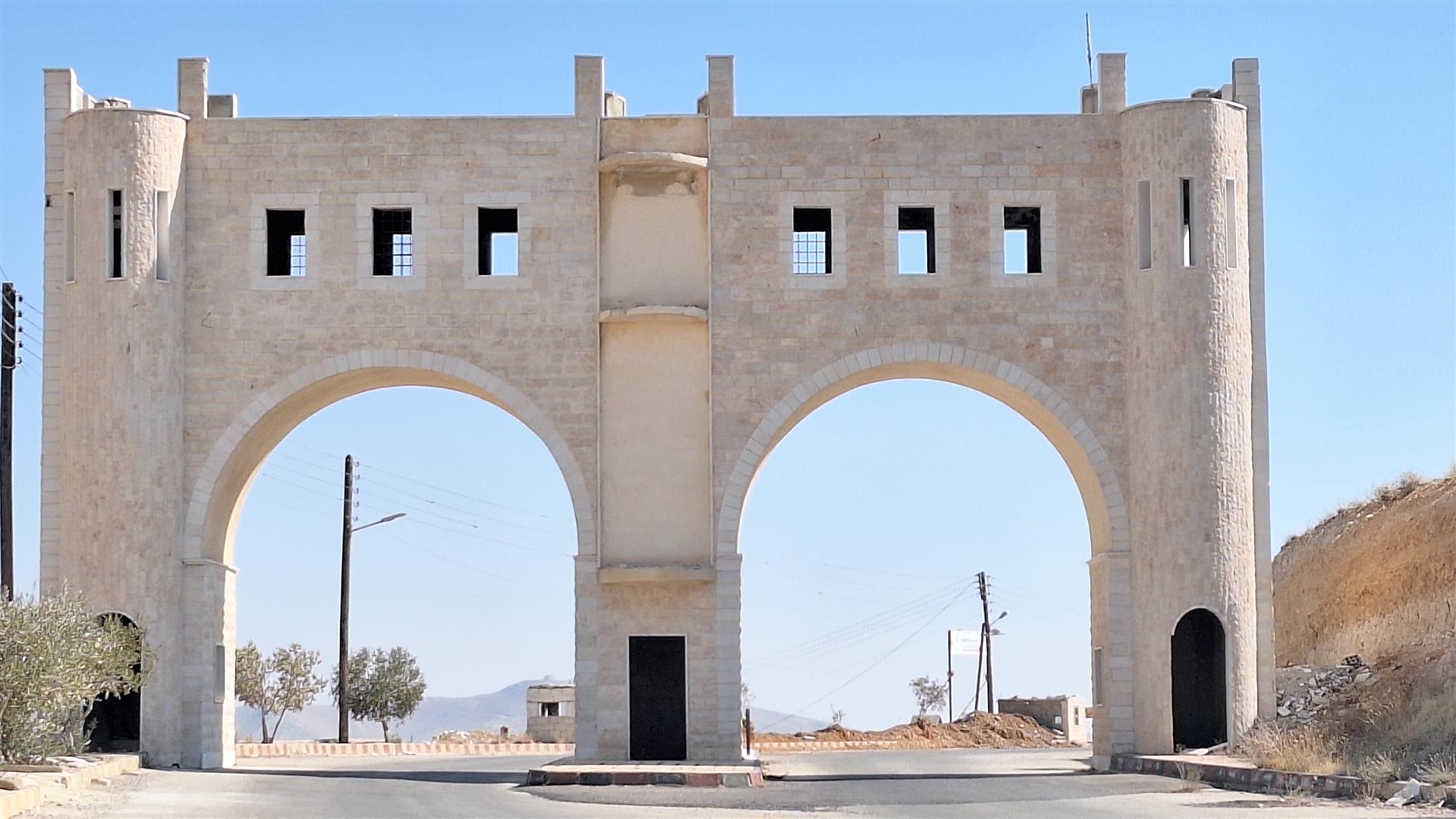
On the way out of the town was this rather lovely gateway.
I rode on to Homs, stopping near the city centre to check for hotels. A young guy stopped to assist me and suggested a hotel. They initially wanted $50 but reduced that to $45. I said no thanks, and left. But basically there wasn’t anywhere else suitable. I went back in and knocked him down to $40, £32. It was a good move because the hotel had a central heating system, and it worked! The price included breakfast. I parked the bike on the pavement and a security guy attached a chain and padlock to it. Brilliant!
I went for a walk up to the citadel, which was a waste of time as there was nothing up there. On the way I saw a guy filling gas bottles from a small truck and guys selling petrol from bottles. I took a photo but then another guy came over and made me delete it. I later learned that it was probably smuggled.
On the way out of Damascus, in the middle of a roundabout, I had seen what was virtually an industry of diesel supply. There was a 1,000 litre tank on the pavement, being filled up from a tanker truck. Then there were guys with 20 litre cans supplying motorists. It all struck me as very odd because there were loads of service stations open.
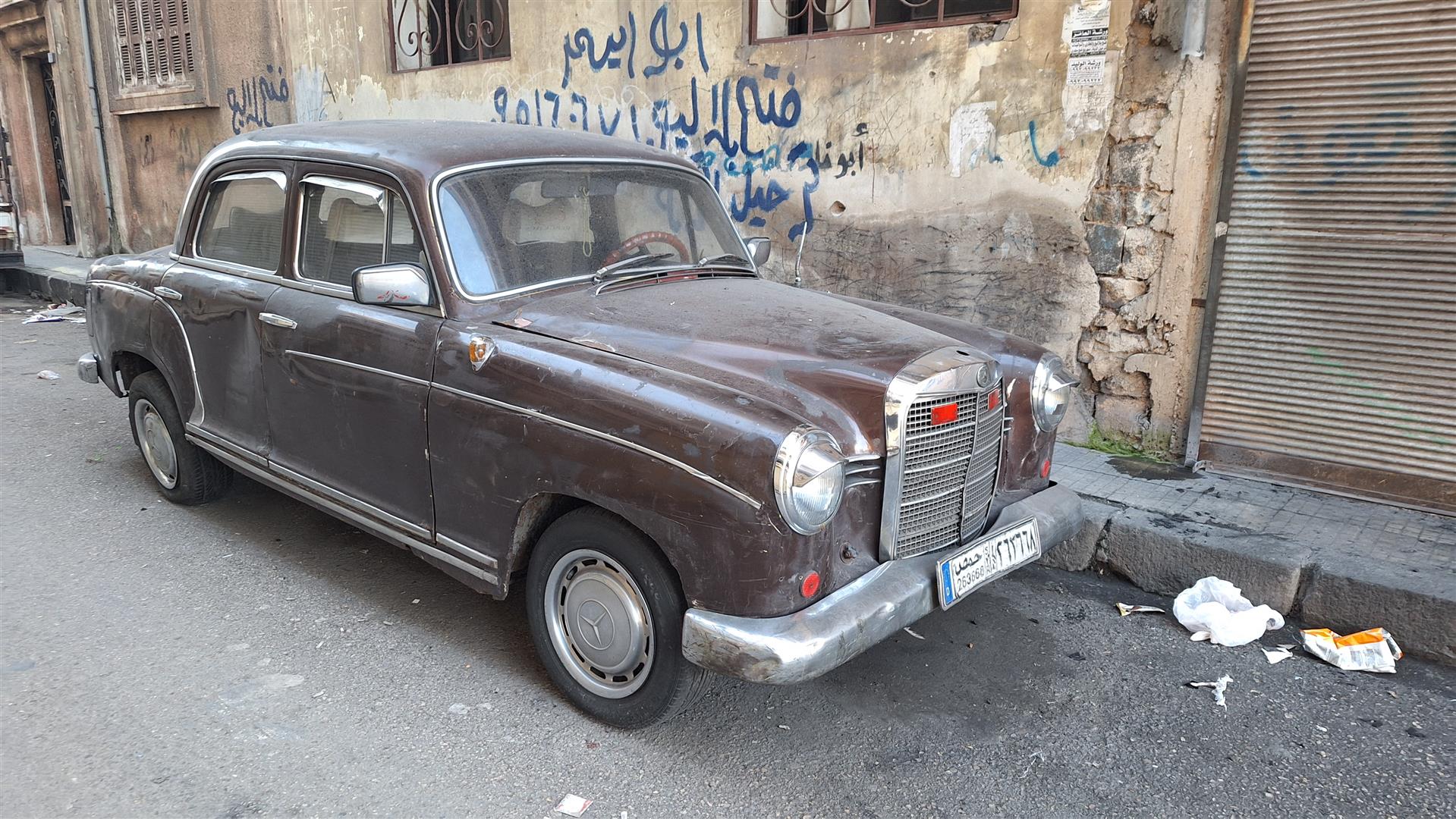
I saw quite a few of these old Mercedes cars in Syria.
The room had a TV that got Al Jazeera and BBC so I was able to catch up on what was happening in the world. The wi-fi was good so I was able to catch up on the internet too. It had been a really interesting day and I’d learned a huge amount.
I left Homs next morning but about 10Kms out of town we all got diverted as the road ahead was closed. It was heading me towards the salt lake, where I wanted to go anyway so I just stuck with it.
I went through about 5 checkpoints. A couple of them didn’t bother stopping me. One wanted to see my passport. They were all very friendly. The guys there are a bit off a rag-tag army. One was wearing an Iraqi army coat with the logo of the regiment who’d guided me to the border. I mentioned it to him. He grinned.

This dead tank looks like it came from Russia, judging by the Z on the front.
There were loads of dead vehicles alongside the road. Some were rusty wrecks and I assume they’d been burned out. Others were just wrecks, and very much stripped out. A couple were army trucks. I saw two dead tanks. One at the roadside, another over in a field next to farm buildings. I also saw a field gun, in a field!
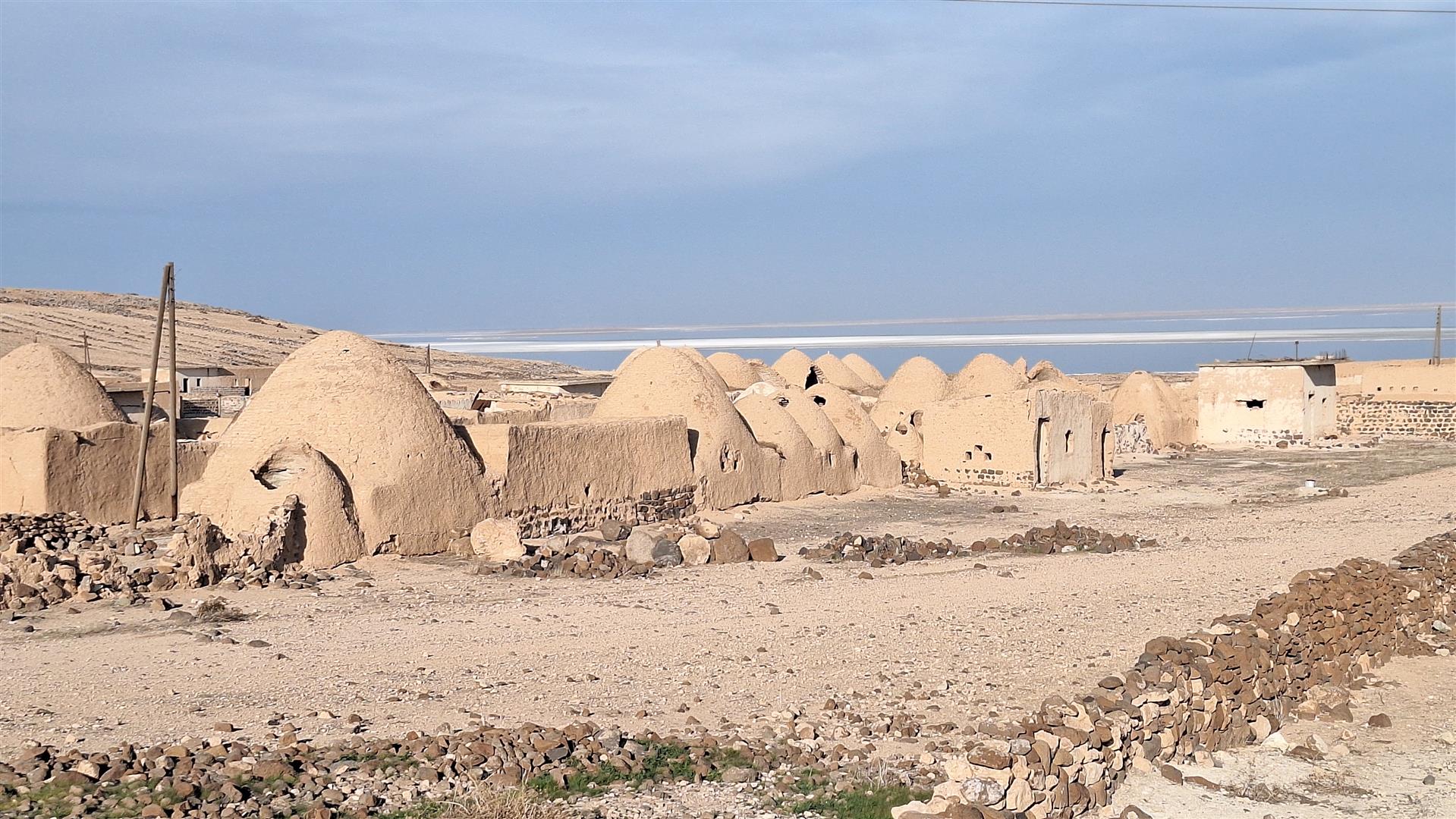
Beehive houses, down by the salt lake.
When I got to the lake there were loads of beehive shaped houses built close to it. They’re made from mud bricks, covered with mud and straw mortar. Their conical design helps keep the interiors cool by drawing air up through the house.
On to Aleppo. The usual city chaos. I’d though that Syrians were OK on roundabouts but nope! Everyman for himself. I found the hotel I’d been recommended but there was nowhere to park. The guy there made it clear that if I left my bike outside it would disappear, no question of it. He suggested a place further down the road, which I couldn’t actually get to.

Backstreet in Aleppo. I hadn’t seen this level of destruction in Damascus or Homs.
While I was outside a guy and his kids approached me to say hello. He ended up taking photos but then led me to an area where there were several hotels. I tried a couple but they were full. Then I came to one which had its own forecourt, with parking. So for the sake of the safety of the bike I ended up paying $50. No breakfast but he said the room is heated and he had hot water.
The water at the sink was only lukewarm although the shower was OK. A small but important win. When I went downstairs to go out for food they insisted I bring the bike inside. I didn’t mind.

Bike safe and sound.
I wandered around looking for food but I couldn’t find a takeaway, which was what I really wanted. So I had to go into a restaurant. I had what I thought wold be a simple meal. I asked for mushroom omelette. He asked if I wanted meat and I said OK. What I got was meat and mushroom but no omelette. The salad was very good though. But the cost was a shock, at almost £12.
Before asking for hot water for my morning tea I went out to buy some biscuits/cakes at one of the little shops I’d seen nearby. But none of them were open. I could have bought a tyre, and a compressor for pumping it up. But not a biscuit in sight.

Aleppo Citadel.

Bomb damage near the citadel.
I left at about 10.30 and went round to the citadel to take photos. It was closed but I didn’t really mind. Those steps looked steep!
I got chatting to a guy and his Syrian guide. He was Indian but living in Australia. He originally came from Mumbai. I chatted to his guide as well, and gave him my best wishes for Syria and himself.
Onwards to the Cathedral of St Simeon Stylite. It’s way up in the hills and it was a good ride up there. The road was OK but not great.
When I arrived I went past the entrance, misguided by Maps.me, and parked up by a restaurant, further up. A guy came out and we tried to chat. He took me up to the roof to show me the view. He also showed the inside of the closed building. It looked ready to go.

A cheering view from the restaurant.

The interior, waiting for the word to go.
He took me down to the proper entrance and the two guards there let me go in to take photos, with one of them following me. It’s a really big place and must have looked amazing in its heyday.

Cathedral of St Simeon Stylite.
Maps.me took me through some tiny, back country roads on the way to my overnight stop of Latakia. Small roads that took me through dead villages or to dead ends. I made it through eventually, out to a main road. Maps.me seemed to get confused very easily.
Some of the roads were pretty rough. But the biggest shock to me was the state of the buildings. Blown up, or with shell holes in the walls. Many of them were simply abandoned. They were missing their doors and windows, as if the former residents had taken them away. Whole villages with nobody in them. It really saddened me.

A deserted village. Very sad.
When I got to Latakia I went down to the seafront, just to see the sea. Then I headed to a hotel that had been suggested to me, reckoned to be $35. They actually wanted $45 but I talked that down. Not cheap, but they supply breakfast and have secure parking for my bike. It’s a nice room and I got them to deliver me a pizza.
The breakfast was very good and I then spent the morning doing some planning.

Dedicated to Septimius Severus. A symbol of the city.
I went out for a walk, down to see the old castle at the port. There was no sign of it and no access into the port anyway. The nearby national museum was also closed. So I walked round to the Latakia Tetraporticus. It’s a trimphal arch gate, about 2,000 years old, built by the Romans and dedicated to Septimius Severus. A nice looking stone edifice, with some decorative finishes.
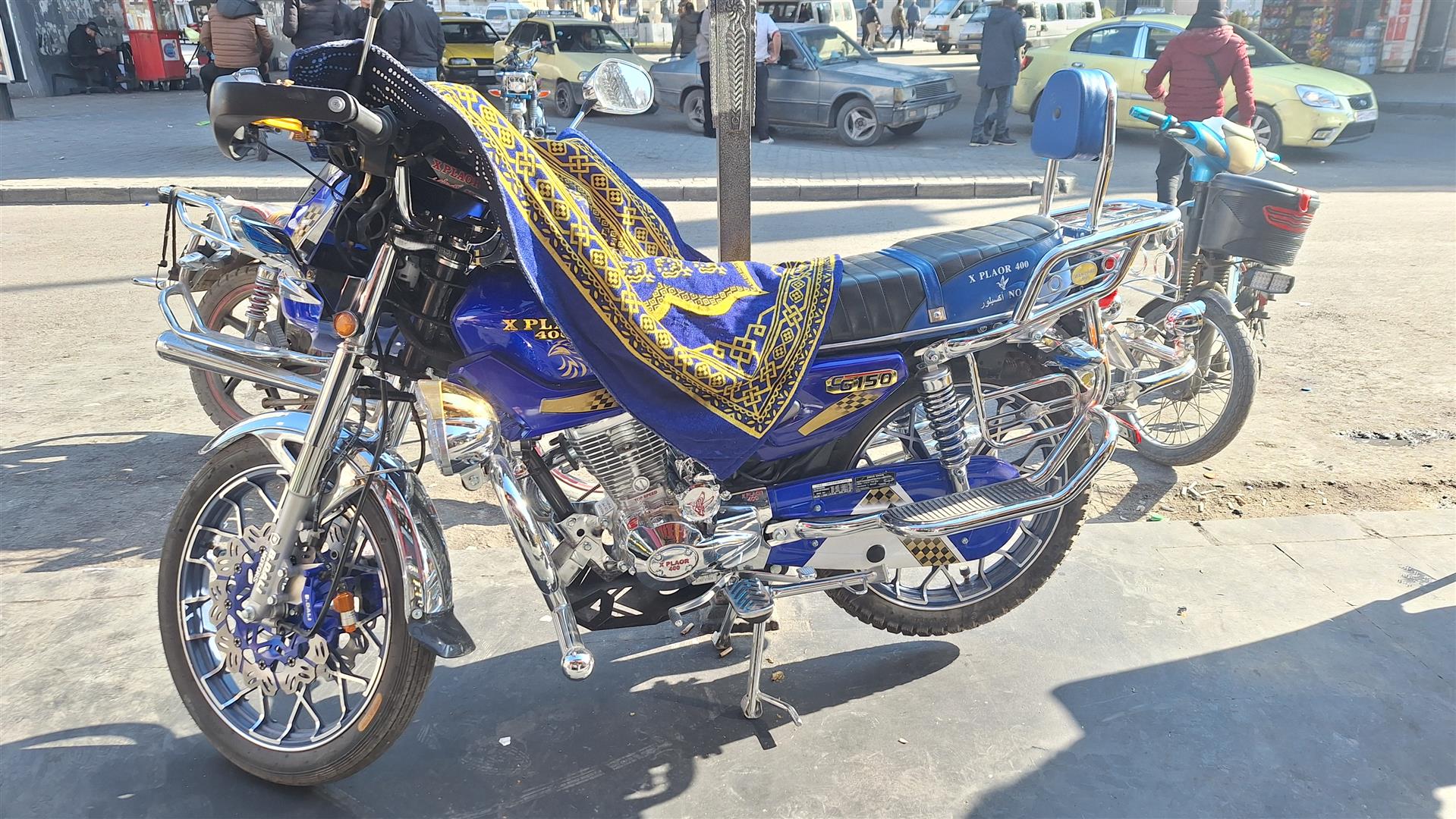
Nicely blinged up bike.
I really enjoyed walking around and seeing the various stalls and shops. There’s no shortage of essentials for people to buy. Lots of fruit and veg; meat and fish; bread and cakes. But also lots of poverty on display. Most cars were old wrecks. There were lots of bikes though, many of them very blinged up.

Bridge support.
After breakfast I got sorted and left by 11. I had an enjoyable ride out to the Saladin castle, except that neither of the maps knew where it was! I’m exagerrating a bit. It sits on one side of a very deep ravine and the maps had it located on the wrong side. But I found it in the end. Once again Maps.me took me down some very off piste side roads to get there. People in the very small villages I passed through were giving me strange looks.

The view from the hillside. Impressive!
A guy was sitting at the end of the approach road to the castle and he spoke good English. He told me the castle was closed but his manager was on the way and he might let me go in. He told me to ride up the road to get a full view of it from the hillside. It was big and impressive!
When I’d come round the last corner on the way up, I’d seen a very tall, thin tower in the middle of the road. It was made of rock but with some brickwork on the top. Zahir, the guy I’d met, told me it was a support for a drawbridge across to the hillside where there was a village for those who lived outside the castle.
Bridge support. Looking rather abandoned.
After a while some people arrived. They’d come to survey the site ahead of doing whatever work was necessary to allow the public to come in. I was allowed to go inside and spent the next half hour wandering around, taking photos.
There were loads of buildings, all in remarkably good condition. Zahir told me it dated back to the 4th or 5th century and had been used by the crusaders. But later research said that the current castle was built in the 10th century, and extended in later years. The name originates from the fact that Saladin conquered it after a two day siege, where he used trebuchets to breach the walls.

Inside the castle. It was a big place.
The interiors were impressive, with arched roof supports. It wasn’t very decorative though, apart from one doorway, designed for a Muslim ruler. Definitely functional. There was a massive cistern up above. Heaven only how much it holds, but it’s a lot! Once I’d had enough of wandering around I took a couple of selfies with Zahir and then left.

The very helpful Zahir.
Maps.me took me along even more obscure tracks before putting me onto the highway to Tartus. I stopped for tea at a roadside shack but otherwise I just rode. A stiff breeze was my companion. As I came into town I looked for fuel but I’d missed that chance.
The hotel had been suggested by someone in the Syria WhatsApp group but he said he couldn’t remember the price. That was a shame because they asked for $55, I reduced that to $50. The guy later told me he’d paid $35 for a double room. No breakfast. So I was in that situation where I knew I was paying over the top but was drawn in by the ‘bird in the hand’ scenario.

This lovely car did seem rather out of place among all the destruction.
It was then I discovered I’d lost my phone case. I probably put it on the seat while I put the phone in the cradle and it slid off. I was very annoyed about it. Later I had to walk the streets looking for another one. Very few places seem to sell the book type. I found one in the end. It wasn’t perfect but it did the job until I could get a proper one.
In the Syria WhatsApp group people had been talking about fighting between Assad troops and HTS, the new regime. Worryingly, it was around Latakia that day, right where I’d been, and also Tartus, right where I was. I could hear what sounded like firecrackers but I didn’t relate the two. I was told there was curfew there until 10am.
Next morning I woke up at 7.30, to the sound of gunfire in the streets!! Not all that close to me but not a million miles away either. And here was me thinking that because HTS had won, there was no risk.
It seemed likely that I wouldn’t be able to go out. I decided I’d be guided by the hotel guys. The WhatsApp group suggested the road to Damascus would be OK. I planned to go there next day, via the Krak des Chevaliers castle. Thomas, a cyclist I’d got to know on WhatsApp, was heading to Damascus that day and I asked him to tell me what the road was like and where he’d be staying so I could meet him there.
I was on the internet all morning, which to me was a good sign of normality. At lunchtime I went for a walk along the seafront. I’d seen people in the streets so felt it would be safe. I photoed a couple of buildings, including the museum. It was closed, understandably.

A government building, on the sea front.
No shops were open, anywhere. Not even a little sweet shop. I’d been hoping to find a bakery. But it was Friday. Along the main street there was some broken glass from shop windows, but no other signs of violence. I came back after about 40 mins.
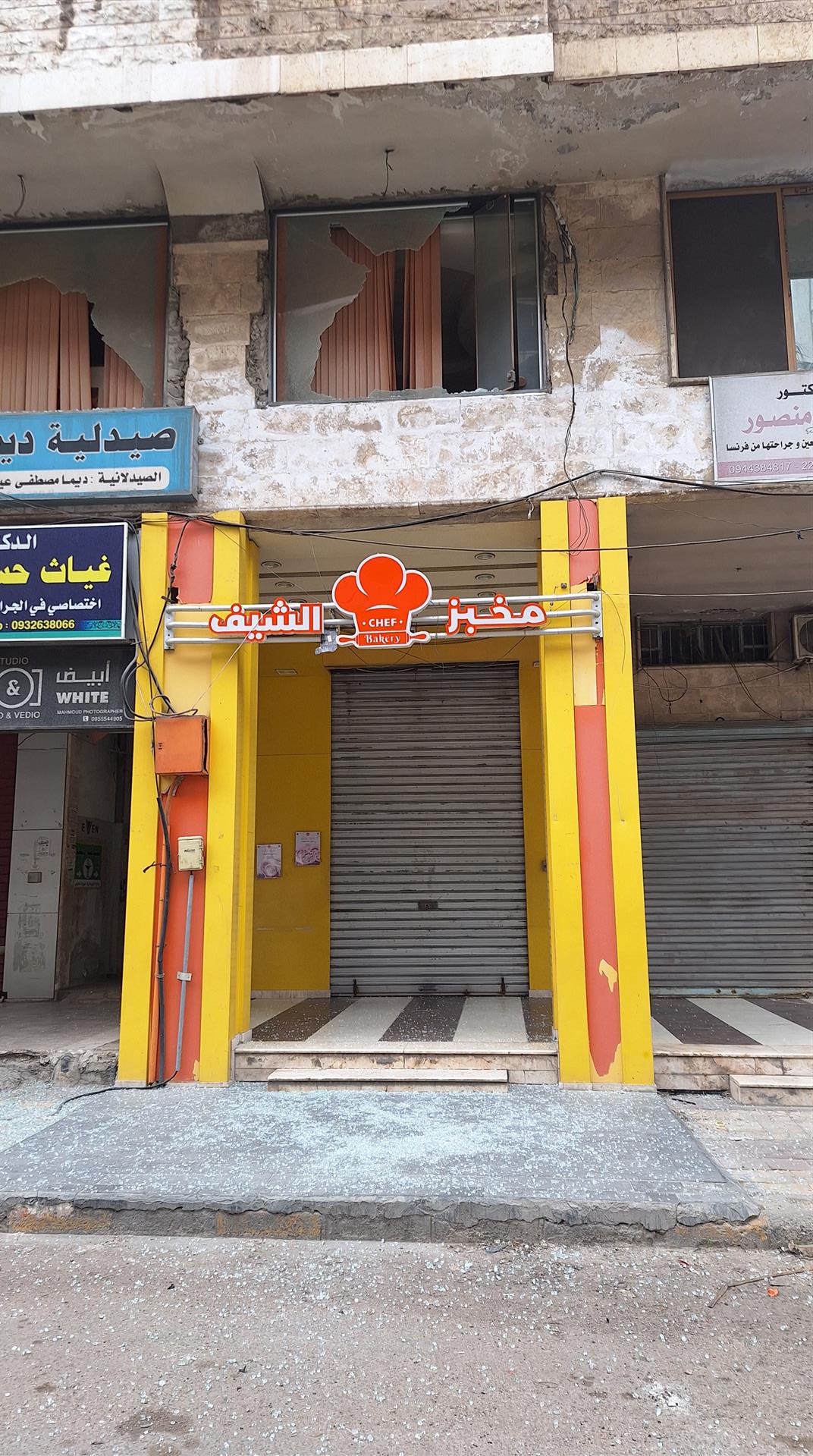
Trouble around the town.
I got on with some planning for Lebanon, then finished off a blog post. It had been a weird day and I wasn’t entirely sure how I felt about it all. Some friends were moaning at me for taking risks, which I appreciated. I consoled myself with fact that I hadn’t known about what was happening so couldn’t have done much anyway.
I left in the morning and came to a check point on the way out of town. They assured me the road to Homs was safe, and on to Damascus also.
Safe but petrol free. I passed a dozen service stations and none were open. The roadside petrol sellers weren’t there either, and I was already on red. I kept going and at every check point I asked about benzine. The answer was always ‘further on!’. The tank ran dry and I had to put in my spare fuel.
I had planned to go to the Krak Des Chevaliers castle but didn’t dare divert because I didn’t know what the fuel situation would be in Homs. But when I got there I saw lots of people selling it at the roadside and I bought 10 litres.

Seen at the roadside.
I went into Damascus and found the Latakia Hotel, as suggested to me by Thomas. But the entrance seemed to be at least two stories up and I didn’t fancy the area regarding safe parking. So I went back to the Brazil hotel. I tried to negotiate a discount, but no joy. I’m in a different room but it’s no warmer. How can a building be so damn cold inside, compared to outside!
I went out to find a bakery and got lots of buns and biscuits, just to be on the safe side. Then I went looking for the same food place as I’d used before. But I walked around for ages without finding it. I gave up on it and went to a different place where I got cold chicken and rice. Then I realised the place I wanted was next door! But it was closed – or closed down. It was hard to tell, which was a shame. I could only guess at the reason.
After eating I went down to the coffee shop to spend the rest of the evening there. It was warm! I had intended to check the chain and top up the chain oiler but it got dark. A job for next morning. But I did get on with some writing, so had a productive evening.
I was up and gone before 11. It was an enjoyable ride but up some very steep hills. I was feeling sorry for poor Thomas on his bicycle.
Getting out of Syria was easy. It took half an hour or so because of queues. They asked for that piece of paper I had and stamped it. I was kind of hoping to use it again and save $50 when I came back. I kept it in case I could get away with it.
The Lebanon side was a 2km ride away. I had to queue for immigration, but not too long. Then it was customs. The guy there filled out a long form and took all the details off my registration document. Then he took $50 off me and gave me a receipt for that. His next trick was to ask for another $50 for himself. I told him a very firm NO. He hinted at a lower amount but I told him very firmly he wasn’t getting any money off me. Cheeky so and so. He’s the first person, as far as I can recall, to try that trick.
He sent another guy over to photocopy my documents and , suspecting what might happen, I took my documents off him as soon as he came back. He asked me for $5. I told him he shouldn’t be getting anything but I gave him $1. I think he might have argued about it but a guy in uniform came over and he left. That guy took half of the pink customs form and then said I could go.
The customs guy in the office made a big point of telling me I mustn’t lose the form he gave me and it had to come back to him when I exited. Hmm. Was he setting me up for problems??
Syria is in a mess! I can’t begin to imagine how people survived under Assad. He treated his own people as if he was a rapacious colonial power, robbing the country and murdering anyone who thought was against him. It’s amazing that a former ISIS leader was the one who deposed him. It makes no sense, except that it happened, but only three months before I arrived there.
Not enough time for major changes to have occurred but hopes were high and the people I spoke to were feeling a freedom they’d been unused to for many years. It seemed that the West was prepared to give the new regime a chance to succeed, although it was unknown in what way any help might manifest itself.
Displaced Syrians were returning in large numbers, looking to help with rebuilding the country. I’d love to go back there in a few year’s time to see if those burnt out trucks have been removed and the missing windows have been replaced.
 MOTOPANGAEA