
Aqaba, Jordan. 8th April 2025.
The southern half of Jordan had been a magical experience. Nature shouted at me from every hill, valley and shore. There had been so much to see and take in. But what would Saudi Arabia be like? Just sand and rock, or was there more to it than that? It was time to find out.
From Aqaba I was at the border by 11am. Jordan took 15 mins to clear. Very smooth, but still costing 35 JOD in fees. They gave me an exit paper. Then it was over to Saudi.
Getting my passport stamped was easy enough. The visa I’d applied for online was on their system. Usefully, the cost included medical insurance. I was photoed and fingerprinted. Customs was also easy. It took the guy a little while to find the info he needed on the registration document, but I helped him along. He wanted to see my Jordan form. There seems to be some tie-in between them. But he didn’t issue me any paperwork of any kind. But no fee to pay either.
I had to have my bags searched and sniffed by a dog. Then I took my bike round to the x-ray scanner. There was a camper van waiting to go in, with a coach behind it. When the camper went in I asked the coach driver if he minded me going in front of him. No worries with that.
Once that was done I went to the exit gate, he obviously had the scan results on his machine, then I went through the gate. All done by Midday. But I realised I didn’t have any vehicle insurance. I saw a building with a sign saying ‘Brokerage Offices’ and went in there to asked about it. They didn’t know what I was talking about.
A bit further along was another office with some German camper vans outside. There was an Arab guy there who said he’d help me. When he’d finished we went back into the first building and he got the same reply I did. In the end I needed to go back through the exit gate and go to a little office on one side. And here’s where the total incompetence began.
The guy seemed to really struggle with getting the information into his system. He kept referring to ‘the car’, I kept telling him it’s a motorcycle. After lots of messing about he finally gave me a figure of 460 Rial (about £42). That, according to a chart on his office wall, related to a car. Obviously I protested. When I kept insisting it’s not a car he came out of his hut and I pointed the bike out to him.
He got on the phone and a younger guy arrived. He messed about on the computer for ages, trying to input the information. Meanwhile I was working up a real sweat in the heat. Eventually he gave me the correct price of 299 Rial for my bike. But then he said I needed to pay him the difference between the two figures, in cash. I very quickly disabused him of that idea. Stupid Boy!
I paid the 299 SAR on my card and got the required piece of paper for the 3 months insurance. It’s clear their system isn’t geared up to deal with bikes, despite them being included on their posted price list.
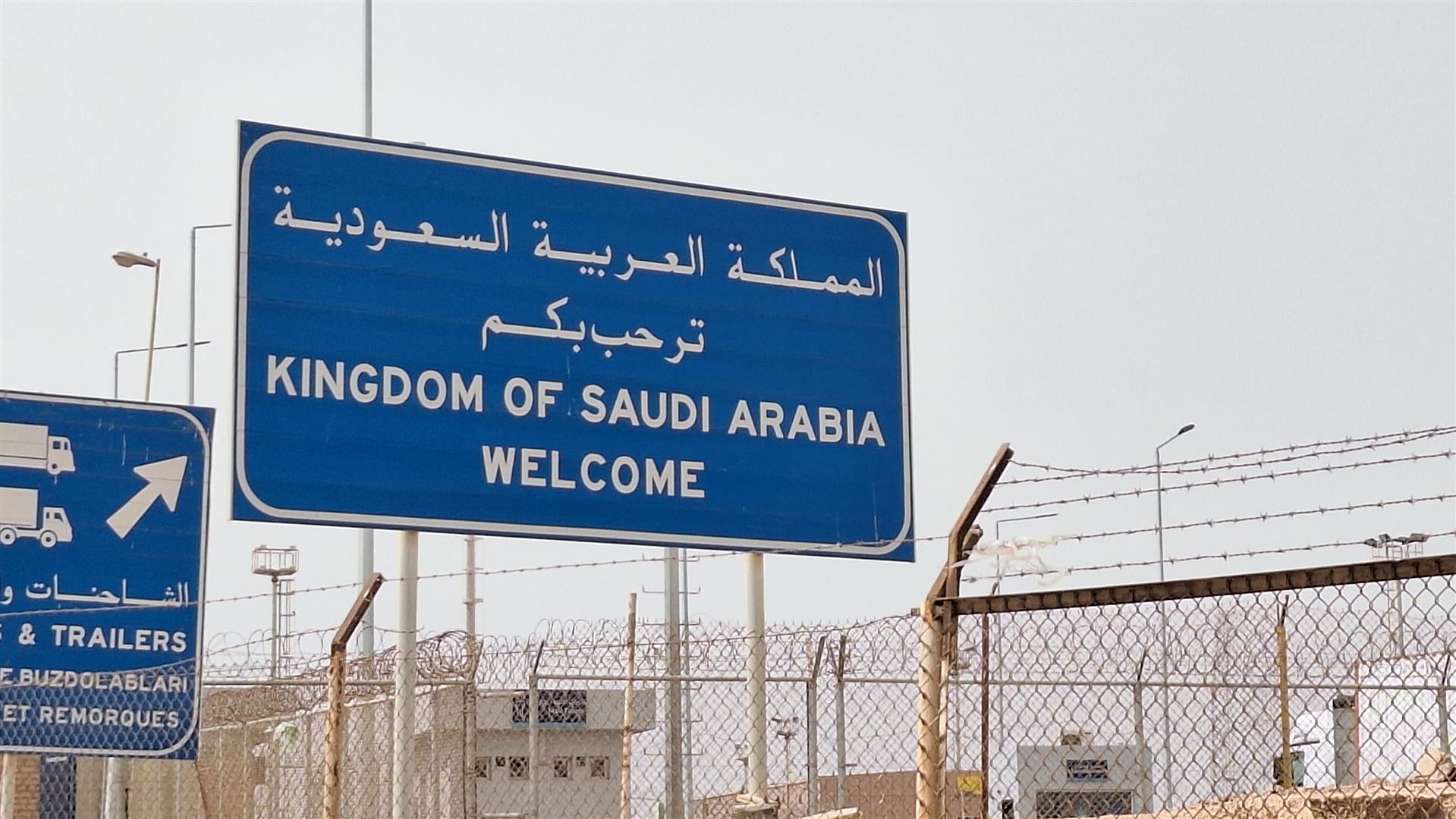
Onto the Arabian Peninsular.
With that all done, I headed to the nearby town of Haql to get some cash and a SIM card. Initially I couldn’t find the ATM Google was showing me so I went to the Saudi Telecoms office. It was closed. A cleaner was inside and he gave me the impression it wouldn’t be for long. Probably at prayers. So I walked back to where the ATM should be and discovered a drive through unit. I’d been looking for a building. I withdrew 500 SAR, getting 2×200 and 1×100 notes.
By the time I got back the STC office was open and a helpful young guy sorted me out a £15 plan, monthly, with about 10GB on it. I can top up as necessary via the app. He said it’s the cheapest way. He also helped me by getting me some much needed water and changing my 100 note into 2×50.
He directed me to a coffee shop, which was closed. Google found me another one where I had an Americano and a rule breaking cake. But it was very nice.
It was here that I discovered I’d been seriously over valuing the currency. I thought it was 2.30 Rial/£. It is actually 4.70/£. Much better!
I booked a hotel in the town of Tabuk and headed up into the mountains. It was dual carriageway pretty much all the way, going up to 900m, but the height brought no relief from the heat.
I filled up, painlessly paying by card. Then I got pulled over by the police. All they wanted to do was say Hello. I arrived at the hotel in Tabuk at about 17.30.

Oooer!
I was disappointed with the room. It had a kitchen, with a fridge and a cooker, but no loose equipment of any kind. I had to ask reception for a kettle, which they delivered to me once the manager had arrived. The kitchen tap had no water. The TV was terrestrial only, with no remote control. Fortunately I found a sports channel. There were broken floor tiles going into the bedroom. The towel supplied was too small. But the lounge and bedroom were OK. I was not impressed. It cost £26.50, which was quite high for me. Was this a sign of things to come?
My first day in Saudi Arabia had gone well. Crossing the border – easy. Getting a SIM card – easy. Finding a hotel – easy. An enjoyable, if boring ride to the hotel. So far, so good.
I gave myself a rest day. I needed to make plans for getting to see the places I’d marked on Google. My normal procedure is to search on Google for “What to see in ……” Then I mark those I want to visit on the map and make plans around them. Sometimes people I meet will suggest other places, which I’ll then add.
The problem with Saudi was that those places were laid out on the map in two north/south rows, one on each side of the country. This made route planning awkward. Some thought was needed. But for now, I was going to visit the Hejaz railway station in Tabuk.
The Hejaz Railway is named after an ancient state on the western coast, that’s now included in Saudi Arabia. It connected Damascus with Medina. It was used by pilgrims to Mecca. But during WW1 it was a vital link for Ottoman Empire troops and materials as they held the Arab tribes under their rule.
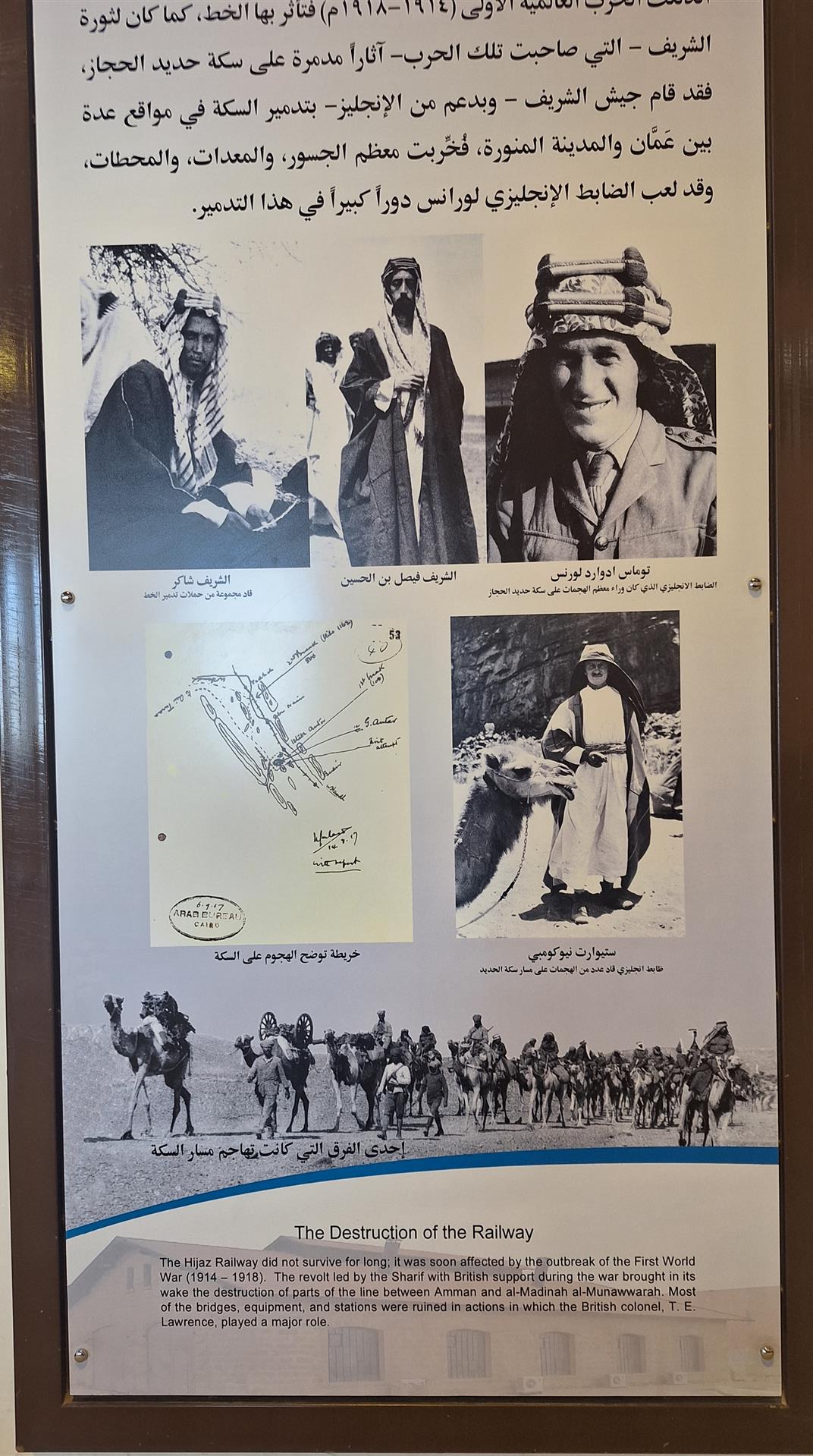
TE Lawrence (Of Arabia) gets a mention.
It became known to the wider world because Lawrence of Arabia spent a large part of his time in that region trying to disable it. And he was very successful most of the time. But the Arab tribes had always targeted it as part of their fight against Ottoman occupation, even before that.

Station buildings.
The station was now a museum. I parked the bike nearby and as I walked to the entrance a guy in a car pulled up and gave me two small bottles of water. How kind!
The buildings are very smart and there’s a preserved engine and carriage in one of them, plus some story boards. There was one building that I wasn’t allowed to go very near to, for reasons I didn’t understand. I think it was a government building. I persuaded the guard to let me take a photo.
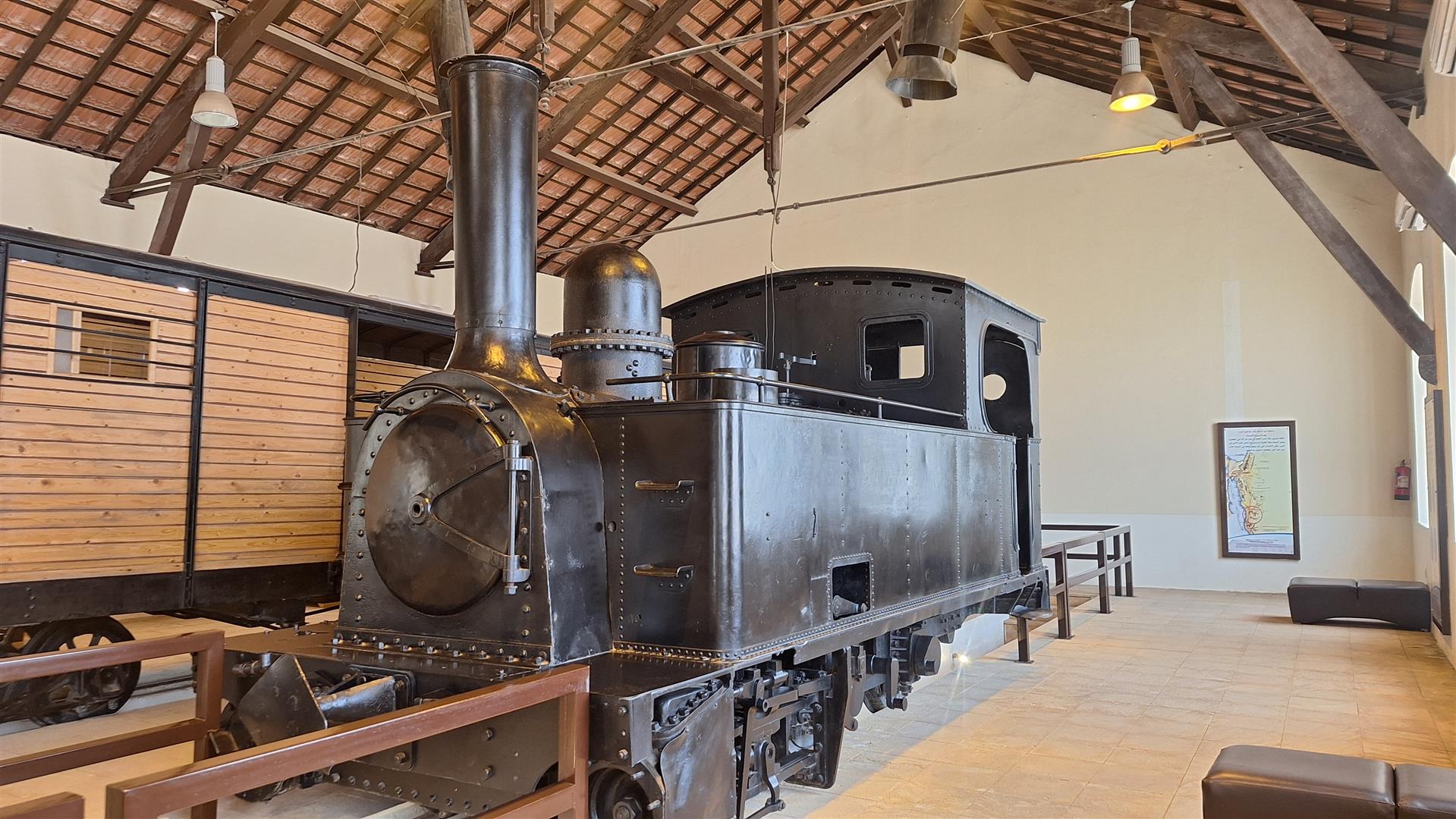
Hejaz Railway locomotive.
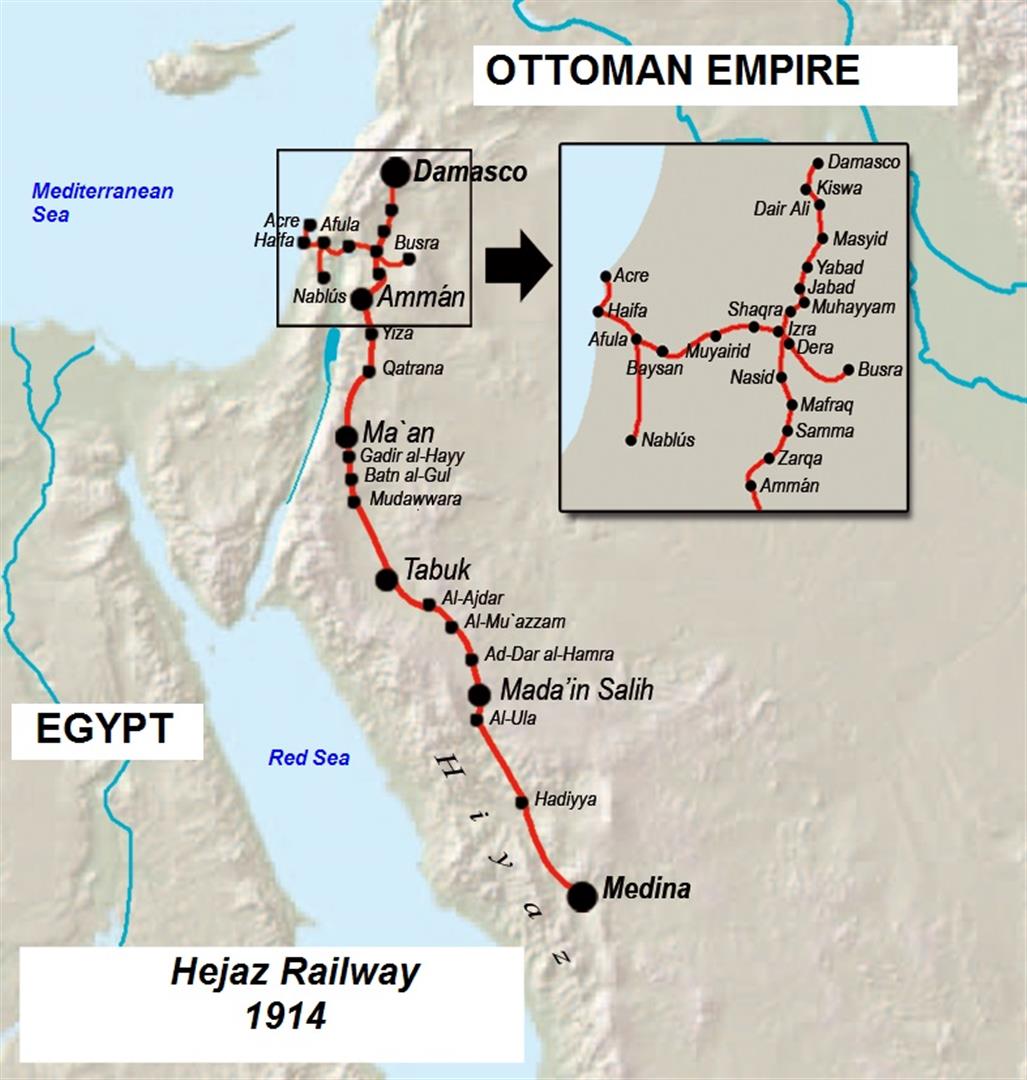
The route of the railway. (Copyright lies with the owner.)
Where next? I copped out of the decision about which north or south leg to follow by first heading to the town of Tayma and its famous well.
A long and boring ride then ensued. Dual carriageway all the way. Nothing to do. Only rock and sand to look at, but with a couple of amusing road signs. A couple of times I had guys saying hello to me from passing cars. I was needing fuel and just before 3pm I found a petrol station. After I filled up a young guy in a car gave me a can of drink. How kind, again! I ate my lunch and booked a hotel before heading off again.

Taymar Symbol?
As I approached the town there were some ground level sculptures at the side of the road. Palm trees and things. I have no idea what they were about. Maybe some kind of town logo? Along the central reservation were sculptures of plants and trees, all looking very welcoming and cheerful. The Haddaj Well was due to open at 4pm so I went there ahead of going to the hotel. But it was closed.
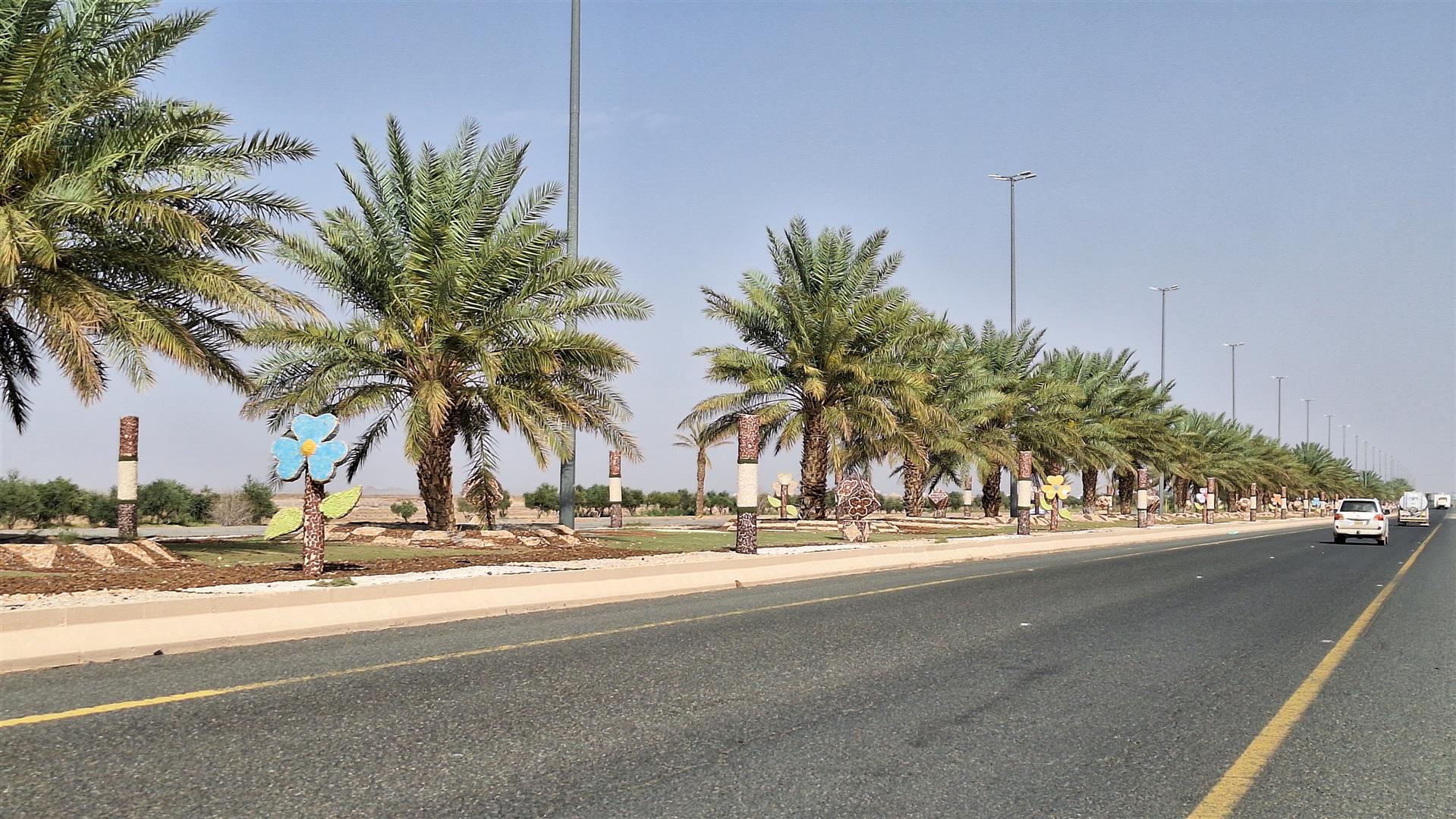
Median sculptures.
At the hotel was a helpful guy who showed me the room and the facilities, which included a kitchen sink and a kettle. Superb! After a cuppa I walked back to the well, which was now open.
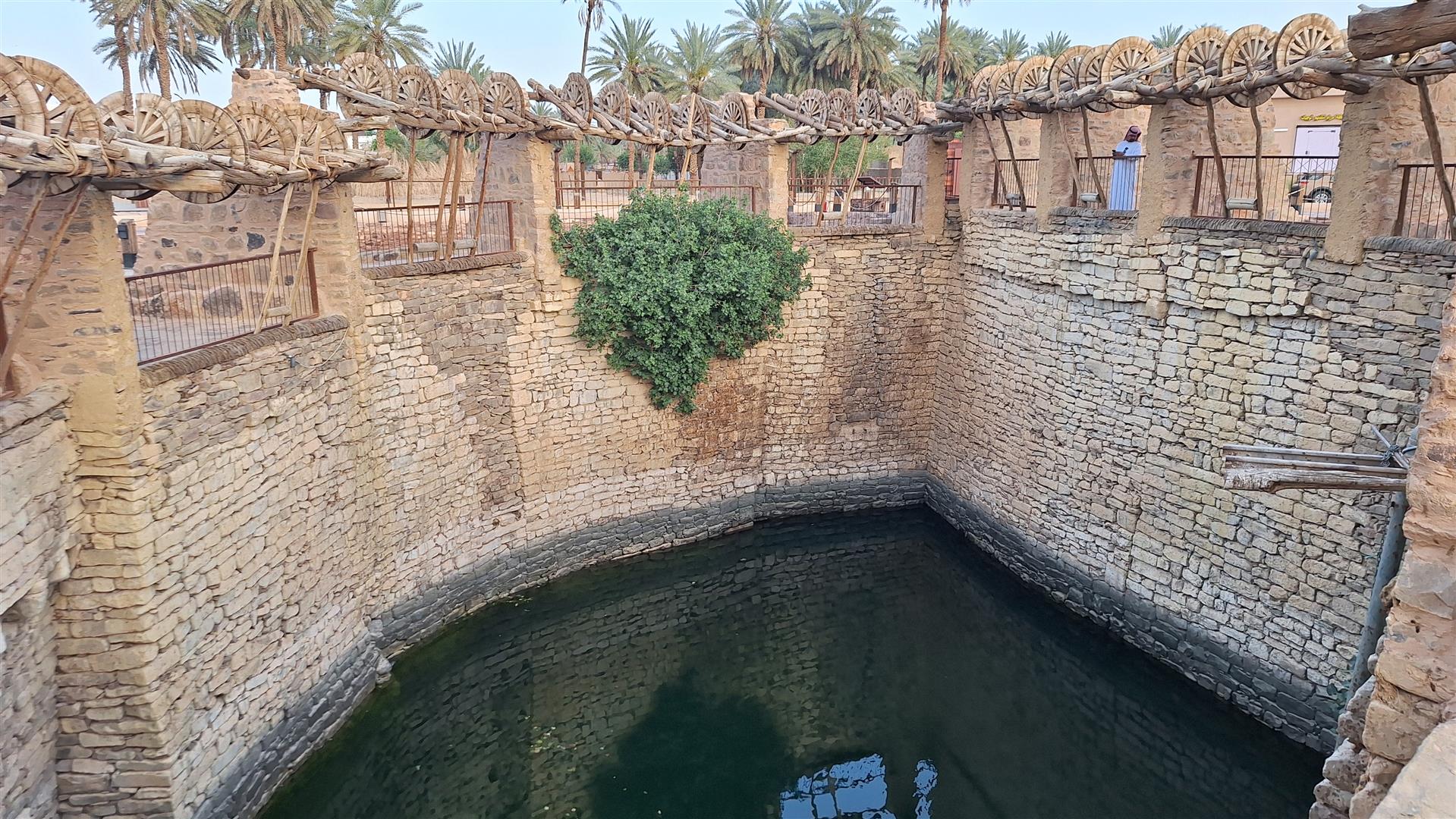
The well and the pulleys.
It’s a superb piece of history. Reckoned to date from 600BCE, it’s never run out of water. It has about 70 pulley wheels, which allow large buckets to be dropped in and filled, then hauled out by camels. The water is then poured into channels which run out to the farms. It’s 65 metres across and 13 metres deep. They’ve done a very good job of preserving and presenting it. I was impressed.

Where the camels walked..
There was another heritage building opposite the well but it was closed. Inside it is an ancient Stele, a stone slab with carvings and writing on it. It’s considered to be very important because it links the town with Egyptian and Assyrian civilisations.
Next morning I headed towards Hegra, a Nabataean archaeological site near the town of AlUla. It wasn’t so warm that morning. Chilly, in fact. But it warmed up after an hour or so. The ride wasn’t so boring because I went onto a single carriageway road after a while and the desert became much more interesting. Some really attractive rock formations to look at and photo.

Is this a herd of elephants?.

A familiar place.
I kept heading to Hegra but when I got to where an approach road should have been, it wasn’t there. I could see a new estate and I guessed that was why. So I rode further down the road – nothing. Then further back the other way. I came to a roundabout and followed a sign for Hegra – which seemed to take me in the wrong direction.
I passed by a mosque, with loads of people outside. Friday prayers, of course. The road came to a T junction, with a dirt road either side. I’d turned back and stopped to photo the palm groves, when a young guy in a 4×4 came up and stopped next to me. He said hello and invited me to come to his place and drink tea.
He went back to the mosque collect his friend and then I followed him down a sandy track to his farm. His friend went off and we sat down and chatted. He showed me on the map where the correct entrance to Hegra was and said I’d need to book a tour for it.

Sautan.
Then he talked about some of the other places. It actually got a bit confusing in the end. He said he wanted to get a bike and travel, like me, so we chatted about that. After a while I left, and I never did get any tea.
I found the entrance to Hegra only to be told, by a nice young woman who was all masked up, that there were no tours available until Sunday. I took a couple of brochures off her, to help with my planning. The coffee kiosk opened soon after so I indulged.
I could tell that some of the other places also needed booking but I found one that didn’t – Elephant Rock. I organised a hotel on Booking then went off to see it.

Elephant Rock.
It’s basically a huge rock that has been eroded at its front end and looks like an elephant, standing with its trunk on the ground. Pretty impressive, I thought. It provided impressive shade for the group of Asian workers who were resting on the other side.
Then I headed to the hotel in AlUla and got booked in. The guy couldn’t get his machine to accept my card and I had to give him all my cash. So the first job was to find an ATM. That done, I went shopping. I got Greek yoghurt, bread, eggs, humus, milk and biscuits, trying to eat sensibly. The guy at the shop had some English so he came out and chatted to me. Then he gave me some water. So much water!
Why am I describing my shopping list to you? Because I recently managed to weigh myself and I was 3-4Kgs heavier than I wanted to be. I was trying to make my breakfast healthier and with fewer carbs. But I was still addicted to cake with my coffee, so there was work to be done.
I went online to see about Hegra. There were no vacancies until Monday and it was Friday. The cost was 95 SAR. That’s £20! It was time to rethink that plan. It was clear from the brochures that I wasn’t going to see anything that I hadn’t already seen at Petra. I pretty much decided at that point to give it a miss. There were other good places to visit anyway.
In the morning I headed to the visitor Centre at the Winter Park, to get a better idea of my options. The route took me around the back of the town and past some impressive sandstone cliffs.
The women there agreed with my decision not to bother with Hegra. They told me of a place called Dedan, which has plenty of rock art and tombs, albeit no temples. They agreed with me when I said that Petra had given me plenty of those. The price was a far more reasonable 60 SAR (£12.50). So that got booked for 3.30pm next day.
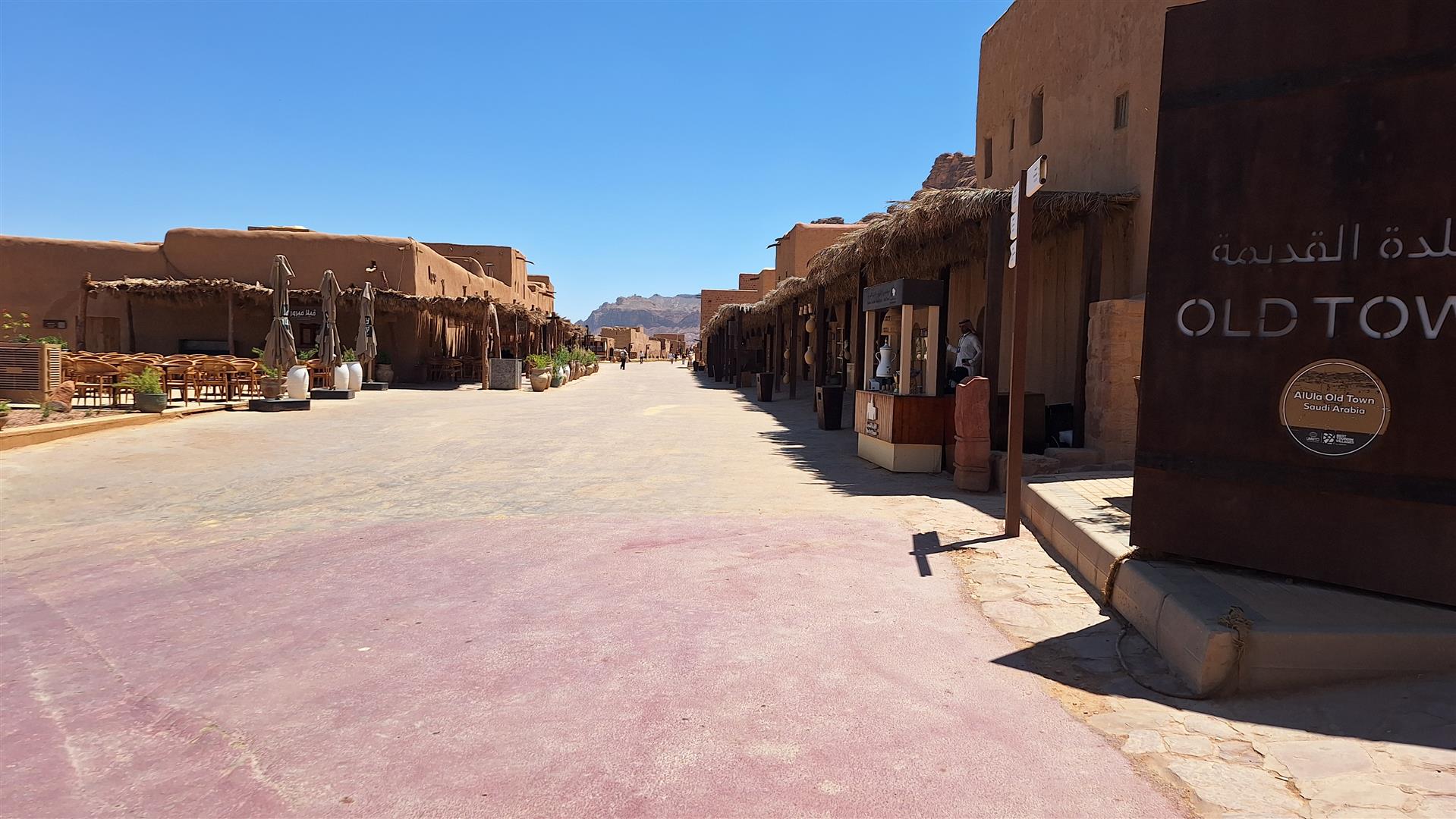
Main Street, AlUla.
Then I went to Old AlUla. I had to use the car park but a courtesy electric cart took me down to the beginning of the town. I walked along the main street to its end, then back again. Then I diverted into the actual old part of the town and wandered along narrow alleys between mud brick houses.
I went up to the top of the old fort to get a good view over the rooftops. It was amazing to see how closely packed the buildings were. There were small open spaces between them for socialising, but not many. I could see how the roofs were constructed from up above. Thin tree trunks laid across as supports, then covered with rattan and clay. Fascinating.
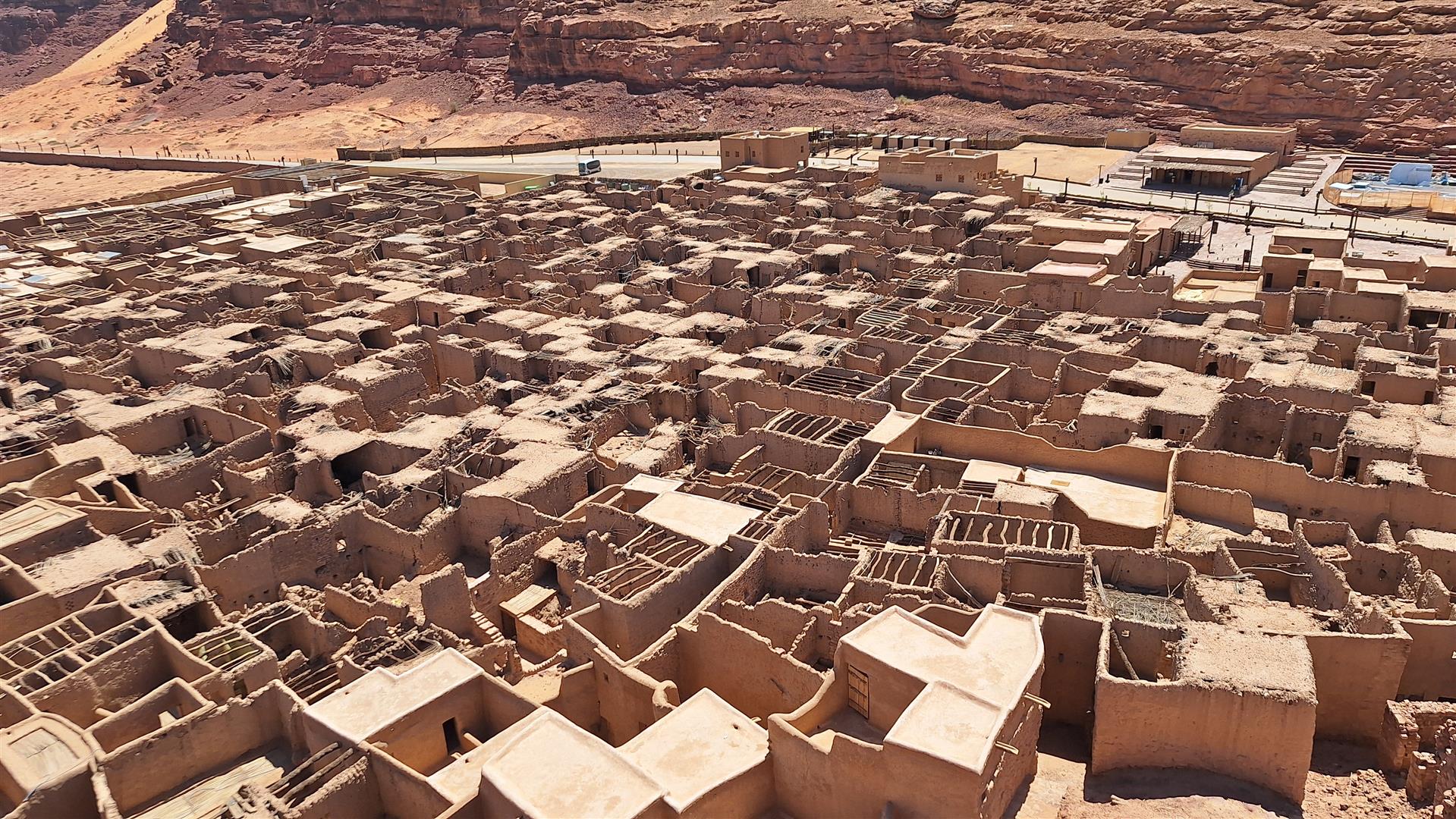
The oldest part of the old town. Very tightly packed.

The oasis allows for plenty of agriculture. Mostly date palms.
Back on the main street I found a public toilet. There were a couple of Indian guys looking after it. One held the door to the trap open for me. Then he ejected some paper towel for me to use when I washed my hands. Service verging on servile, it seemed to me. Outside I saw several of them walking around and sweeping up. These rich Arab countries run on cheap south Asian labour, rather like the USA does on Latinos. But they did an excellent job of keeping the place clean.
In the golf cart on the way back to the car park I got chatting to some people. They came to look at the bike and to chat about it. Then some English people came past and spotted the number plate. So we chatted as well. An older couple and a young one.
The older woman works at the embassy in Amman. Her man does nothing as he’s retired. A nice meeting. It was only later that I thought I could have asked her if she had any knowledge of the British couple imprisoned in Iran. Who, I hear you ask?
A British couple in their fifties were arrested for spying while travelling through the country on their motorbikes. They had an official guide with them but the woman decided it would be a good idea to interview people, including women, about how they felt about life in Iran. Is that spying? It sounded like it to me, albeit very low level. They currently languish in prison.
I got a cup of coffee and decided to try to get to the Hijaz railway station near Hegra. That was a total failure. Once again, Google tried to take me down a road that no longer existed. And, once again, the only route to it was via the new entrance to Hegra, and its fee.

Date palms on a farm.
I loafed around all the next morning on the internet. I did my best to plan my route and I decided to go down to Medina then back up to Hail. Then south to Riyadh and into Bahrain. From there I thought I’d cut back across to Jeddah and continue south. Then I’d have to cut back across to Riyadh again to curve around to Oman. But that might get changed. (Look at the map at the top.)
I enquired online about a visa for Bahrain and discovered I could get a visa at the border. I asked on the Middle East WhatsApp group and was told the bike would get in easily. I also researched The Emirates but that was less clear.

Dadan rock tombs.
After lunch I went out on my tour. It was very good indeed. I’d assumed Dadan was Nabotean but it isn’t. It’s from the Kingdom of Dadan, followed by the Kingdom of Lihyan. They occupied the area between the 9th and 2nd centuries BCE. Their income was from a similar source to that of the Naboteans and the tombs were mostly built in the same way. They also had the same expertise in managing water supplies.
Everything was super well organised, with a nice young woman talking us through it all. A coach took us out to the Dadan site where we could look at the rock cut tombs. Then we went a bit further to an area of temples where they’re still digging and reconstructing. It’s reckoned that 95% of what there is to find is still hidden.
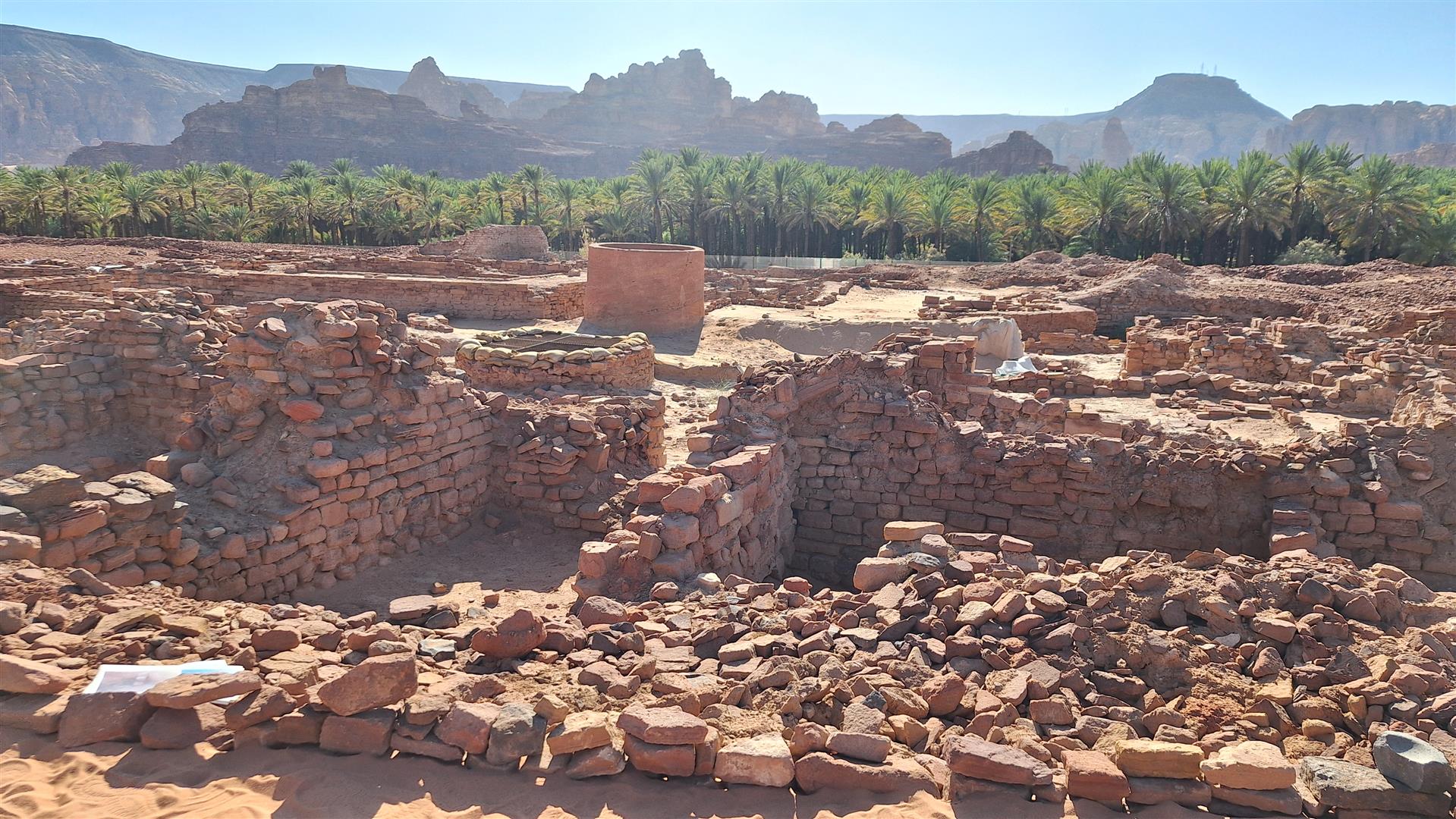
Exploration of the runins. There’s much more work to be done.
I was impressed by the fact that our two guides were women. The one that was explaining everything to us spoke excellent English.
Then we got back on the bus to go to Jabal Ikma where we saw hundreds of rock writings and petroglyphs. Some where in an old Arabic script. Most were cut into the rock but some were in relief.
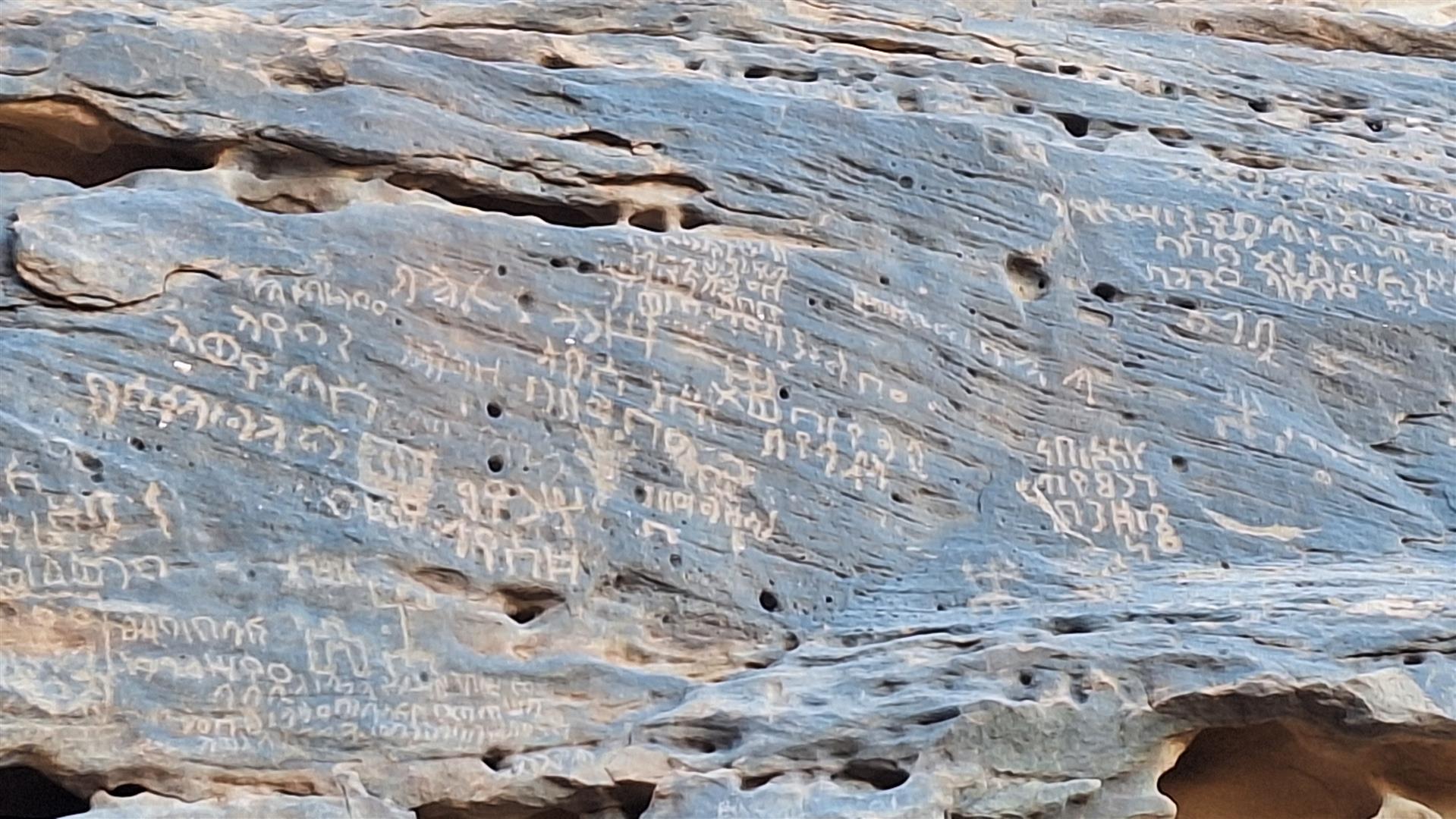
Rock writing.

In relief. This must have been really difficult.
Out by the rock face I noticed that the rocks at the bottom of the cliff were the same colour as those at the top. But the bulk of the cliff face was almost white. My theory was that movement of the earth had caused most of the cliff face to fall down, probably where there was a fissure. An American near me said that his daughter was an amateur geologist. I pointed my theory out to him and suggested he take a photo to send to her, to see what she thought.

The white cliff face and the rocks piled at the bottom told me this was a rock slip.
We went back to the visitor centre and had a go at carving our names onto pieces of rock in Arabic, but I got bored and gave up on it.
The whole trip was very interesting and was very well organised.
After a good day out a bad night followed. There was a family in a room near to mine and they were letting their kids run about screaming and crying all night. Plus all sorts of crashing and banging. At one point I got dressed and went out of the room to confront them but I couldn’t find them. I went up two flights of steps but no sign of them. This was at 4.30. Eventually they mostly shut up and I got back to sleep somewhere near six and woke up at 9.30. I was not happy!
I set off to Medina but made a diversion on the way. There were two places related to the Hejaz Railway that I wanted to visit.

The 21 arched Hejaz railway bridge.
The first was the 21-arch Wadi Reshad Bridge, one of the few that still survive. It’s in surprisingly good condition and looks good with its grey and red brickwork. The rail bed is still flat and smooth. I’m guessing it’s been refurbished for tourism’s sake, although it does lie a couple of kilometres down a stony track. I imagine that interest in the railway is fairly niche, but there’s lots of people who love these things.
Further along the old Medina road lies, literally, what’s referred to as the Lawrence Train. It’s a collection of carriages, wagons and an engine, all lying in the sand. It’s a rusting hulk. The tracks that brought it there have long since been removed. It typifies what Lawrence and the tribesmen that he led where trying to achieve during the Arab Revolt of 1916. Unfortunately the site is surrounded by a fence and there was no way for me to get a photograph of the topside of the engine, only the wheels.

A very dead train.
Then it was another long and boring ride to Medina, but with a fuel stop for me and the bike. The terrain was very dull. Sand and low rise hillocks, mostly of scree type rock. At one point I had to stop while a camel stood in the road, which made great photo opportunity.
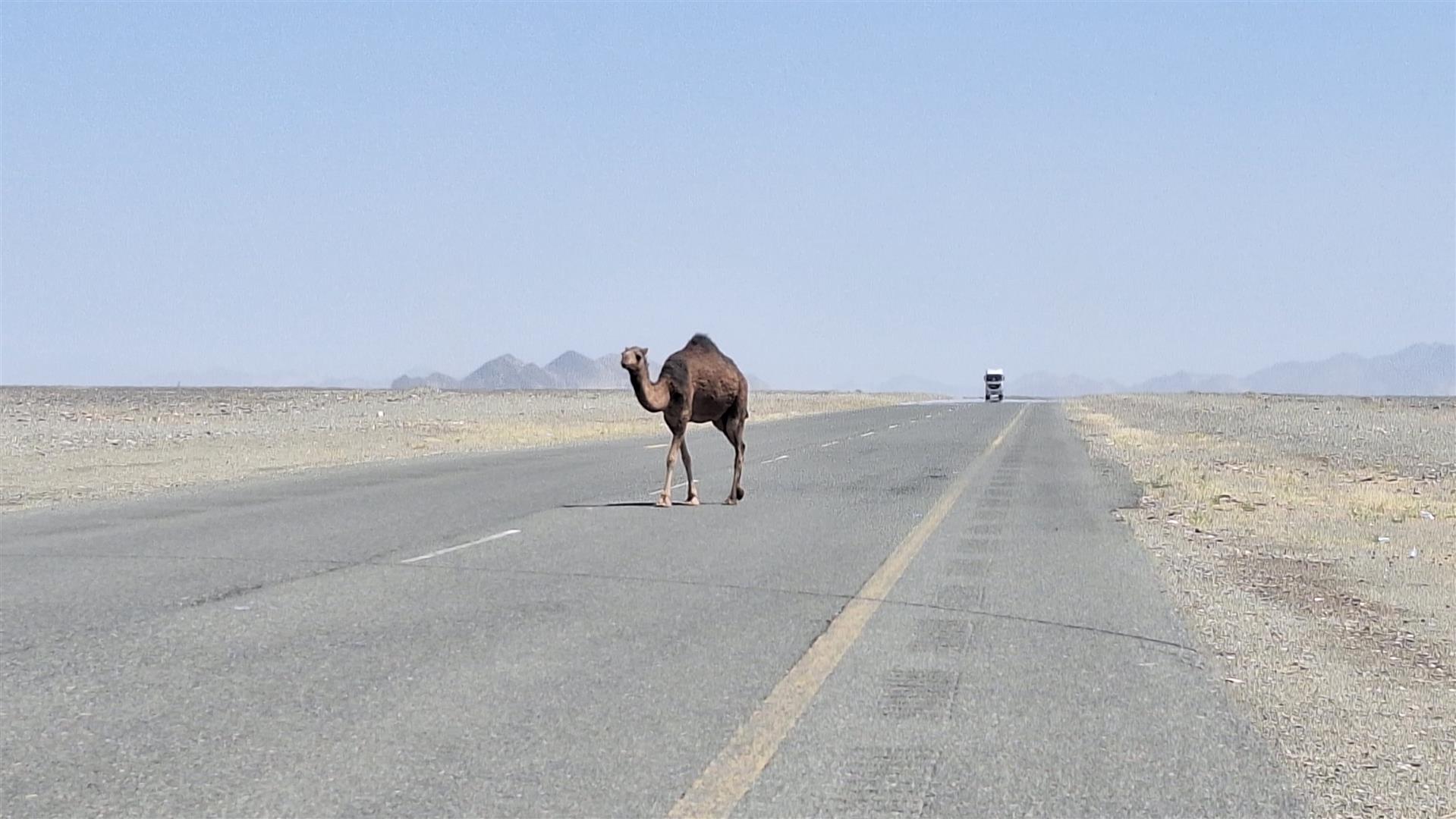
Controlling the traffic.
Via a friend of a friend I’d managed to make contact with a guy who lived in Medina. He said he’d be delighted to show me around the city. Of course I agreed. Ahmed came to collect me at ten. We went to all the places I wanted to see.
Masjid al-Qiblatayn. The mosque from where Mohammad directed people to pray towards Mecca rather than Jerusalem. Which raised the obvious question as to why the first mosque was there. Research gave me no explanation except that in the early days of Islam Jerusalem was the direction of prayer. Mecca was already a holy place, predating Islam. It was Prophet Muhammad’s birthplace so became Islam’s holiest city.

Masjid al-Qiblatayn Mosque.
It’s a beautiful place, although not highly decorated inside. We popped in and I took a photo. I took some of the outside too. What I really liked was the sunshades placed along the walkway. I saw that at more than one mosque.

An excellent idea in such a hot country.
Then it was coffee time. We went to quite a swank place for coffee and French Toast. Bread covered in caramel sauce with bits of fruit. Very sweet and very naughty. Thankfully we shared a piece. There was a woman sitting behind us who was wearing a burka and had to lift the mask up to feed herself. That just seemed stupid to me.
Next we went to Al Masjid an Nawabi. This is the site of the first mosque in Medina, built by Mohammed. Obviously it’s been rebuilt many times and also looks stunning. Prayers were just starting so we couldn’t go inside. So, once again, a couple of quick photos.
People were hurrying, even running to get inside. There were large carpets outside with people, mostly women, sitting on them to pray. Ahmed said that running isn’t allowed and the guy we saw was doing wrong. Interesting. I’d read that non Muslims weren’t allowed into this mosque. But I could have gone in, Ahmad said.

Al Masjid an Nawabi Mosque.
I had run out of data and was trying to top up. But I wasn’t able to receive the code the app was sending me. Eventually Ahmed got into the app but it wouldn’t accept my card. I needed to add money then buy a package.
There was an STC shop nearby so we went there to get them to do it. The guy said it’s my phone not accepting the message. Then I remembered that I’d received what I thought was a spam message and had blocked the number. Oh dear!
We sat in the car for a while until Ahmed managed to get some money onto it using his card. Then I was able to buy the data I needed. He very kindly treated me to the top up.
He’s a very nice guy and lived in Canary Wharf for two years while he did his masters degree. It was one reason for his very good English. We talked about his family. He has thirteen siblings from his father’s 3 wives. Does that still happen there? I didn’t know.
He dropped me off at the Dar Al Madinah museum. This is all about Mohammed’s activities in the city and has lots of diorama displays telling various stories about him, and from the Koran. Nice to see, with some other interesting items on display.
The next day was just for travelling. I left at 10.45. It was quite warm and I was anticipating a hot day. And it was. But the bike and I were OK.
I stopped for fuel at about 1pm and had some lunch. Then I stopped for a break under a flyover an hour and a half later. I needed a drink! As I waited to pull away a white car pulled in behind me. It looked like police, possibly come to check me out. But I just gassed it and left.

Timely warnings.
The traffic coming into Jeddah was busy, with a couple of hold ups. But nothing too bad. I found the hotel OK. It had an underground car park so that’s where the bike was left.
In the morning I went to the the Al Taybat International City Museum. It’s a fascinating place. The outside of it is a replica of traditional building styles. Inside are various courtyards which were filled with replicas of old style houses, from Jeddah and the surrounding area. It was very beautifully done. It must have cost a fortune.
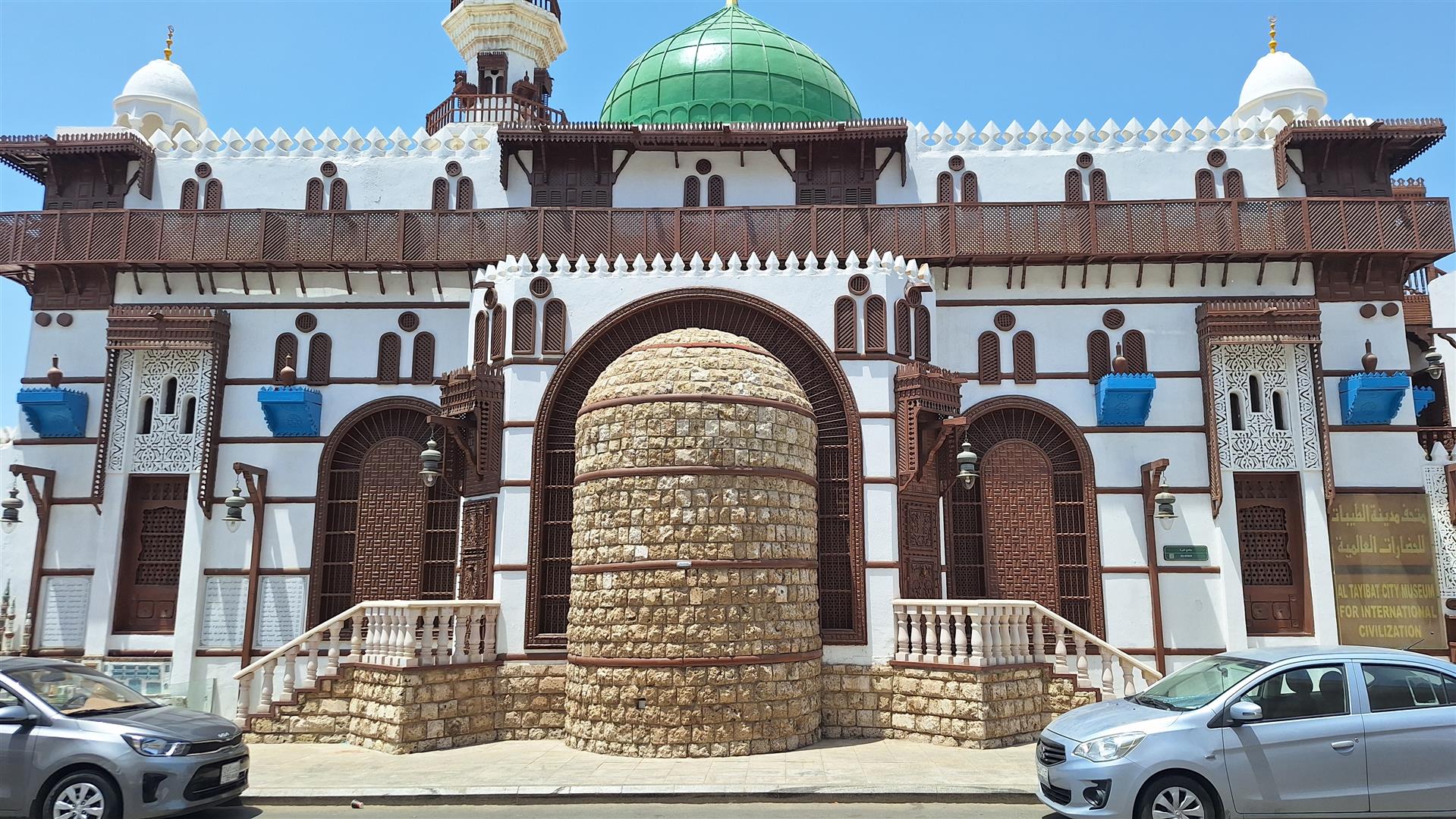
Exterior of the museum.

Various styles to be seen in the display area.
I found my way into a museum building, which was crammed full of artifacts and artwork. Hundreds of paintings, showing everything you can think of. Some nice modern art. Lots of old style Arabic pictures. Rugs on the walls. Any amount of household goods in display cabinets. There was even a section about Arabian industry, with all sorts of car parts.
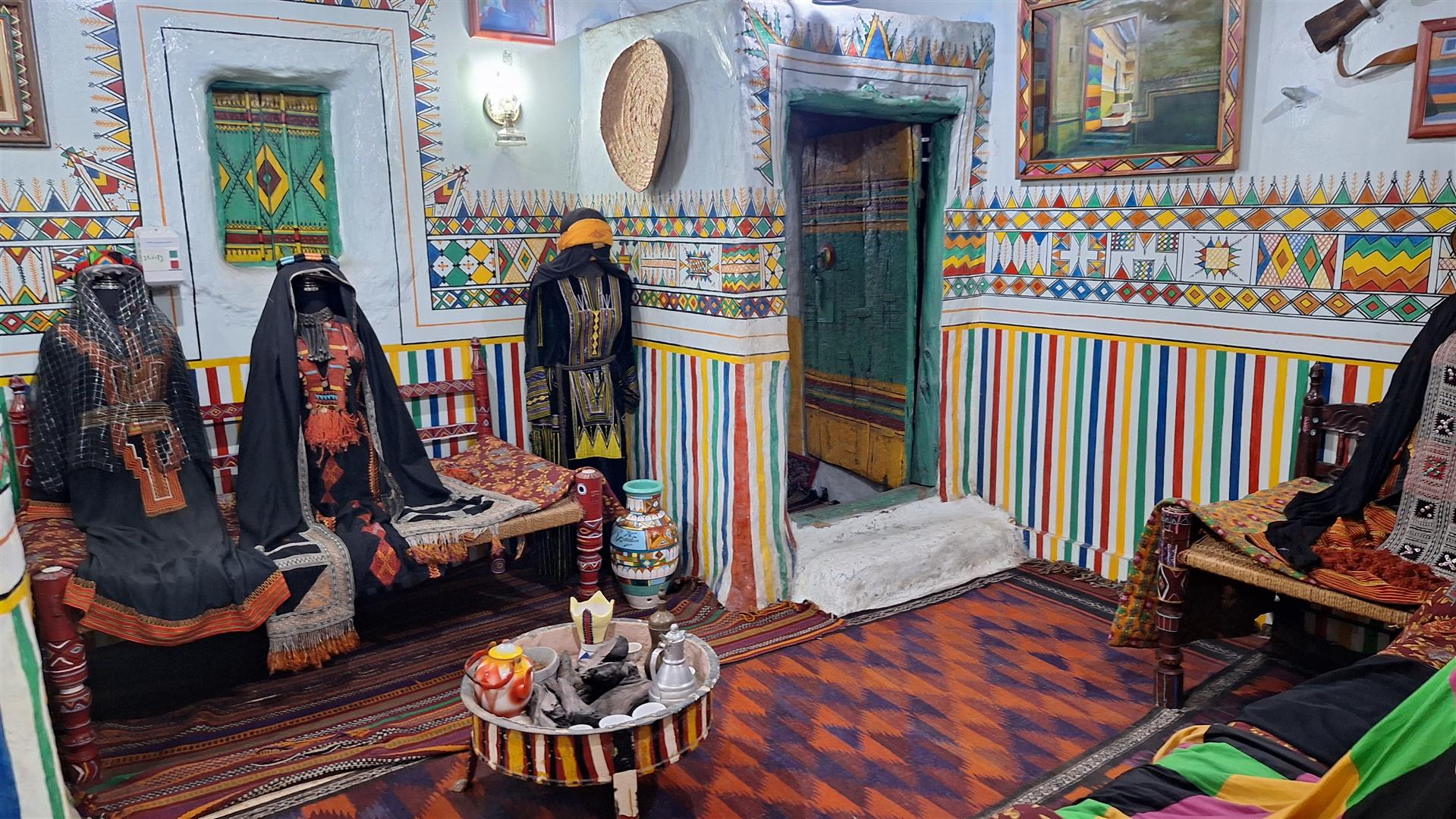
Traditional room.
I liked the large pewter jugs and bowls they had on display. Lots of costumes. A replica of the interior of a typical house, with furniture etc. The whole three floors were crowded with items. It was really good.

Large pewter jugs.
Some of the artwork on display.

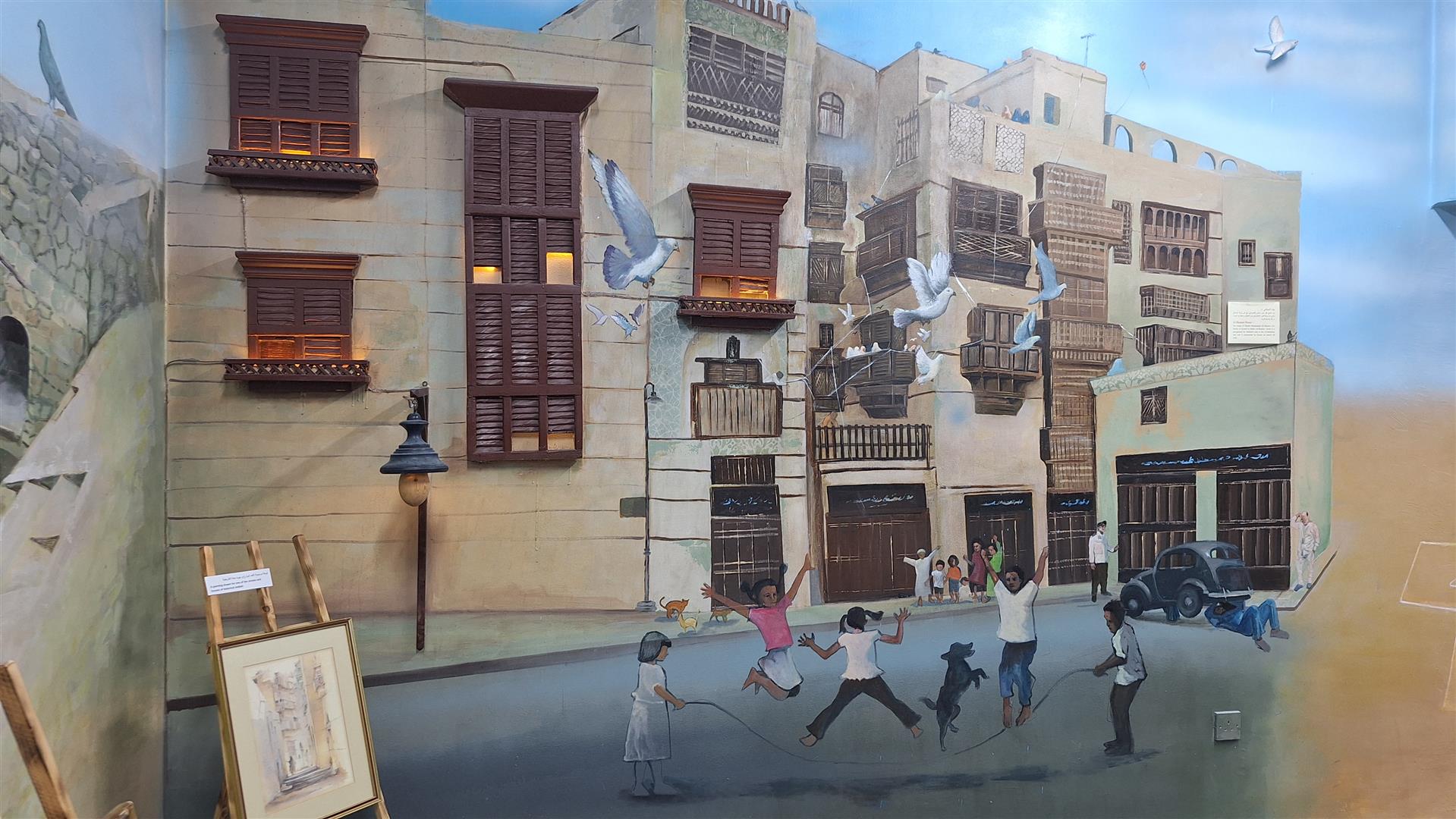
A few days before this my Airhawk seat cushion had developed a leak. I needed to find a cycle store to get a puncture repair kit or somewhere to repair it. I saw a repair shop on Google and went there, quite close to the museum.
They sorted me out. The guy did a very careful job of preparing the area, with plenty of glue and a decent sized patch. It looked like it should hold OK.

Jeddah Gate.
Later on I walked down to Jeddah Gate then tried to walk around the old town. The problem was that there was a huge amount of renovation work being done and large parts of it were fenced off. I got to see some of it and took some good photos. Many of the buildings were verging on a state of tumbledown. Lots of the window balconies were almost falling off. There’s a huge amount of work needing to be done, although I don’t know what the ultimate plans are.
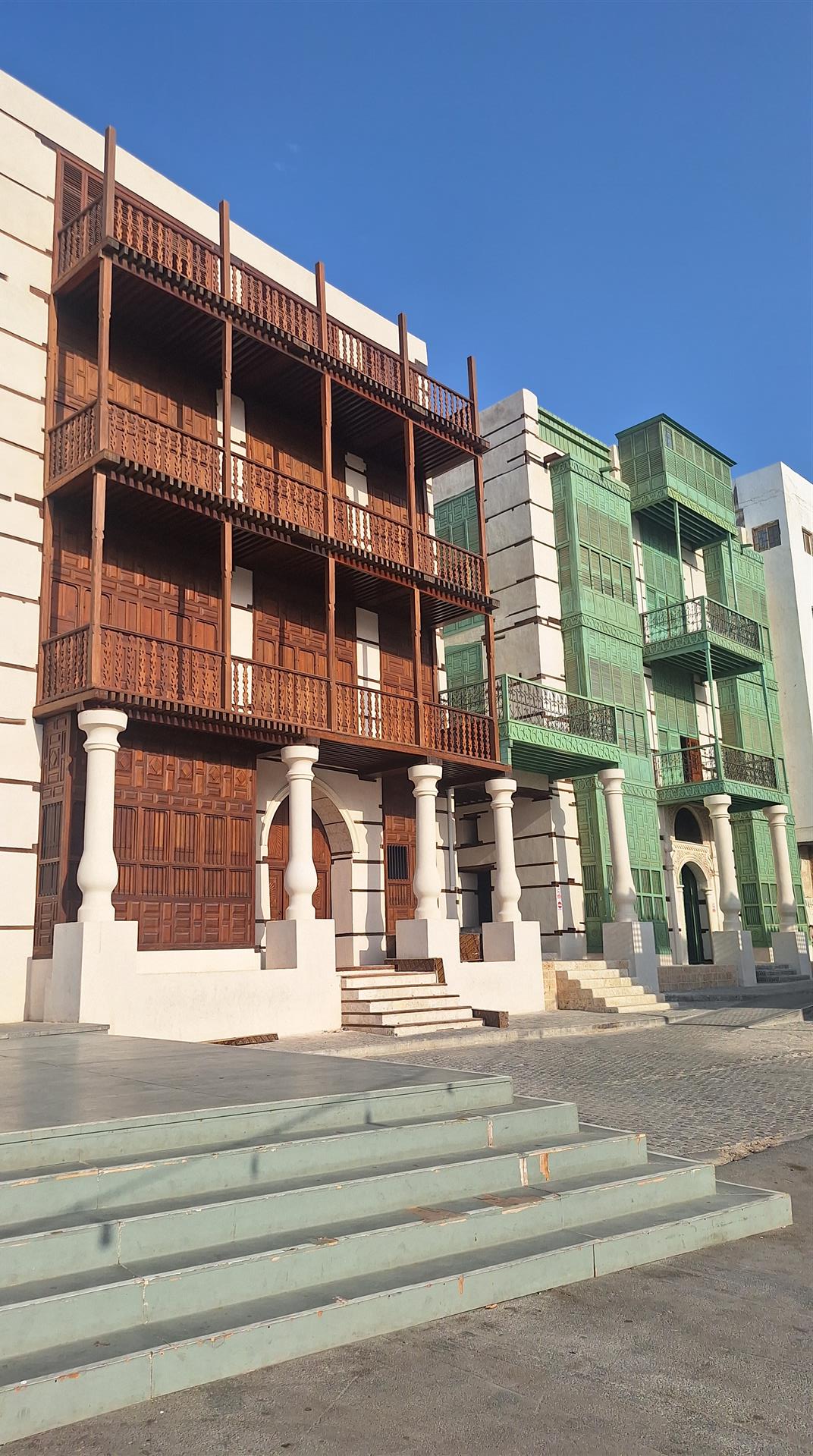
A good looking heritage building.

Ready for refurbishment.

Time for demolition?
After a bit of wandering around I managed to find the Al Shafee mosque. Made from plain wood inside, and looking good because of it. It had one minaret. Old and simple.

Inside Al Shafee Mosque.
Then I went to Al-Matbouli House museum. A 400 year old house, with lots of furniture inside, all laid out in a traditional style. The method of building was pretty basic, with logs as door lintels, for example. But it must have worked because it’s still there despite some very slanted walls. But I was annoyed with them because their card machine wouldn’t work with a foreign card. It’s a tourist attraction, guys!
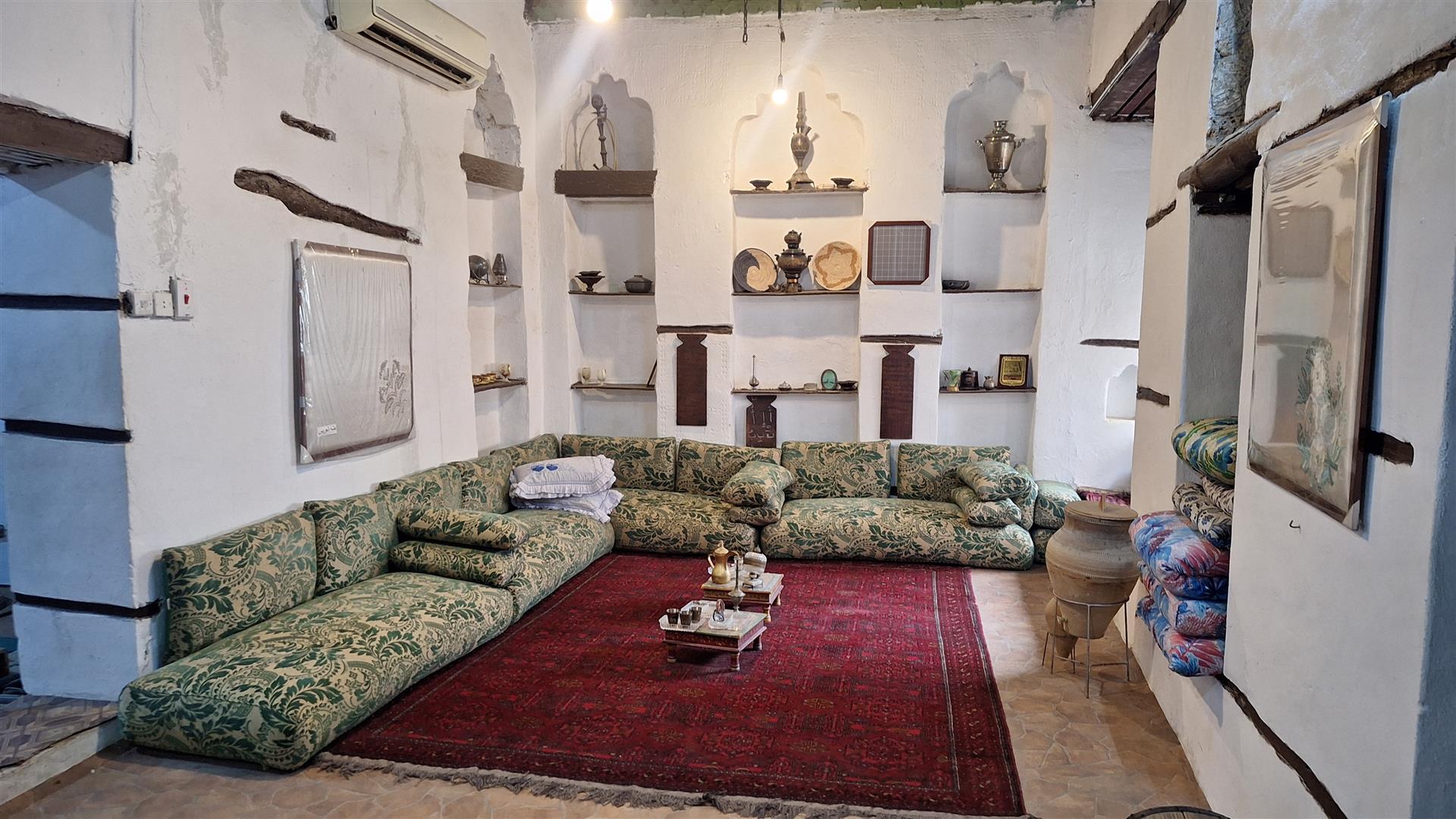
Inside Al-Matbouli House museum.
Jeddah is one of Saudi Arabia’s biggest cities, which I enjoyed visiting very much. There was lots to see and riding or walking through the ordinary parts of the city was interesting. Saudi drivers are mostly considerate. And, as with Jordan, I was struck by how few bikes there were.
I decided that I like Saudi Arabia. The people are super friendly and the whole country is very well organised. I felt very welcome. I was pleased and impressed to see a lot of well educated women working at the tourist sites. Of course they wore traditional dress but that was no surprise. The country seems to have worked hard to change many of its negative aspects. But I still couldn’t get a beer – which actually didn’t bother me at all.
Reading Lawrence of Arabia’s auto biography gives the impression that the country had nothing other than sand, rocks and camels. And that was mostly true. Commerce centred around agriculture and revenue from pilgrimages to Mecca and other religious sites. But in 1938 huge reserves of oil were discovered, which changed everything.
The existing borders came about when the the Hejaz Kingdom, along the coast, was amalgamated with the Kingdom of Nejd, ruled by the House of Saud, in 1932. The country has free health care and free education, including university. Women are not excluded from any level of education although there’s almost no co-education. Despite all this, it is still an absolute monarchy, with the only elections being held at local levels. And women are allowed to vote. Lots more info here.
 MOTOPANGAEA