
Wadi Musa. 29th March 2025.
Because this post mainly focuses on two unique places I’m going to sectionalise it, which isn’t something I usually do. But I think it will better this time. Another reason is that there will be too many photos to be able to insert all of them in the text.
From Shobak Castle I rode to the Petra visitor centre in the town of Wadi Musa. I got hold of a map of the site. It was BIG, with some long walks needed to get to some of the places. I made plans for three different visits, to different sections, including to the monastery, which was a long way up in the hills.
I mentioned the need for a hotel to the guy on the info desk and, lo and behold, he had a friend who’d just opened a new hotel. He rang him up and negotiated a quite good price, at 23 JOD, to include breakfast. To put that in perspective, £1 would buy 0.90 JOD. After thinking about it over coffee I got him to book four nights. One downside was that it was at the top of a very steep hill, so I knew I’d need the bike to go down and up.
I rode up there and met Khalid, the owner. Then I went for a walk around and found a restaurant nearby, that was quite expensive, and a small shop that sold very little. I bought some biscuits and an ice cream at the shop. Khalid had offered to sort me out some food for that night so I took him up on the offer. Ongoing I planned to find a cheap place down below and eat there before coming back up to the hotel.
One problem was that I had to pay for the room in cash so I ended up with very little JOD left. But places would always take dollars.
Going there was a mistake really, because there was nothing anywhere nearby. I’d have been better off in the town, nearer to shops and eateries. But it was done so I had to live with it. A place down below would have probably been much more expensive though. The room was very nice and there was a kitchen where I could make a hot drink. Good enough then.
Petra
Petra has a much different history to almost everywhere else in this region. “Inhabited since prehistoric times, this Nabataean caravan-city, situated between the Red Sea and the Dead Sea, was an important crossroads between Arabia, Egypt and Syria-Phoenicia. Petra is half-built, half-carved into the rock, and is surrounded by mountains riddled with passages and gorges. It is one of the world’s most famous archaeological sites, where ancient Eastern traditions blend with Hellenistic architecture.” There’s lots more info here.
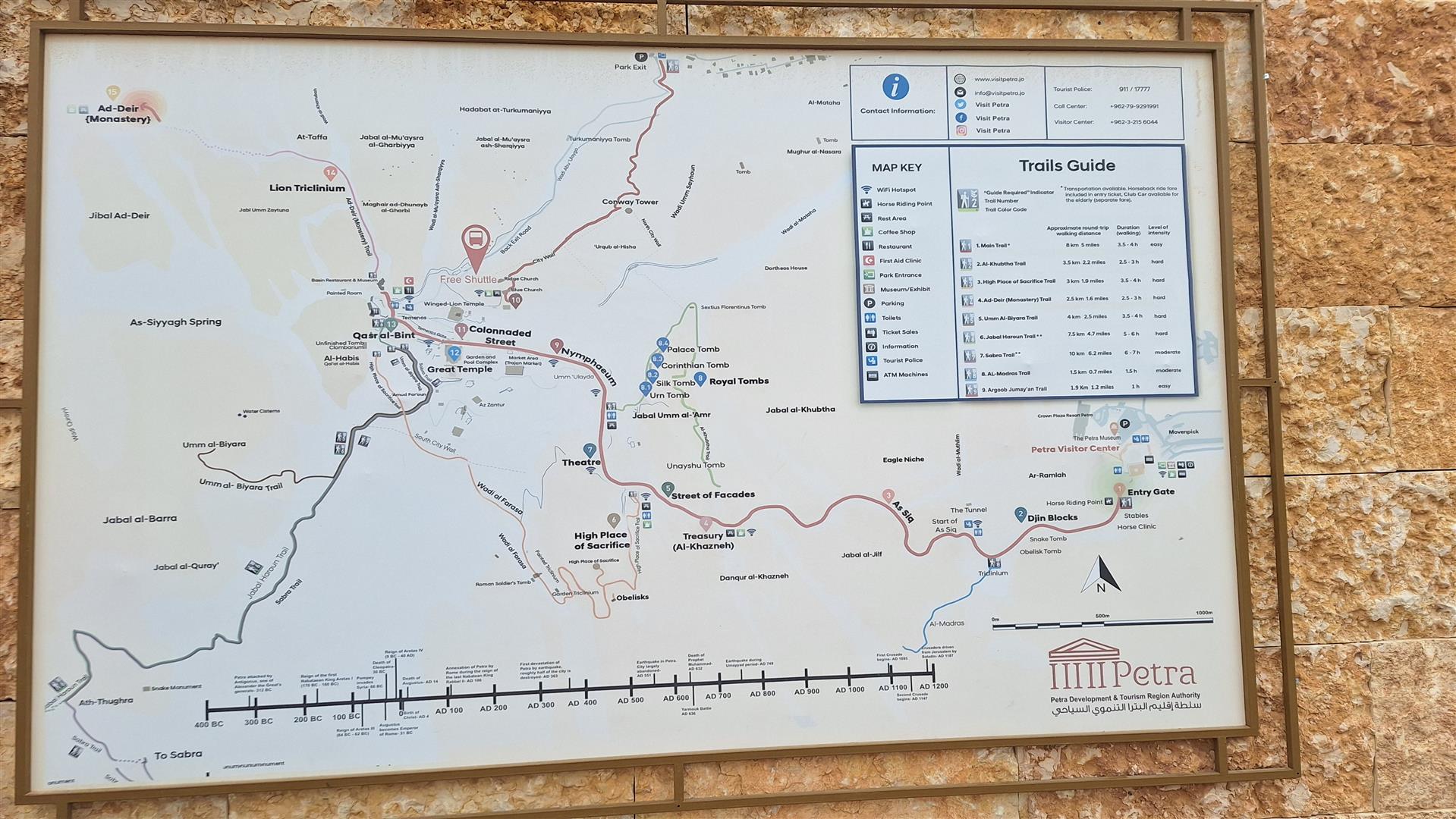
Map of the site.
My Jordan Pass, once again, allowed me to visit the site on three separate days. The useful thing was that they didn’t have to be consecutive, provided they fell within the two week validity of the pass. When I presented it I was issued with a three day ticket.
It was a brilliant day! Petra was amazing! Better than all the information suggested. I walked down to an area called the Djin Blocks. There I saw the Obelisk Tomb. The five pyramids above it represent the five people who would be buried there.
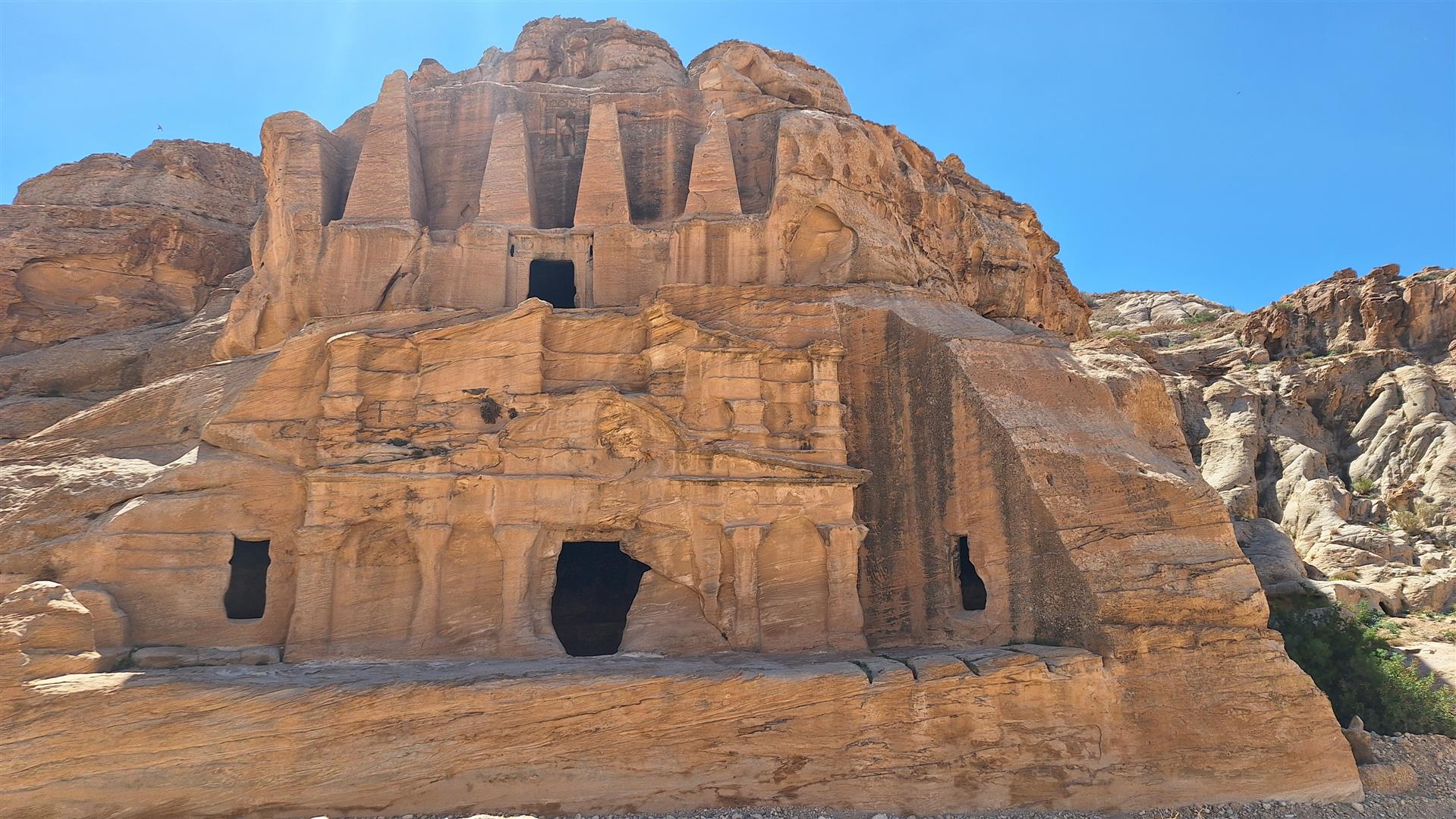
The Obelisk Tomb, near the beginning of the Siq.
Then I entered the Siq. This is a cleft in the natural rock which has water channels along each side, with the occasional sump for people to drink out of. The cleft, and the water, must have been very cooling on a hot day.
The city was built by the Nabataeans, during the 1st centuries BCE and CE, and who’d occupied that region for at least 300 years. They had control of the trading routes that carried very valuable goods, such as spices, Myrrh and Frankincense. This movement was taxed and tolled so they had plenty of money.
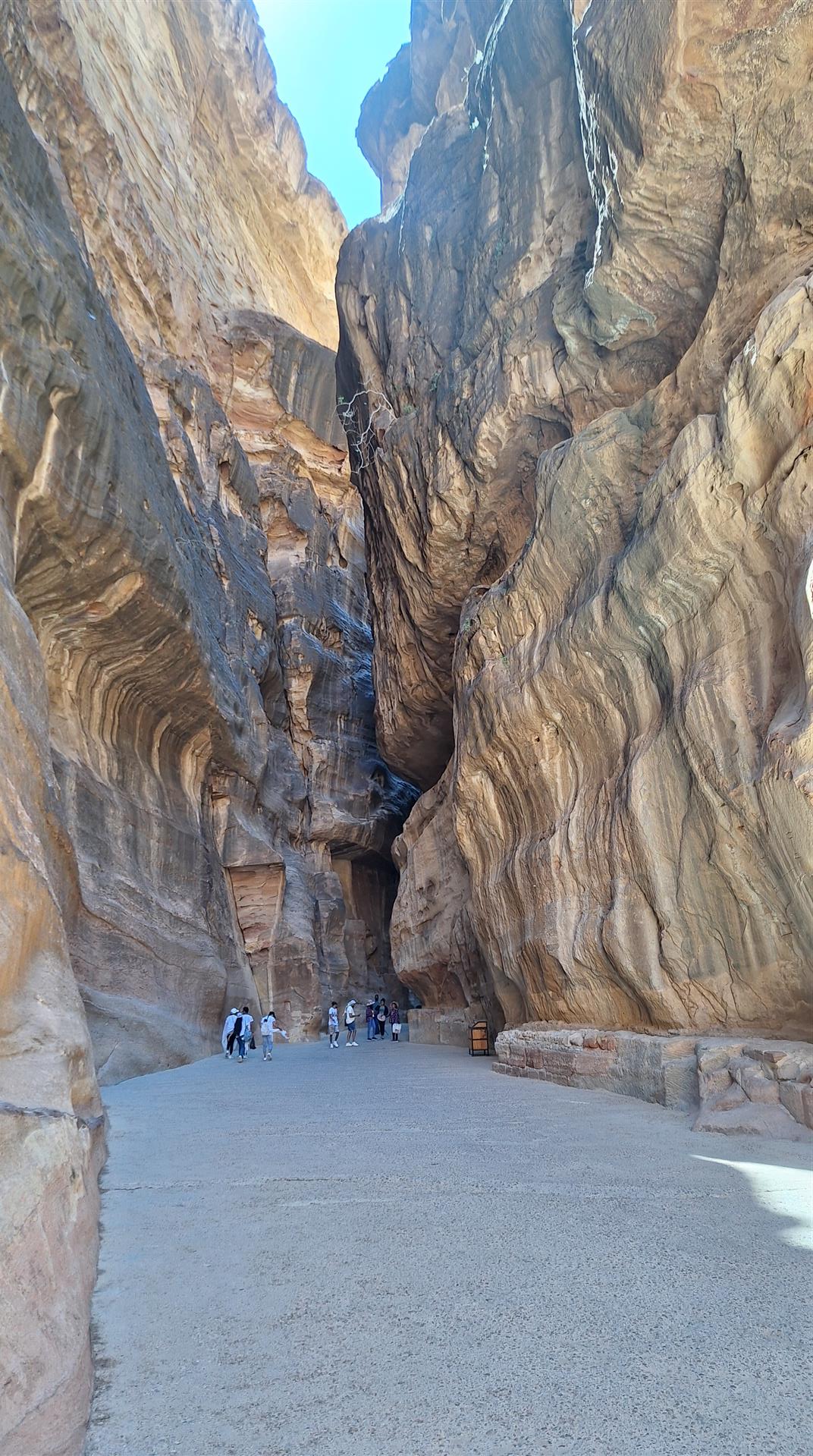
Inside The Siq, with the water channel running along the side.
Their other great skill was in managing water resources and supplying it to their city. But they also had great skill in finding and storing water in the deserts, meaning they could guide caravans and pilgrims on their journeys. Yet more income. From around the first century CE the city was also occupied by the Romans, although historians say this was by mutual agreement.

The magnificent Treasury.

A closer view of the statues above the entrance.
So it was fitting that the Treasury, Petra’s most magnificent building, was the first one I saw when I came out of the Siq. Massive in size and with a magnificent frontal aspect of columns and decorations. It was carved from the solid rock, a skill seen all over the site. There was no access to the inside though.
I walked all the way along the main trail, exploring the tombs, temples and the Roman theatre. All of them were magnificent, both in structure and design. When the sunlight was on them the colours were amazing. And I was amazed!
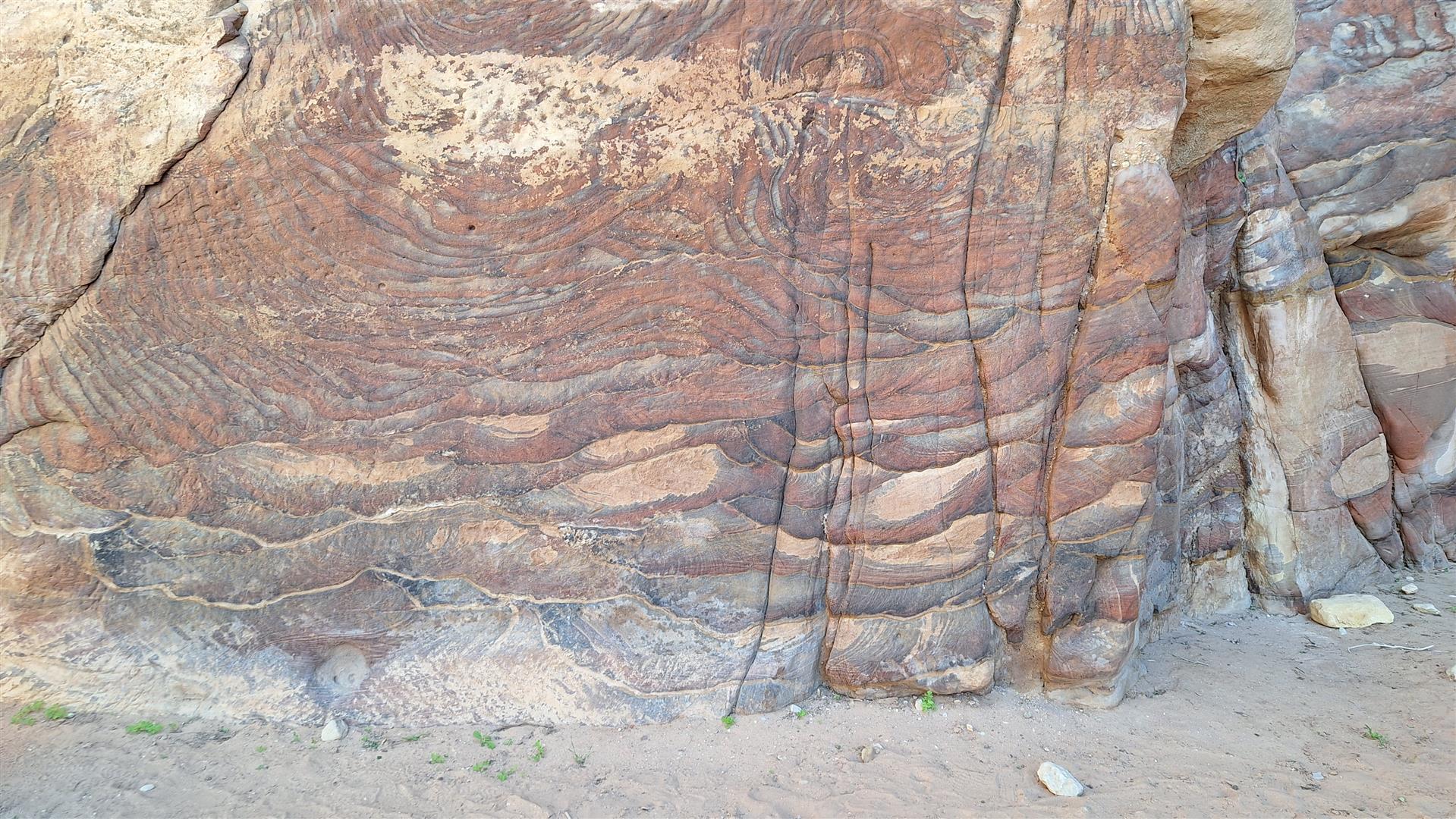
Magnificent colours in the rock.
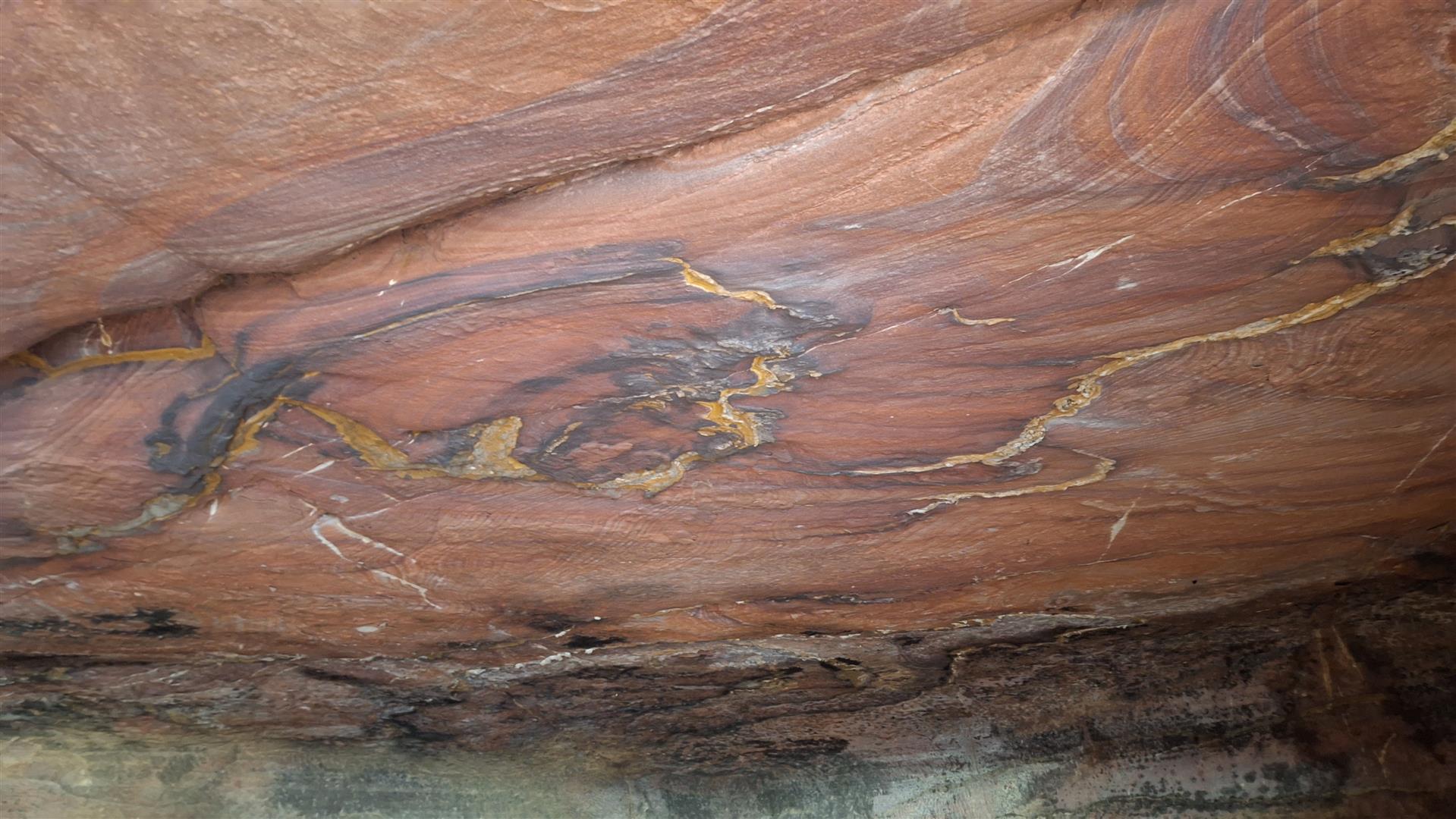
A ceiling inside one of the buildings.
But easily the most wonderful feature was the surrounding rock. It had intertwined layers of different rocks, with different colours, lapping and overlaying each other in a wonderful way. It was enchanting. I don’t think my camera captured the colours properly, in truth, which was disappointing.
After a while I stopped for a coffee and to eat lunch. I had a very annoying cat trying to share my food. I did give it a bit of egg but then it tried, but failed, to run away with my cheese triangle. In the process of stopping it I knocked my coffee over! Luckily they gave me another one.
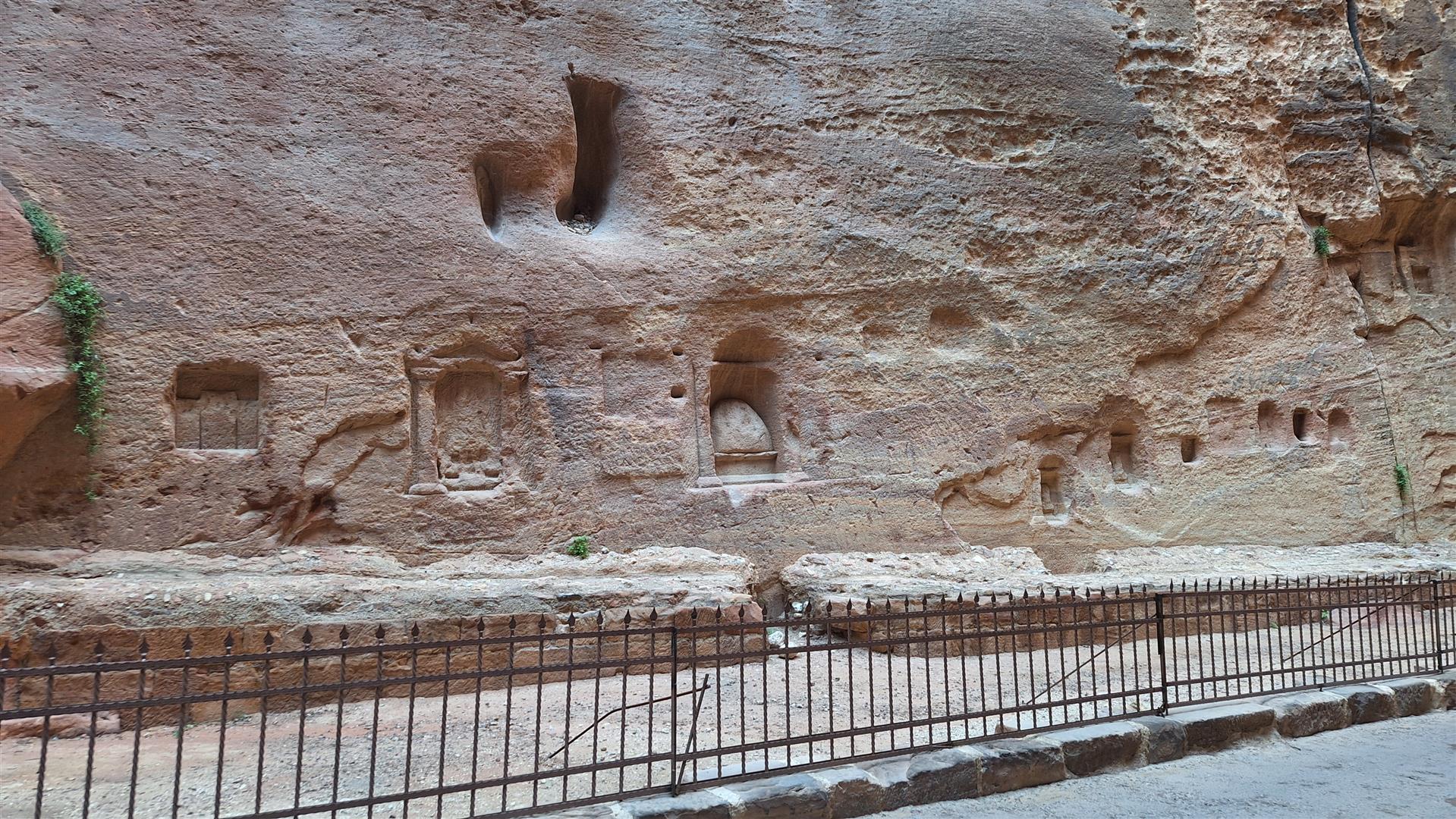
‘Votive niches’. Small statues would be placed in them.
I walked all the way down to the end of the trail, checking out everything on the way. At that point the steep path up to the monastery began. The thing about this place was that there were several side trails, of varying difficulty, going up into the surrounding hills, that lead to other features. I was determined to tackle one of them that day.

Tombs, cut into the rock.
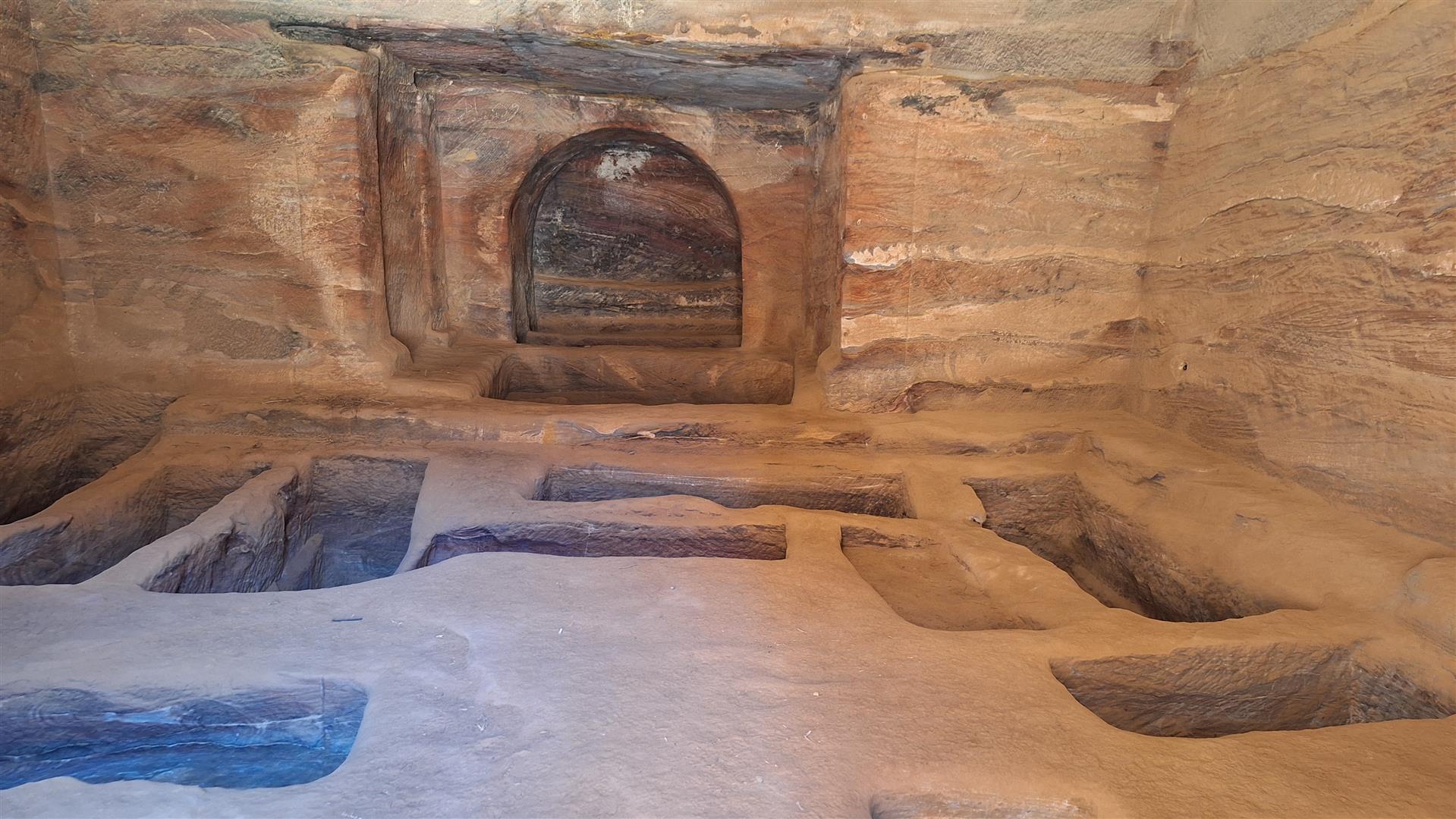
Inside a tomb. Holes carved out, ready for the next shift.

One of the temples.
The one I chose was the Trail of High Sacrifice, which led up into the steep cliffs and to an altar at its highest point, where sacrifices took place. It was a very steep climb. Mostly steps, and very tough. The map suggested 3.5-4 hours return, for a 3km distance. It didn’t take anything like that amount of time. Probably 40 minutes up, including rests, and 20-30 minutes down.

The sacrificial altar.
Once up there I had a magnificent view over the city. The altar was clearly designed for the purpose, with a central hollow that had a channel for the blood to flow out of. All very chilling.
Once I was down from there I headed back along the Siq. I’d forgotten how steep it had been coming down, because it was very steep going up! Eventually, with a rest, I made it. What an excellent day, with more to come next day.
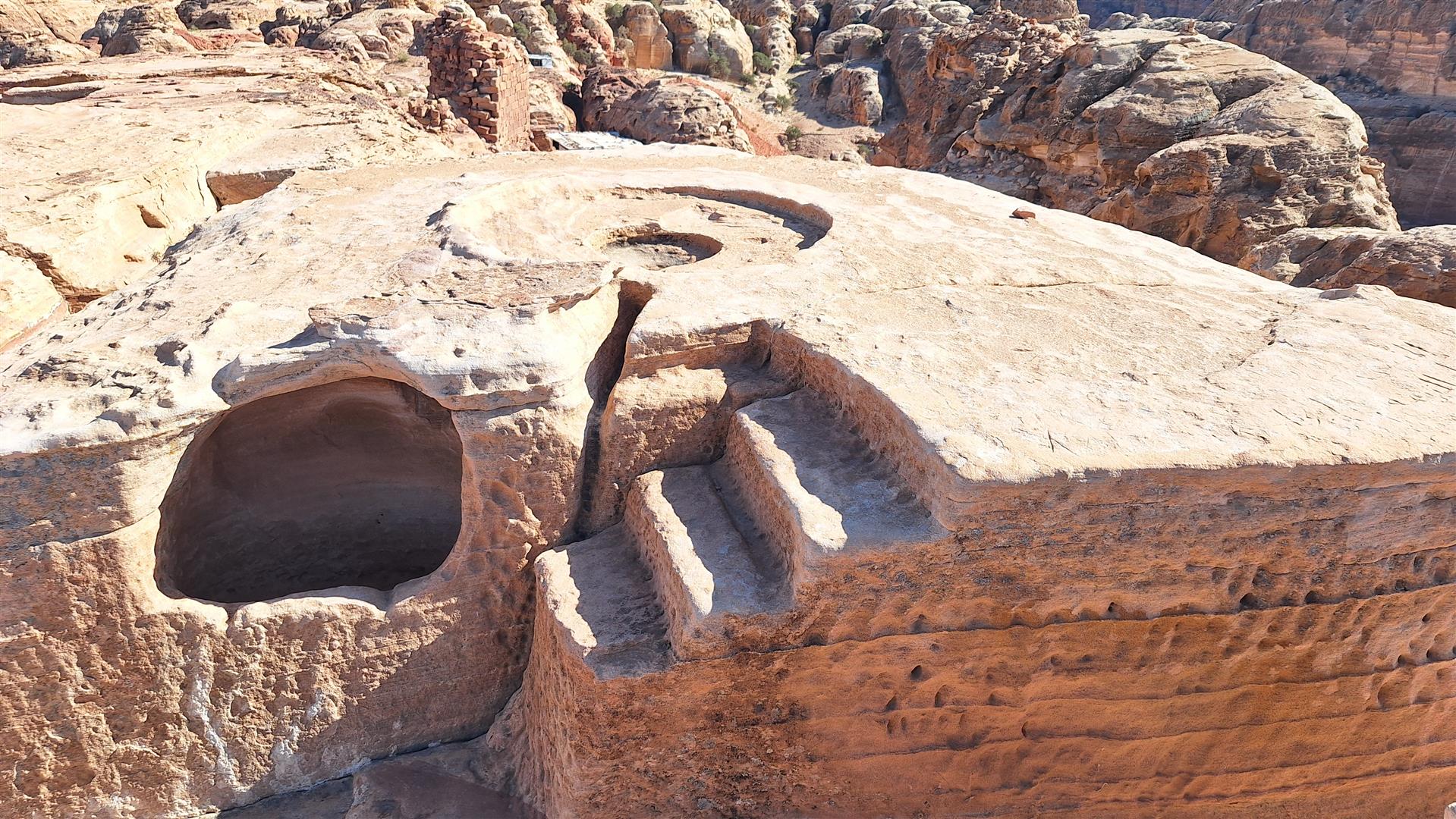
Designed to catch the blood as it drains out.
I checked the restaurant within the site. A couple of people were sitting outside drinking beer. I looked at the menu and it was far too expensive, although that wasn’t a surprise. That was the only place around selling beer, apart from expensive hotels. My solution was to walk along the street opposite the entrance and to find a cheaper place. So a pizza finished off the day, minus the beer.
Another great day followed. One of the attractions I wanted to see was Ad-Deir Monastery, high up in the hills. It was accessible from the main area, near the big temples. But it meant climbing up a track, described in the brochure, as ‘Hard’. It involved about 1,000 steps, or more, and a 2.5 km walk. But I’d learned that there was a less onerous route via a ‘back road’. There was a free minibus that went from the visitor centre up to a car park above the main site. From there a paid-for jeep would take me up to the start of the trail.
I found the mini bus and it took me up to from where the jeep leaves and then I paid for the jeep. It was actually a big, open backed, light 4×4 truck, with seats. That took me to the beginning of the back trail.
The climb wasn’t too bad really. I chatted with a couple on the way up, meaning I wasn’t particularly out of breath. There were lots of steps. The jeep driver had reckoned 800, but I didn’t think it was that many. Some of it was pathway. But was it worth it? Well yes, it was.
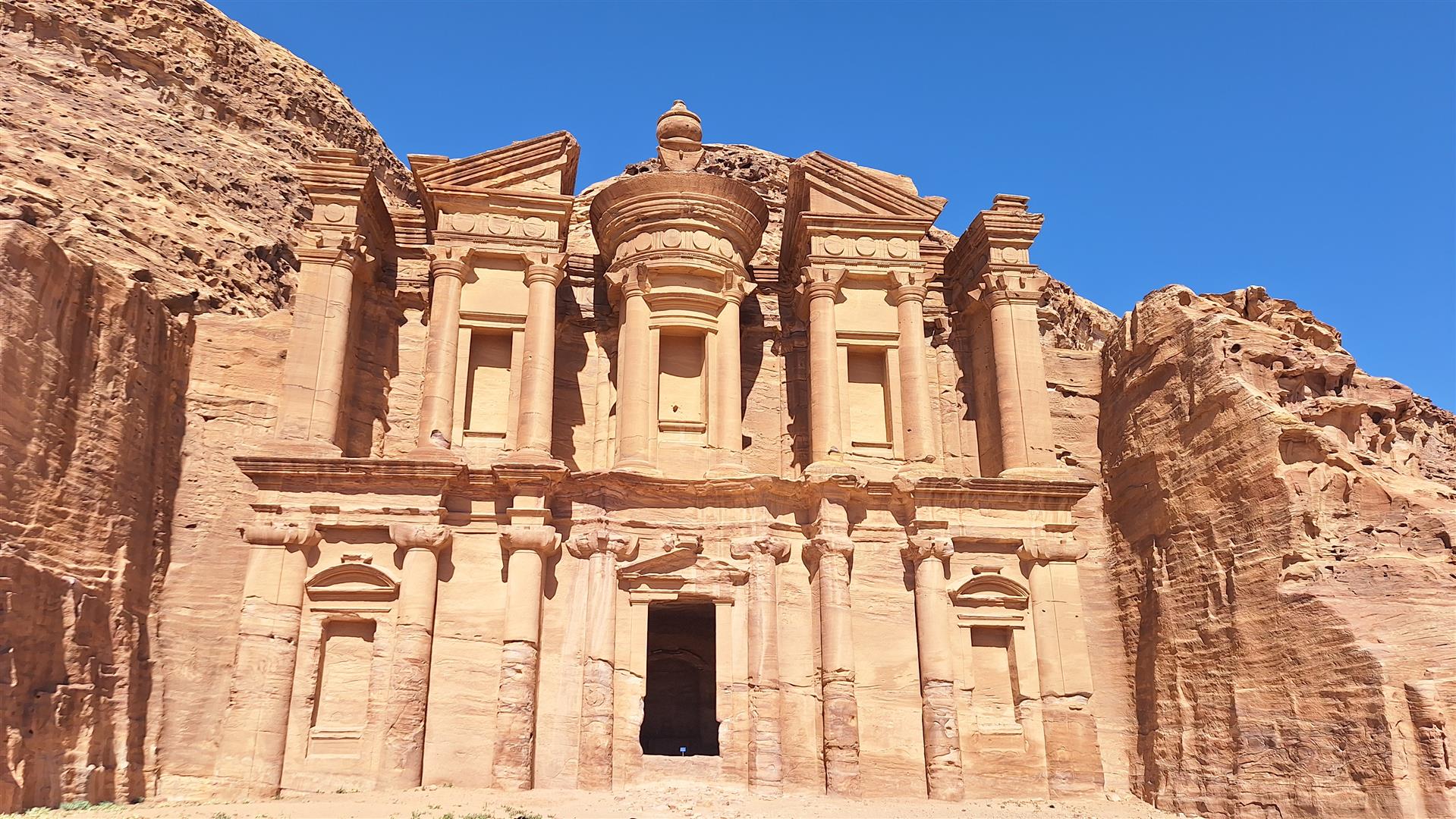
Ad-Deir Monastery.
Built in the 2nd century CE, the monastery had a huge frontage, forty three metres wide by forty eight metres high, with pillars carved into the rock, and upper doorways that didn’t actually go anywhere. There was one large chamber at ground level, which had an altar inside. The hills alongside it were full of little hermit caves, quite a lot of which were high up and appeared to have very difficult access.

A higher view of the site.
I walked up to a high point to get an overall view of the site then I had coffee and lunch.
I went back down again, but via the main trail. The climb down was very steep and long, with seemingly endless steps. I was very glad I’d used the other route to come up. I’m not sure I’d have made it up the main route.
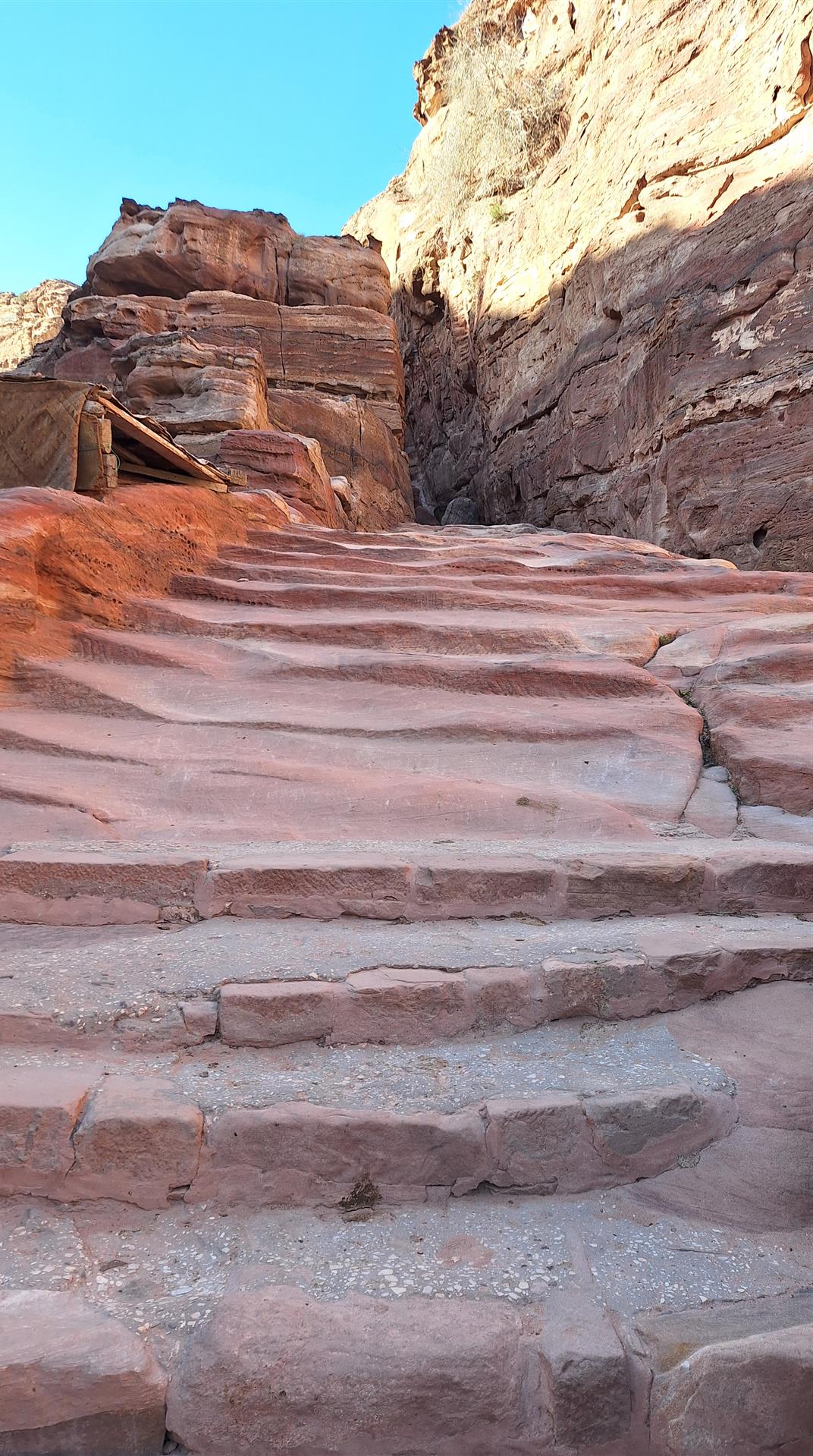
These are the steps that I was happy to have avoided.
Once down at the bottom I had another look at some of the buildings. Then I walked up to the Treasury, thinking to get the courtesy bus back to the main entrance. But it wasn’t free, as I’d originally thought. 15 JOD one way, which was a lot. So I set off to walk back.

The Roman amphitheatre.
I came to the place where I’d rested the day before and rested there again. When I started walking again a guy with a horse approached me and pointed out that my ticket entitled me to a free horse ride back up to the top. I happily went for that.
The guy dropped hints about payment and when we got there I gave him one dinar and my loose change. The look of disappointment on his face was classic but he couldn’t actually say anything. I was chuckling to myself about it as I walked out of the complex. It was him that told me it was free. But I had no more small notes to give him anyway.

Watching me watching you.
One of the restaurants in the street opposite did a tuna salad for 4 dinar and, with the ice cream I’d already eaten, and the bread that came with it, that was sufficient.
It had been a pretty good day all round. A day of rest would follow, writing and planning. I thought I might go to Aquaba on the way to Wadi Rum.
Petra was a magnificent place. It was largely destroyed by a 4th century earthquake and that, combined with changes in the trade routes, led to the city’s demise. It was deserted in the 7th century. From then on it was only known to local Bedouin tribes until, in 1812, a Swiss explorer revealed it to Western eyes.
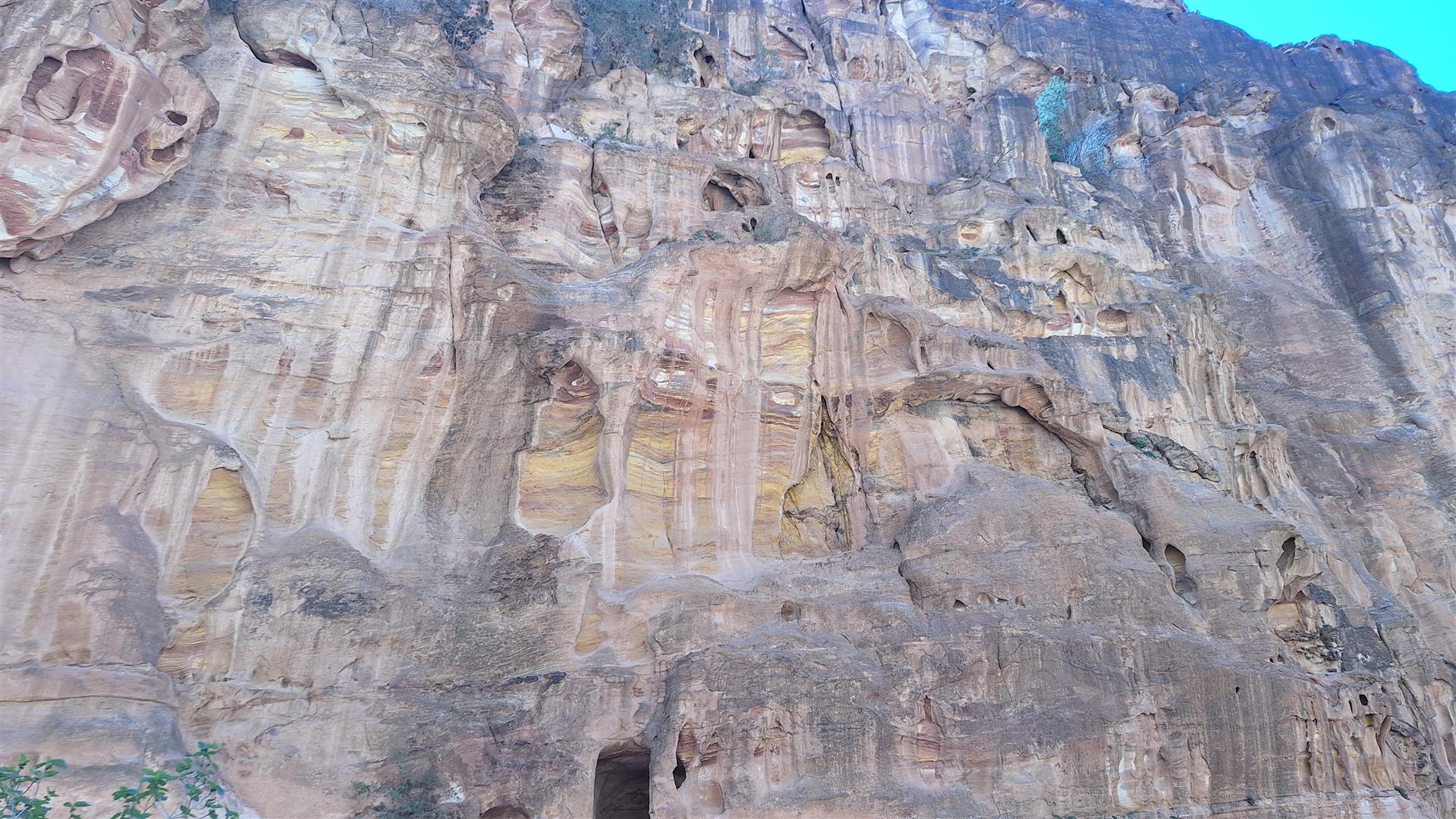
Another delight from erosion.
After the delights of Petra my next place to explore was Wadi Rum, a desert landscape in the land of the Bedouin. But before going there I headed to the town of Aqaba. There was museum and a fort to look at.
The road went up high – 1700 metres, and it was suitably chilly. I only had light riding gear on but I wasn’t worried as I knew I’d be going down again. Which I did.
I passed, and noted, the turning for Wadi Rum on the way then got myself into the town. It was a very smart looking place, full of visitors, and hot and sunny. I found the museum and parked up.
It wasn’t open though, but the fort was. I had a wander round it. It was small and in good order.
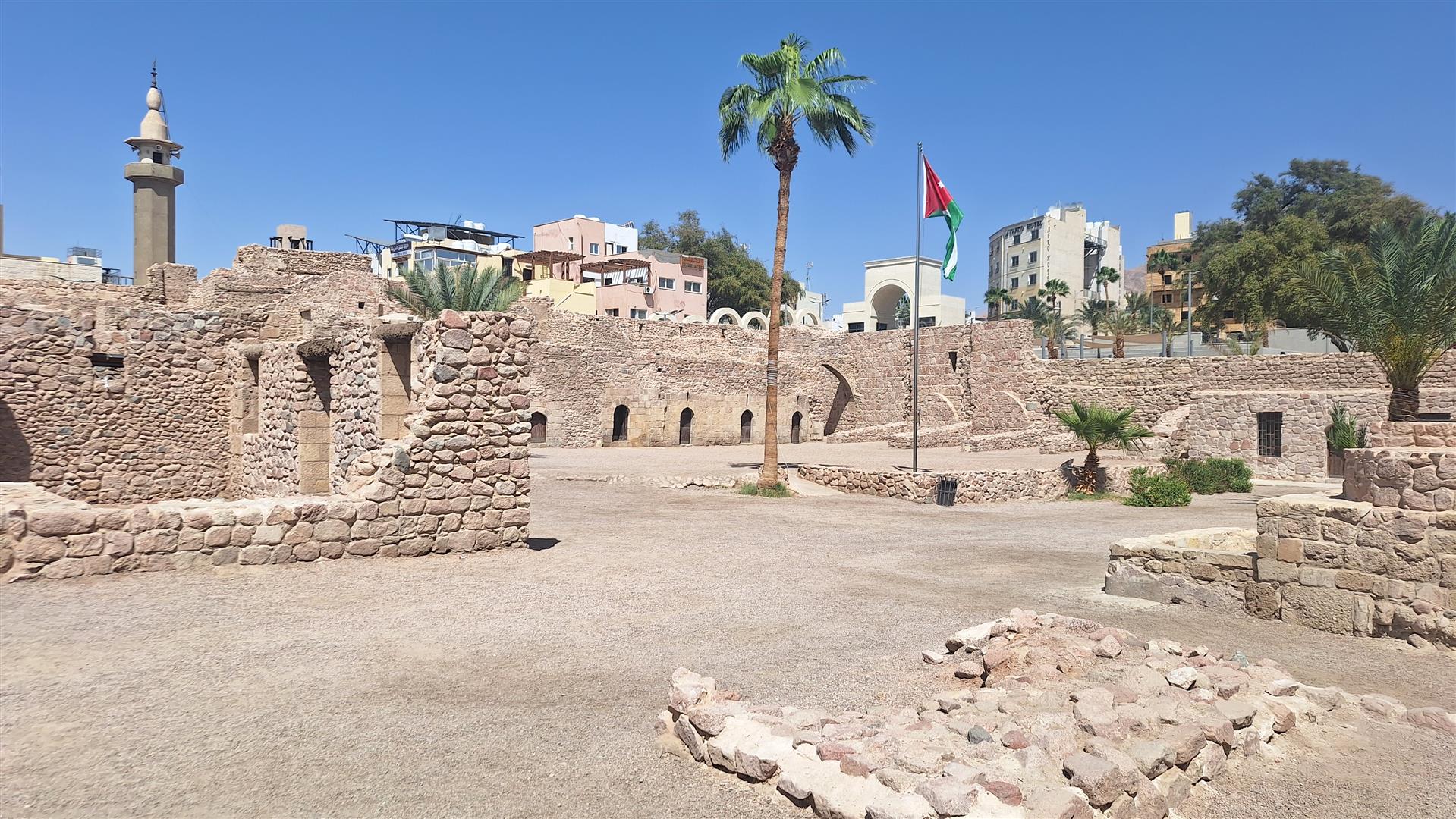
In the fort at Wadi Rum.
There was an area where paintings were on display too. It had been a key place in the Arab revolt during WW1, so Lawrence of Arabia probably stayed there. I’ve started to re-read his auto biography as I’m now in his area of operations. It’s called The Seven Pillars of Wisdom, should you be interested.
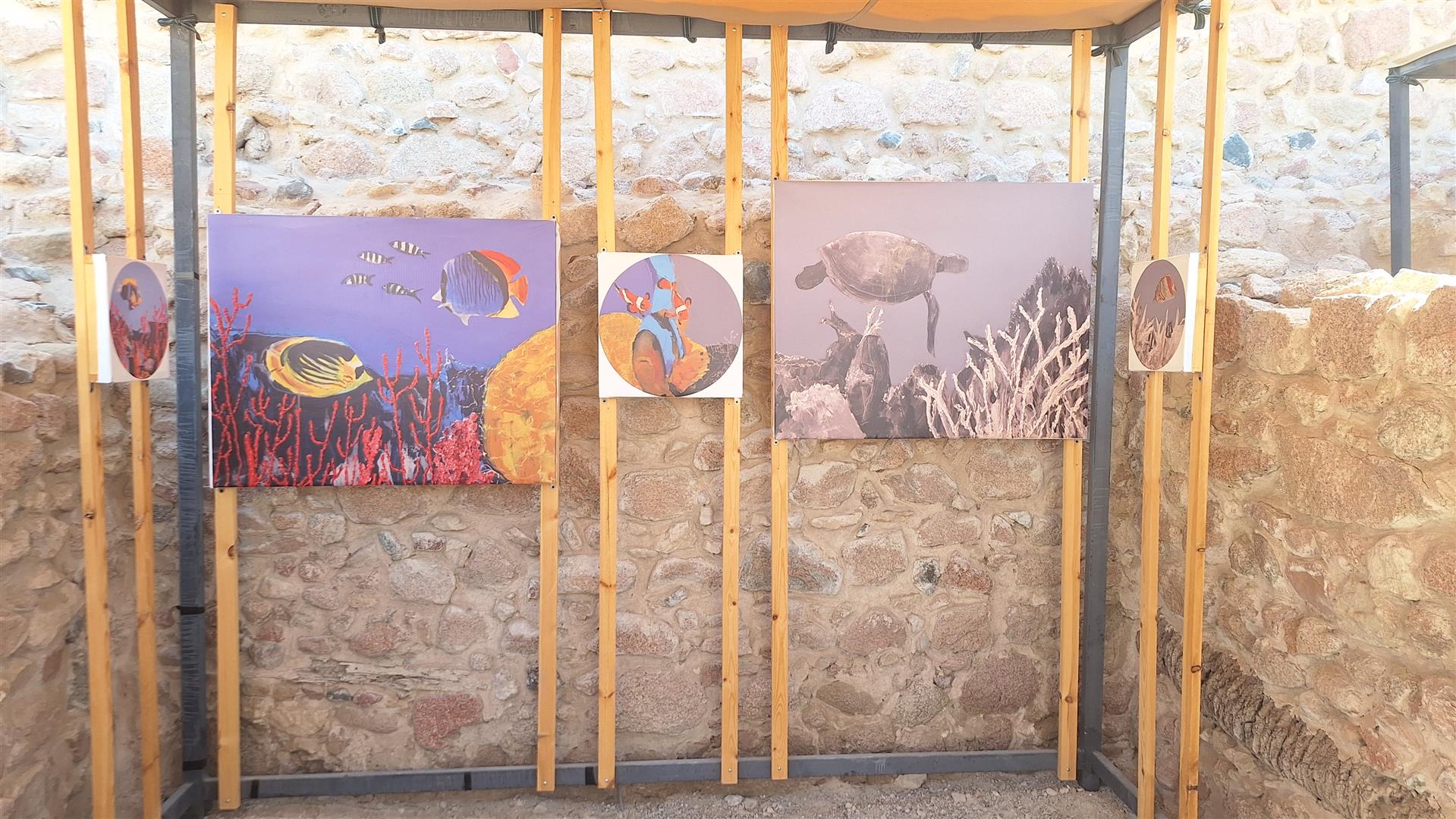
Some pretty art work.
I needed a place to stay and Extra Traveller Hostel came up as the best option, so I set Google for there. But something had happened to the GPS signal. Even the Garmin had lost contact. I had to just head in the general direction until it came back again.
It wasn’t a bad place. I was in a dorm. One of the other guys in there was a Liverpudlian and he’d found a pub where the Liverpool v Everton game was being shown that evening. A real local derby.
We walked over to the Rovers’ Return (no less) to watch the game. It was great to do a ‘normal’ thing like sitting in a pub, with a mate, watching a game. Liverpool won 1-0, but made really heavy weather of it. But the result is what counted.
Bernie is an interesting guy. He’d emigrated to Australia and lived in Sydney but had worked all around the Gulf. He was retired and was on a Middle East holiday. He’d explored the town and knew of cheap places to eat, just off the busy roads.

The forecourt of the museum. The canon had been captured from the Turks.
After a restful morning I walked down into the town, to visit the museum. There was a display all about the Arab Revolt of 1916. Lawrence of Arabia got a couple of mentions. There was a really high flagpole in the plaza in front of it. Having read about the flag of the Arab Revolt, I noticed that the flag flying was exactly that one. Initially I’d thought it was the flag of Jordan. It’s clear that the revolt has a huge resonance in this region.

The flag of the revolution.
After that I took a walk back along the beach. It was very busy, with lots of families enjoying the sun, sea and sand.
Bernie and I walked down to the town, to the cheap eatery he’d mentioned. Soup, chicken and rice for 2 JOD was just right.
I stayed in Aqaba for a couple of days more, trying to catch up on writing. I went for a haircut and when I asked the guy the price he said “Up to you”. That is something that really annoys me. I told him off for doing it so he said “4, 5, 6, 7 ……?” I told him 5 JOD which he accepted. He did a good job too.
I mentioned to the guy at the hostel about wanting to go to Wadi Rum and he had a friend who did tours. He offered a six hour jeep tour, with an overnight stop and 3 meals. It started at 1pm and finished after breakfast next day, which meant I could come back to the hostel for the night if I wanted to. The cost was $100, which Bernie reckoned was OK. I asked for it to be booked.
Wadi Rum.
An excellent day followed. It was a pleasant ride down to the Wadi Rum visitor centre. They looked at, and stamped, my Jordan Pass, but didn’t scan it. That was lucky, as it had expired.
I found the base for Wadi Rum Magic Nature Camp, parked the bike and drank tea. Then I changed into my shorts, ready for the desert. There was a German couple there too but they were going on a train ride. I’d spotted a steam engine on the way in. They told me it runs up the track for an hour, then comes back. It would have been on part of the line that Lawrence of Arabia kept blowing up.
When I saw them at our overnight camp they told me there had been a display of riders and pretend fighting alongside the track, with guys on horses etc. It sounded good.
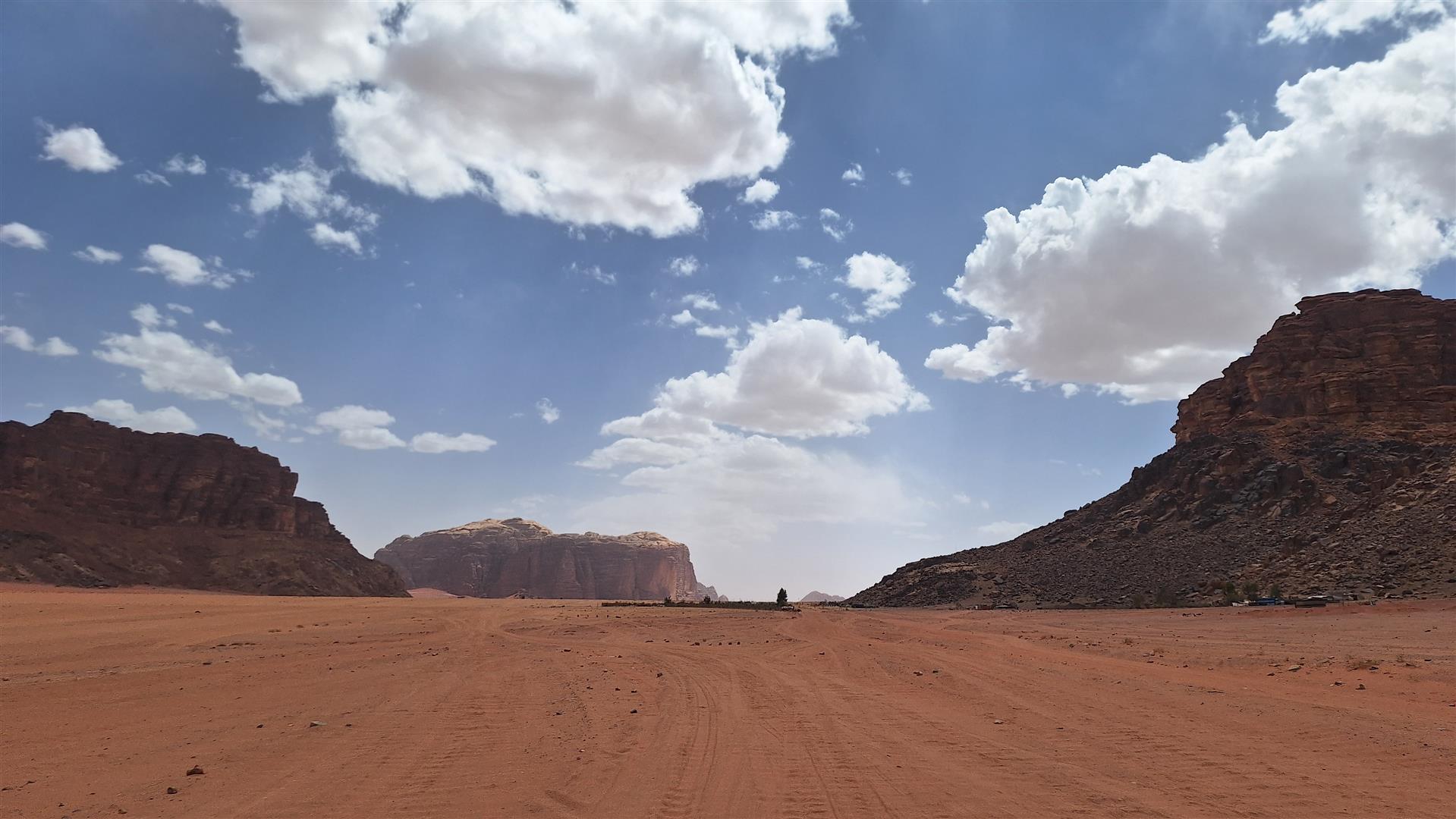
The magnificent desert.
Wadi Rum is a protected area of desert and rocky outcrops and hills of sandstone and granite. It’s called A Desert of Mountains. Throughout history it’s been home to nomadic Bedouin tribes. These days many of them earn a living from the tourist trade but still herd their goats. There are various ways of exploring the desert, including camel and horse. Needless to say, I chose the jeep. I undertook a desert trip on a camel once. Never again!

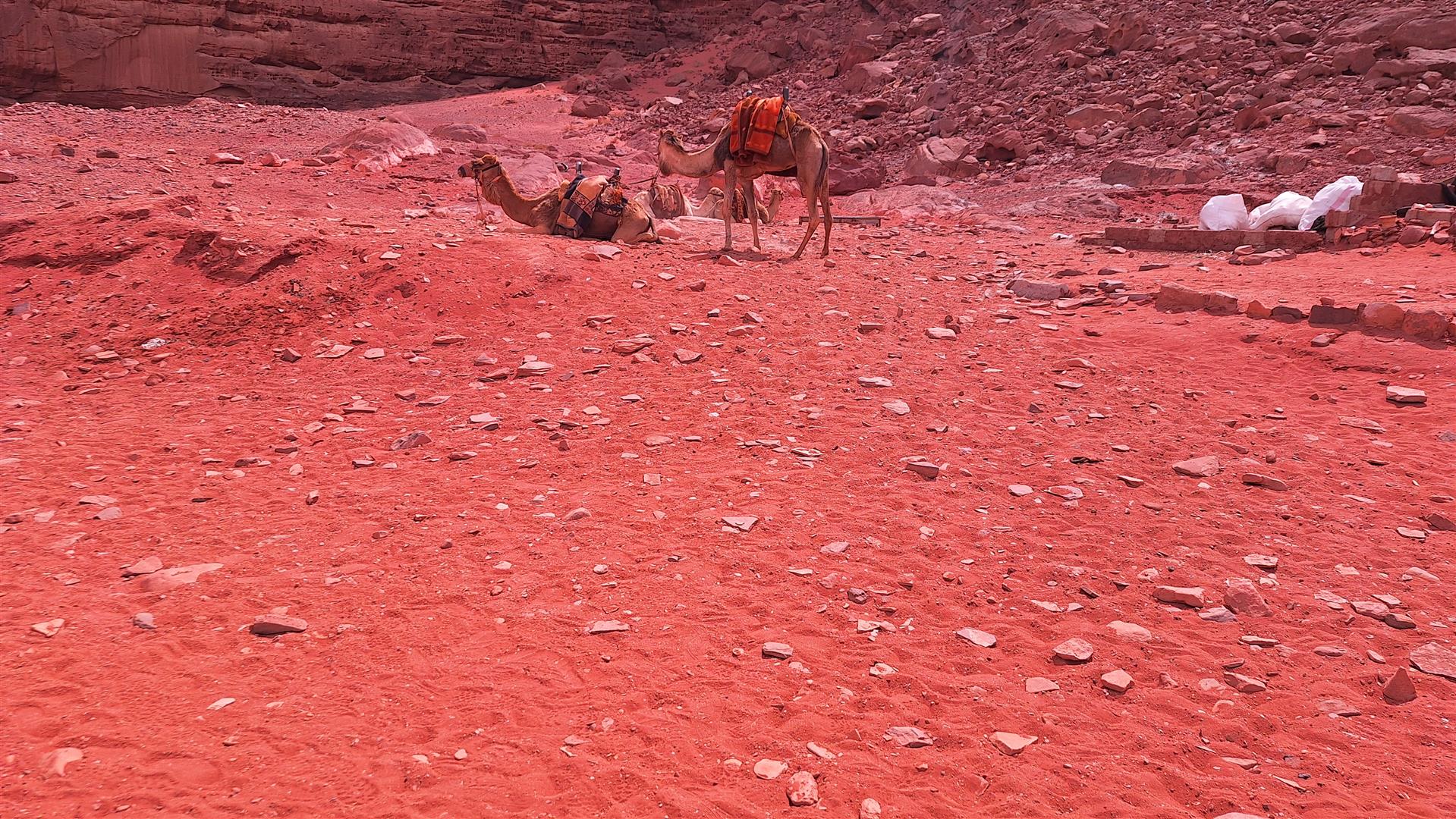
Lovely creatures as long as I’m not on the back of them.
There was just me and a young Japanese woman in the 4×4. We headed off into the sand and visited various places to get an experience of the incredible landscape.
I’d got a guide and map from the visitor centre, which helped with an awareness of where we were within the park. The first place was Lawrence’s Spring, where he was supposed to have washed during his journey. Hardly thrilling, if I’m honest.
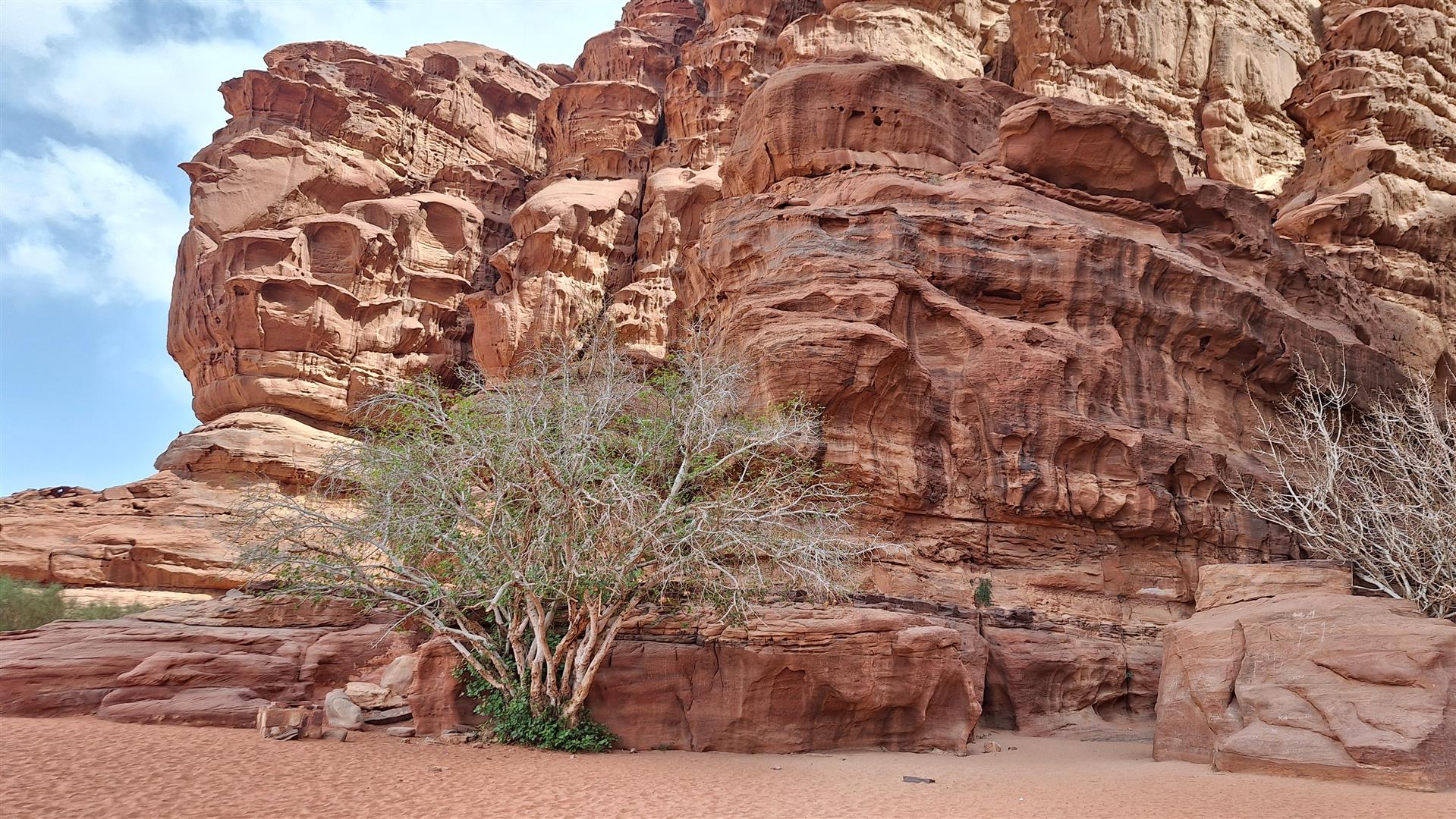
Seen in Khalid Canyon.
The next place was Khazali Canyon, a very narrow cleft in the rock where we saw some writing and pictures carved into the rock face. Some of it was Nabateen but the drawings pre-date that era.
Following that were the sand dunes, blown by the desert wind to pile up against the rock face. Our guide/driver, Awwad, showed us where we could climb up a dune to get a nice view of the desert.
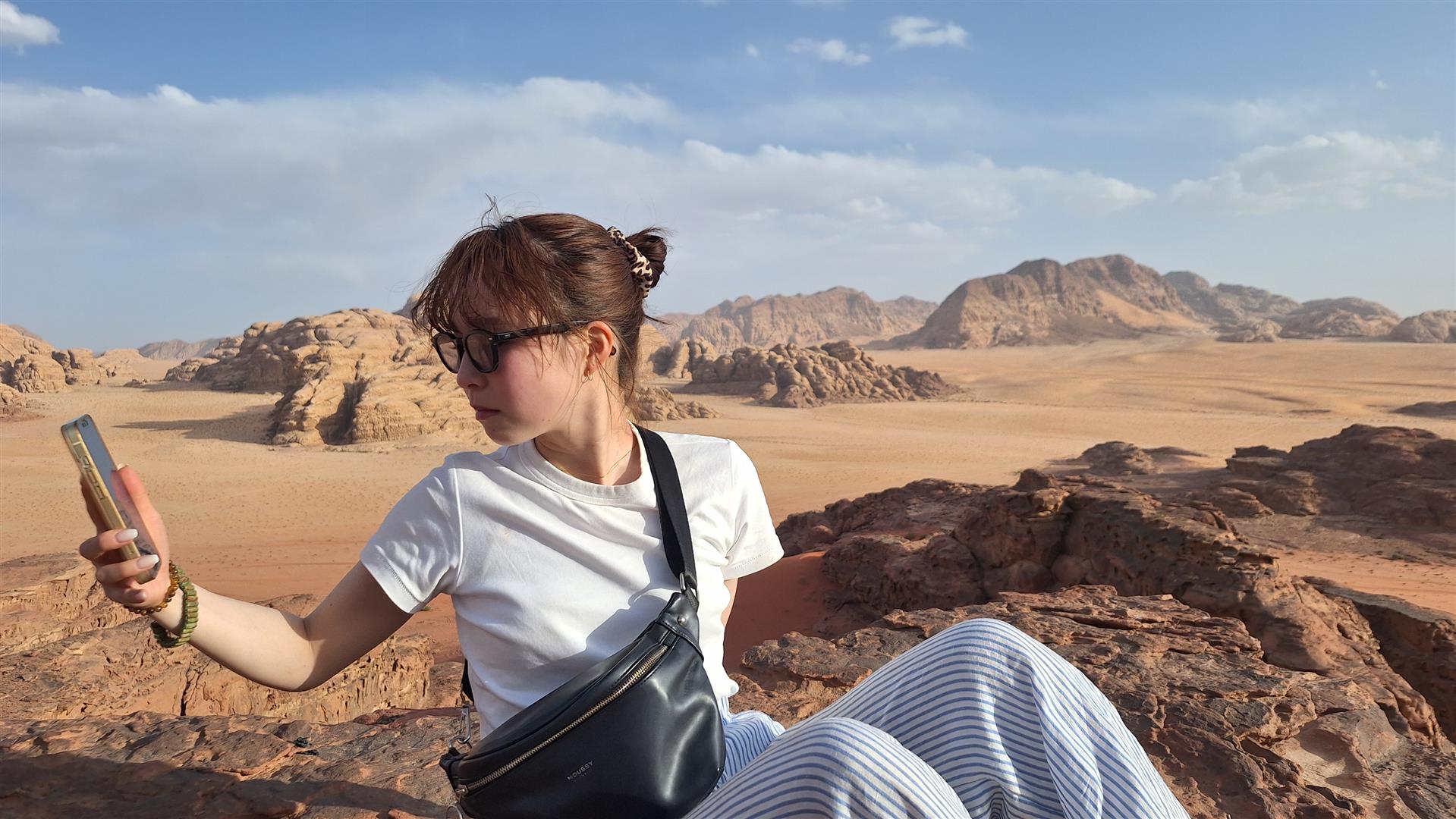
My Japanese companion.
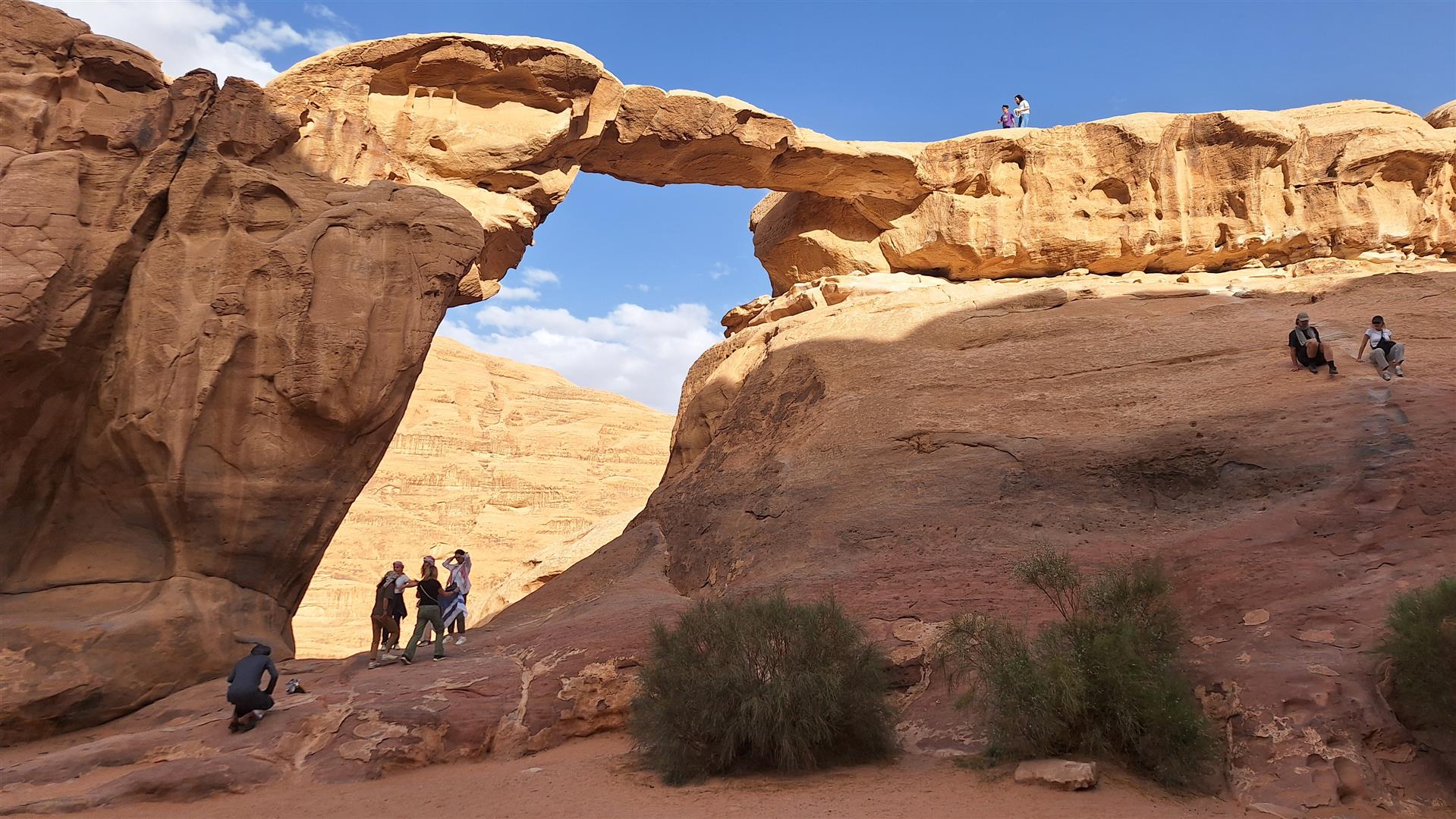
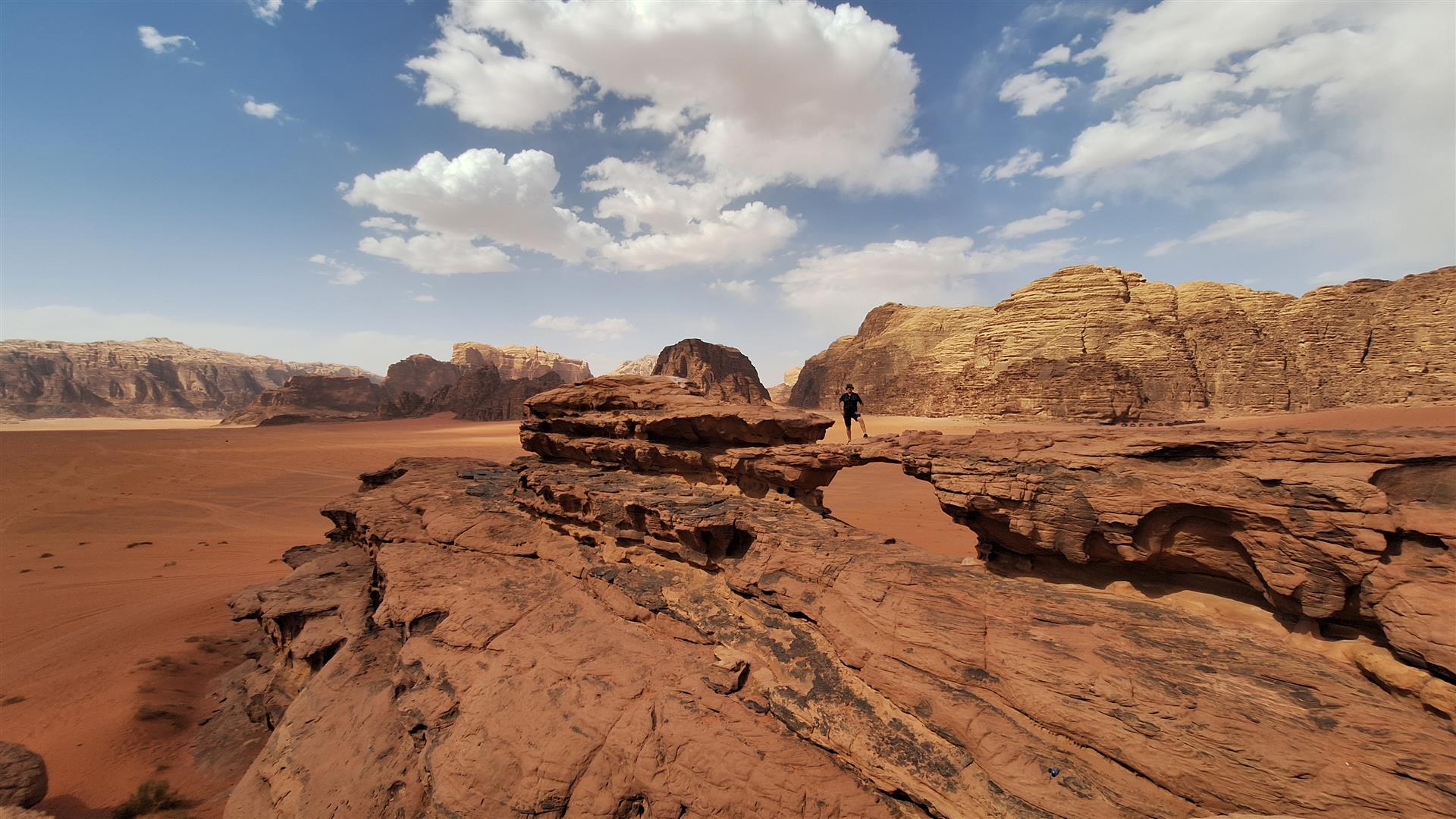
We went to two rock bridges, Little Bridge and Um Frouth Bridge, which were places where the rock underneath had been eroded, forming natural bridges. We climbed up while Awwad took photos of us. The scramble up the rock was a bit hard in places, although the route was well worn. Of course, the view was superb.
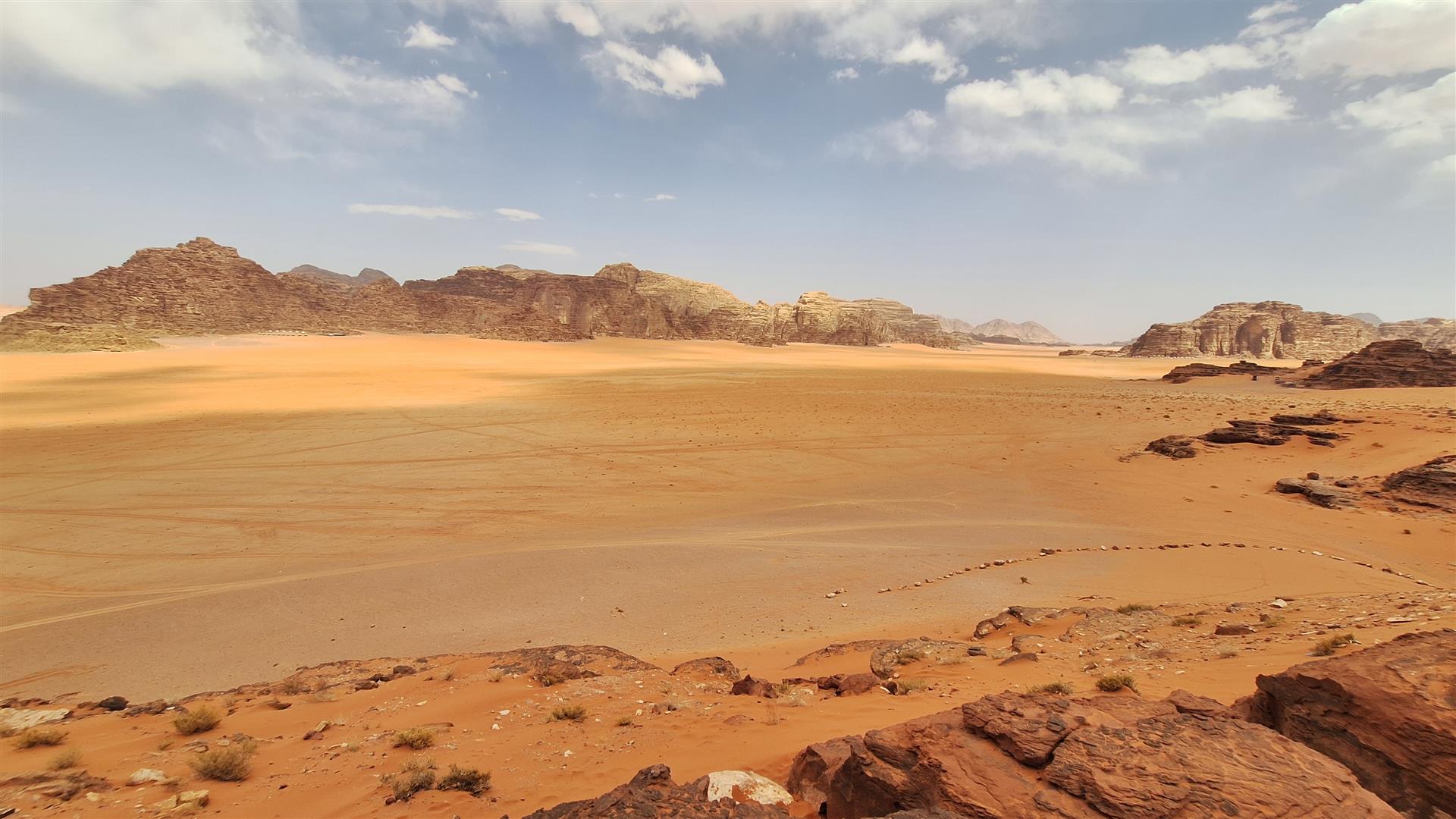
A magnificent view across the desert.
At Burrah Canyons we went through another narrow ravine while Awwad drove round to the other end to meet us. We climbed up to a high viewpoint so as to gaze out over the desert. The most notable thing there was the way many of the rock hills seemed to just leap out of the sand. It was incredible what erosion has achieved over the millennia.

Burrah Canyon.
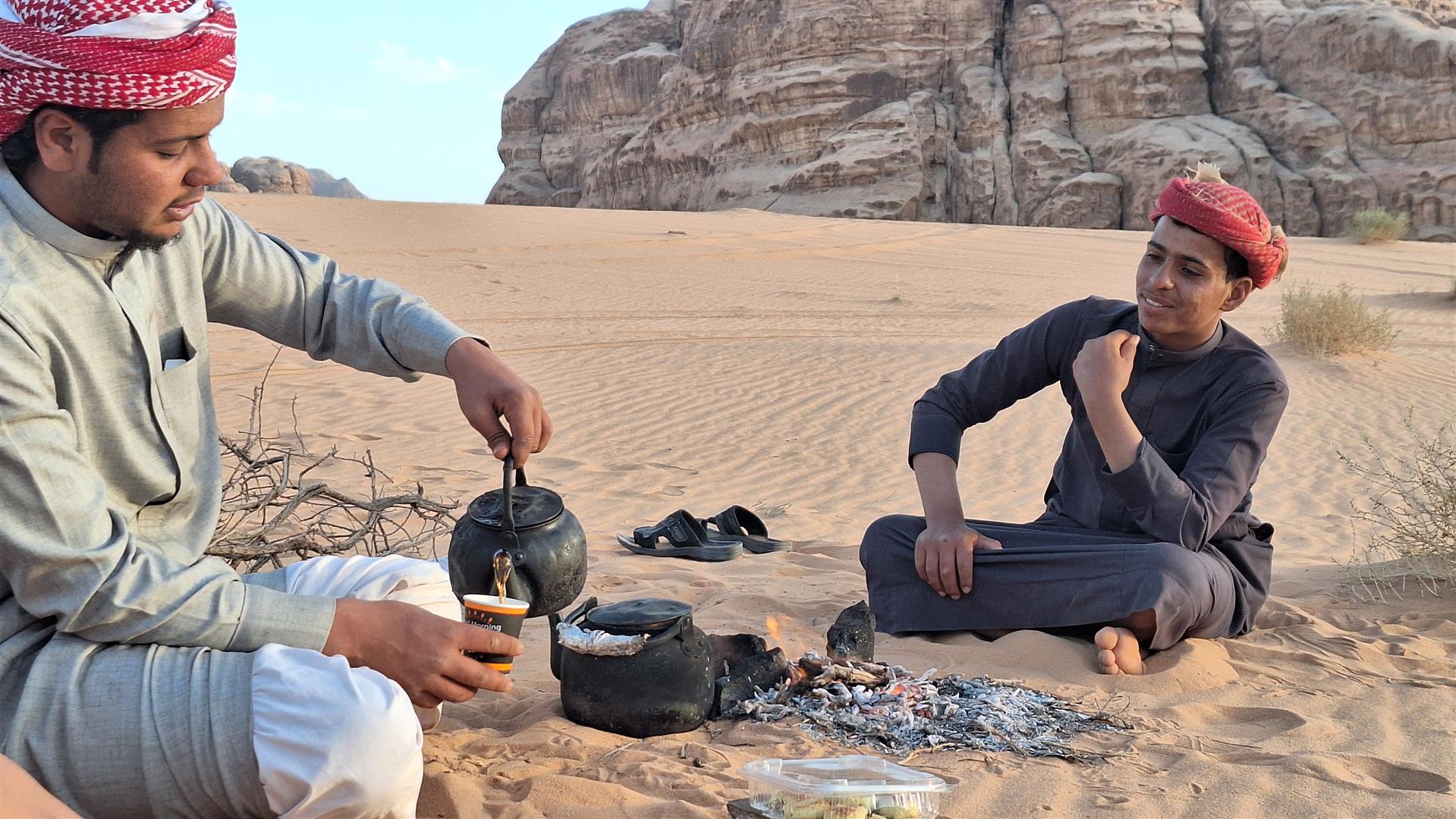
Then we drove to the sunset site of Al Ghruroub. It wasn’t much good because of clouds. But Awwad and a friend made tea, so that wasn’t too terrible.
Finally we came to our overnight accommodation, which was really good. It was a collection of permanent tents each with a double bed inside. The bathroom was built from wood and was a little way across the sand. The facilities were of very high quality. There was a big tent where we ate, with comfortable seating and with tables. Very Western, deliberately I reckoned.

Traditional cooking method.
The food had been cooked using their traditional method, which was to bury an iron stove in the sand, with hot rocks beneath it. Everything, including the rice, was cooked in there. The meal was chicken, with a very nice selection of veges and potatoes. Some excellent salad too. Baclava to finish off with. There was wi-fi there, which just about worked.
Some entertainment came after the meal, with the ten or so visitors joining in as well.
This had been an excellent day. The only challenges came when scrambling up dunes or rock faces, which was good fun. We were very well looked after accommodation wise.

Enjoying some music in the richly decorated tent.
But of course the best aspect of it all was being out in this wild territory where raw nature reigns supreme. Man needed to adapt to survive and it amazes me how people achieve that in such harsh climates.
There are animals out there, including the Syrian Wolf, Striped Hyena and Nubian Ibex. There is a programme underway to re-introduce the Arabian Oryx, some of which which have been bred in captivity for this purpose. Many of the rocks have writing and drawings on them. Mice, insects and reptiles live out there too. Birds of prey also come to visit. Wonderful! This site is a good one for more information on Wadi Rum.
After a very nice breakfast we headed back to the village from where we’d started.
Bernie had asked me to collect a towel that he’d left behind when he made a similar trip. I went round to the office of the Nomad Tour company and met the very lovely Bianca, a Dutch woman who had been working there for 10 years. I also met the owner, who told me about a border crossing to Saudi Arabia just down the road From Aqaba. Why I hadn’t noticed that on the map I didn’t’ know.
We had a long chat about how she came to be there and how she felt about it. She wanted to help the Bedouin tribes come together to make the tourism work better for them. She reckoned the Government took too much off them. She had a degree in tourism and had worked in marketing, so had plenty to offer. I thought that was a great story.
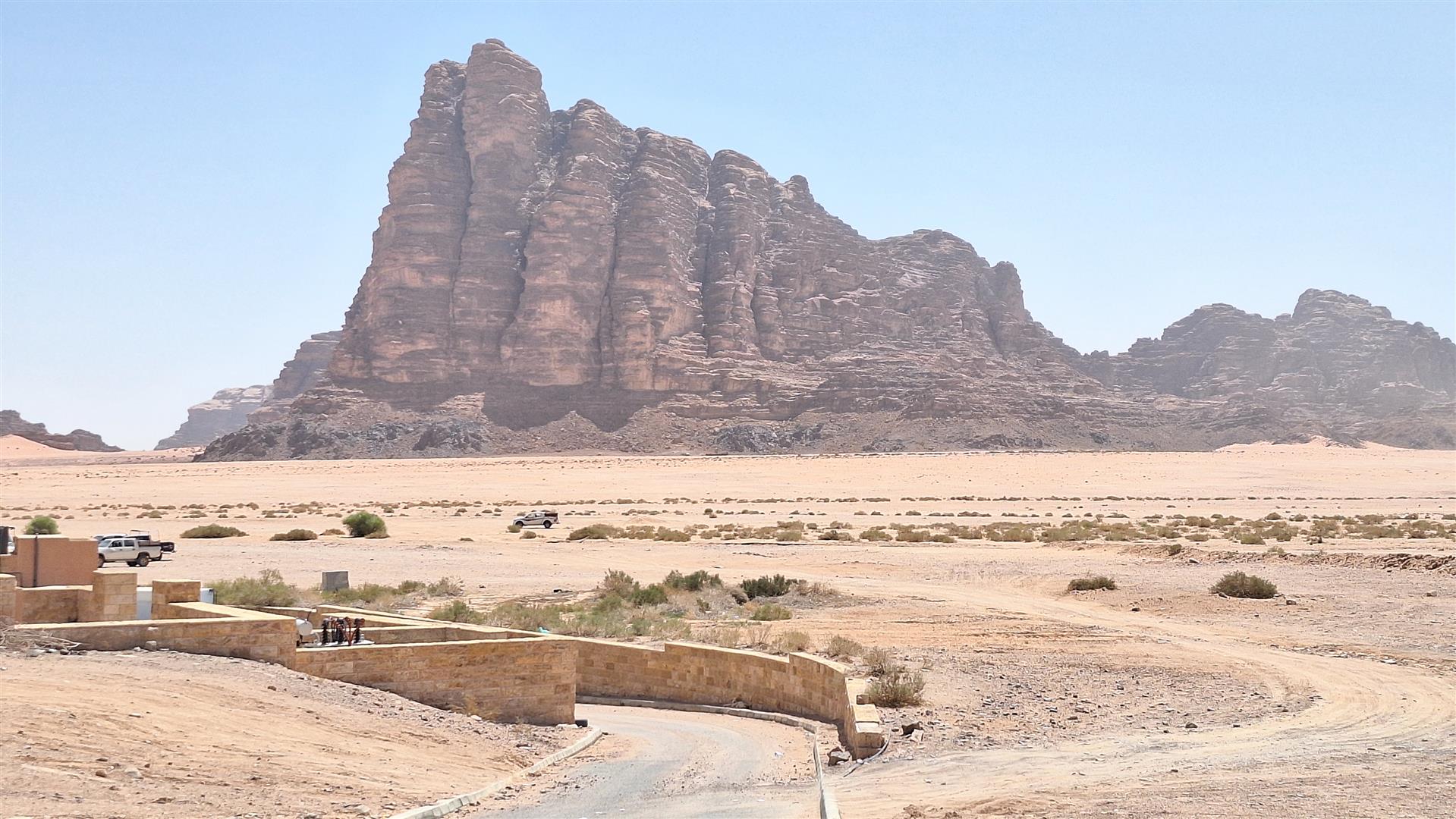
The Seven Pillars of Wisdom.
On the way back out I stopped to photo the Seven Pillars of Wisdom, named after Lawrence of Arabia’s autobiography. The original name was Jebel al-Mazmar, which means “The Mountain of the Plague.”
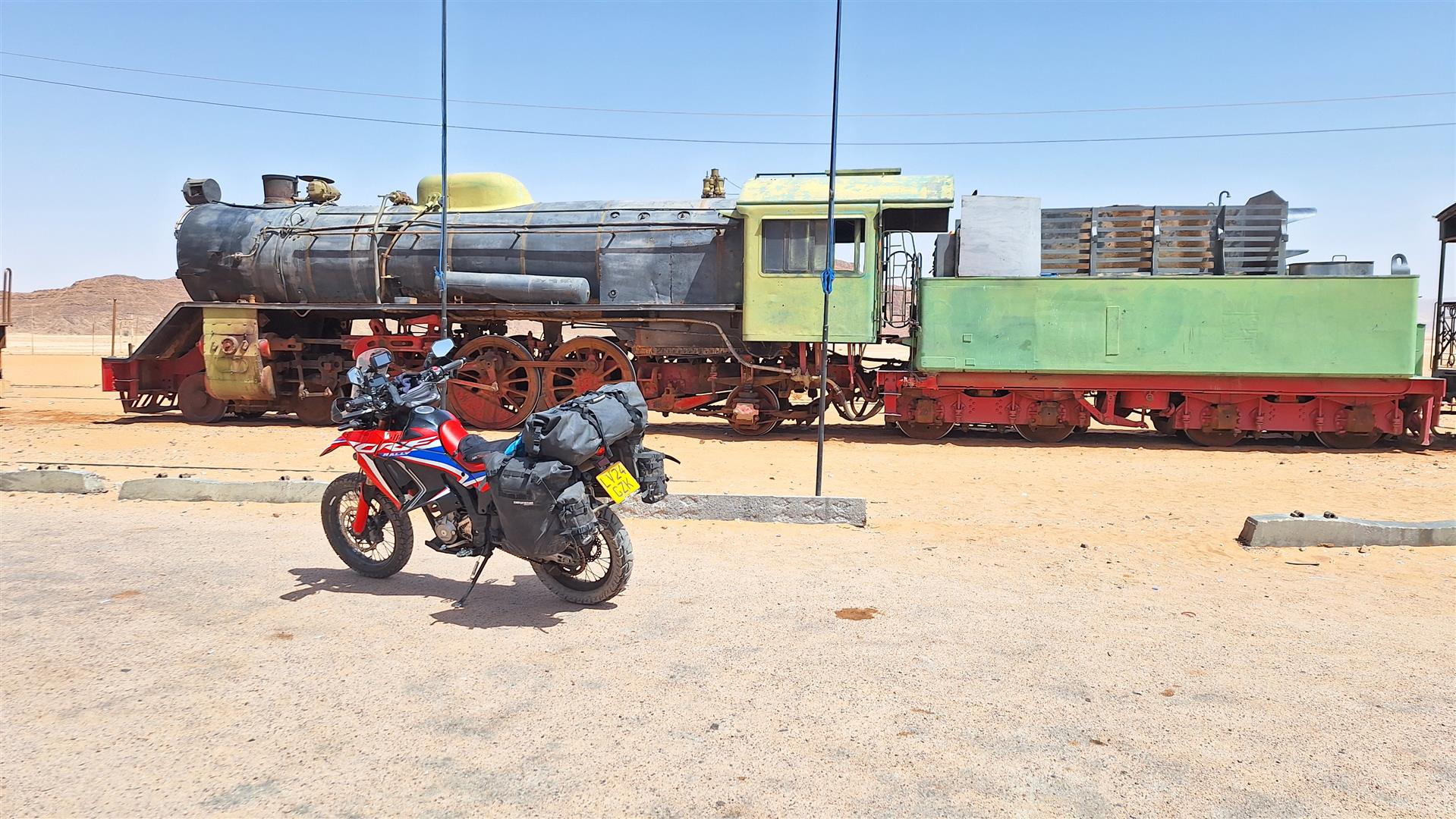
Steam loco for tourist trips.
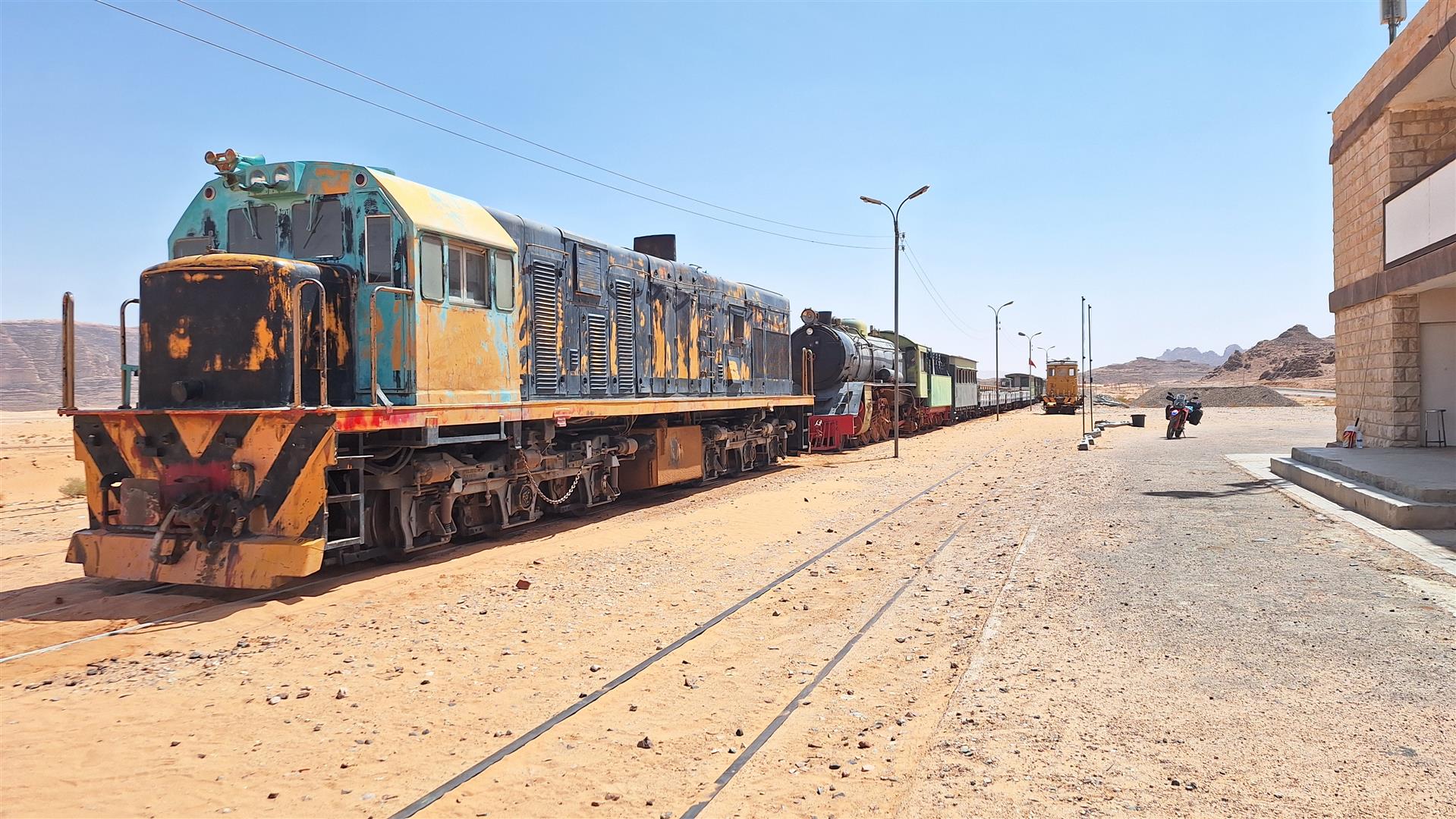
Diesel loco as well.
Further along the road I stopped at the station and took some photos of the locomotives. There was a diesel loco stopped in front of the steam one. I wondered if that did all the work with the steam engine just for show. I decided that was unlikely as the steam engine looked like it was working. It was oil fired rather than coal.
Back at the hostel in Aqaba I gave Bernie his towel then made plans for the border crossing into Saudi Arabia.
More photos of the desert.



 MOTOPANGAEA