
Kigali, Rwanda. 5th September 2025.
I left Kibale at about 11am, with a short ride to the border ahead of me. I left my small money behind as a tip.
It was an easy ride there. I was sad to be leaving Uganda behind, especially after meeting people as nice as the boat couple. They’ve adopted me as their ‘Papa’. They want me to try to promote their business in England. There’s very little chance of that, although their details have been mentioned in the blog.
I got to the border at 11.50. Here’s how it went.
The first stop was Rwanda customs. Achim had warned me that if I got stuck behind a coachload of people I could be in for a bit of a wait. He’d also said that they might want me to remove my panniers to go through the scanner.
Things worked out well. I took my big bag in to be searched. I had to wait 15 minutes or so. A guy came out to look at my panniers. I didn’t need to open them, he just asked what was in them. He also asked about drones. And that was that. Their scanner wasn’t working anyway, which almost certainly helped.
Further along I came to a building shared by both countries. I quickly got stamped out of Uganda and went to the Rwanda window. After a while she gave me a chit to take to another window.
He gave me a piece of paper to take to the bank where I had to pay $50. I gave her a $100 bill and got the change in Rwandan Francs. Back to the same window where I received my stamp.
Along to the Uganda customs window. I actually gave it to the wrong guy. He passed it to the guy sitting next to him who stamped my CdP out of Uganda. Then the first guy stamped me into Rwanda. Job done, in one hour. Very good.
There was a restaurant upstairs so I went up there for coffee and cake. After that I departed.
I hadn’t checked whether Rwanda was RHD or LHD so I hedged my bets a bit until I saw other vehicles. They drive on the right. I later learned that it used to be occupied by Belgium, which accounts for that and the use of francs.
It was a really nice ride along a twisty and good quality road. Most of the locals ride bicycles, often with a seat mounted on the back for a paying passenger. They also use a home built rack to carry all sorts of things. There were dozens of pedestrians along the roads too. Bikes are used here in the same way that motorbikes are used in Kenya and Uganda.
I gradually went down, from 1900m to about 1400m. There were small towns and villages along the way, busy with people and commerce.
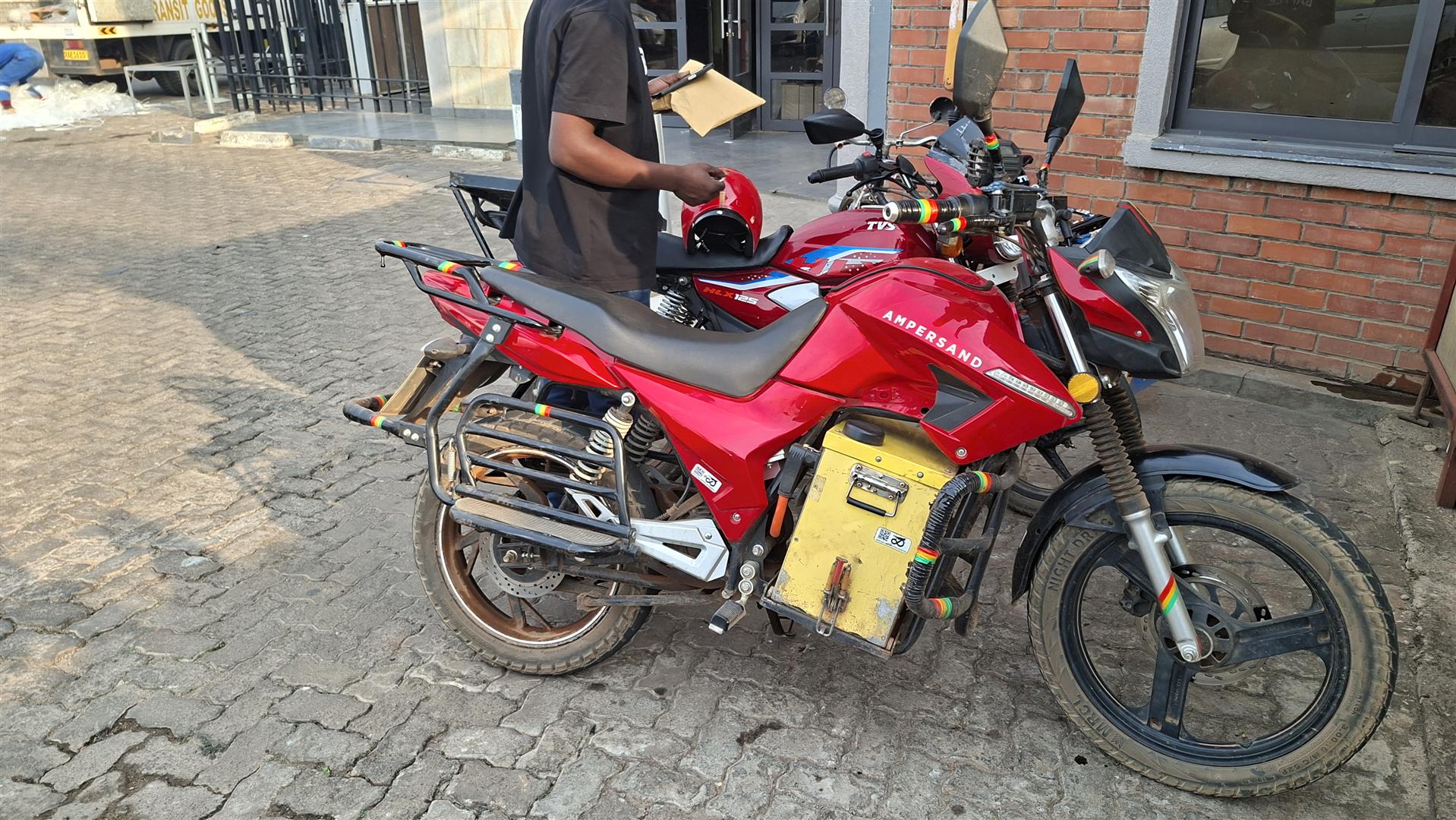
Jury rigged electric drive for this Boda Boda bike.
The city was busy with lots of Boda Boda bikes. I kept an eye out for the police and the speed traps I’d been warned about. I saw a couple of police cars but no cameras.
In the city things turned bad. I’d booked a hotel but the name, address and location of it were all wrong. The Google maps location on Booking was wrong. The postal address was wrong. I rode around the city for at least 30 mins with no success. Fortunately Organic Maps was able to take me to an MTN phone shop so I could buy a SIM card.
I had to queue outside for a while but once I got to the counter I bumped into an American named Yale. He was also queuing for SIMs for him and his wife. He works in finance at the US embassy. She and their son have come with him.
We had a really nice chat about my travels and which countries he’d worked in, the Philippines being one of them. I gave him one of my cards as he wanted to look at my blog.
Once I’d got a SIM I tried to ring up the hotel but couldn’t connect. So Yale tried it for me and got through. The guy said I could WhatsApp him on the number on Booking.com and when I did he sent me through the location. I said goodbye to Yale and found my way there.
There was no sign on the gate and I quickly discovered it’s not a hotel but a guesthouse. Chris, the guy there, said the info on Booking relates to a place they used to have. I told him he needs to get it sorted out!
There was a restaurant next door which sold me a very nice meal. I had two beers because they only came in small bottles. That Belgian influence again.
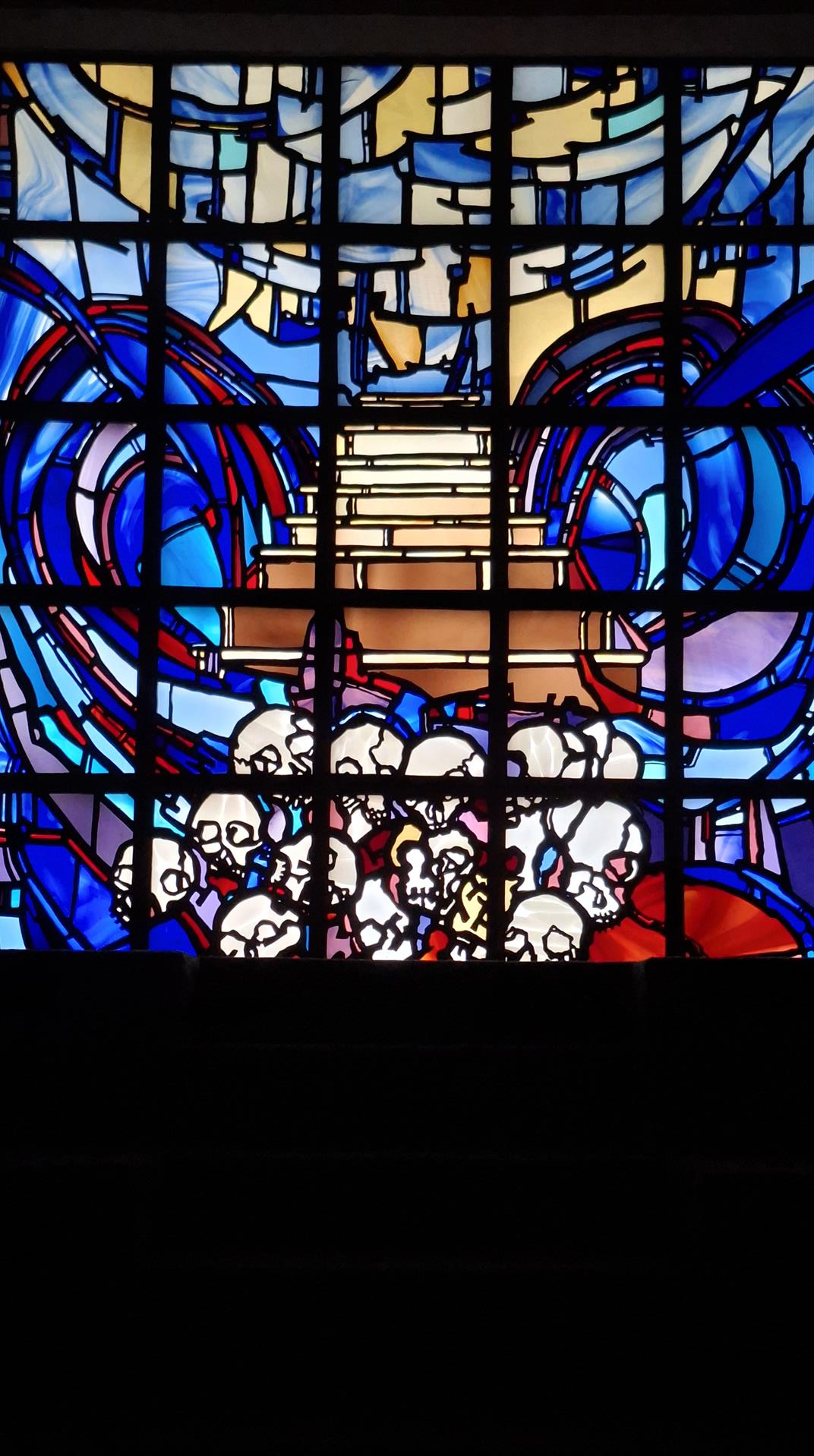
“Stained” glass.
Whenever Rwanda is mentioned then the genocide of April 1994 always comes to mind. It definitely came to mine and I was pleased there were a couple of memorial centres to visit in the city.
I walked to the first one, hoping to get a haircut on the way. Good old Google showed me a barber shop that didn’t exist. Fortunately I passed by another one. There was an old guy sitting outside and when he saw me heading towards the shop he leapt up and directed me to his chair. I wasn’t about to escape. He did a good job at a cheap price.

Anexcellent sculpture, I thought.
At the memorial centre there was no entry fee as such but we were ‘encouraged’ to make a contribution, $20 minimum, more if you wanted an audio guide – which I didn’t.
They showed a video of interviews with survivors. Then there was a very good photo exhibition, with lots of explanations, describing how and why it happened.
The scene was set by the Belgian occupiers who put the Tutsis up as being better than the Hutus and using them as a somewhat higher class of administrators. The Catholic church claimed them to be racially superior to the Hutus, thereby engendering racial division among people who had, prior to colonisation, lived together peacefully.
It was Germany that had first occupied Rwanda but the Belgians took over during WW1. The story of the effects of colonisation is the same as most other occupied places.
Once independence came along, in 1962, politics reinforced the divide. Rwanda ended up being a single party state and slowly drifted toward a racial divide where revenge was inducted against the Tutsis. It was low key stuff at first. But an aeroplane carrying the Rwandan and Burundi president s was shot down early in 1994 and it was blamed on the rebel Tutsi army. That was the signal for slaughter. The Hutu dominated government had been making plans for this for a long time.
Many families were a mixture of the two tribes and they tended to live together as neighbours. But then the horror of the genocide began with Hutus torturing, raping and slaughtering Tutsis, even within their own families.

A few victims, on display.
This was all promoted and encouraged by the Hutu government and around 2 million lives were lost. The memorial site is also the location of mass graves holding around 250,000 people.
It’s an appalling story which also reveals the ineptness of the UN response. It only ended when the rebel Tutsi army drove out the government forces. Since then there has been a ‘truth and reconciliation’ programme to develop harmony and forgiveness. More on that later.
It’s a tragic story and reinforces how awful colonialism was.

Graves containg multiple victims.
I ate at a different place that evening and they had the England v Andorra game being shown on the ‘big screen’, which was actually a white painted wall with a projector aimed at it. Nice result and nice food too.
A group of people had arrived at the guest house the previous night. After breakfast we got chatting. They’re from different countries and are involved with the African Union. They were there for a conference. We went outside so they could be photographed with me and my bike. They were a great laugh and we had a good giggle.

Good people, working hard for Africa.
Then a guy arrived on a KTM 790. Name of David, from New Zealand. He’d just crossed the border from Uganda, but only for a day. He was going back next day for a gorilla tour. I never did quite get to understand why he only came for one day then going back, instead of coming after his tour.
Anyway, he’s a nice guy and has travelled various bits of Africa, usually about one month at a time. He sometimes leaves his bike there but after this trip he was shipping it home.
Then I got on the bike and rode down to Kant House Museum. It’s named after one of the German administrators.
This place describes Rwanda before Europe invaded. They had a monotheistic religion with the king as their god’s messenger. They had a perfectly functional justice system, based around family and community practices.
Their education system was all about men teaching boys and women teaching girls.
It was the Catholic White Fathers that mostly destroyed this system, insisting on teaching them religious practices but little else. The German protestants did better, forging ahead with proper education, European style.
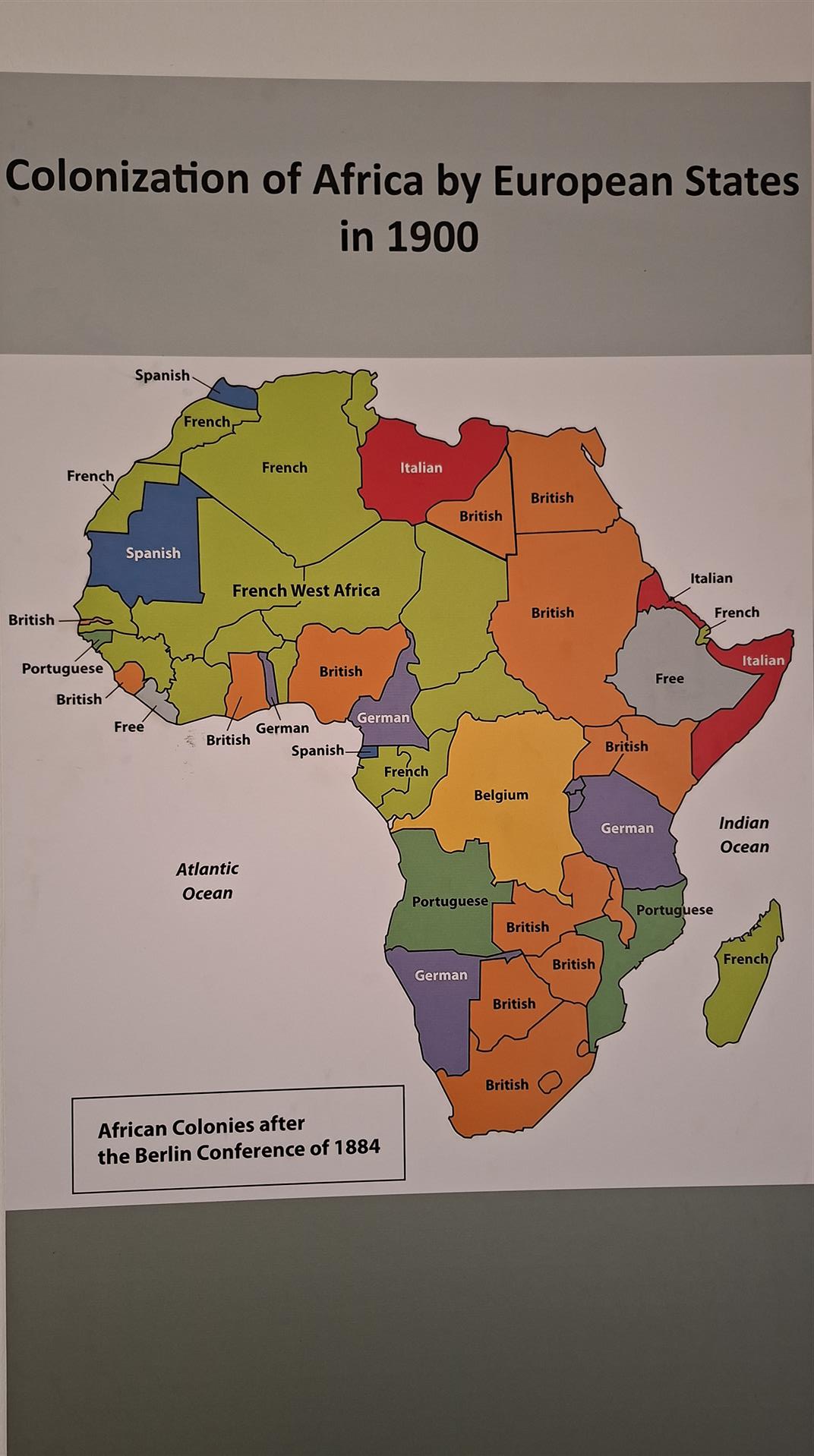
The European division of Africa.
European science insisted on using social Darwinism to divide the world’s people into broad racial groups, based on perceived intelligence. In Rwanda they decided Tutsis were a cut above all others, including Hutus, and so the seeds of the genocide were sown.
There were lots of photos and descriptions of how the occupation affected people, especially the destruction of their culture. And, of course, how the Belgians then took over.
Interestingly, the Germans were happy to leave the original Rwandan methods of ruling in place. The Belgians absolutely were not, insisting on changing everything to suit their methods. A very interesting visit.
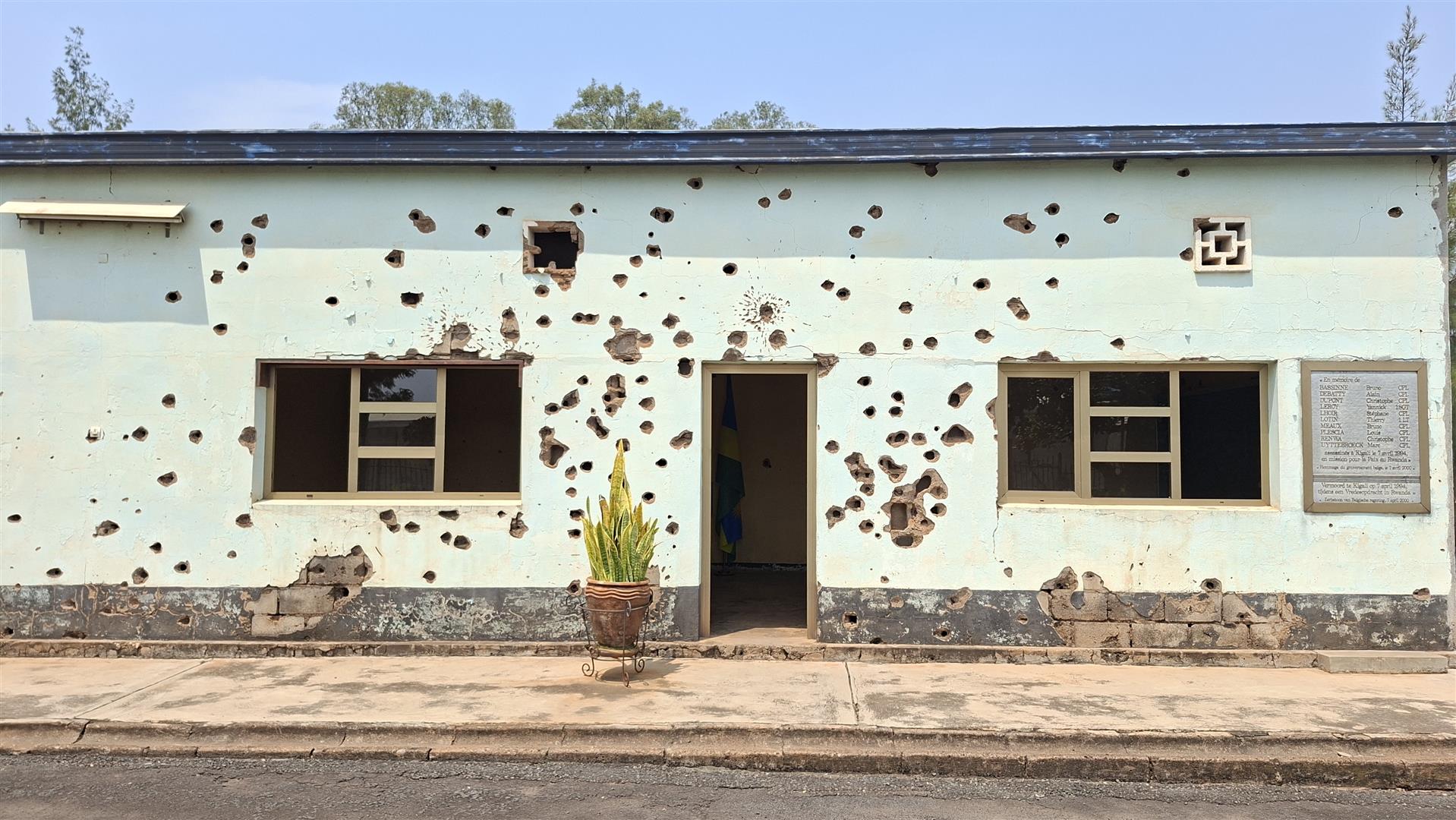
The building where the commandoes sheltered.
Then I went to see the Belgian Peacekeepers’ Memorial. This was a sad tale of inept leadership and lack of action.
Ten Belgian Commandos were captured by the Hutu army but despite their HQ being told of their plight, no attempt was made to rescue them. Ten commandos died, along with some officials, some of whom were women.
There’s a memorial outside with stone columns representing each of the ten commandos. Made from Belgian stone, each layer of stone represents a year of their age. It was very nicely presented.
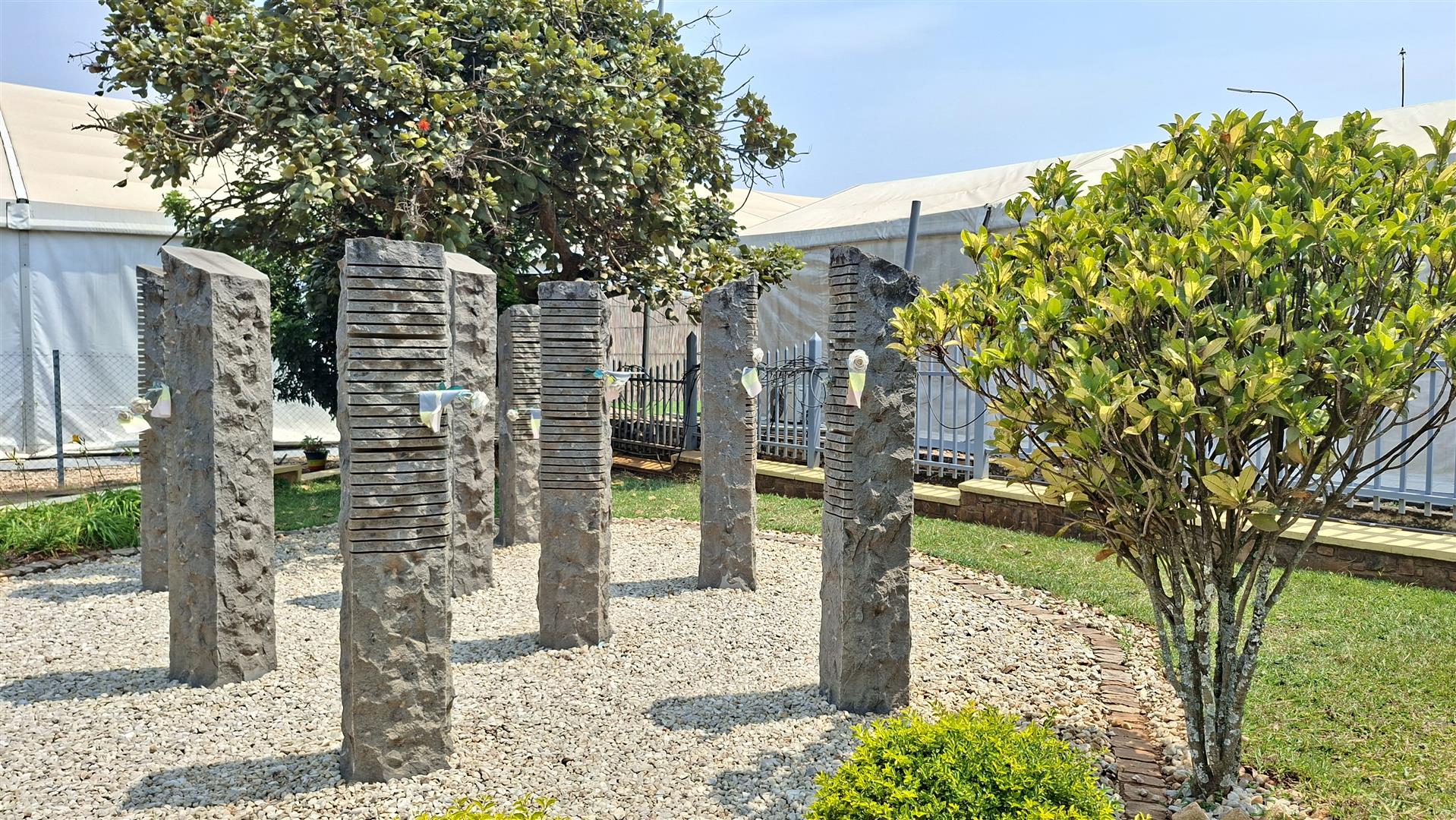
Their memorial.
I rode out to visit the Ethnographical museum, which I couldn’t find. There was a building at the location given on Google but it looked like it was being rebuilt.

The Wall of Pipes and nobody knows why.
So I gave up on that and went to see the Wall of Pipes. It was just a half height wall with lots of drainage pipes sticking out of it for no apparent reason. A real oddity.
After that I went to see the Kanyinya Canopy Walk. I rode down a steep dirt track for about 2kms until I came to the suspension bridge across the ravine.
There wasn’t really a canopy to speak of. There were some skinny trees near the beginning of the bridge but nothing to see in them and they didn’t cover the bridge in any way. Not a canopy at all to my mind.
I walked across it until I was above the river that wound through the ravine and took some photos. I was accompanied by a bunch of kids. When I got back to the bike I gave the eldest of them 1,000 RWF and told him to share it around. It almost caused a riot, with some of the others trying to take it off him. Very amusing.

Bridge across the ravine, but no canopy.
The ride back up the path was easier than I’d expected it to be and was a good little test for me and the bike.
In the evening I joined David at the restaurant next door. We had a very nice travellers’ chat over beers and food and he suggested a couple of places to visit further south. A good way to round off the day.
There was another genocide site that I wanted to visit so I headed out to the Nymata Genocide Memorial. Once out of the city it was a steady ride until I got there. This place was a former church were 10,500 people were murdered.
I read and photoed all the info boards outside then a woman guided me around the interior. It had loads of coffins on the floor and benches covered with the clothes of the victims. No Photos allowed though.

Coffins which were, I hoped, just for display.

Racks displaying the clothes of those murdered.
She tried to explain what the coffins were about but I didn’t follow a lot of it. She showed me down into a crypt where there were more coffins, some open. I’m not sure why though. There weren’t any bodies in there.
Then she took me down into another crypt where there was a display of skulls and femurs. A brief look around the outside then she left me to it.
So I went back inside and took photos, but I forgot to go downstairs to photo the skulls. I took a photo of the newly built church before I left. The original had been de-consecrated because of the killings.
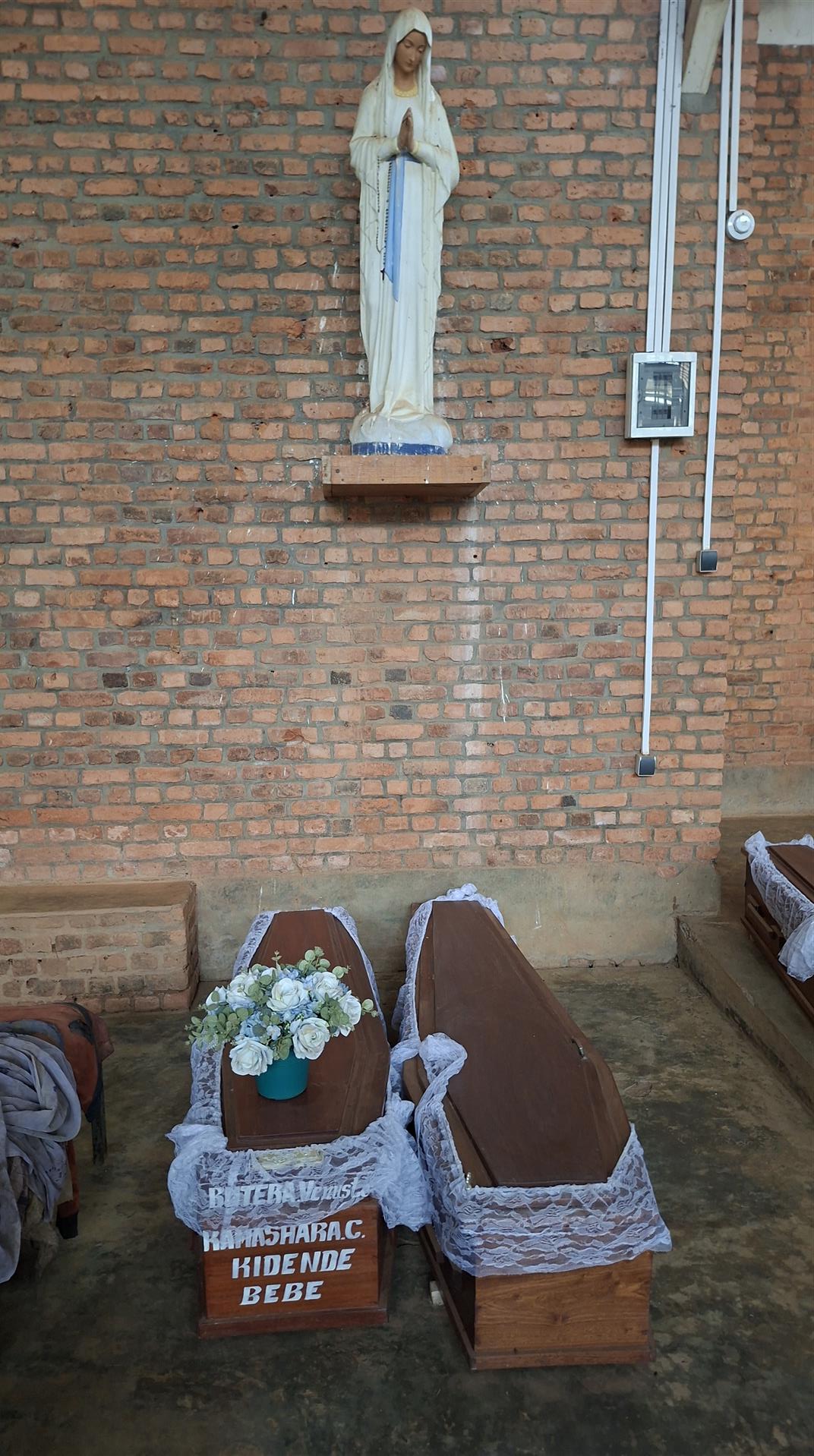
She was nowhere to be seen when it mattered.
When I went back to the bike I was highly amused by the antics of a little girl, about two years old, who was trying to climb up onto my bike. She hadn’t managed it by the time her mother took her away, but she tried hard.
In the evening I had a good chat with one of the woman from the African Union. She’s from Nairobi and told me that all countries in Africa are now members. She’s dealing with agriculture, trying to help SMEs.

A VIP day for these folks at their meeting, so dressing smart was the order of the day.
Next morning the AU delegates were all dressed up in their finery, ready for a presentation to government VIPs. So photos just had to be taken before I left.
From Kigali I headed out to Ruhengari with a couple of places identified for a visit.
It was a good ride up there. But I had two near misses. One was where I wasn’t concentrating on the road and came close to hitting some people on a crossing.
The other was where I did a bit of a dodgy overtake close to where a couple of coppers were standing. Further along I got pulled in by another one and he said he was going to fine me for dangerous overtaking. He asked to see my licence, and then my IDP. But then he let me go. Phew!
I found a good hotel and later I walked up to a very nice restaurant, just managing to escape the rain. The food was very good and yet still very cheap. I was forced to drink a second beer while I waited for the rain to stop.
Next morning, with a better forecast on hand, I set off to see the Gorilla Naming Village. The road up there was very twisty, passing through lots of built up areas and their attendant police. After the previous day’s near miss, I took things steady.
The village was a slightly strange but interesting place. When I got there, and had parked in the correct place, I got latched onto by a young local guy wanting to practice his English. He followed me around a bit but I didn’t encourage him.

A superb model of a gorilla family.
The purpose of the village is to hold the gorilla naming ceremonies that take place every year. Naming ceremonies are a big part of Rwandan family culture and this has been extended to the gorillas, for two reasons. The first is to get local peoples’ buy in to the gorilla conservation projects that are centered on the nearby Volcanoes National Park.
Since the beginning of the century Rwanda has run an ever more successful gorilla conservation programme, as has Uganda. There are now over 300 of them in this area. The second reason is, of course, for tourism. Rwanda is a very small and crowded country and the land the gorillas occupy could have been used for farming. So getting the buy in of local people people was vital. And tourism brings good employment. There’s a good explanation of it all here.
It’s not a village as such. It’s an area which has fantastic models of animals woven from reed. The biggest is a family of gorillas, which is easily 20 metres high. They were sitting next to an arched walkway. Very photogenic, from all angles.
Next to them is a giraffe. Next to the entrance is a lion. Across the way is an elephant, also next to a walkway. The photos tell a much better story.

A lion as well.
Over the back are some replica houses, also made from reed and grass. One is a chief’s hut, three others are more normal size.
There were no info boards, sadly, but Google had the answers.
When I left the same guy approached me and was talking about their local football team, which didn’t have a ball to play with. An obvious request for money. I declined the offer.
On the way back I found a café but I managed to leave my backpack behind. I realised as soon as I got back to the hotel and returned to collect it. My bike gets a lot of attention when I ride past people and I’m sure some of them must have wondered what on earth the foreign idiot was doing, riding back and forth.
I went to a nearby café for something to eat. I got talking to a young guy named Eric. After a while another guy came along named Emmy. We had a good long talk about Rwanda. I asked him how he felt about the compulsory monthly community work. He was all for it. (Explained soon.)
We talked some politics for a while, including about Kenya. Problem was that I couldn’t quite hear him properly a lot of the time. Never mind, it was good to talk.
An hour had gone by since I’d ordered my food so I went inside to see what was going on. The idiot had forgotten about it!
He cracked on with it and it arrived after about another 25 minutes. It was very good and when I went to pay the bill he only charged me for the food. I got the beer for free. Quite right too!
Next morning I left for Nyanza. Shortly after leaving I noticed that the ABS light was flashing so I pulled up near a junction and switched off. But there was a copper there and he decided to check my number plate against his data base.
To my complete surprise I had three outstanding speeding tickets. I suggested I’d pay at the border, which he was OK with. I was hoping they wouldn’t check. But they will, of course. I hadn’t noticed being flashed but just to rub it in I got flashed twice more during the ride. So it looked like I was in for 50,000 RWF. Around £25.
Later on I looked up what the speed limits are and it seems they’re 40kph in urban areas, such as Kigali. I’d assumed 50. Out of town they’re either 60 or 80kph, and it’s hard to know which. I sometimes see signs for 60kph and sometimes 80kph. Cameras are quite easy to spot, provided I was looking for them.
The road went up to 2500m and got chilly and damp. Rain came in but it was only very light and I didn’t bother with wet gear. That was the right decision as it went away eventually. The road was very twisty but I didn’t push things. Partly because of speed and partly because of the slippery conditions.
The road deteriorated towards the end, with rough areas caused by roadworks and general rough patches. I became all cautious in the wet, plus I was now super wary of speed cameras.
When I arrived at the hotel I had a look at the bike. The ABS light behaved itself until I got near to the hotel, when it started flashing again. In addition, the two indicator warning lights on the instrument panel were flashing as well. Very odd.
I thought it might be loose battery terminals so I took the cover off and tightened them up. They were a little bit loose. I topped up the oil and checked the chain at the same time.
Over in the restaurant French seemed to be the alternative language. There were some French guys there and one of them helped organise a cold beer for me.
I ordered food and sat drinking while I watched West Ham v Spurs. Spurs won in the end. But there was no sign of my food. I asked the young lady about it and she seemed to have thought that I wanted it in the morning! She went off to chase it up.
It didn’t take long to arrive and it was really lovely. Chicken steak, chopped up and fried, plus vegetable rice. Excellent.
I did a bit of reading up about Burundi and Tanzania. I need to decide whether to bother with Burundi. There didn’t seem to be a lot there. Crossing from Rwanda to Burindi can’t be done, otherwise I might have gone there. The border is closed because each country supports a different side in the DRC conflict. DRC is the western border to both countries. Bloody politics!
A Visa On Arrival for Tanzania is $50 for single entry and $100 for multi. So going in/out/in from Tanzania to Burundi is the same price. Thought was needed.
In the morning I went out to see the places I’d earmarked. The first was the Kwigira Museum.
It was a very interesting place. It mostly covered modern Rwanda and how they used Gacaca to deal with the after effects of the Genocide. (See below.) It wasn’t the simplest path but it worked very well and was faster than any other.
The Govt reintroduced Umuganda, which is the community service I’d read about already, and mentioned in my talk with the guys at the café. It is an ancient system but the Belgians had destroyed it. (See below.)
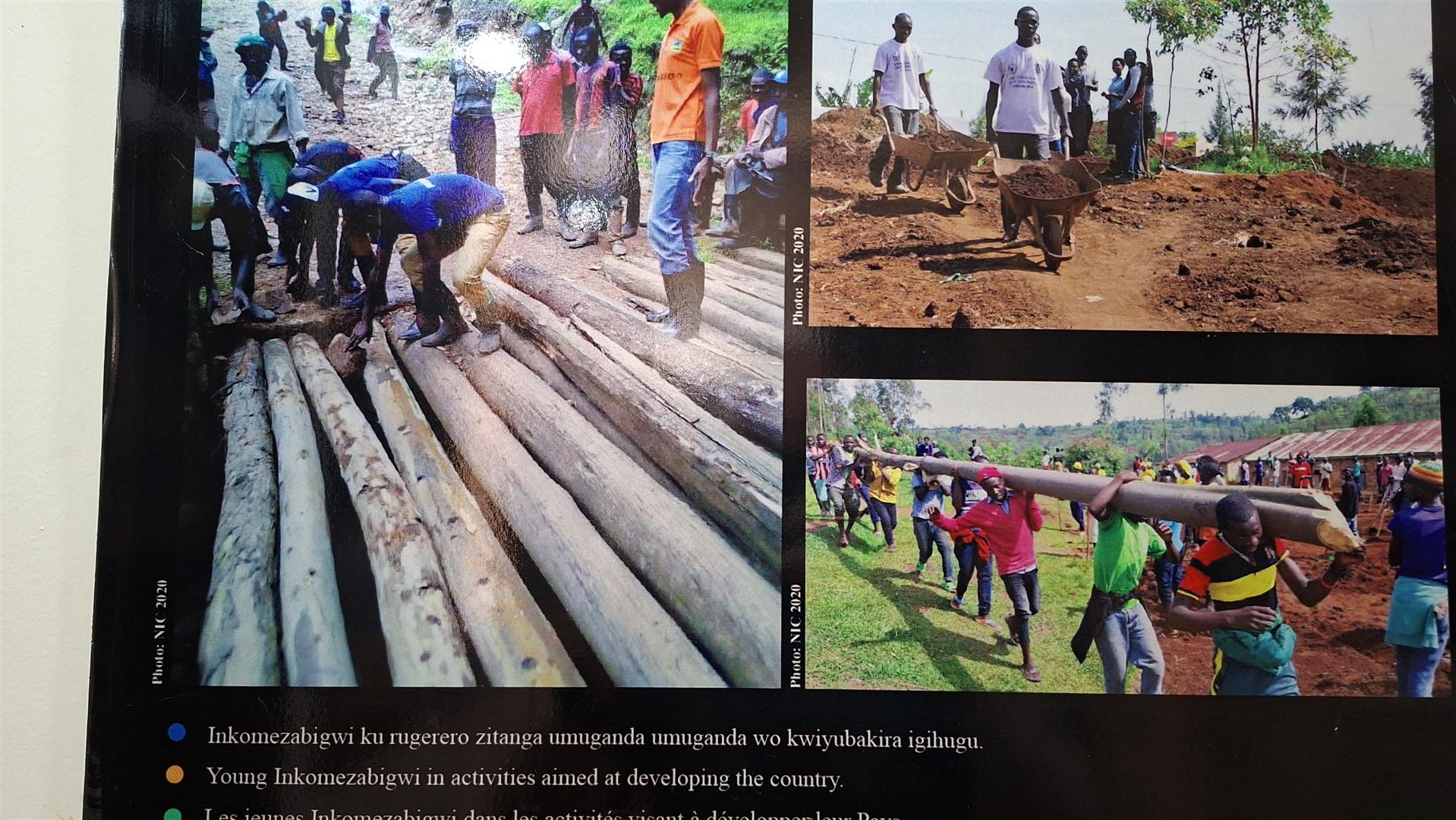
Community service.
Another thing that was introduced was the giving of a cow to poor people. The cow is the mainstay of African farming. Doing this improved childhood nutrition and the dung helped the family improve crop productivity. An excellent idea that has worked well
There were lots of interesting pictures and detailed info boards. President Kagame has his detractors but many of the things he’s done for Rwanda seem to be very good. The woman who took my money followed me around and was there when I had questions to ask.
The other visit was to the King’s Palace Museum. The entry fee was quite high but it included a very informative guide.

A kingly reed house.
There’s a replica of the king’s traditional house, plus a buttery and brewery. The walls are woven from bamboo, which I hadn’t known grew there. I haven’t actually seen any but then, I didn’t look for it.
The king’s new palace, which he didn’t live to occupy, was a rectangular and functional building which followed European design.
There was more history to read in there, about Rwanda’s early days and how it grew in size. So that was interesting too.
Then he took me out back to see the royal cows (and a big old bull) in a compound. I was encouraged to engage with them although there was a minder there to keep me safe. They’re long horn cattle and those horns are pretty big up close.

This cow was very docile, I’m pleased to say.
I’ve mentioned two traditional Rwandan processes. Gacaca is a method that communities used to resolve disputes. The community leaders would form a panel and listen to everyone involved in the dispute. Then they’d give a decision which was accepted by all concerned out of respect to them.
The genocide left very deep wounds in the country, which needed dealing with if there was to be any chance of moving forward. There were three way of doing that.
The first was to do nothing and just release the perpetrators back into the community. Clearly that would create huge amounts of resentment and revenge.
The second was to use the legal system to prosecute all who had done wrong. But there were so many that it would have taken 120 years to complete that process. Add to that the cost of their incarceration.
The third way was to use Gacaca, and that was what happened. Almost two million cases were dealt with in this way. In many ways it was a more difficult route but it was fast and it worked. The punishments meted out were community based and helped to reintegrate victims and perpetrators successfully.
The other process was Umuganda, which can be translated as ‘coming together with a common purpose to achieve an outcome’. It used to be used for such activities as building village houses. A common enough practice throughout the world.
These days it’s a legal obligation on every able bodied person between the ages of 18 and 65 to provide four hours of community work on the last Saturday of every month. And I have to tell you that I’ve rarely been in such a clean and well organised country.
Another fascinating day out. And I was happy to find that the flickering dash lights had been cured.
What a fascinating country Rwanda had been. It has a tragic history, both of colonialism and the 1994 genocide. But from the outside looking in the recovery seems to have been remarkable.
 MOTOPANGAEA