
Kampala, Uganda. 24th August 2025.
Danish Michael had put me in touch with a German guy named Achim Vogt. I knew the name from the WhatsApp groups and he’d invited me to stay with him in Kampala. Because it wasn’t very far away I didn’t leave until after lunch.
I headed off along the main road I’d used the day before but got stopped by the military police and was forced to turn round. It was very odd because they only seemed to be stopping bikes. I found a parallel route that got me back on track and on into the city.
The last 20kms was very busy with traffic, especially taxi bikes. These guys have a dedication to moving forward that astonishes even an experienced London rider like me. They put all the Indian cities to shame. But I found Achim’s house with no problem.
He came out to meet me and made me feel very welcome. He made me a coffee and we went out onto the terrace to sit in the sun and chat. His wife is Lebanese and that’s where she was at that time, so I didn’t get to meet her.
He works for a German NGO, funded by the SDP, that helps countries stabilise their political systems and also helps with environmental systems. All the German parties have such things and, with the exception of the AfD, they all operate abroad. They’re funded by government money. I didn’t know this, but the UK has a similar organisation called The Westminster Foundation For Democracy.
They’ve travelled a lot, including around Africa. His Nissan Pajero is from Lebanon and he was talking about shipping it back there after they’ve done some more travelling. He asked me about using Alan, who I’d used in Dubai, and I assured him he was an excellent person.
We chatted about my travels and his. He was impressed and fascinated that I’d toured Iraq and the Levant. I told him about the events in Syria and Lebanon.
I also met his two very long legged dogs. They’re brother and sister and were rescued from the street. They’re over affectionate and I needed to be relaxed and friendly to win them round. Which I did with the male. The female was far more wary but not aggressive, despite her frequent barking.

Achim’s dogs. Brother and sister.
I needed money so Achim took me to the nearest Equity bank. Then we went to a pizza place that he recommended. The pizza was excellent and the draft Nile beer wasn’t bad either. My treat, as a way of saying thanks for the hospitality.
We came back and had a beer from the fridge, and more chat. He’s currently acting as go between for the government and the city authorities, trying to improve the city’s transport networks. A lot of it is about the Boda Boda taxi bikes and the minibuses that supply most of the city’s transport.
Boda Boda is a shortening of Border to Border, which began as transport within the smuggling network. Bicycles, then motorbikes were used to transport the illicit goods from border to border. There’s 300,000 of them in a city of 4 million people. He said they earn pretty good money.
He’s now working with a Ugandan female lawyer who’s taking over a lot of the work he’s been doing. He said something that suggested there’s a strong desire to ease out people like him. He’ll retire next year and will go off travelling again.
I didn’t go out the next day as the weather turned wet. In the evening he took me to a restaurant called Skyz, which is a hotel with a restaurant up on the roof terrace. We had an excellent meal plus a beer. It was quite an expensive place but Achim insisted on paying for everything despite my offer of some money towards it.
They had a quiz on the go so we sat and guessed at the answers without officially taking part. They had some unusual categories such as Tattoos and Fruit. We were getting 5 or 6 right in most rounds.
After breakfast I aimed to go out. The sun was shining and I left at about 11. I went to the Kasubi Tombs. That was very interesting. They’re the final resting place of the Ugandan Kings. To complicate things there were five kingdoms in Uganda but this place was about the most important one.

The King’s tomb.
The legend is that kings don’t die, they disappear into the forest, never to be seen again. So the main building is a large house/temple/tomb where the body of the last king is hidden in the rear section, i.e the forest.
The buildings are made with wooden supports, reed walls and date palm leaves which are cut into thin strips, dried and woven into thick (about 150mm diameter) rings which then are held up by the wooden supports. Spear grass is then used as thatch.
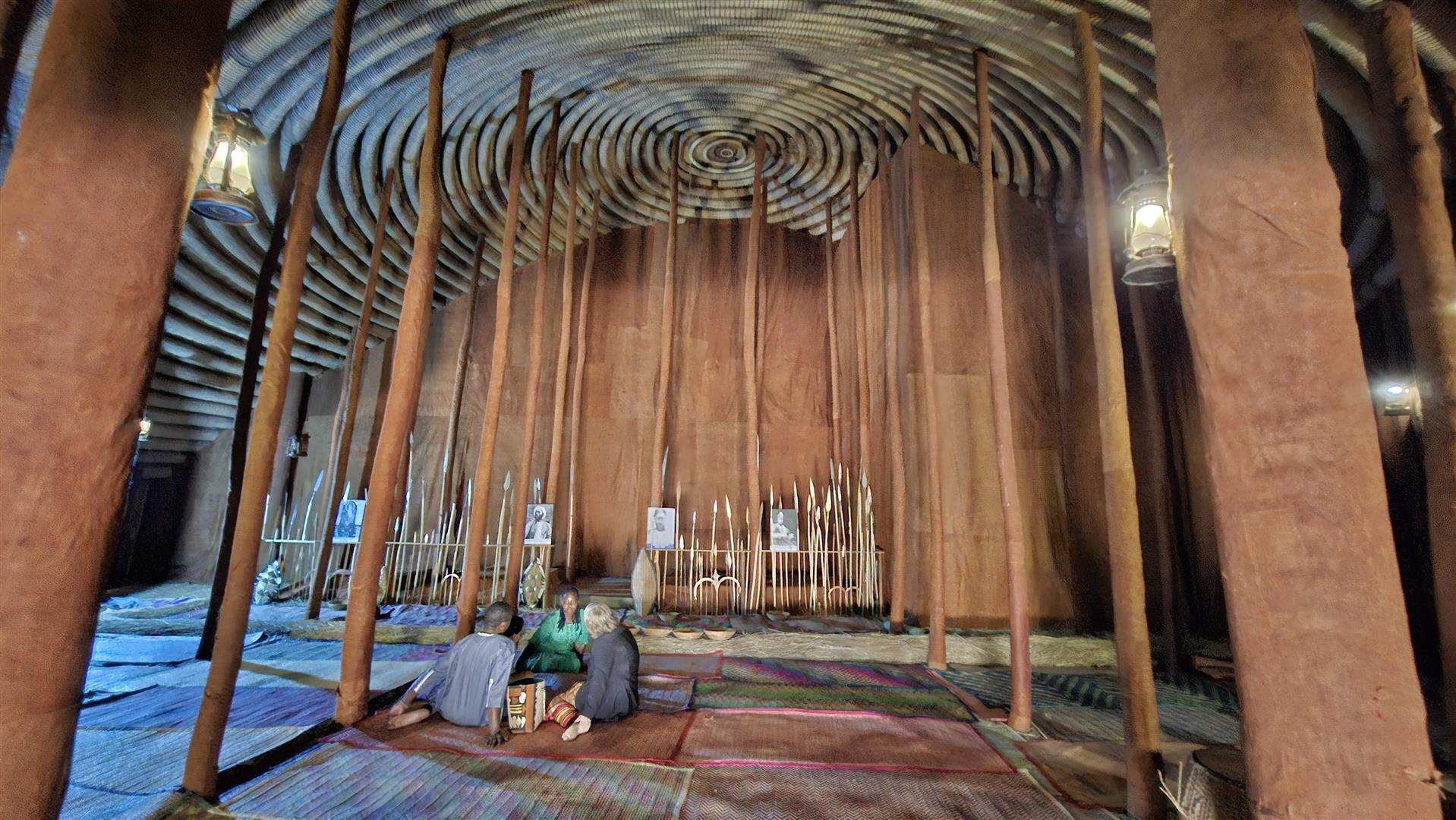
This is very clever design and construction, all with locally available materials.
It’s all very intricate and clever. The posts are covered in tree bark which has been beaten and treated to make a kind of cloth. It’s also used as a material for painting on.
The guide showed us some of the drums they use and explained a bit about them.

Stunning artwork, using the tree bark.
I’d met a party from Czechia on the way in. Father, daughter and boyfriend. I chatted to him about the bike and my travels. He rides a BMW and tours Europe. He asked me if I always travel alone and I said yes. I could see his brain churning a bit.

The cathedral exterior.
From there I went to St Mary’s Catholic Cathedral. A good looking building, from the turn of the century. Some nice stained glass to look at. While I was there the 1pm mass started and it was quite well attended. I was still looking around but was generally ignored.
A guy showed me around and then got me to fill in the visitors’ book. He also made sure I had an envelope in which to place my contribution. Needless to say, I slipped out of a side door. I never give money to religious organisations if it can be avoided.
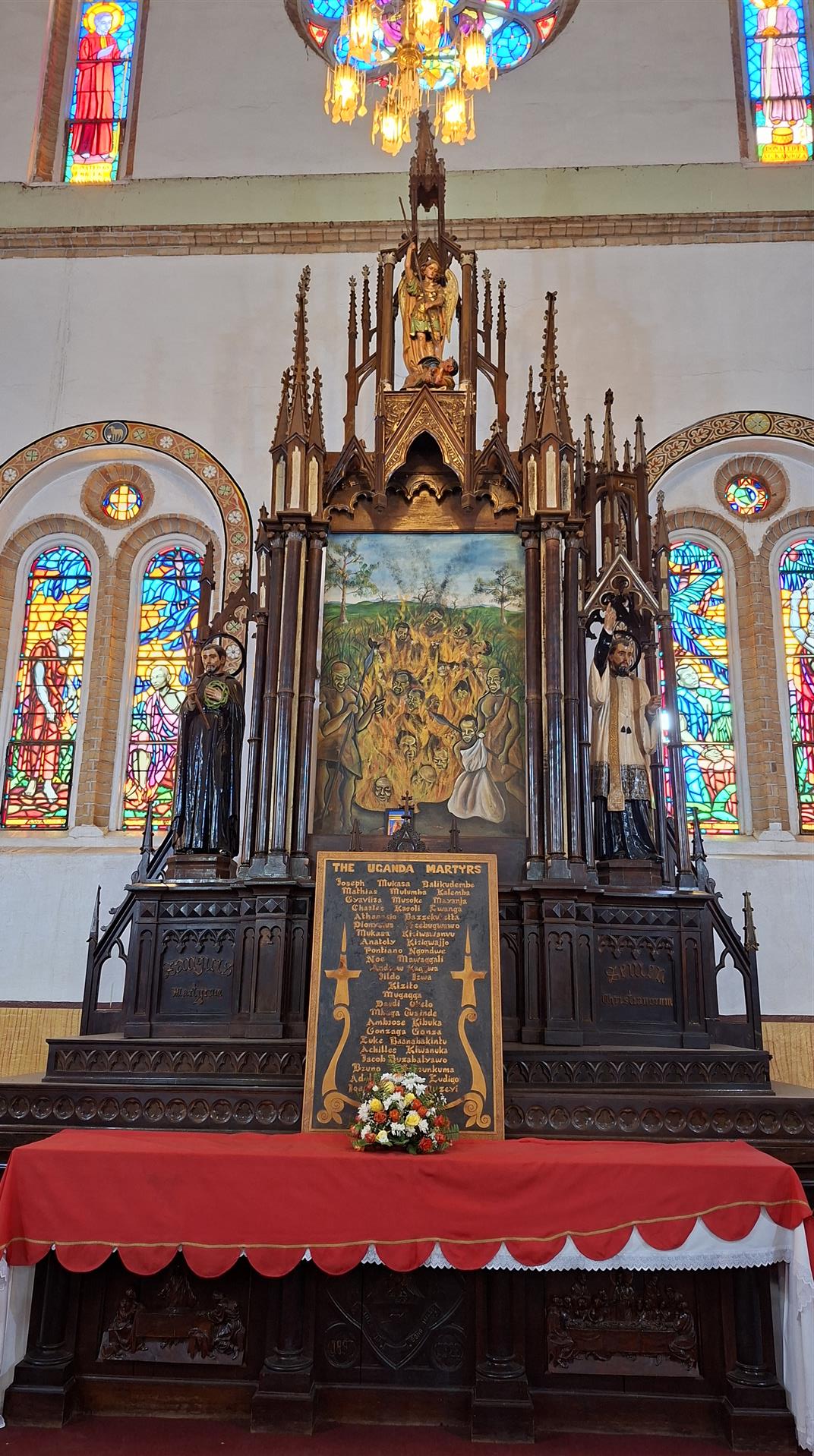
Quite a stunning altar.
Next I went to the King’s Palace. A nice looking but fairly modest building. He had just arrived that morning so I wasn’t able to go in.
The woman guiding me showed me Idi Amin’s torture building. It was built as an armoury by Israel but he converted it into a torture centre. Once people went in there they never came out again, she told me.

The King’s Palace. Quite modest in style.
Most of the victims were educated people, such as teachers, which is no surprise from a brute like him. But his successor, Yusuf Lule, continued their use.
She also talked about their having been five kings, many chieftains, with 57 languages. The king is just a figurehead. He doesn’t live in the palace because of its history as being a place where kings were killed.

A classic car wreck.
There was the remains of an old Daimler limousine outside. It was a wreck and it had the bumpers off an old Cadillac bolted on and the wheels from a Rolls Royce. Samples from several of the king’s old cars.
That was very interesting and the woman knew her stuff. I gave her 5k. On the way out I got a photo of the two guards at the gate.

Two happy sentries.
I checked Google to look for grocery stores and spotted a Carrefour supermarket. I rode round there, blagged my way into the car, not the bike, park and went shopping.
They sell fresh cooked food so I bought half a chicken and some English style veges for later on as Achim was out that evening. I got some apples and mandarins too, something that was hard to get from small shops or stalls.
Next day Achim was at work until 5pm and when he came back we went to look at the winch on his Pajero. He’d told me it was faulty so I offered to have a look at it. I could see that the winch rope had got bit folded over itself and was jammed. It would only wind in, not out, when the control was used.
We released the freewheel mechanism and I pulled the rope all the way out to free it off. Achim took the control apart and there was a connection that had come off. I put that back on and reset the grommet where the wires came out. With that done the winch worked as it should and we wound the rope back on properly. A good job well done.
We went to the pizza place again. We had to park down the road as the car park was full. When we walked back up we were held up by some soldiers, who wouldn’t let us pass despite Achim’s arguments. The president was at an event across the road and we had to wait for him to leave.
The pizza and beer were just as nice as last time. Achim was explaining how thieves will take a phone off the dashboard of a car just by reaching in the window. It will be a guy on the back of a bike who does it. He’d had three phones stolen. Earlier he’d warned me against walking around on my own. He said there’s a lot of violent theft, even in daylight hours. Kampala seems to be a haven for thieves.
Back at base we chatted about various things, including the Middle east, which he knows a huge amount about. Syria still has lots of fighting going on and isn’t yet in a good place. He’s not certain how things might go. We also talked a bit about our future plans. There’s a chance we might be able to meet in South America.
I was keen to go on a visit to see some Shoebill Storks, a rather unique bird. Achim had tried, without success, to line up a tour for me with a guy he knew but he only catered for groups. So I booked a hotel in Entebbe where I knew I’d be able to organise something.
I left next morning after fond goodbyes. Spending time with such a knowledgeable person as Achim had been really great and I’d learned a lot.
Kampala to Entebbe wasn’t far and didn’t take long to reach. I settled in for a rest.
When I went over to the restaurant in the evening there was a crowd of people in there who turned out to be English Venture Scouts with their leaders, from Birmingham. They’d been in Uganda for three weeks doing voluntary work at an orphanage and a school. Good for them. I told them about my visit to Baden-Powell’s home in Kenya, which they hadn’t known they were so close to.
After some internet research I found someone that could take me on a trip to see the Shoebills. I planned to meet him next day. It cost me $80, cheaper than the first place I’d tried by a useful amount.
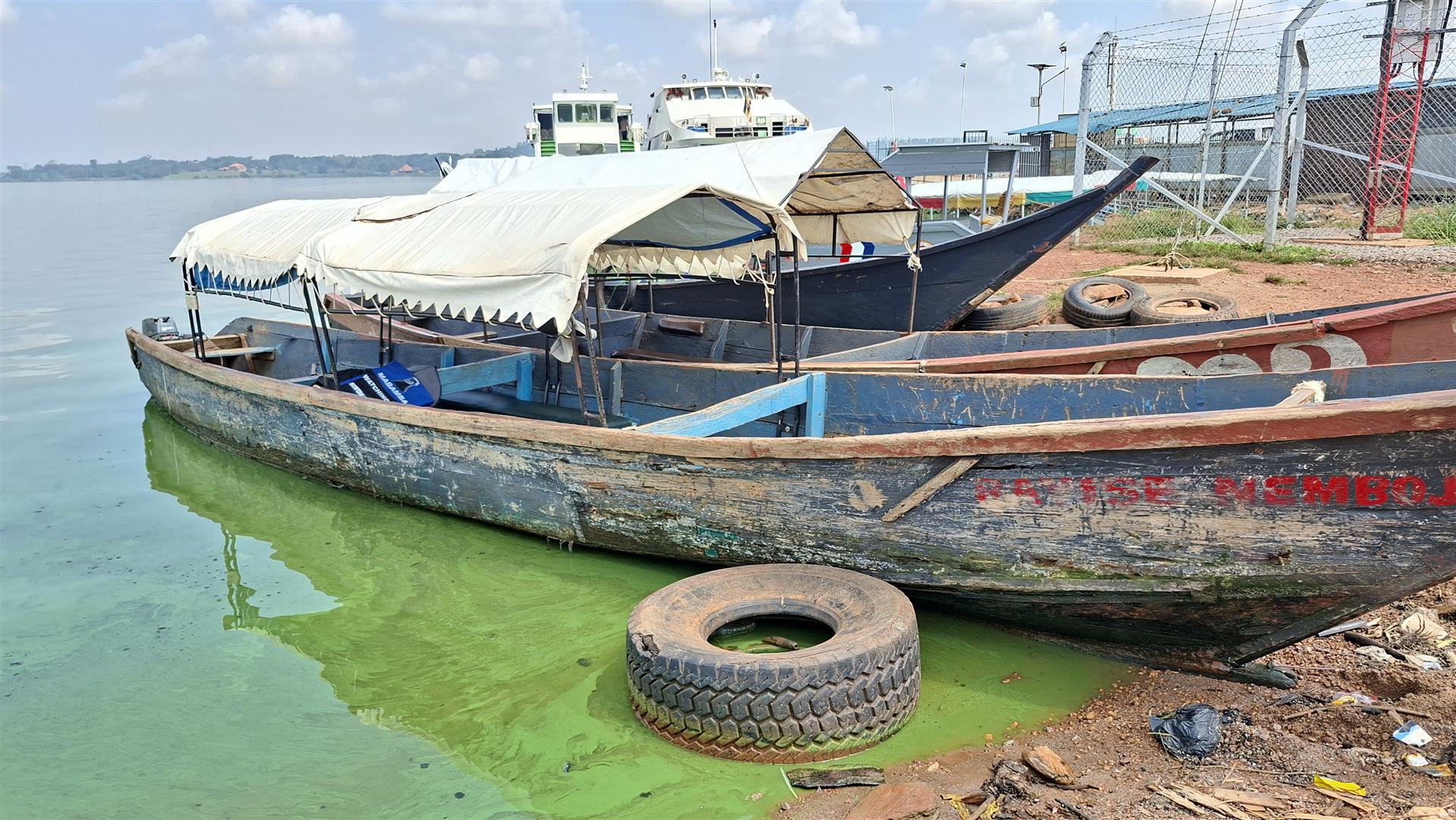
A typical tourist canoe.
Entebbe sits on the shores of Lake Victoria, Africa’s largest lake, which is shared by Uganda, Kenya and Tanzania. I went down to the meeting place for 11am next morning. My guide’s name was Livingstone and his sidekick steered the canoe. A quite large one with an awning over the seats.
We headed across the lake for about 30 minutes before meeting up with a smaller canoe. This one had a guy at the helm and a young woman too. She was our guide.
I asked Livingstone about the depth of the lake – 88 metres at the deepest point. There was a lot of green algae in the water, a result of a lack of oxygen. But he said it helps clean the water.

A Pied Kingfisher takes flight.
In the smaller canoe we wandered into the reed beds and swamps, along narrow passages. The woman was pointing out various birds, the most common of which was the Pied Kingfisher. There were many magpies as well. I can’t remember the names of many of the birds. I tried to take photos but a phone camera seriously fails at that task because we could never get close enough. Added to that, those inconsiderate birds kept flying off.

The elusive Shoebill Stork.
Eventually we found our target, the Shoebill Stork. Just one, sitting among some reeds, looking chilled. I took loads of photos and after a while they managed to manoeuvre the canoe around the other side of it and got closer. Then I was really able to get some good photos and a video. Once in a while it would dip its bill into the reeds it was sat on and come up with what looked like a frog. They mate for life but tend to spend most of their time alone. They’re quite big birds, about twice the size of a fat London pigeon, grey in colour. And that bill looks very unfriendly.
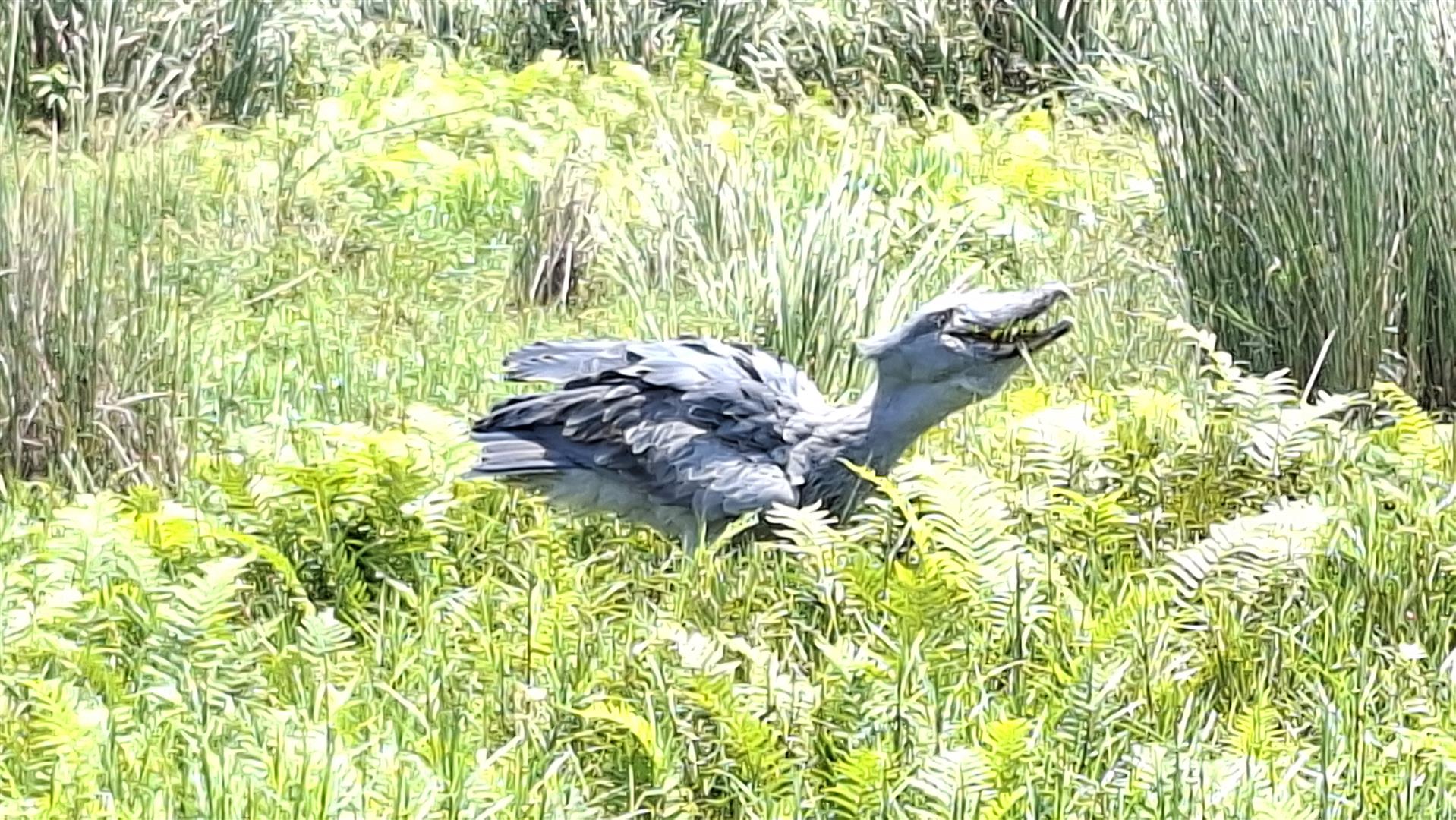
Swallowing a frog.

Locals, just passing by.
Eventually we made our way back to the bigger canoe. The guides had been very good, well worth the tip I gave them.
There’s a ferry that carries my intended route north across a narrow part of the lake. I asked Livingstone about it. It’s free and runs every half hour. But it only crosses 3 times on Sunday. That was a shame as by then I’d decided to stay another day, leaving on the Sunday. Never mind, going via the expressway wouldn’t take any longer.
I paid him the $80 and gave him 20,000/- for him and the boatman. The trip was really good and was well worth the money.
Achim had suggested I visit Queen Elizabeth National Park, which is up in the north of the country. He said the road that runs past it is pretty good and there was a fair chance of seeing animals along that road without needing to enter the park itself. So to that end I left Entebbe and headed to the town of Fort Portal.

These strips always came before a road hump. And there were plenty of them.
The road was good for about 100kms then it turned to gravel, which made riding near trucks very uncomfortable because of the dust clouds. Then it became good, bad, good bad, with lots of potholes. But it’s what my bike was made for so I had no real problems.
Fort Portal was just a staging post with nothing to see. The hotel I chose was dreadful because it had no water supply to the rooms. Plumbing problems, I was told. The breakfast was pretty bad too and I was glad to be able to move on. I made a complaint to Booking.com for listing a hotel with those kinds of problems in the first place.

I crossed the Uganda Equator. Half the bike is south and the other half is north.
Next day I rode towards the park on an asphalt road that lasted for about 100kms, crossing the Equator on the way. When I turned off into the park the road was dirt, but I was able to maintain 4th or 5th gear most of the way. But I didn’t see any animals. I didn’t go into the park itself. By that time I’d already decided to go on a proper safari trip in one of the less expensive countries. The only animal I really missed out on was tree sleeping lions, which are a feature of that park.
I over nighted in a small town called Kihihi, in a decent hotel with hot water and a good breakfast.
One of my friends had recommended I visit lake Bunyonyi, which is quite close to the Rwandan border. It has lots of islands to cruise around. Sam used to work on the canoes when he travelled around there. So from Kihihi I headed down there.

A typical dirt road village.
The road was mostly dirt and passed through small settlements and villages, with people going about their daily lives. All of the land I passed was cultivated, either with fields of crops or trees laid out plantation style. I mostly didn’t know what was growing, although sugar cane and maize were easy to pick out. Sourdough is a common crop in that area too. It’s used for making beer.
As I entered the town of Kibale, close to the lake, I spotted a café and stopped for a break while I decided where to stay. We all know that coffee and cake are essential boosts to the decision making process, don’t we? I decided to treat myself for a few days and settled on a lakeside hotel of better than normal quality.
I tried to book it via Booking.com but they said it was full. So I tried Agoda, who gave me a very reasonable price. But then things went very awry. When I got there the receptionist said the booking hadn’t come through, that the money hadn’t come to them from Agoda and that tAgoda are always doing this kind of thing even though they don’t deal with them anymore.
Well, I thought, this is a fine mess! They had a room, but at a much higher price than Agoda had stated. I’d just ridden 10kms down a rough track to get there so I put my hand a bit deeper into my pocket and paid up. Later on, after a lot of messing about on the internet, I found Agoda’s WhatsApp number and managed to cancel the booking and obtain a refund. Folks, don’t’t use Agoad!
The hotel was of a very nice standard but didn’t have wi fi in the rooms, only in the lounge area. Not very impressive for $50 per night! They also had power supply problems, common enough in Uganda, but seemed reluctant to start up their generator when the power failed. I had to chase them up a couple of times. Cost saving I suppose.
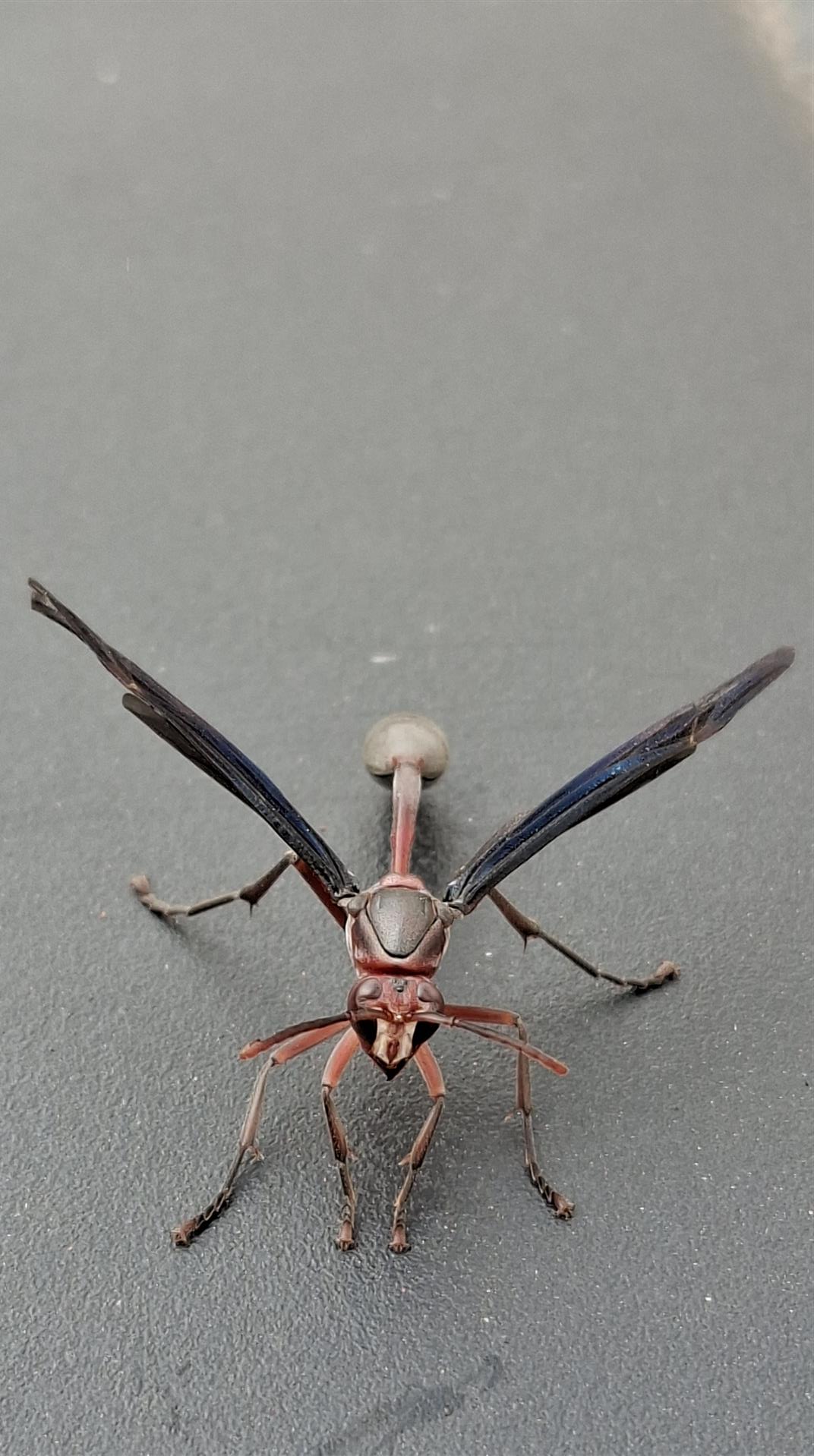
My breakfast companion. It was very sleepy wasp, waiting for the sun to warm it up.
I didn’t do much the next day apart from making some arrangements for a future event that doesn’t concern this blog. When that was done I went for a walk down to the hotel jetty. There was a boat about to head off around the lake with tourists in it and a smaller canoe moored up.
I got chatting to a young woman who was holding a very lovely baby, smiling and gurgling at me. (The baby, not the woman.) I mentioned that I wanted to go on a trip around the lake and she told me she could arrange that for me if I wanted. The hotel had quoted me 200k for that, she quoted 150k, cash of course. I told her I only had 100k left and she said that would be OK. We agreed to meet next morning at 11am.
I met her down at the jetty, along with her boyfriend, Prosper. The large canoe, with awning, belonged to Prosper’s uncle and his cousin was at the controls. What followed was a very enjoyable and enlightening trip.
We set off and toured around the lake. It has twenty nine islands. The depth varies from 44m to 900m. It’s in a caldera and the lake was formed when volcanic activity diverted a river about 10,000 years ago.
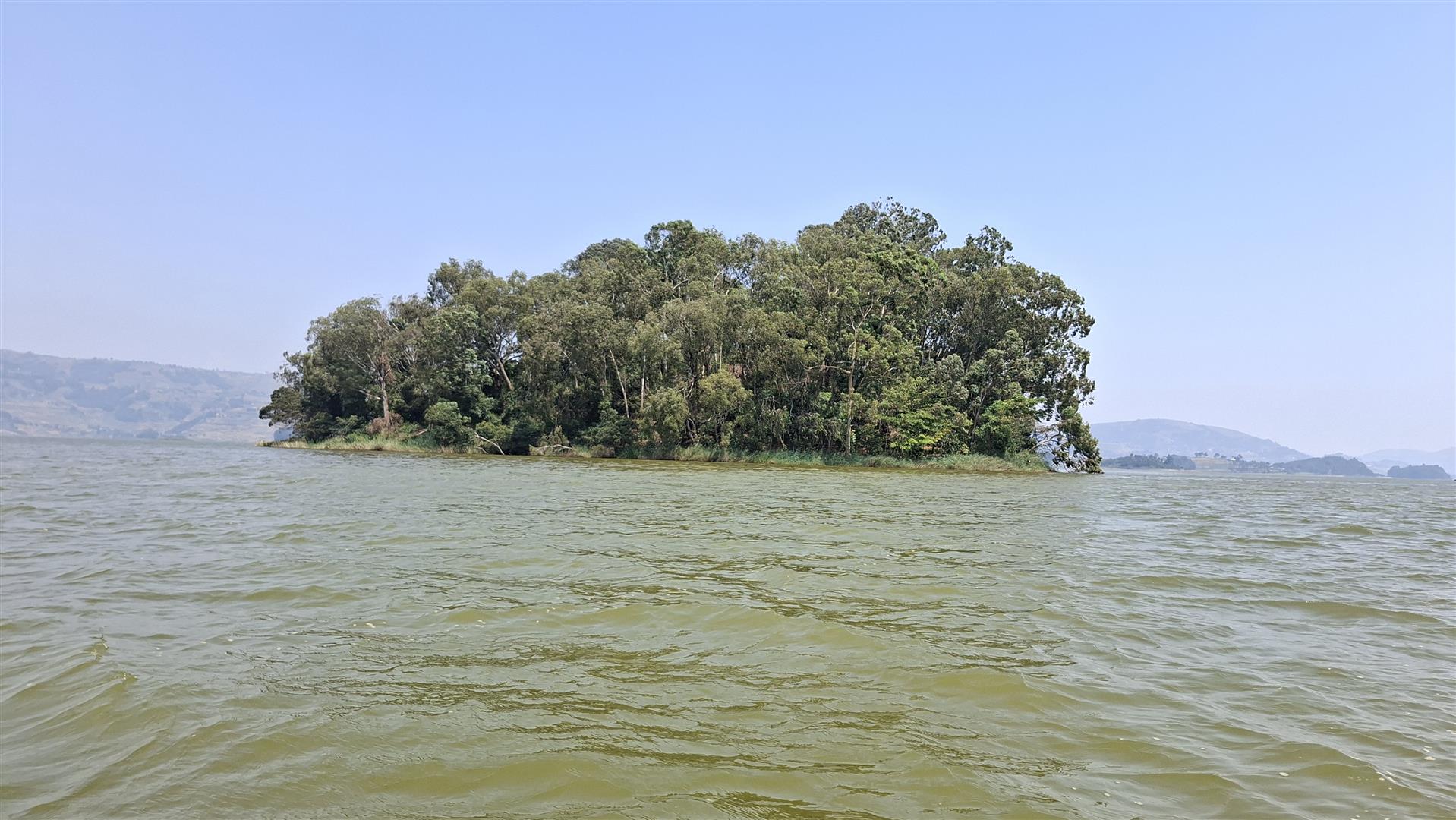
One of the islands.
He told me that there had been an underwater eruption about a week before, making the water turn yellow from the sulphur. It was slowly clearing up though.
He pointed out buildings on an island that used to be a leper colony, run by missionaries, that are now used as a school. He told me all about the myth attached to Upside Down Island.
A starving woman followed a party of revellers out there hoping for some food. But they refused to help her and sent her away. Unfortunately for them she was a sorceress. She paddled a safe distance away then turned the island upside down, drowning them all. Then she turned it right way up again. Allegedly, no animals live there anymore.

Prosper, Rachel and baby.
Eventually we came to a landing point where we left the boat. They showed me some land they cultivate, with cabbages, sweet potatoes and tomatoes. They hope to build a house next to it and then get married one day.
We then walked up a steep hill to the small village where Prosper came from. Talk about poor! No electricity; no water; no school; no other facilities of any kind.
One house had a small PV panel on its roof and I commented that at least they could charge phones up. Nobody has a phone. No motorbikes or cars.
Their only source of water is the lake, which is 200 metres or so below the village and involves using that steep path. It must be a real challenge in wet weather.

The only water is the lake, down at the bottom of this steep track.
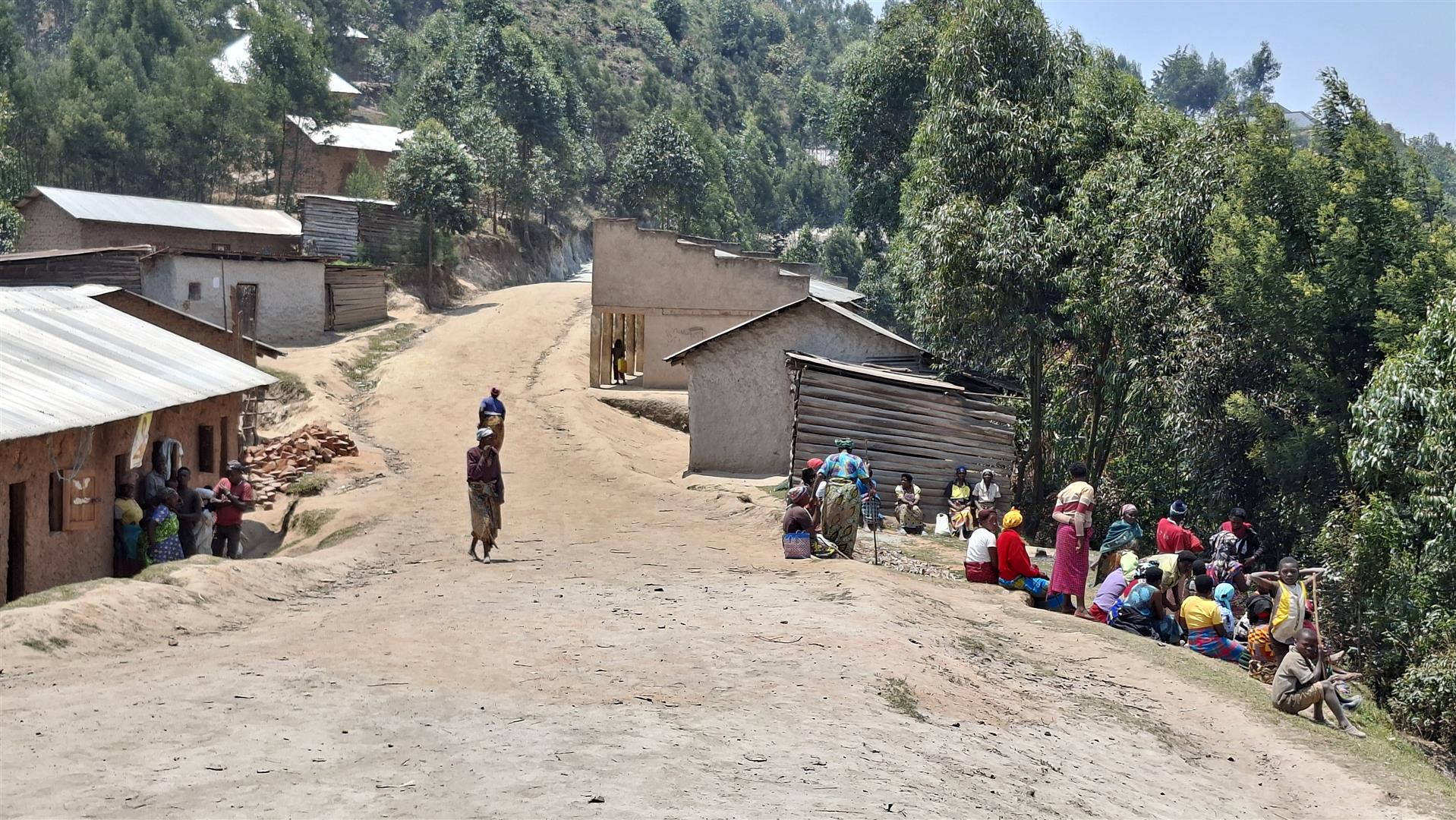
Very poor people in a very poor village.
They were telling about some initiatives they were involved in, to make improvements. Volunteers came in from time to time to try to educate the kids. But it’s too little to make much difference.
At times like this you have to ask, “Where’s the government?”. Nowhere to be seen, is the answer. But simple improvements could make a huge difference to places like this. Rainwater storage. A PV powered pump to draw water up from the lake. Education!
They’re all subsistence farmers or will go and work somewhere else, at 5,000/- per day – £1. How do they get there? There’s no boats. But the village is actually on the mainland, so I suppose they walk.
If ever there was a place that confirmed the need for foreign aid, then that was it.
Some kids and adults came back down with us to the boat and I was able to get some photos.
After that we came back to the hotel. The agreed price was 100k. I gave them $50 – 175,000/- The extra was partly towards their wedding and something for their village projects. But it was still less than the 200k the hotel had quoted me. That trip left me feeling angry and frustrated about the inequality of the world.
Their web address is http://www.njojjo-tours.com Email at njojjo-tours@gmail.com
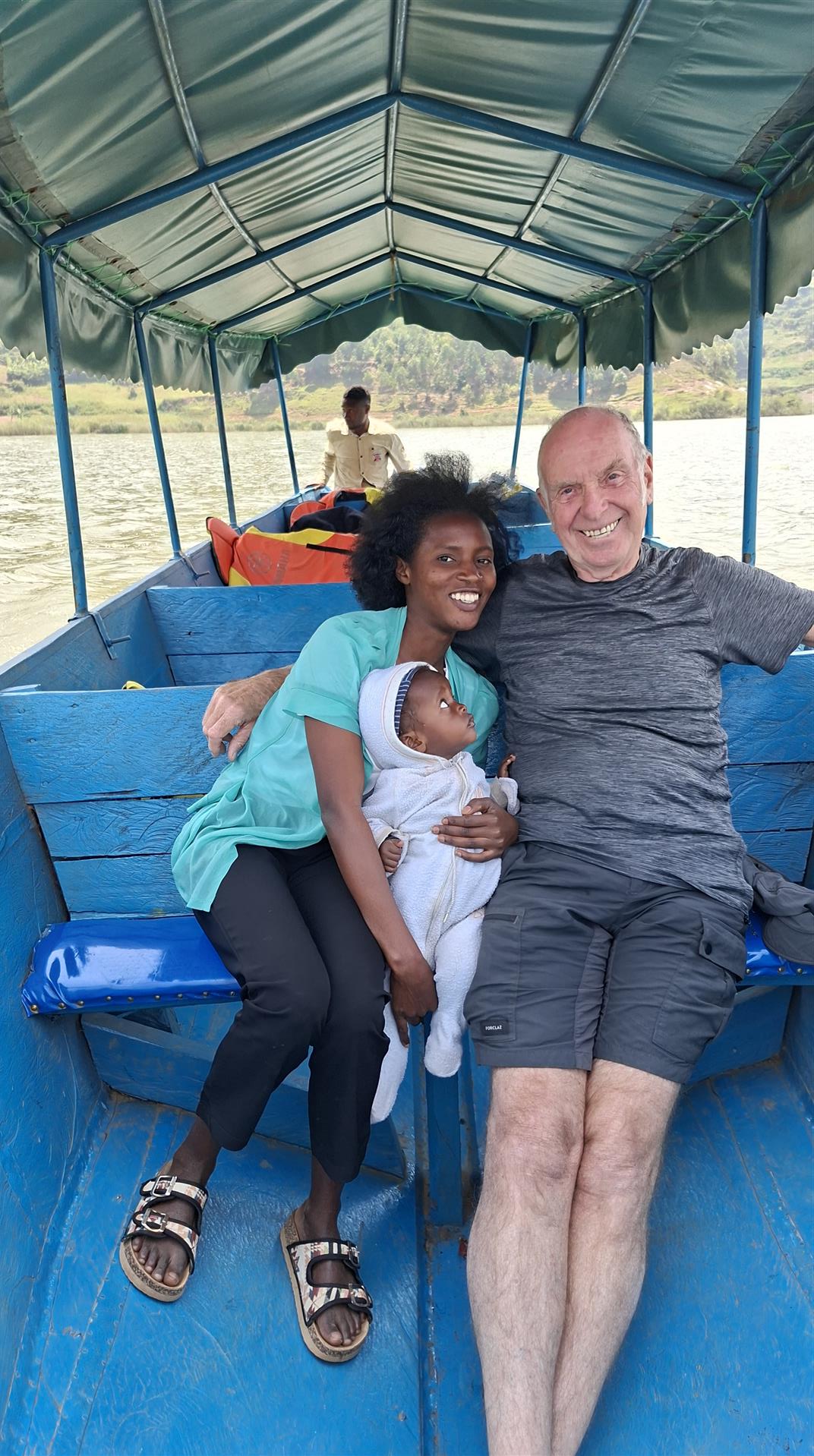
I’m now referred to as Papa.
Next morning it was a case of ‘Another day, another country’. The border with Rwanda wasn’t very far away.
 MOTOPANGAEA