
Zanzibar. 2nd October 2025.
Zanzibar beckoned. I’d arranged with the guest house to leave my bike there, at $2 per day. Cheap at half the price. A Tuk Tuk (called a Bajaji in Tanzania, because they are mostly made by that Indian company) came to collect me at 11.30 for my 12.30 ferry.
At the port the usual ‘helper’ insisted on taking me onto the ferry but then got seriously upset when I only offered him the coin I had in my pocket – 500/-. In fact he refused to take it. I’m guessing my reputation has plummeted among the Ferry Port Pirates.
The ferry has three price levels and the cheapest one, which I’d chosen, offered seats with very little legroom. The journey was 1 hour 20 minutes and I was happy to sit and read my book while the rain hammered down outside.
We docked in bright sunshine, which augured well for my visit. Another Bajaji took me to the closest point possible to my hotel and a local taxi driver then walked me down the alley to show me where it was. Fee free! Very kind of him.
The hotel was very basic but it was also cheap. There was no hot water but the desk jockey brought me a kettle. Showering would be with a bucket and a scoop, Indian style. But at least I could make tea.
After a while I went out for a walk along to the seafront. It’s a very pleasant area and was full of tourists. There was plenty going on along the beach front. Young guys jumping into the water and another group doing somersaults by bouncing off a tyre in the sunset. There was a street food area too.

Somersaulting in the sunset.
I’d been thinking of going on a walking tour next day and I found the meeting place, next to the cannon outside the old fort. There was already a group there. I chatted noncommittally to a guy who’s a guide. But I was thinking I’d just do it myself.
I’d marked a café on the map to try, and had some tuna fish, rice and salad, plus a Milinda (fizzy drink), for 17.5k. It was all good. That price translates to £5.50.
I struggled to find my way back to the hotel and found it by luck. Google wasn’t very effective in the narrow alleyways of Stone Town. The door to the hotel was open and I recognised the guy there. The walk was a good introduction to Zanzibar. It’s a very chilled place.

Sultan’s Palace. For wives only.
As I’d decided yesterday, my walking tour was self guided. I walked up to the Maruhubi Historical Site, getting quite warm on the way as it was a fair distance. It was an interesting place. 12k to get in and it was made clear that my guide would expect a tip. No shit, Sherlock. He walked me round the building and made quite a good job of it.
It was built in 1880 but suffered a fire in 1899 and has been abandoned ever since.
I struggled a bit with the guide’s English but got the gist of what he was saying. He showed me various rooms, including the toilets – thrilling! The palace was for the Sultan of Zanzibar’s ‘secondary wives’. Concubines in other words.
There wasn’t all that much to see inside. Outside there were some remains of the 4km aqueduct that brought water down from the hills.
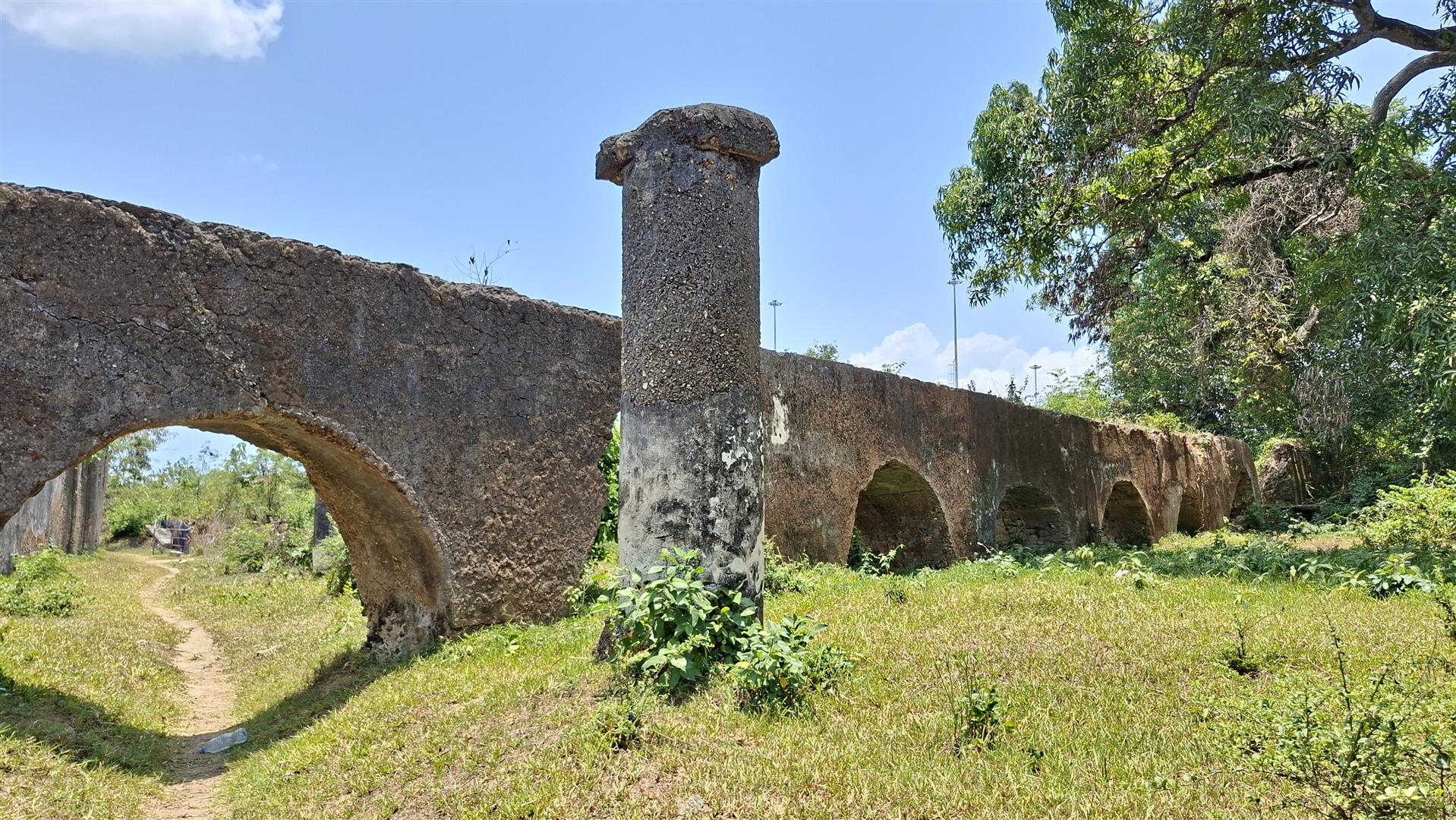
What’s left of the aqueduct.
Then he walked me down to the beach and showed me various boats, including a canoe dug out from the trunk of a mango tree. He even showed me piles of empty shells. Oooh, what a thrill.
I sat down for a while to have a rest then walked up to the main road and got a Boda Boda bike back to town.
I photoed the Old Dispensary, which had been renovated with funds from the Aga Khan Trust for Culture. It’s now a clinic. I popped inside for a couple of photos, apologising to a couple of women who were in the waiting room.

The Old Dispensary. Classic building style.
Down on the seashore I found a place for coffee, but no cake, and sat around people watching.
Then I visited the old fort. Built by the Portuguese then improved by the Arabs. It was free to get in and houses a lot of art displays and tourist shops.
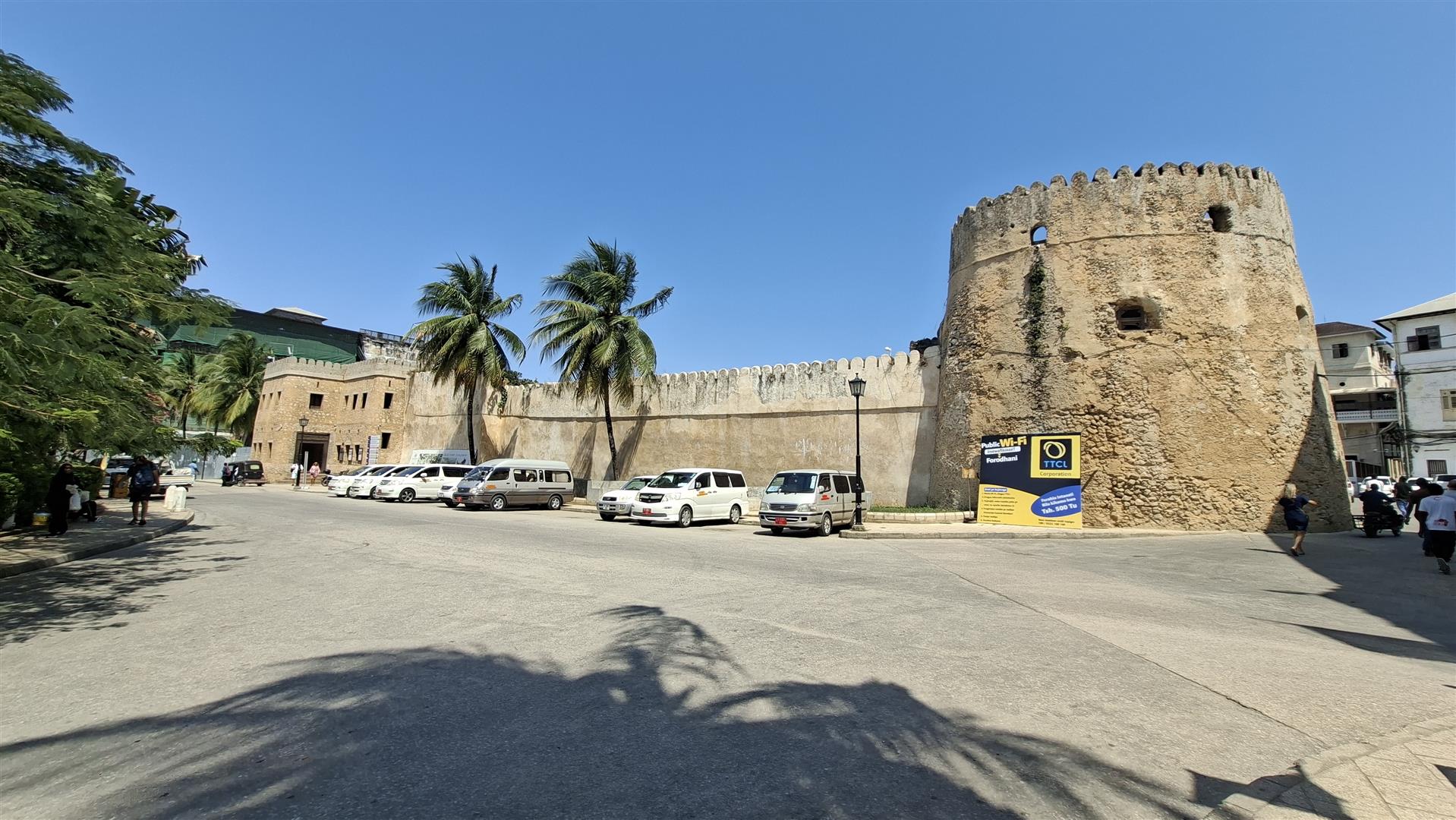
The old Portugeuse fort.

Shops inside the fort.
After that I just walked around looking at and photoing old buildings. I visited the Tanzanite Museum, which told the story of this unique blue mineral which is only found in the foothills of Mount Kilimanjaro. I’d never heard of it before. But it does look good when it’s polished and set.

Tanzanite.
There were lots of tourists around and lots of touts too. I got very fed up with young guys trying to ‘befriend’ me and help get to wherever I was going. They invariably reached into an inside pocket and produced something they wanted to ‘show’ me (sell me). I never did get as far as finding out what any of them were.

Freddie Mercury’s old home, now a museum.
Next morning I headed up to Jaws Corner. It’s a tiny square with a palm tree planted in the middle. Its claim to fame is the wall painting of Jaws. And it’s pretty good.
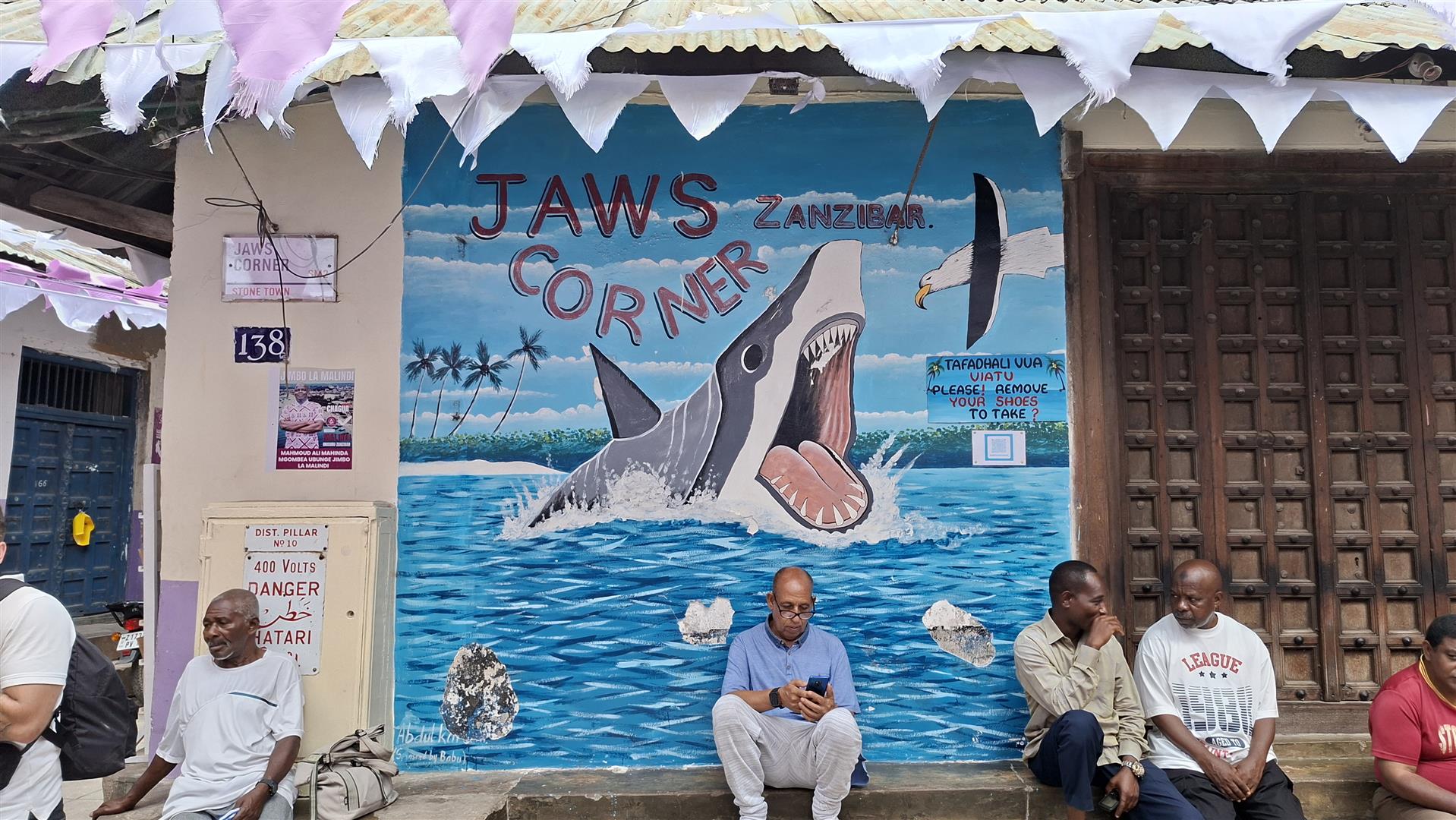
A striking piece of wall art.
It’s reckoned to be a gathering place for people in the evening, where they socialise, play dominoes etc. There are some tables there for that purpose.
The square is surrounded by shops selling the usual tourist stuff. There’s a couple of pro Palestinian posters on the wall too. I walked up and down the alleyways a bit to take photos.

Pro Palestinian painting.
Next was the Anglican Cathedral. When I eventually found it I discovered that it was part of the slave trade memorial. The church had been built on the site of the slave market.
I paid the entry fee and collected my guide. He made it clear he expected a tip, saying he was still a student.
He showed me into the church and down into the crypt. This was an area where slaves were held on trading days until they were sold.
The shocking thing he told me was that any unsold slaves were killed. If they didn’t sell they were assumed to be no good and to have no value. Their bodies were thrown out into the bush. About 10% suffered this fate.
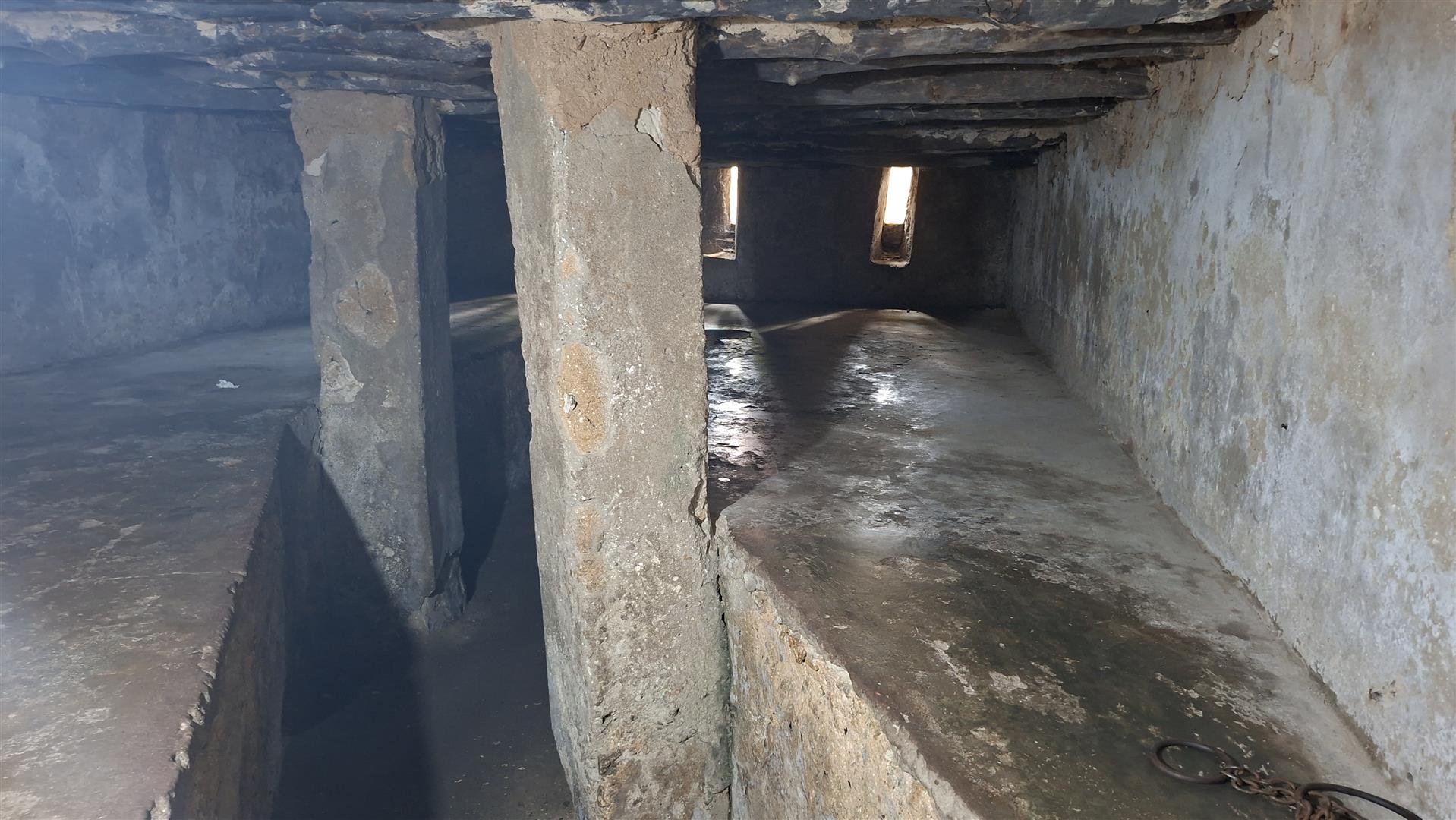
Where the slaves were held before being sold.
Then he showed me the memorial sculpture. After that he took me to the door of the exhibition and that was the end of his role. I gave him 2k at the end.
The exhibition was a couple of rooms filled with very good info boards about the slave trade. Here’s some key points.
Zanzibar became the centre of the trade because it’s an island so they couldn’t escape.
Most slavers were Arab and, eventually, Indian. Slavers went into the interior and raided villages, which they burned to the ground and took everyone captive. Sometimes village chiefs sold their own people to the slavers.
Marches from the interior to the coast of up to one year were not uncommon. Trustworthy slaves were used as guards and porters. Freed slaves earned good money in these roles. As you can imagine, many of the captives died.

Slave memorial.
Eventually so many people had been taken as slaves that there weren’t enough left to produce food to supply to the growing towns on the coast. So slaves were sent back to work the land.
In the middle of the 19th century the Omani rulers started to grow cloves. This was very labour intensive so fewer slaves were sent abroad. Some Omanis saw the writing on the wall and were moving away from the slave trade into agriculture.
British missionaries were putting huge pressure on those involved in the trade to stop it. Eventually British rule brought it to an end but not until the beginning of the 20th Ccentury and only after the Omani rulers caved in to political pressure.
The whole story is dreadful and the effects are still being felt today in that descendants of slaves are sometimes treated as second class citizens.
All of that was very interesting but also extremely sad. The Arabs were the most prolific slavers of all those who practiced it.
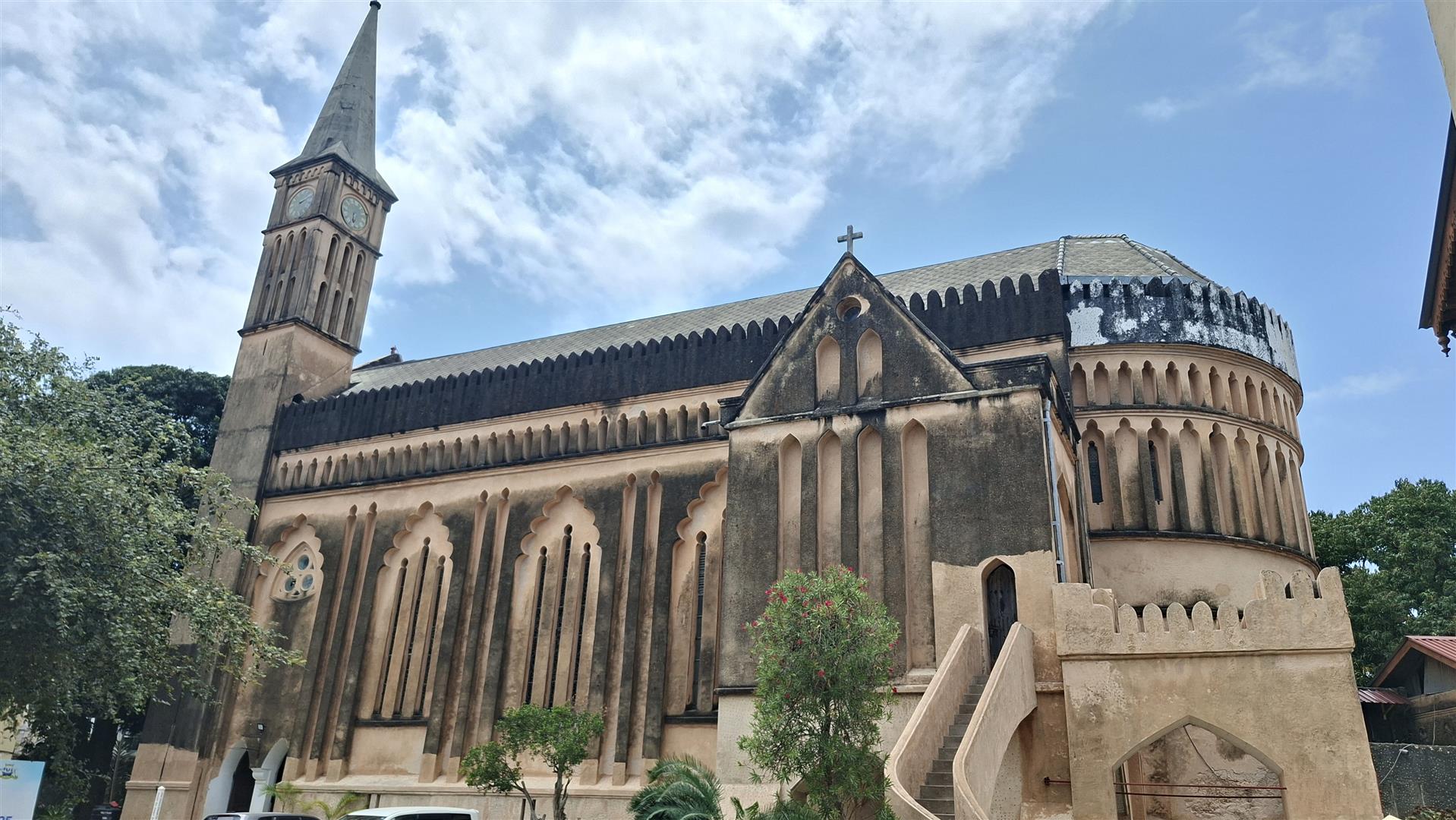
The cathedral, built over the old slave market.
I had coffee and cake after all that. Then I walked down to the Peace Museum, set up after WW1. It was just an ethnographic museum and not a very good one.
In the evening I walked round to the sea front. I was planning to go to the food market in the park by the sea front but I spotted a restaurant that sold pizza, at a good price. I stopped there and it was very tasty.
I did have a wander round the food market afterwards. It was super busy. Most of the food seemed to be meat on a skewer as far as I could see.
Next day I didn’t go out until the afternoon. I spent the time just walking around, enjoying the old buildings, eventually getting to the beach area. I walked further on down to the ferry terminal to check out the departure process. I was shown where I needed to go but wasn’t able to find out whether I could use my ticket on a different date to that printed on it. I decided I’d come up there early next day to check that out.

One of the beautifully refurbished old buildings.
Then I just hung around the seafront area people watching. There were a group of lads who’d take turns to run up to the sea wall holding a sign, then jump off it showing the Welcome to Zanzibar sign to the watching tourists by turning around in mid air. I couldn’t quite work out why they did it as there didn’t seem to be any money involved. Just high spirits I suppose.
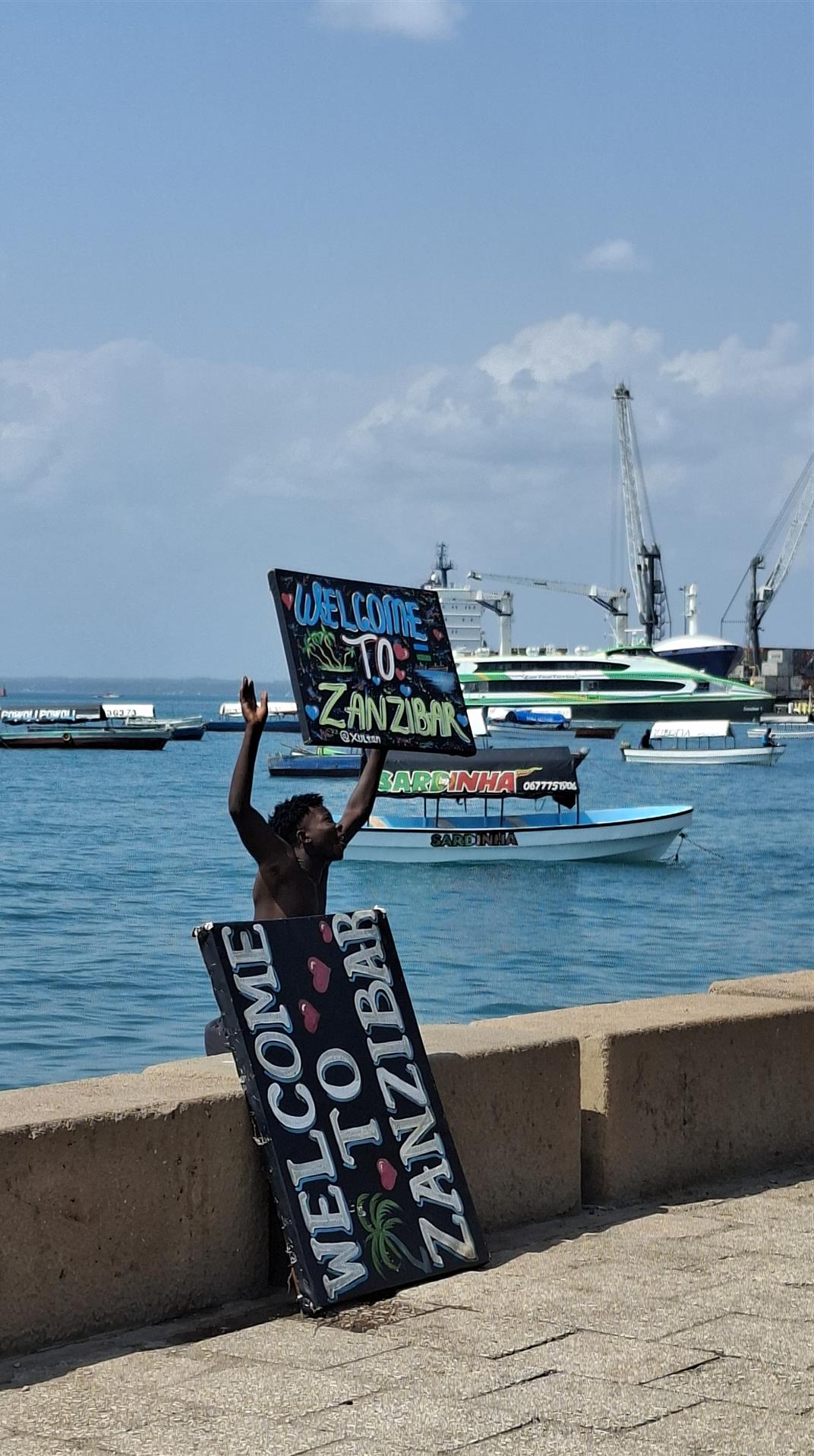
‘Welcome to Zanzibar’.
Danish Michael had suggested a place I should visit further north on the island and I spent time trying to decide whether to go there or go back across. The weather forecast wasn’t looking good so I was unsure. In the end I decided to go up there if I wasn’t allowed to get onto the ferry next day.
After breakfast I walked down to the ferry terminal and was able to change my ticket. Decision made then, I was going back to the mainland.
They let me hang around in the hotel until 11.30. I walked down to the main road and got a Bajaji straight away. The cheeky so and so wanted 10k for the five minute journey, he got 4k.
I sat in the waiting area and as I headed towards the boarding ramp a guy took me over and made sure I got on the right boat, telling me there were two. Then he walked me past the queue, got me quickly on board and found me a seat. He also wanted 10K, he got 5, but at least he’d been useful. An hour and a half later I was back in Dar Es Salaam.
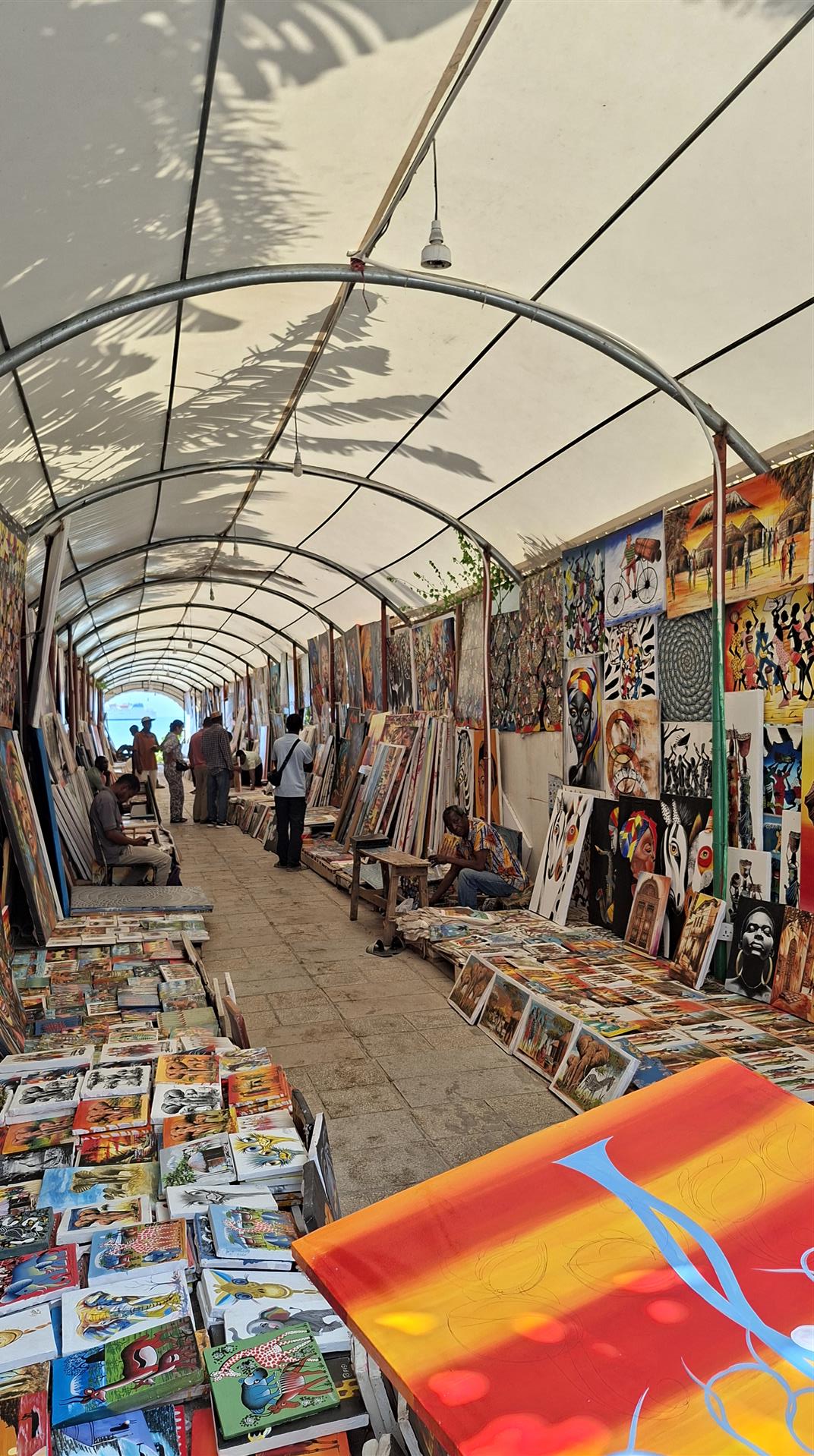
Art for sale. Genuine and freshly painted.
Once off the ferry I walked out of the terminal and away from the mob of Bajaji and Boda Boda touts until I was outside the cathedral. From there I used Bolt to get a Bajaji back to the guesthouse. He was a helpful guy and I was happy to pay him 5k rather than the 3.5k he asked for.
I was now in a different room and was delighted to find it was half the price. After all that activity biscuits and coffee were the order of the day, followed by a snooze in the heat of the afternoon.
That evening I didn’t fancy the BBQ place so I walked along the main road and went to an Indian restaurant. The stupid people have their menu on Instagram, which I’d got fed up with and had deleted from my phone. The waitress had to go and get her phone to show me. I wanted the chicken biryani anyway. It was delicious! It had some kind of sweet ingredient, which wasn’t overpowering at all. The drink I had tasted like peach, or mango. Also lovely.
Options. I wanted to visit Olduvai Gorge, a place where some German archaeologists had found footsteps and skeletons dating back about 1.5 million years. I’d come quite close to it when I rode across to Dar Es Salaam so I was cursing myself for not going there. I also wanted to go to Burundi, the route to which would take me that way.
But then I also wanted to visit a place further down the coast. Doing all of that would have meant zig zagging across the country. The decision was to forget about the coast and focus on the old bones.
So to that end I headed back the way I’d come, towards the town of Arusha. My final words in the journal entry were “Fingers crossed for no rain tomorrow”.
Well that didn’t work out very well.
As I left the city I could see a gathering of clouds ahead of me. I stopped to put my wet gear on just as the rain started and boy, did I need it.
During the ride the bike seemed to hang back occasionally. Not misfiring, just a bit reluctant. But it did seem to be only going uphill and I don’t remember feeling it before.
But after the rain had cleared the bike seemed to find a new lease of life, as if it had grown another cylinder. It was surging forward. At one point I looked at the speedo and saw I was doing 100kph. And that speed was confirmed by the phone and the GPS. All very odd.
I stopped at the same garage for coffee that I’d stopped at before. The woman remembered me and the Snickers was still crumbly.
More heavy rain after I left there but I survived. I found my hotel easily enough. There was no hot water but she brought me some in a bucket.
She sent out for tea. Fish, rice, veg. Perfectly fine for an en route stopover.
I have a friend named Sue who was taking part in a charity hike up Kilimanjaro. She was staying in the town of Moshi so I headed there, hoping to meet her. I’d been trying to contact her without success. But next morning I managed to wake her up by calling her on WhatsApp. Once she’d told me where she was staying I headed round there.
When I arrived I was told she was with a medic having her stitches changed. Eh, what? She told me she’d broken a glass the previous night, and she hadn’t even been drinking! She needed eight stitches in her hand, poor thing.
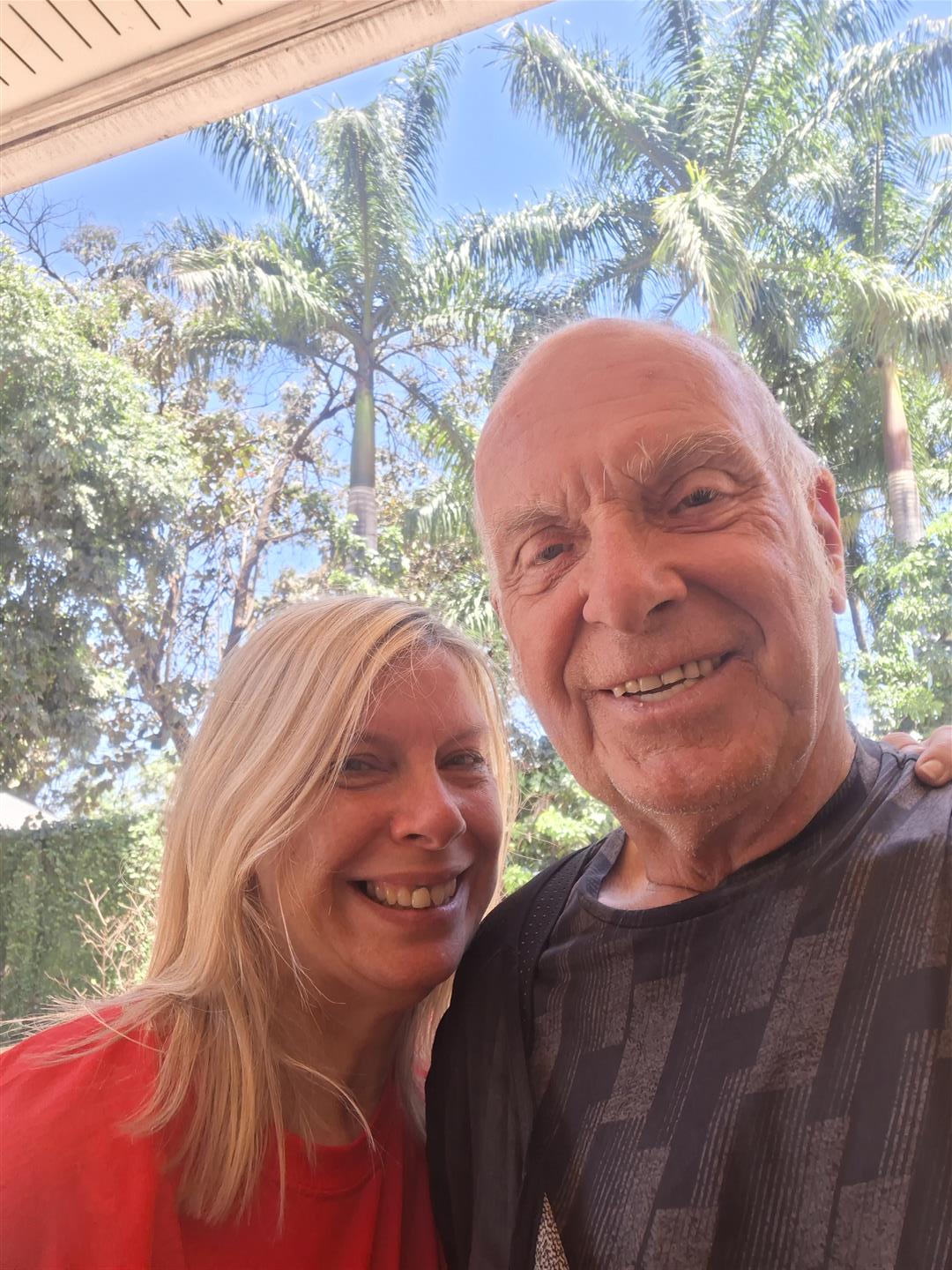
It was good to meet an old friend from footballing days. Sue and me.
She was flying home that day feeling very disappointed. She hadn’t managed to get to the mountain top because, at about 4,000 metres, her lungs had let her down. HAPC – High Altitude Pulmonary Congestion – had forced her to abandon the climb and come back down, under the advice of the medic. She would recover quickly she was told. I felt really sorry for her.
We had a long chat and a catch up of our news as we hadn’t seen each other for many years. After that I headed off towards my overnight stop, near to Olduvai Gorge.

I was allowed to briefly visit this place even though it wasn’t yet open.
I’d booked a couple of nights at a place which turned out to be a monastery but occupied by nuns. How random. It wasn’t cheap but cost far less than any of the other places in the area. I had to pay for dinner for the two nights and also paid for a lunch for the next day.
During the evening, after dinner, the nuns were performing a dance and action routine. There was a white couple from Belgium staying there who, I discovered, were running a course on philosophy. The performance was in their honour. The nuns they were training were all from various places in Tanzania, with one from Kenya. I sat and watched, fascinated, while enjoying the wine that had come with my dinner.

A dance of thanks, which seems to involve balancing a bottle.
When I spoke to the guy on the desk about Olduvai Gorge it was my turn to be disappointed.
I asked him if I could ride to there but he said not because the route went through Ngorongoro national Park, where I definitely wasn’t allowed to ride my bike, as is common in such places. I asked him whether he could find a guide to take me there. He could. It would be $400 to visit the gorge and $700 if I want to tour the national park as well. I did give it serious thought but it was just too much money.
I asked about just visiting the NP and his contact quoted $570. I reluctantly agreed but when he said he would only take cash I changed my mind. I wanted to pay by card. So that idea was abandoned. I decided to go back to Arusha and take a tour from there, as found on the internet. Even with having to spend two nights in a hotel, the price I paid for that was still cheaper, albeit only to the national park.
So I booked the tour, booked a hotel in Arusha and headed back there. On the way I stopped at a filling station which had a café and there I met Matthew and his mother. He was admiring the bike and was asking about it in a sharp London accent!
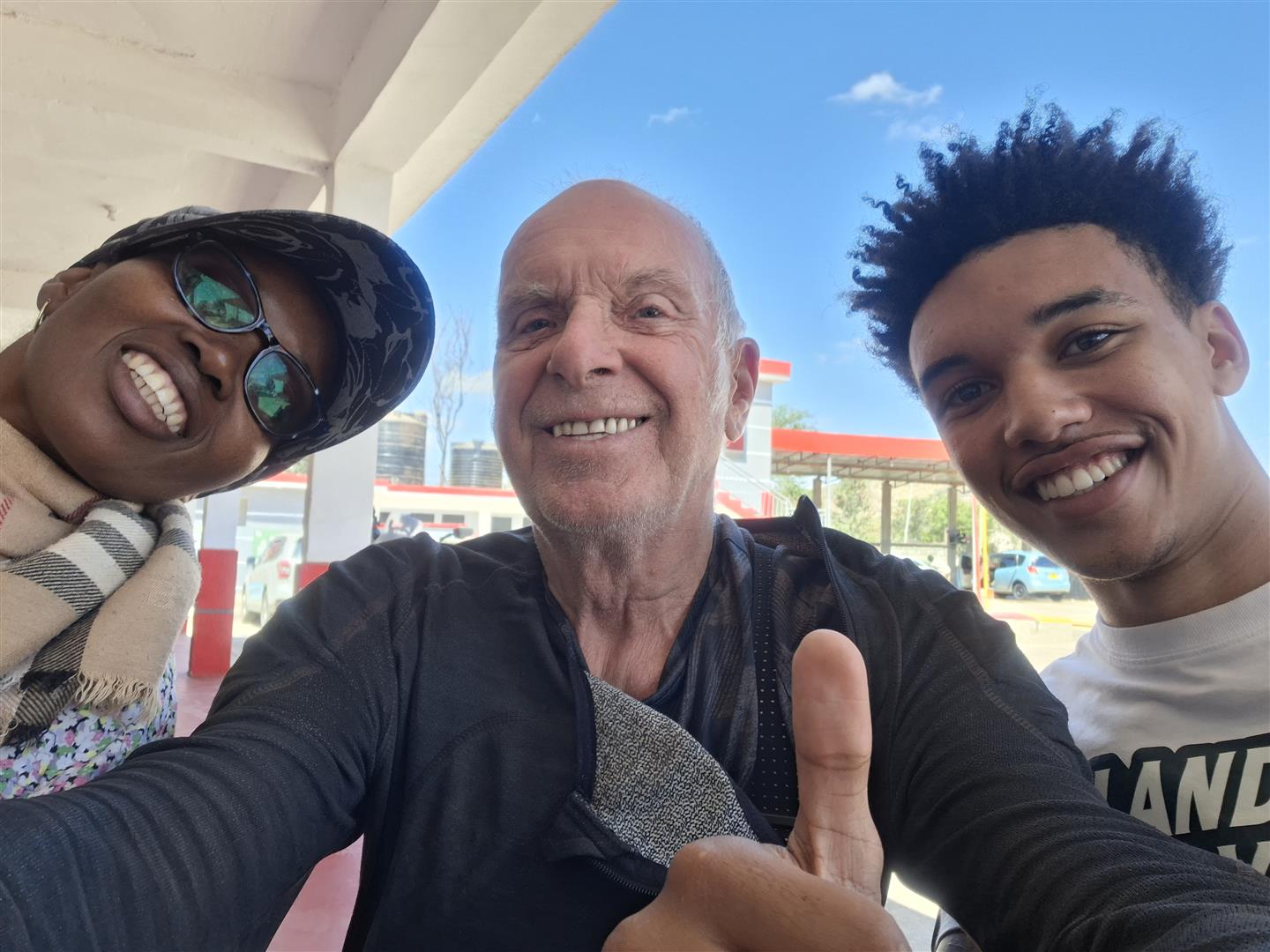
Matthew and Mum.
They used to live there, and then in Hastings but came back for his education, which struck me as odd, although they are Tanzanian. He’s got a Huskvarna 450 moto cross bike and there’s a track just along the road. That accounts for the big scar he had on his arm. It was good to have a chat and he was asking about my travels etc. A welcome meeting.
It was a 5am start for the tour and to that end I went to bed early. But at 10pm I got a phone call from the tour company wanting to know what hotel I was at so they could pick me up.
Then she told me there was a problem with the transfer of money from Trip Advisor. They own Viator, the tour company I’d used to make the booking. She said she’d cancelled the payment and had sent me an email with a link to ask for a refund, which I followed and activated when I’d got up.
She then sent me a link for making a payment direct to them. Usefully, that represented a £30-ish saving as she’d given me a discount. But my suspicion was they wanted to avoid paying the commission.
At 5am I was collected and we set off. There were three Japanese in the Safari jeep already, two young women who were on holiday together, and a young guy who worked in Nairobi. They all spoke English too.
We headed out of town on the now familiar road, through dark and deserted streets. After a while we stopped at a place to collect the food for lunch. Further along we stopped at a hotel to collect a French couple. They were still at breakfast so we went in and had breakfast too.

Maasai Warrior.
At the park, and once our driver had registered us, we started the climb up to the rim of the caldera, up at 2300m. The view over the enormous basin of land was fantastic. Formed by an extinct volcano, it’s flat and extensive, with a salt lake in the middle, and the blue sky in the far distance, past the steep slope on the opposite side of the caldera.
We wound our way down the well beaten path and joined the parade of Toyota Landcruiser Safari trucks which tagged along behind each other, all eating the dust of the one in front. It went on like this all day.

Toyotas, as far as the eye can see.
We were told not to open the windows, which didn’t open anyway on my side, and that we would have to stay inside except at designated rest sites.
To describe all this as a tourist activity would be doing it a grave injustice. It was more like a nationalised industry. There were probably close to one hundred of these vehicles in the park while we were there, every one a Toyota. The boss of that company should be very grateful to all the wildlife that people are so keen to see.
The vehicles have pop up roofs so when we stopped we were able to look out and use the guide’s binoculars to see the animals in the distance. We had to stick to the tracks so they were very useful for bringing the distant animals closer.
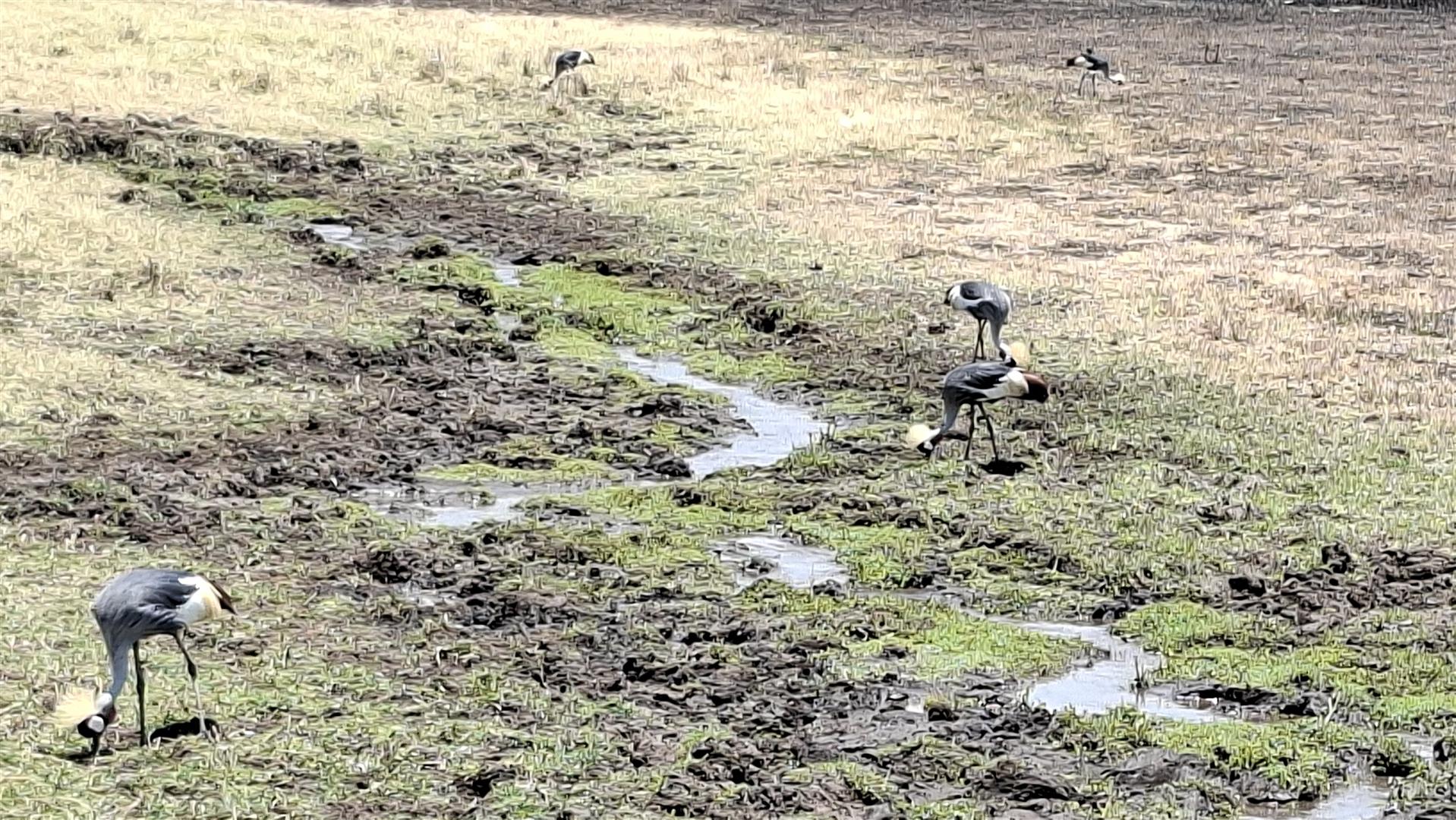
I don’t know what these Punk birds are called.
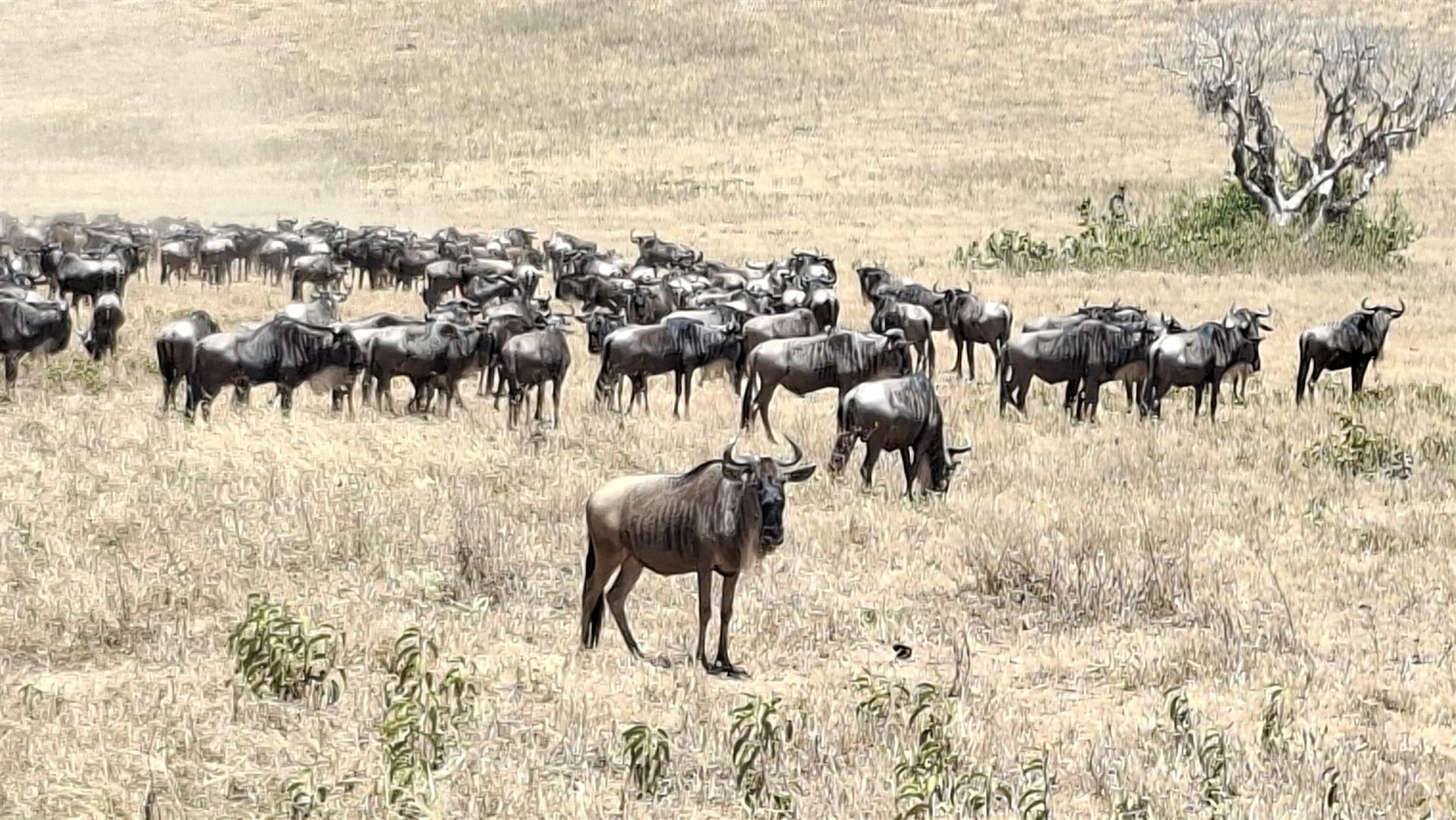
Wildebeest.
What did we see? Eventually, a very rare black rhino, of which there are now six in the park. They’re still threatened by poachers.
Antelope, zebras, wildebeest, buffalo. All of those in great numbers. An elephant, a few giraffes. A lion family. Mum, Dad and two or three cubs, hanging around near the water and waiting for their evening meal. Various birds, one with some very different plumage. It had a punk hairstyle and colourful feathers.
The salt lake had loads of birds, including pink flamingos. But there was also fresh water, from an aquifer and from streams, which attracted other birds. The beasts were hanging back during the heat of the afternoon and the lions were waiting patiently for them to come down to drink. Birds of prey wheeled overhead too.
We were able to get quite close to some animals, including wildebeest and buffalo, as they walked across the savanna towards water and pasture. The grass looked very dry so I wondered what it was they were so busy eating. I believe it’s the fresh shoots that feed them.
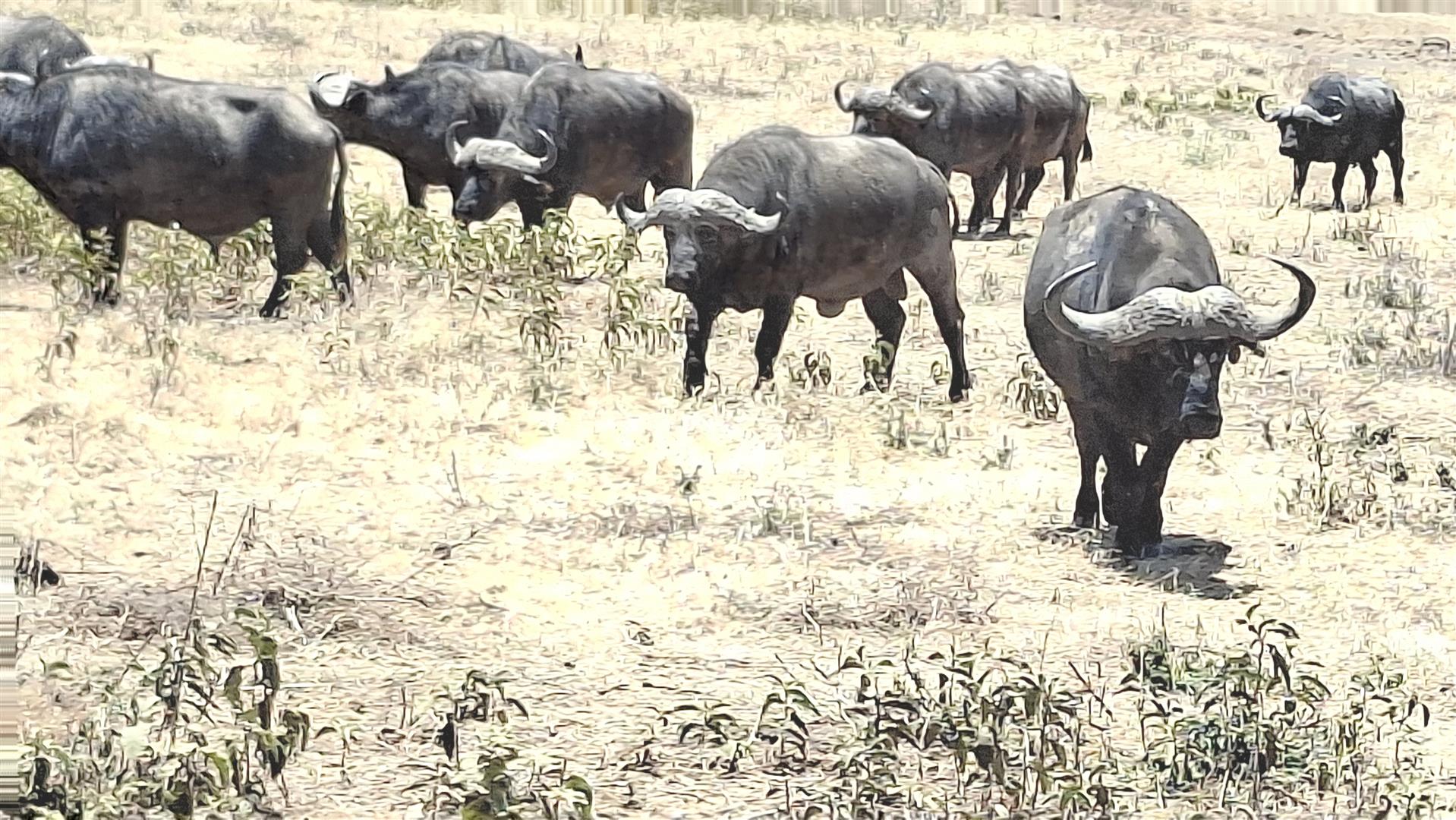
Buffalo. Big beasts.
We stopped a couple of times for a necessary break and then to have the lunch supplied by the tour company. It had become very warm and sitting outside eating and chatting was very pleasant.
We were joined by 50-60 other Landcruisers at the same place.. The ice cream and coffee stall was doing a roaring trade.
Eventually we had to leave that fabulous place to get back to Arusha. We got held up for about twenty minutes by another VIP passing through, and it was well after dark before I was dropped off back at the hotel.
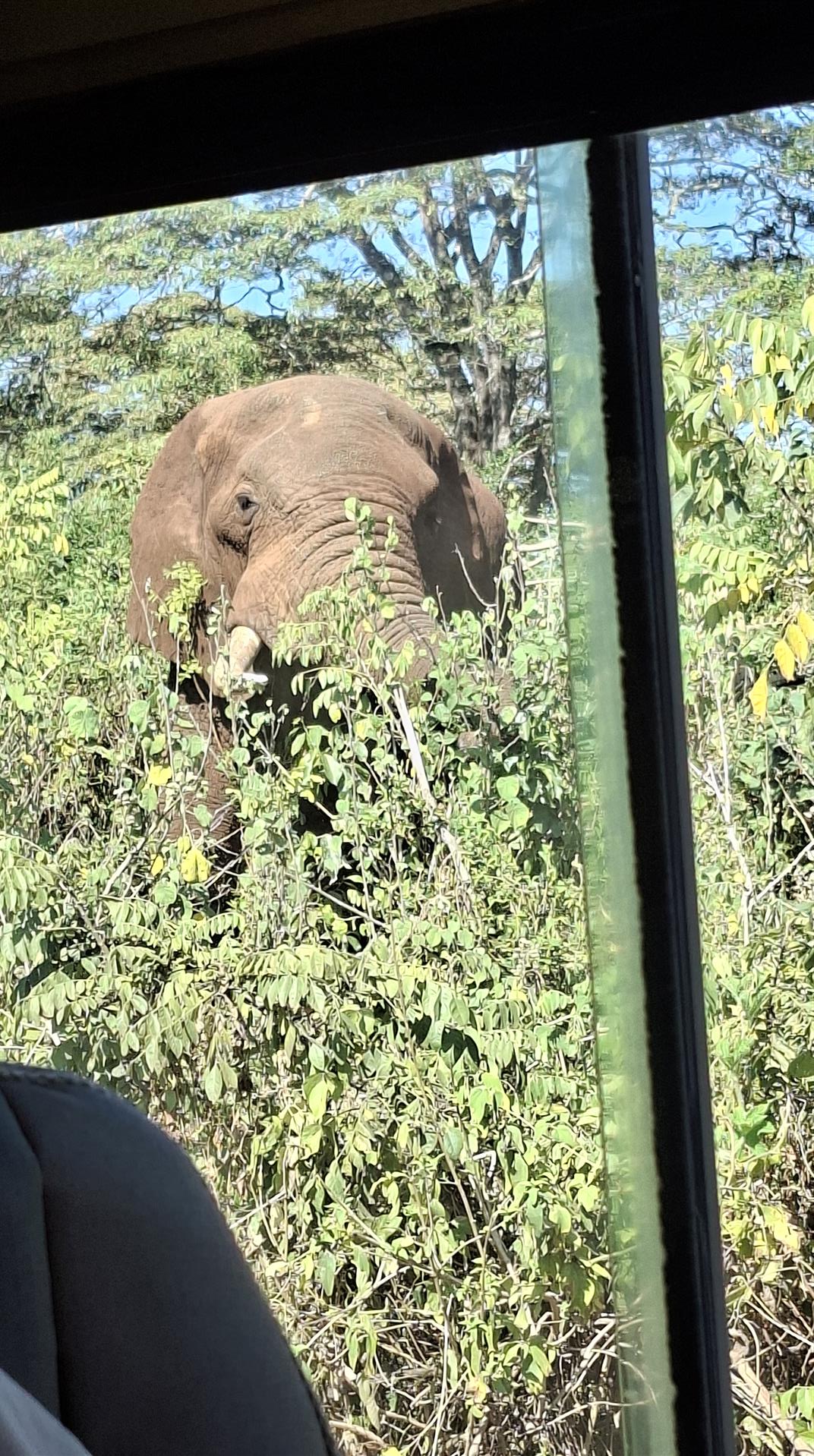
By the exit, waiting to see us off .
Summarising that experience? A very long day, and not cheap at £250. But it was worth the money. Ngoronogoro National Park is unique because of where it is.The animals will always be there because there’s enough food and water. They have no need to wander very far so are easy to find. The sight of that basin of land, surrounded by a rim of hills, is something very special, even mystical. I enjoyed it very much and in good company.

The vast Ngonogoro Crater.
After all that excitement I went along to the town of Singida, next to the lake of the same name, for a couple of days RnR. The hotel I found was right on the water’s edge and had a swimming pool. Once I’d sorted out my room I went for a walk around the grounds and came across a group of young people lining up for a photograph.
They were all dressed alike, looking very smart. So I took a photo too. Then they insisted I join them. Pretty soon music started playing and they started dancing. I joined in and tried to keep up but it wasn’t long before I sidled off and watched instead. I’d thought they were there for a meeting or something but I was told they came round to entertain people. That was a bit of fun.

Dancing and smiling.
I walked over to the hotel bar, next to the lake, and bumped into another traveller named Christan, from Switzerland. He was a long term traveller too, using a Toyota pick-up with a camping unit in the truck bed. We had a good chat about where we’d been, especially Iran. I told him about the British couple who’d been arrested there, he told me about a French couple that had also been arrested.
We agreed that being able to travel the way we do is a privilege which shouldn’t be abused, as these people seemed to have done.
I met Christan again at breakfast for more chat, then he left. Later on I went and laid by the swimming pool to get successfully cooked in the sun.

Lakeside at sunset.
Next day I headed off to a place called Diobahika where I stayed a couple of days to catch up on some writing and to make a decision about going to Burundi. That decision was to not bother. Nothing I’d read about the country inspired me to visit it.
So I decided to go down to a town on Lake Tanganyika for a couple of days. I’d noted a hotel on the lake shore, albeit very expensive. I had a good day on the road. At the height I was at the earth in the fields was very red and it looked so fertile and productive. But I thought it must be a post harvest period as a lot of the fields were empty.
At one point I passed an area of trees, almost certainly a plantation, which had enough houses to create a town but all spread out among them. They went back 2-300 metres through the trees but with almost none of the usual roadside buildings. It looked very odd.
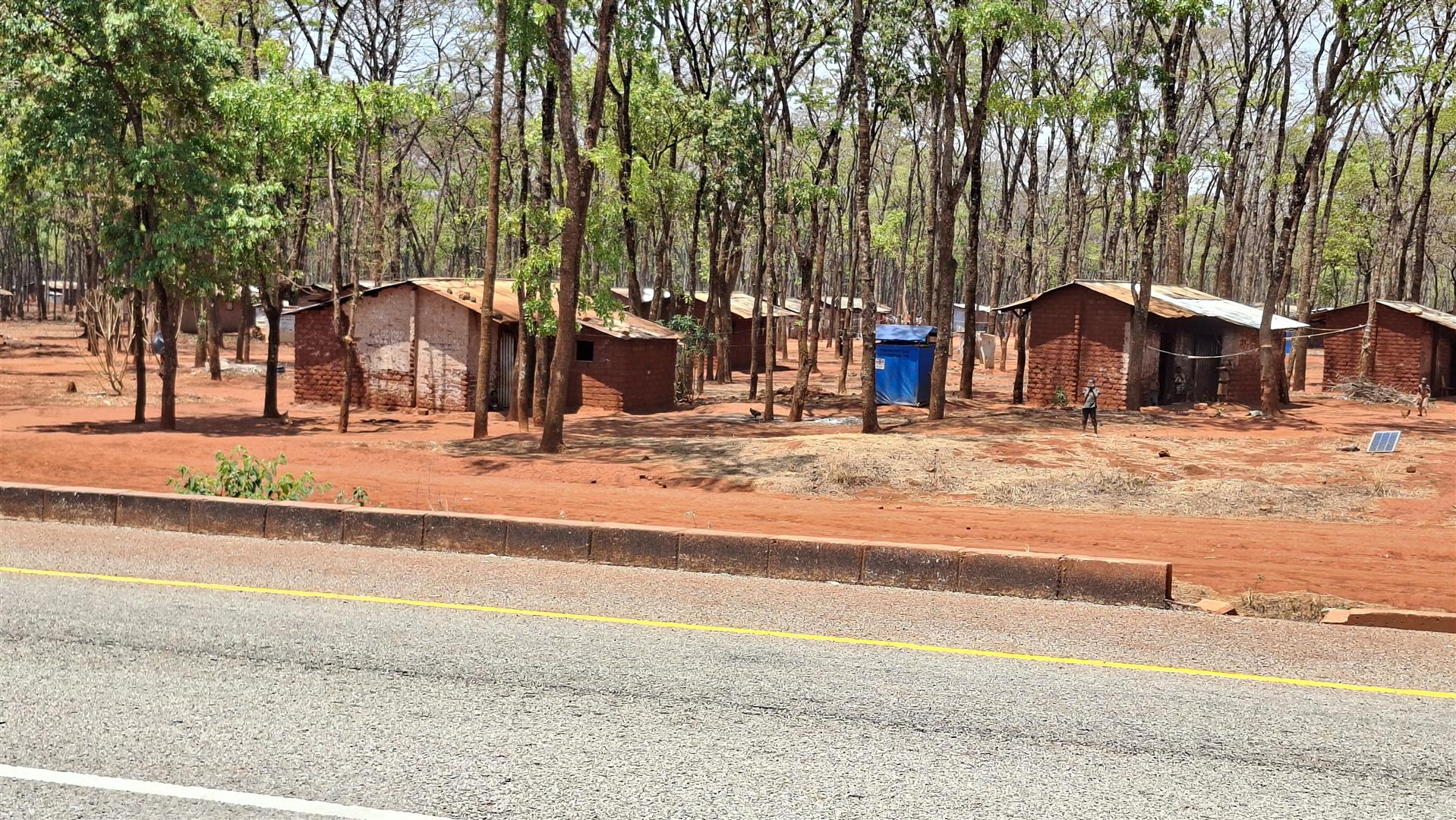
Scattered among the trees but with no roadside frontage.
I’d left town with over half a tank of fuel but by the time I finally came to a filling station I was on reserve. I hadn’t see any others at all. Tanzania has some areas where there’s few towns and therefore big distances between a petrol supply. But because I carry a spare five litres I was never worried about it.
Once again I’d been getting symptoms of a bad battery connection. The bike wouldn’t start so I took the side panel off and fiddled with the earth connection. It was OK then and I didn’t get any issues for the rest of the day. But it needed to be sorted out. The other effect of the loose connection was to the running of the bike, with the engine holding back the same way it had done the other day. That was cured too.

It was not unusual to see sights like this.

Double whammy.
There was nowhere to get coffee so I pushed on to the hotel I’d seen on Google. But I didn’t stay there because it was too expensive, which didn’t surprise me.
He rang up another place for me, usefully cheaper, and there I stayed. Once I was settled in and had had a cuppa, I sorted out the bike.
I’d been conscious of noise from the chain and when I checked there was definitely a difference on the adjusters between each side. One of the spacer blocks for the wheel spindle was on the wrong way round so I moved it and was able to line up the marks on the swinging arm and block to be the same on both sides. It expected it to be better..
Then I had a go at the battery. I took each terminal off, greased them up and repositioned the connectors so I could get a socket onto the bolt more easily. I fitted a spring washer too and got it properly tight. It all feels much better now.
I had a good meal and tried a Windhoek beer. It was just as bad as the others had been. I have to ask myself, why do I bother?

Walking with poise purpose. Always impressive.
In the morning, after a not-too-bad breakfast I went out for a walk down to the port. There was a ferry terminal there and I thought it would be a good place from which to view the lake. But no. I could see the ferry but the terminal was behind locked gates. There were railway lines going here and there within the port area but no way of gaining entry. Commercial activity spoiled my view.
Instead I walked down into the town and came to a square, in the middle of which was a roundabout. One side was full of market stalls and buses. Another side was occupied by a station. It was very common to cross railway tracks while riding Tanzanian roads. Here was a chance to see the source of the journey.
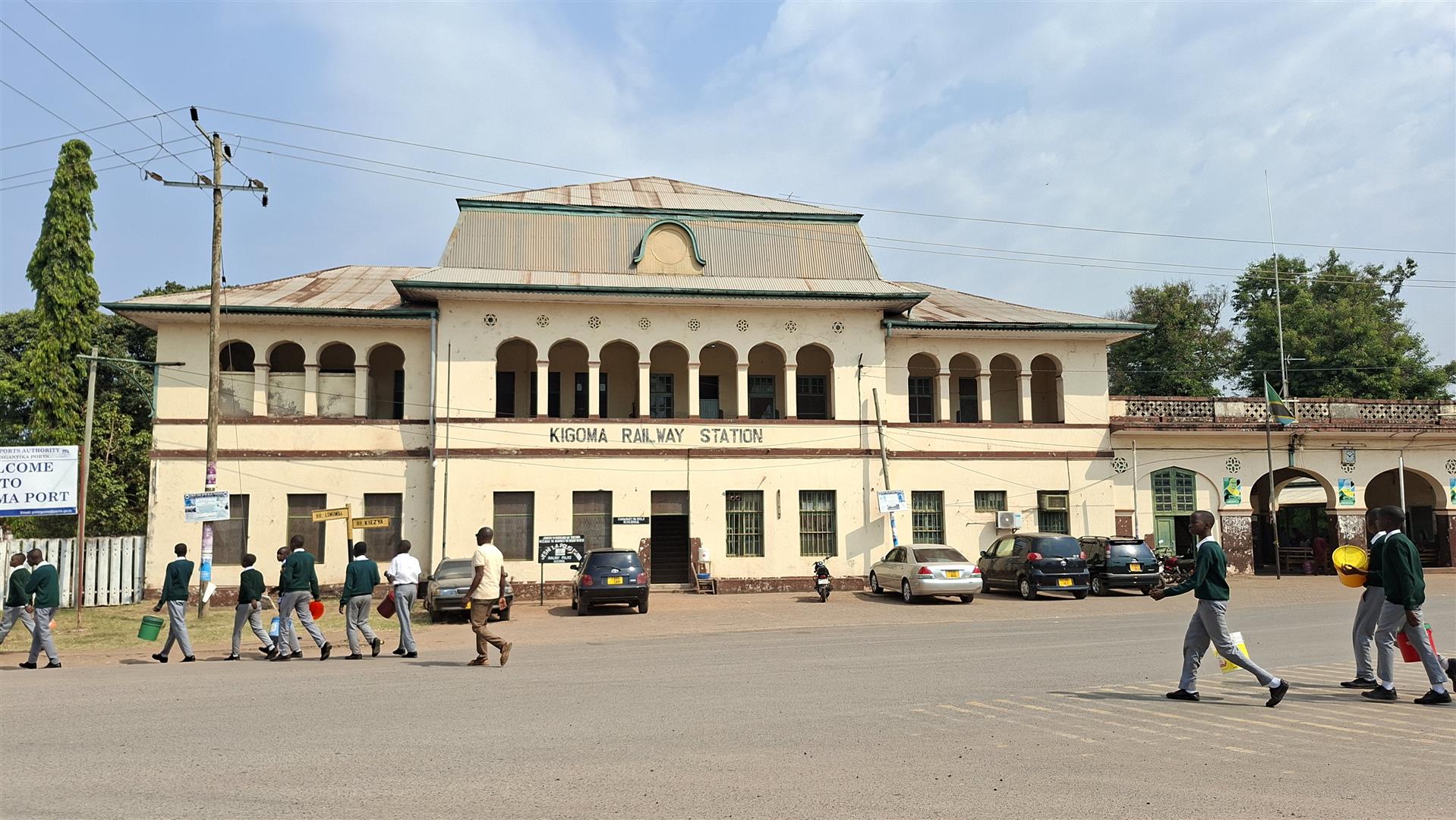
Kigoma Station.
Unlike in Kenya and Uganda, I had no knowledge of the history of the Tanzanian rail network. The station building was clearly several decades old and while wandering around I spotted a plaque stating that this station was the best kept in 1965.

Boasting.
There are two lines in Tanzania. The TANZARA, which was built as a joint project between Tanzania, Zambia and China. That one runs from Dar Es Salaam to Zambia’s copper belt. But this one, called the Central Line, runs from Dar Es Salaam up to Lake Tanganiyka and was built by the German occupiers before WW1. Huge amounts of trade goods and natural resources were shipped across the lake and Karimba is the terminus. British occupiers added some branch lines to important towns.

Just arrived. A big Diesel/Electrical hauling a passenger train of twelve coaches.
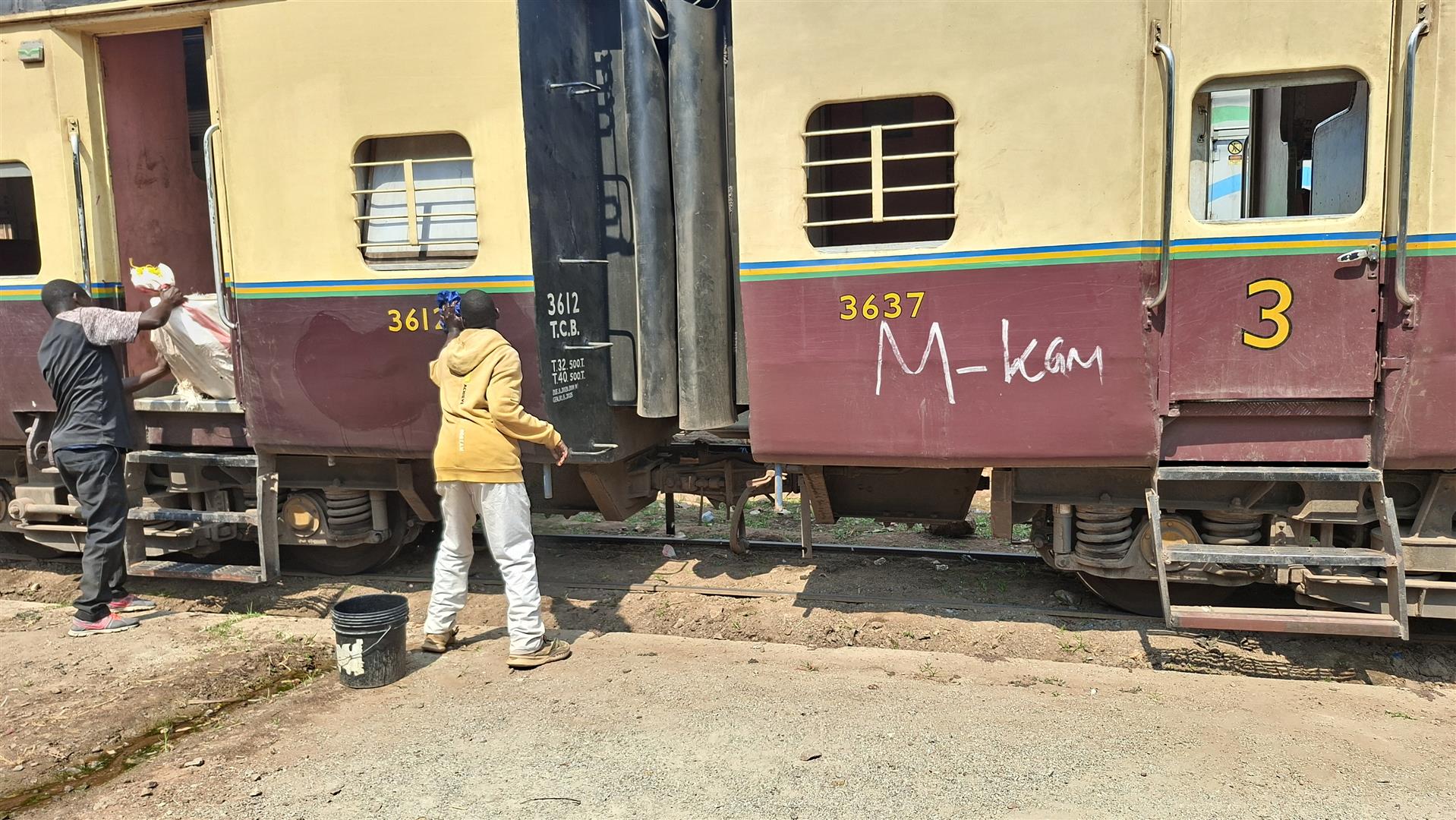
Keeping it clean.
Interesting enough. But far more so was the train that had just pulled in at the platform. It consisted of a dozen carriages hauled by a large diesel electric locomotive, which had been re-manufactured in Kuala Lumpar in 2016. The carriages had all been built in Madras in the 1990s.
I watched the passengers getting off, hauling their baggage along the platform with the help of plenty of porters. On a notice board was a chart showing the fares for 3rd class, 2nd class and 2nd class sleeper.
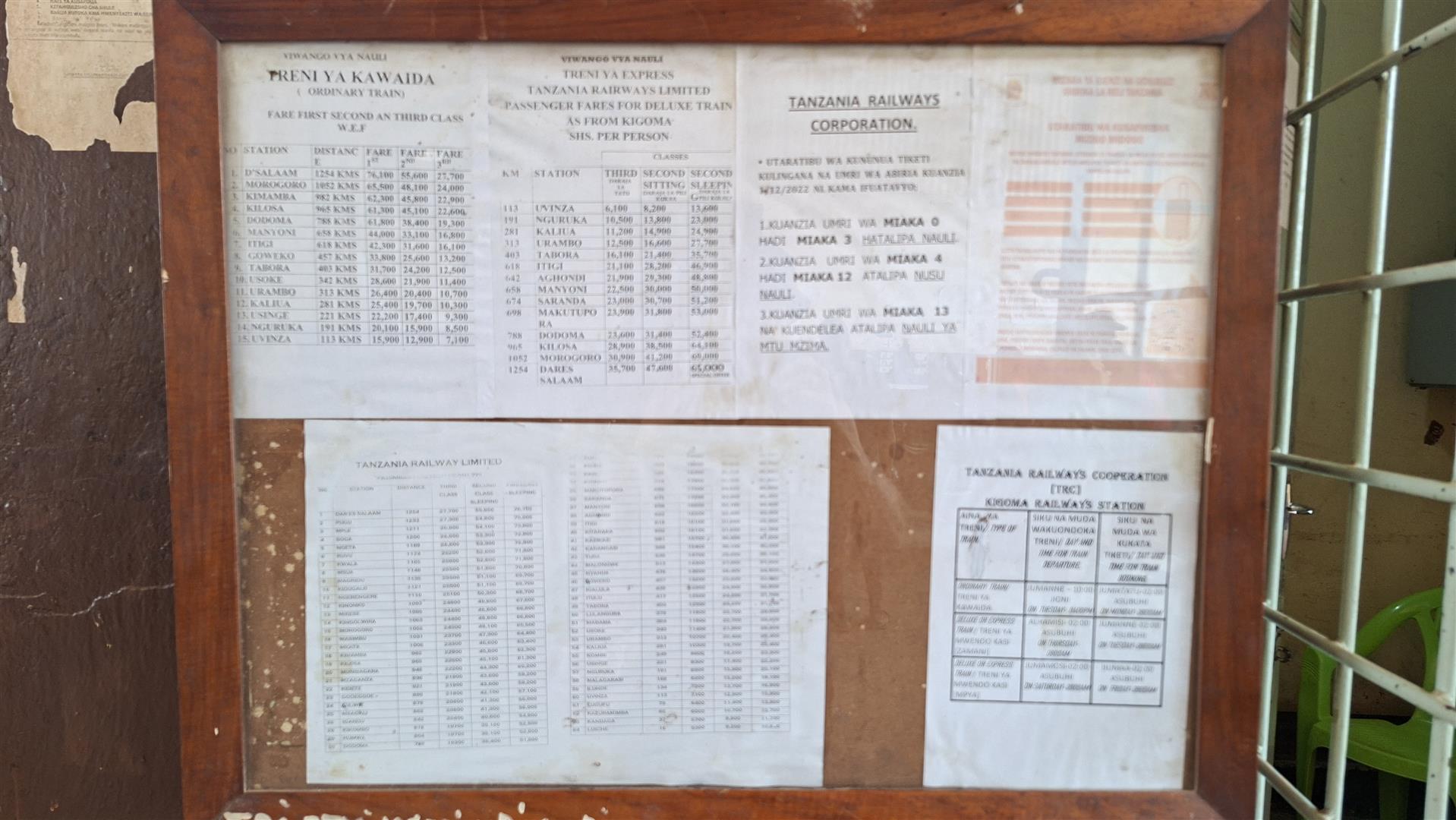
Fares on the board.
There was a lad walking along the train cleaning off graffiti, which came off very easily so was probably chalk. I busied my self with taking plenty of photos. As you might have gathered by now, I do like anything to do with railways.
Back at the hotel I went and sat in the bar where there was power, meaning I could charge my laptop and phone. It had gone off in my room the night before and I couldn’t understand why there was power in the bar but not in my room, which was immediately above it. Anyway, it soon came back on. I suspect my displeasure caused them to switch the generator on.
Meanwhile my data had run out, which both surprised and annoyed me. The young lady at the bar rang the IT guy who put more on for me. The three of us chatted, both of them amazed at my journey, just like I am sometimes. The guy asked me how I funded it and what inspired me to do it. Common questions and always a pleasure to answer.
A short pause will follow. More soon.
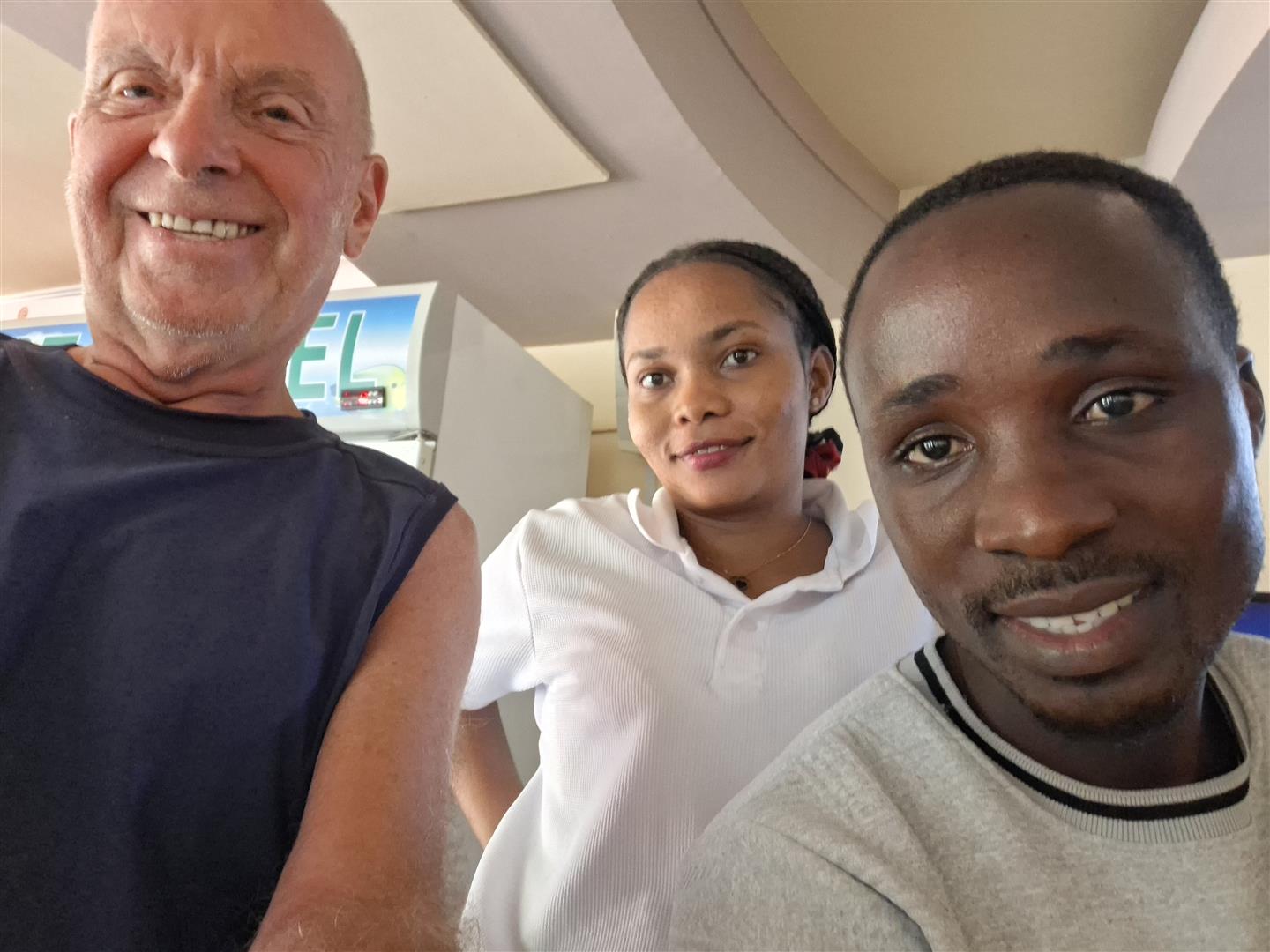
Very helpful staff at the hotel.
 MOTOPANGAEA