
Beirut, Lebanon. 19th March 2025.
I’d aimed to get back into Jordan within a day and that was achieved. Being in three different countries in the same 24 hours does feel a bit odd. Although the day was successful, it was expensive, with a kick in the backside at the end of it.
I left by 10am and enjoyed the climb back up over the pass. 1550 metres at the top, although no mist this time. Google maps wasn’t navigating, which was weird, so I had to use Maps.me. It isn’t very good! I was at the border by midday, having filled the tank just beforehand. That usefully used up all my Lebanese money. Then the fun began.
Getting out of Lebanon was easy enough. A little bit of wandering about to get the stamps I needed and to get customs clearance. Syria was a different matter.
Immigration was OK. No fee, fairly quick. I tried to move on after that but was sent back to get a stamp in my passport for the bike. That hadn’t happened when I entered last time.
I tried to escape once more, showing my original bike document and hoping that would be good enough. But the gate guards knew their stuff and weren’t having it. A guy came over with me to customs. I got out of there once I’d coughed up $57! I tried to make the point that I was going straight to Jordan but they weren’t having it either. But why the extra $7, compared to $50 when I came in? Something to do with “The General”. I thought he said. Boss’s bunce, or a General Rule? I ddn’t know.
Finally I was gone and headed to Damascus. Maps.me worked OK and got me through the city. I passed loads of people selling fuel, and I’d seen lots of people in Lebanon buying it. The weather then got very windy and a bit chilly. I was pushing the speed as much as I could, to the detriment of my fuel consumption. The gusts were blowing me about quite a lot.
I was at the Syrian border by 15.30, getting worried about the Jordan border closing at 4pm. It only took 15 minutes to clear, but I was charged $5 at customs. Humph!
Over on the Jordan side I went through the same process as when I entered before. Straightforward but time consuming. I wasn’t worried about that because I knew I’d get through eventually. But I now had the impression that the 4pm closing time didn’t apply. It hadn’t made sense the first time although it had happened anyway. Possibly only with Iraq.
When I was at customs they asked me if I had insurance. I showed them the one I had from before but they immediately noticed that it had expired. So I had to pay 27 JOD for a new one. Plus 20 JOD for customs fee. The visa fee was included in the Jordan pass, as before. Meanwhile I had gone to a phone place and had to pay 13 JOD to refresh my Jordan SIM and get 20GB of data.
And this is where life kicked me in the backside. I told the guy to put the SIM in slot 1 on my phone. But he didn’t. He put it in slot 2. He gave me the SIM he’d taken out and I threw it away, assuming it was the Lebanese one. It was only when I was 20 kms down the road, and Google maps wasn’t working properly, that I realised what had happened. I’d thrown away the SIM card from my World Sim account. This is an account I use for international calls, such as when I want to call a company in the UK. It isn’t free but it’s very cheap. Extremely annoying!
I carried on to the hotel. The bike was left outside the front door, locked and covered. Reception was 24hrs, so I felt it would be safe enough. The room was very good. Nice and big, with a kettle and decent bathroom. There was TV with all the news channels. Breakfast was included. It felt nice to be back in a calm and organised country.
I stayed in Irbid for two more days. The weather was very wet and I was in no hurry. I did some shopping, did some writing and made some plans. I was heading back to Amman but there were some places to visit on the way.

The preserved village of Umm Qais.
First one was Umm Qais, a preserved village whose history went back to pre-Roman times. It had been in use up until fairly recent times so was in good condition. I discovered it was one of the Decapolis, a collection of ten cities, all linked together for trade purposes. That was a new one on me. It dates back to Greek Hellenistic times, and into the Roman era too. It had been occupied by the Ottoman empire and Jordanians up until the 1960’s.
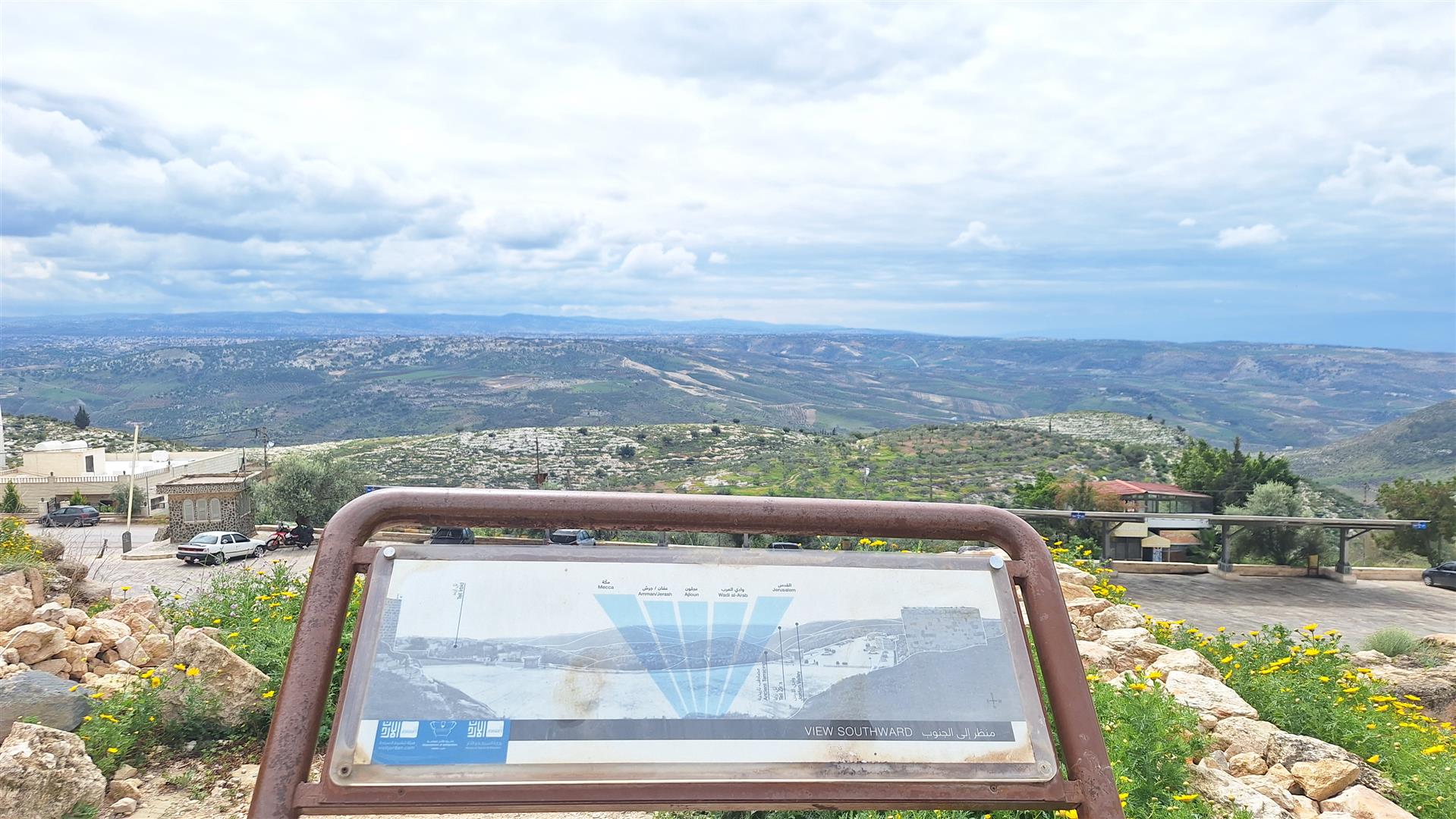
The Golan Heights, with Jerusalem off to the right.
The other interesting thing was that the village overlooked the Jordan Valley, with the Golan Heights, Jerusalem and Nazareth in the distance, according to the sign. Unfortunately the village was damaged in Israel’s 1967 attack on this area.

Going down!
When I left there I went down hill, and down, and down. I happened to glance at my GPS and saw that I was at an elevation of -201 metres. I thought it had gone wrong and I stopped, turned it off, then on again. Same reading. The altimeter app on my phone confirmed it too. The Jordan valley drops down to an astonishing -400 metres. I wasn’t that far from the Dead Sea, so it made sense. It’s just that I hadn’t realised it was as low as that.
Next stop was at Pella, a fairly small set of Roman ruins. There was a small amphitheatre there, but not very spectacular. I took a walk around anyway then ate my lunch.
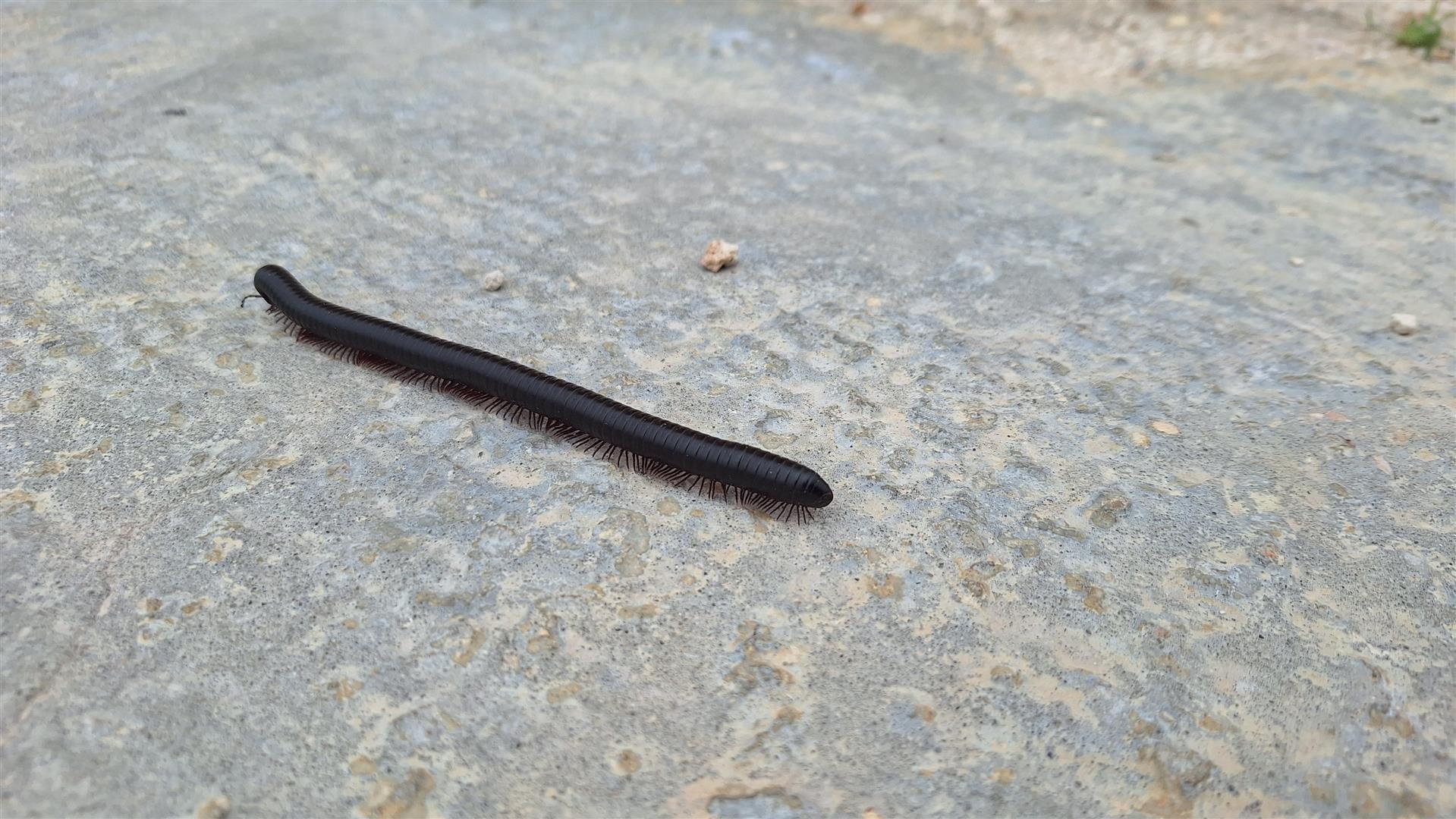
One of the other visitors to Pella.
A much better place was Ajloun Castle. Up on top of a rocky outcrop, this was a big place, built by the local Muslim rulers to keep the Crusaders at bay and to protect the route between Syria and Egypt, as well as the local iron mines. I was able to go on top of a couple of the towers and generally walk around most of the interior. It was very well preserved and a good example of the architecture of that time.

Ajloun Castle.
I gave the staff there a bit of a shock when I arrived because the road up to the gate was so steep I wasn’t able to manoeuvre the bike to park it while facing uphill. So, to their consternation, I rode through the gate, where I was able to turn it around and go back down. I got it parked eventually but it was very awkward.

Very well preserved interior.
I went on to the Battuta hostel. Jude was there and booked me in. She seemed to have been telling some people about me and she described me to one guy as legendary. Very embarrassing!
I went to Blix again, only to find they’d messed it all up. No draft beer, and the bottles were only small ones. Fortunately they were running a large discount. Just as well given that the beers were normally 6 JOD each!
Back at the hostel I met Madeline and we had a chat. They’ve changed the breakfast menu a bit and now it doesn’t include a drink of any kind. That’s a bad decision. The owner obviously ignored my suggestion. Money grabbing, in my opinion. I stayed there two nights, just to relax and catch up on writing and on plans.
When I left I went to the Cave of the Seven Sleepers, not far from the city. There wasn’t all that much to see. There was a door across the cave entrance, so no access inside. I guess they were still asleep and didn’t want to be disturbed. The legend is that during the 3rd century seven young Christians were being persecuted. So they went to this cave and fell asleep for several hundred years.

The cave of the seven sleepers.
Then I wasted some time going to Iraq Al Amir, a place I’d already been to. I’d forgotten to change the symbol on Google maps from ‘I want go there’ to ‘I’ve been there’. It did explain why the roads I was riding looked a bit familiar.
That was followed by a nice ride across to the Baptismal Site of Jesus, also known as Bethany Across the Jordan. This place is where John the Baptist is reckoned to have dunked Jesus in the river Jordan, thereby making him a Christian – kind of.
I arrived and was directed to a parking area where I stopped next to a Spanish registered Honda. I wasn’t sure what size but it was small. I went over to the visitor centre and met the rider, Thomas, from Madrid. He told me there was a bus to take us to the site. I went to the loo and when I came out the bus had arrived, so I got on it. Most people were clutching tickets, I hadn’t had time to go and get one. In the end it didn’t matter.
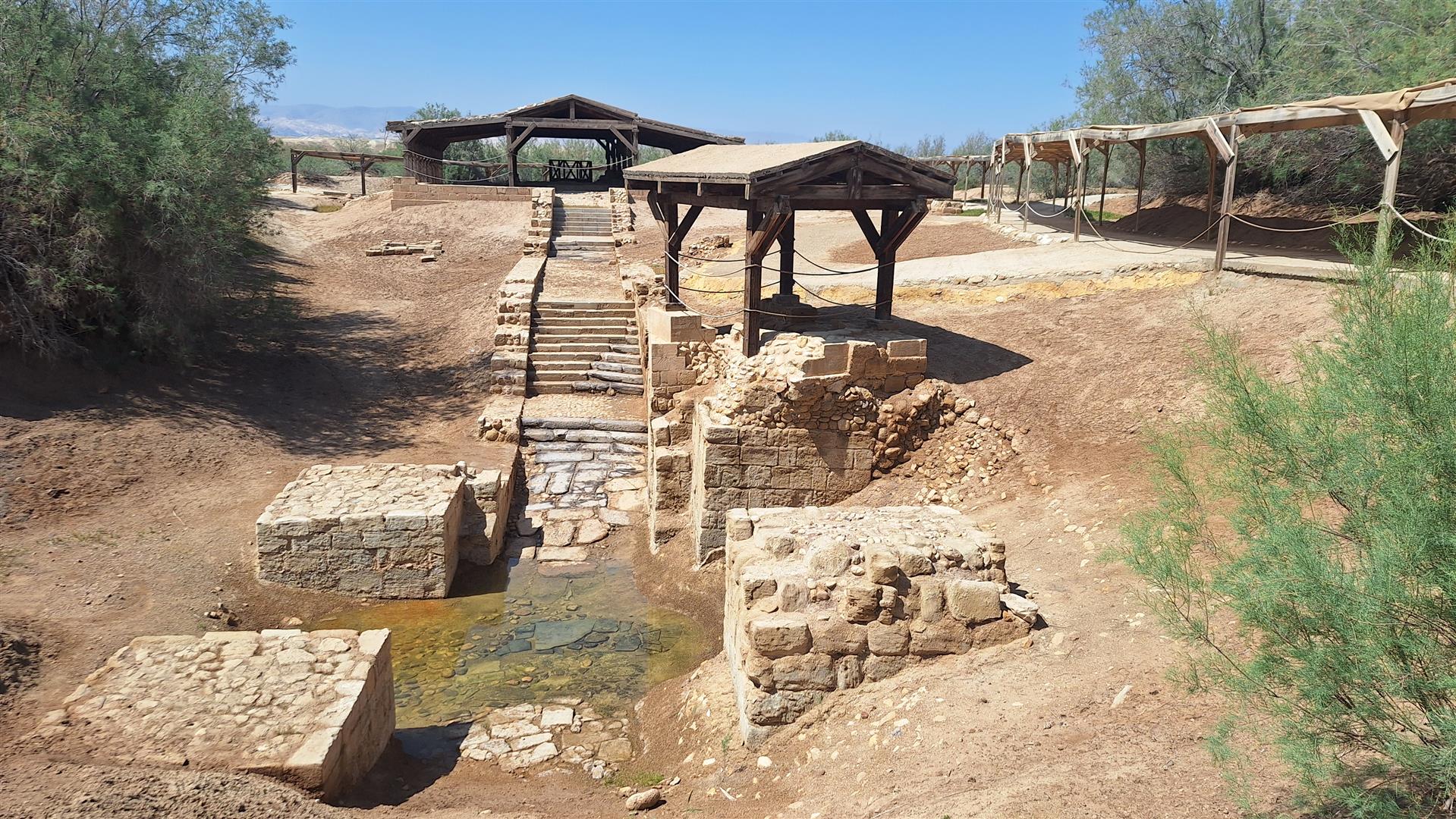
Where Jesus was supposed to have been baptised.

Some old bloke from Italy visited as well.
When we got down to the site our guide told us the story. In front of us was a baptismal cruciform, which had been built in about 600 CE. He said there had been five churches built there but they kept getting washed away in floods. But the River Jordan, over the centuries, had moved about 200 metres westwards, closer to Palestine. So it was just a salty pool.
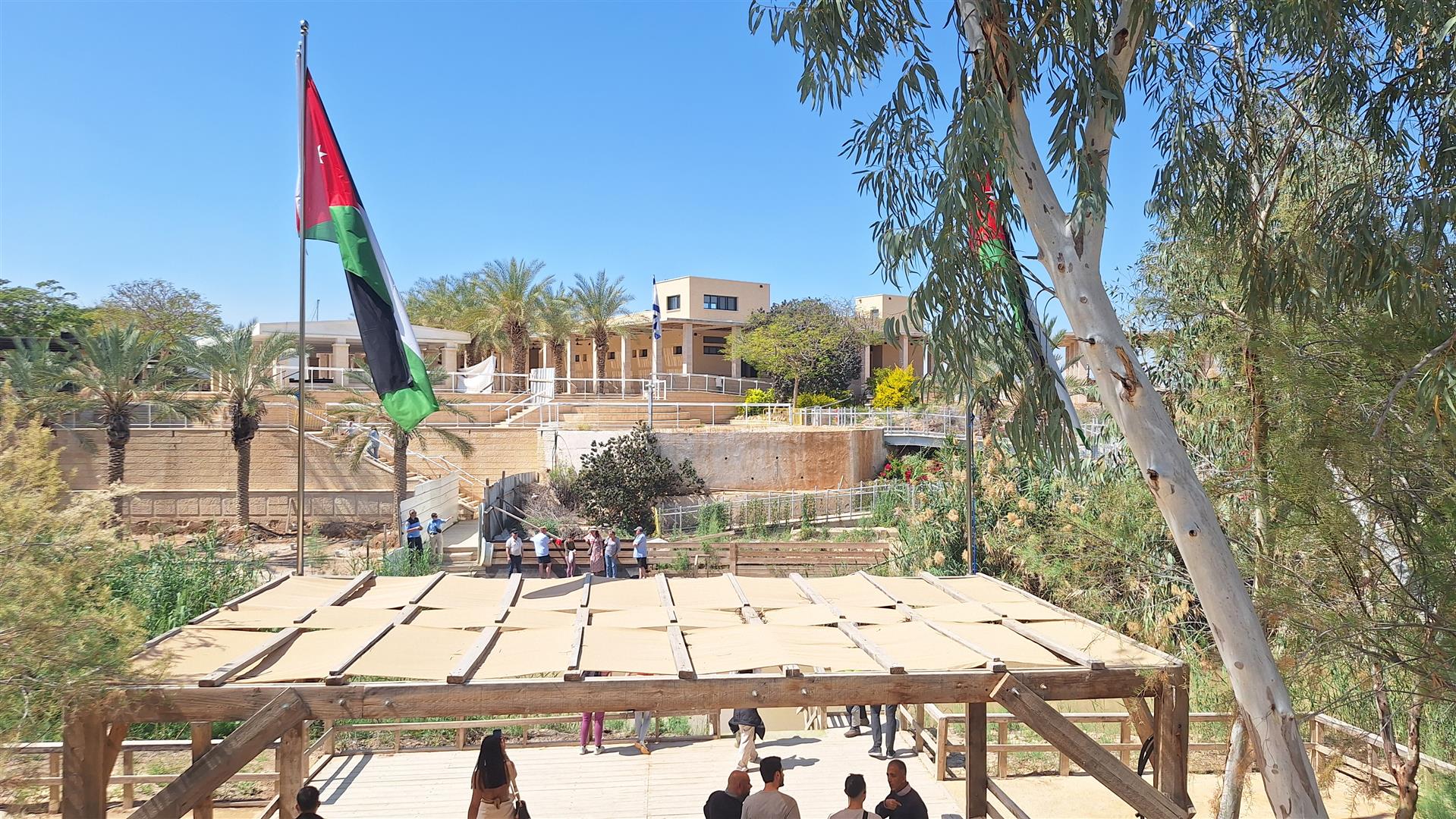
On the bank of the Jordan River.
We moved on to the actual Jordan river bank, with the border between Jordan and the Palestinian West Bank in the middle of the river. There was an Israeli flag on the opposite bank. The width was only about 10 or 12 metres. There was an area on each side where people could go into the water.
When we arrived an American voice hailed us from the other bank, asking where we were from. I shouted back, “Everywhere”, which seemed to puzzle him a bit. Later on I saw him in the river dunking a couple of people in the water. I guessed he was a religious leader of some kind and had arranged a trip to religious sites, including this one. I thought it both amusing and nonsensical, but who am I to judge other people’s motives?
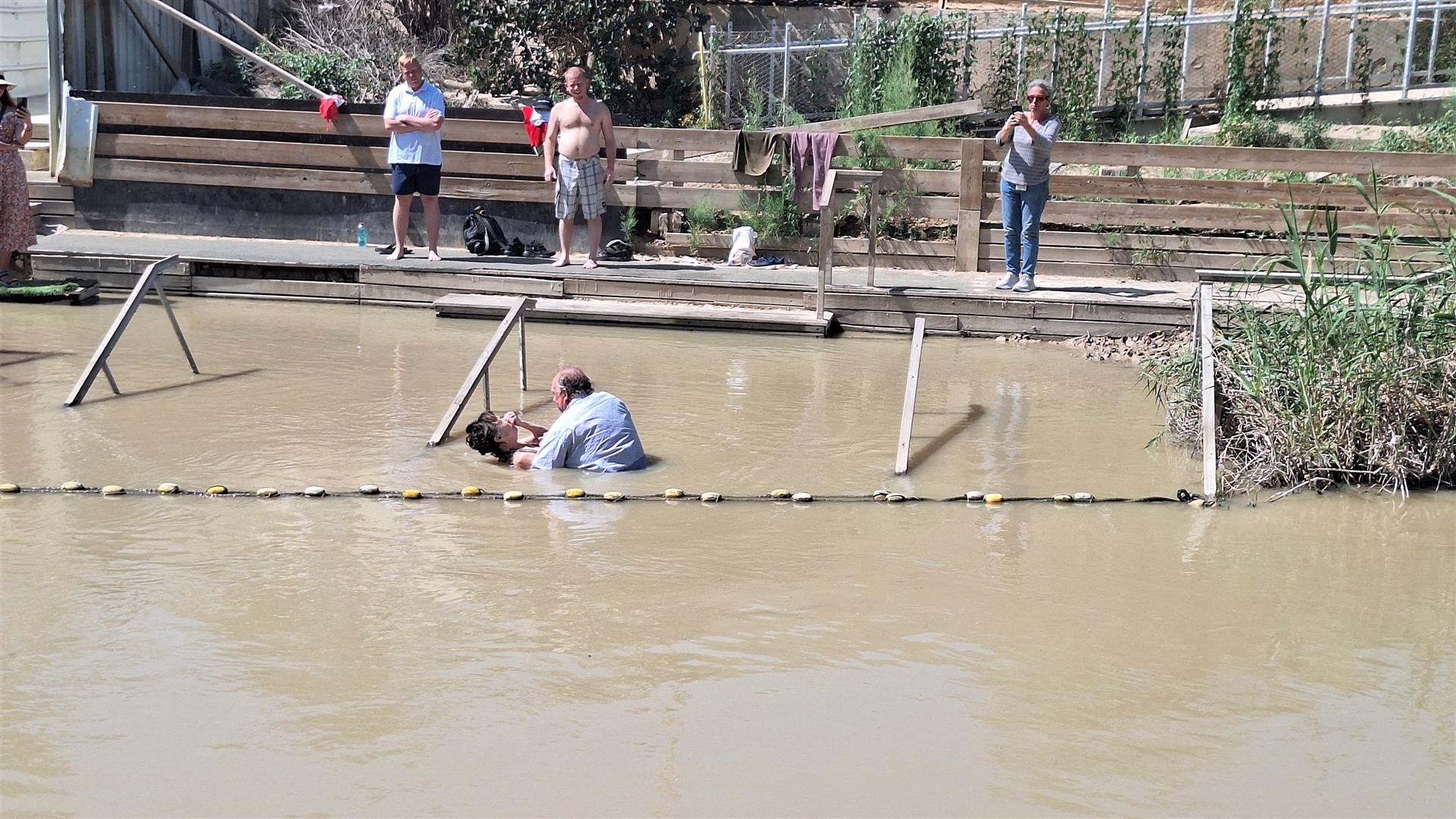
Being dunked in the River Jordan.
I had a quick look inside the nearby Greek church and took photos. This whole area is very dry and arid, with hills all around. The other side of the river is no different. It was a strange feeling to be among so many ancient biblical places. It was shame I wouldn’t be going to Israel as there would have been many interesting places to see. It would have to be added to the ‘later’ list in the hope that Israel became a decent country one day, so that I could visit it.

The Greek Church.

Some of the murals inside.
I chatted with Thomas. He has been around quite a lot. He often ships his bike to, or back from, various places and then rides those areas or countries. He looked older than me so I suppose that method suits him more than mine does.
I booked a hotel and then rode there. Another great ride, along small roads through the hills. I had been down at minus 300 metres and Madaba, my destination, was up at 800 metres and wasn’t so warm.
The hotel was in a large compound, right next to a big Greek Orthodox church. It contained a very important mosaic showing 6th century Holy Land but was, unfortunately, closed for renovation. However, before I left I was able to get in, by kind permission, and see the inside. The mosaic was excellent.
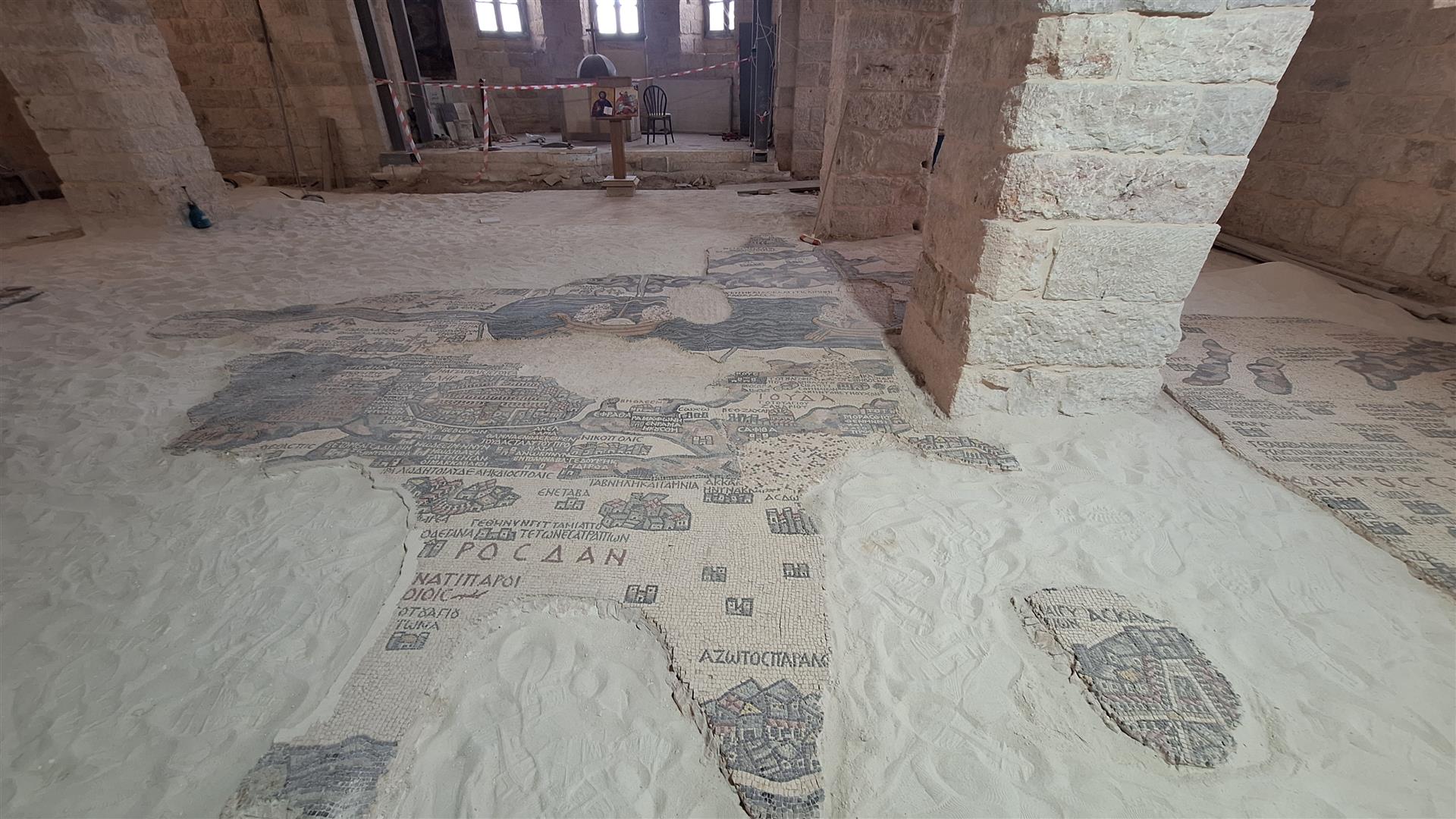
The mosaic of Holy Land sites, undergoing restoration.
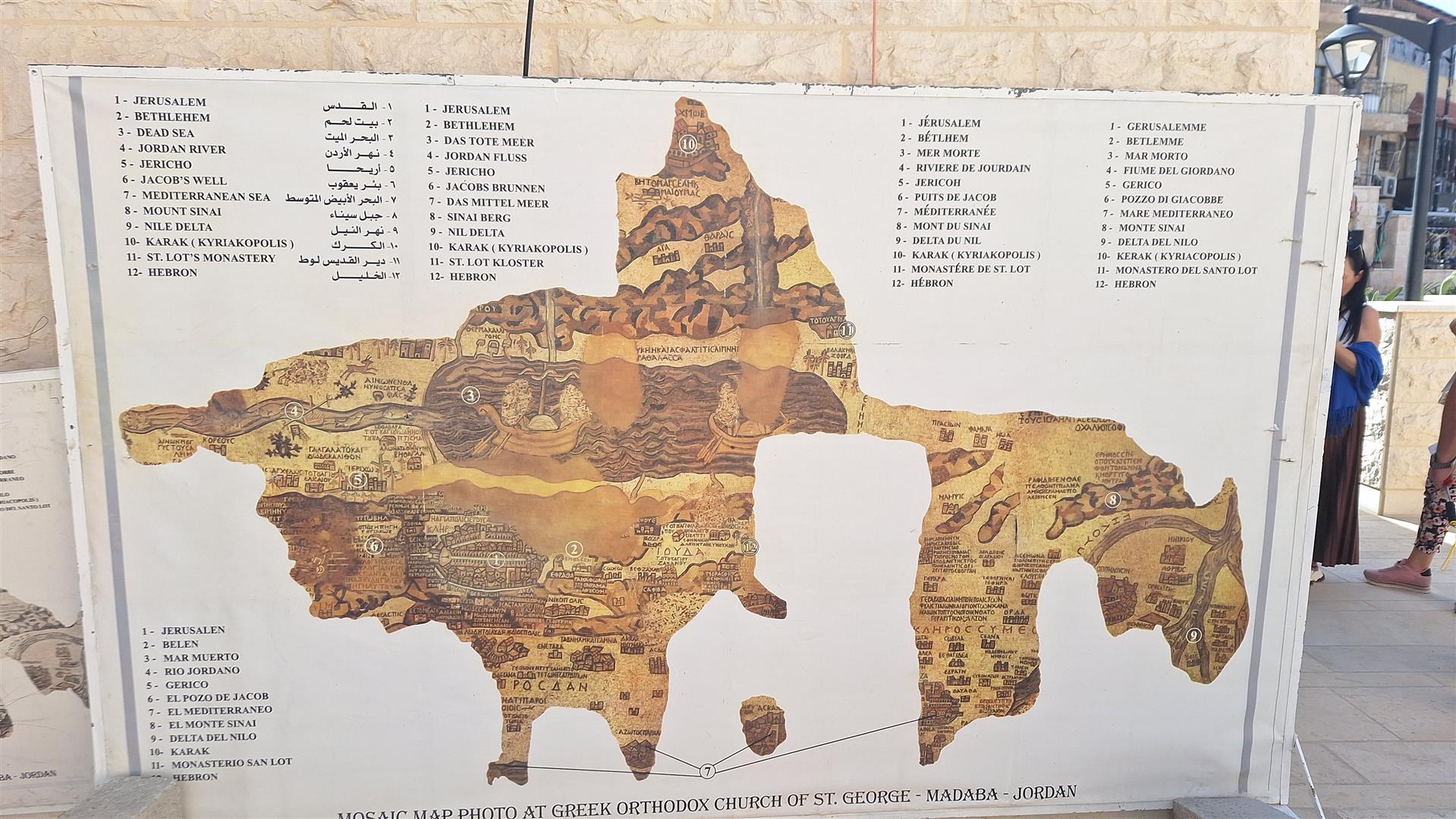
How it will look when it’s finished.
My room was good enough and when I asked about hot water for tea he brought up a kettle and some tea bags.
It had been a very good day for riding and viewing. Very informative and interesting.
A chiiled out morning followed, before going out for more sightseeing. Madaba is renowned for the mosaics that are to be found in various buildings. Its origins date back to the bronze age but was, of course, also settled by the Greeks and Romans.
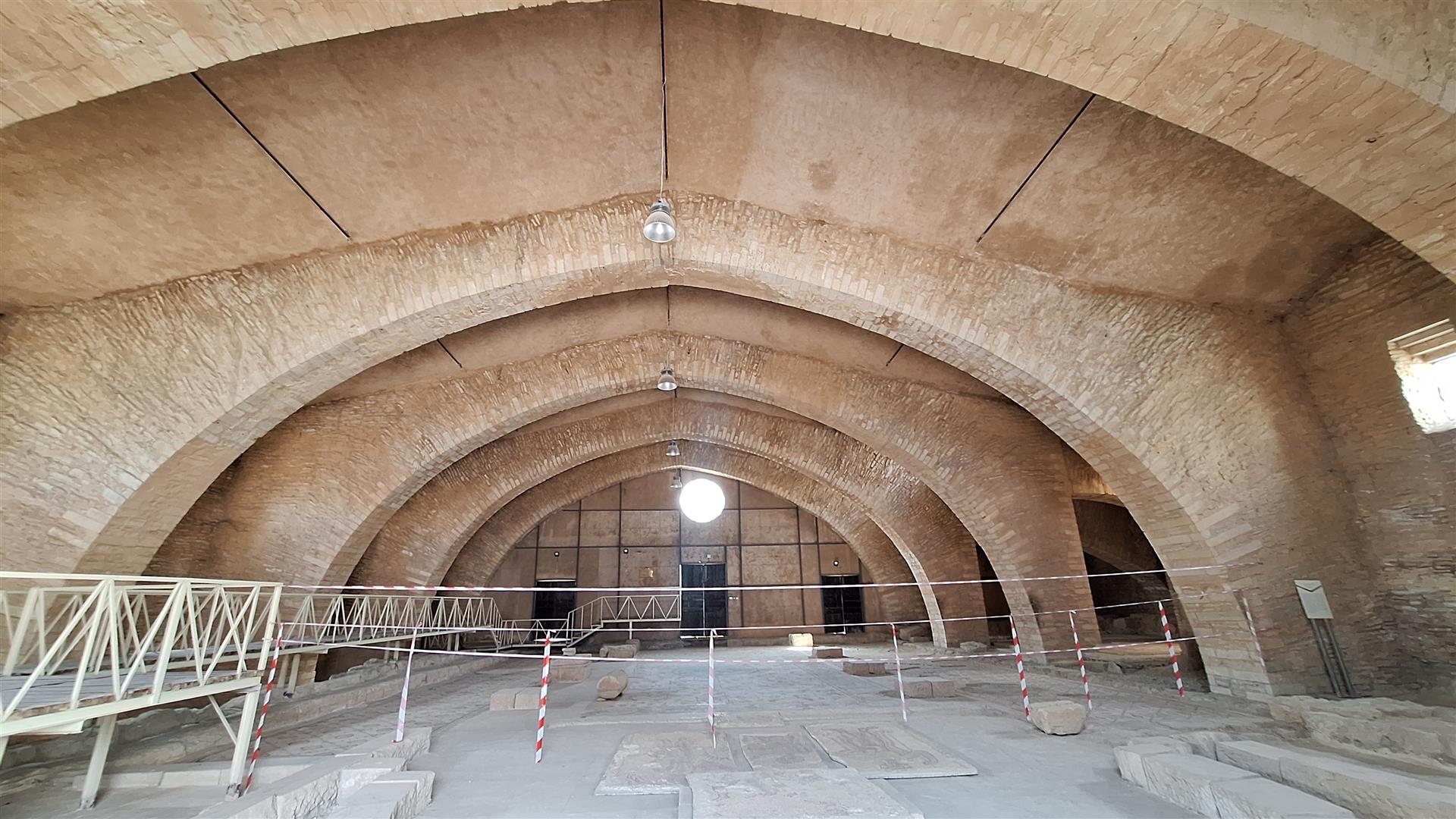
I liked the roof of the Apostles’ Church.
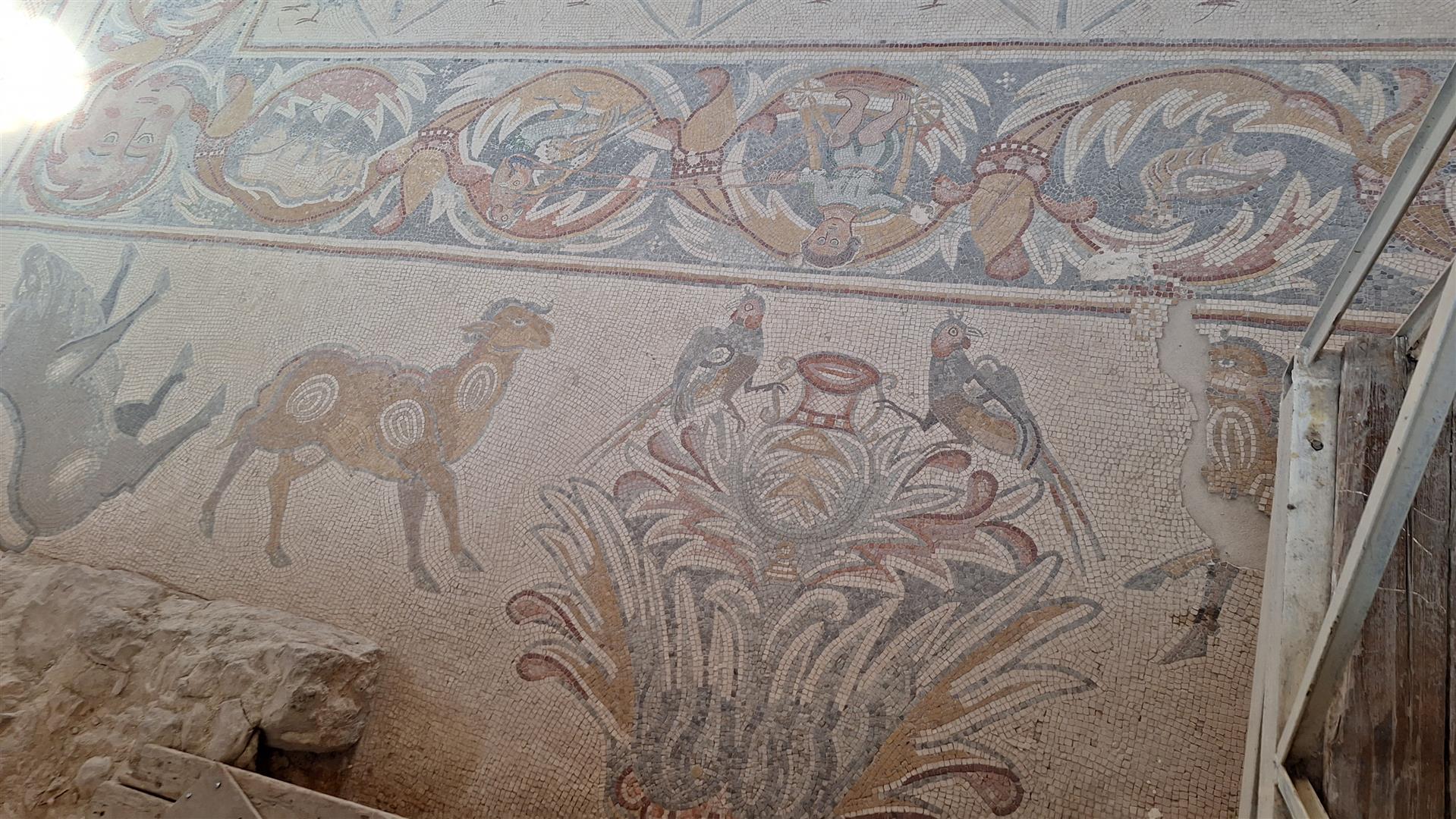
And this mosaic too.
The first visit was to the Apostles Church. A small and low building. There was nothing much inside, although the arched roof supports looked good. There were some interesting mosaics too. When I arrived I realised I’d forgotten my Jordan pass. The guy there asked my name and said he’d trust me. That was his lead in to trying to become my guide. I declined.
Then I went to the Archaeological Museum. This was a collection of houses that had been converted into a museum. There was a very good collection of mosaics there, mostly from buildings in the city. Some were in their original locations and had been found during restorations of the property.
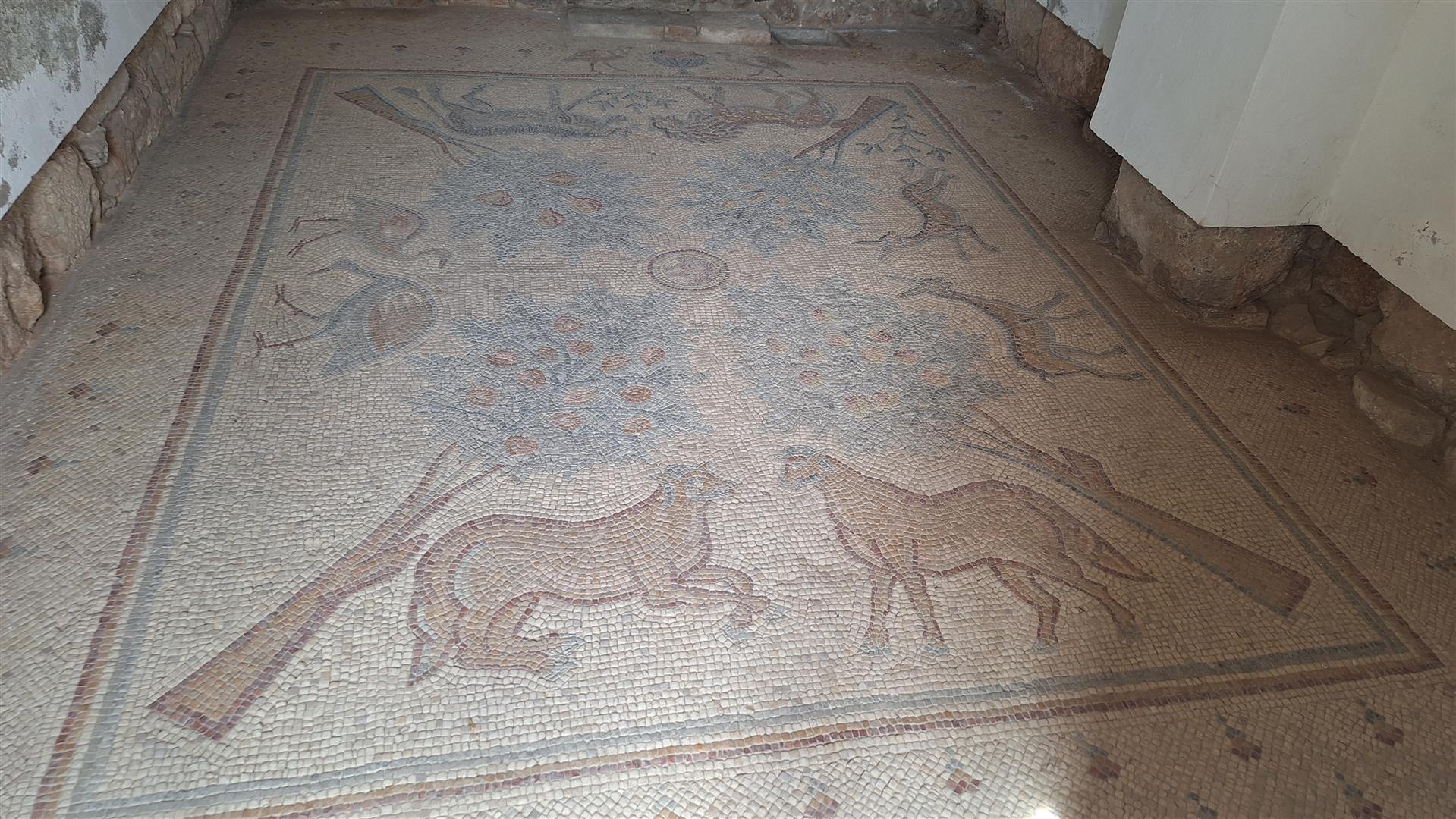
One of the mosaics in the museum.
The biggest site was the Archaeological Park. This was a really good place. Once again, a lot of the exhibits had been discovered in more recent times. Late 19th to mid 20th century (by a German evangelical group), then continued by Jordan. There was lots there.

The Roman road running through the site.
A Roman road ran through it, with various buildings along side. Mostly churches, with a major focus on Prophet Elijah. He seemed to be an important figure in all three of the desert religions.
Another major exhibit was the Hippolytus Hall. It dates from Roman times and had been altered and added to through the various historic periods. Some beautiful mosaics once more, and lots of info about the building itself. It took a while to see all around it as there was plenty of it.

You wouldn’t think there’d be a code within a mosaic.
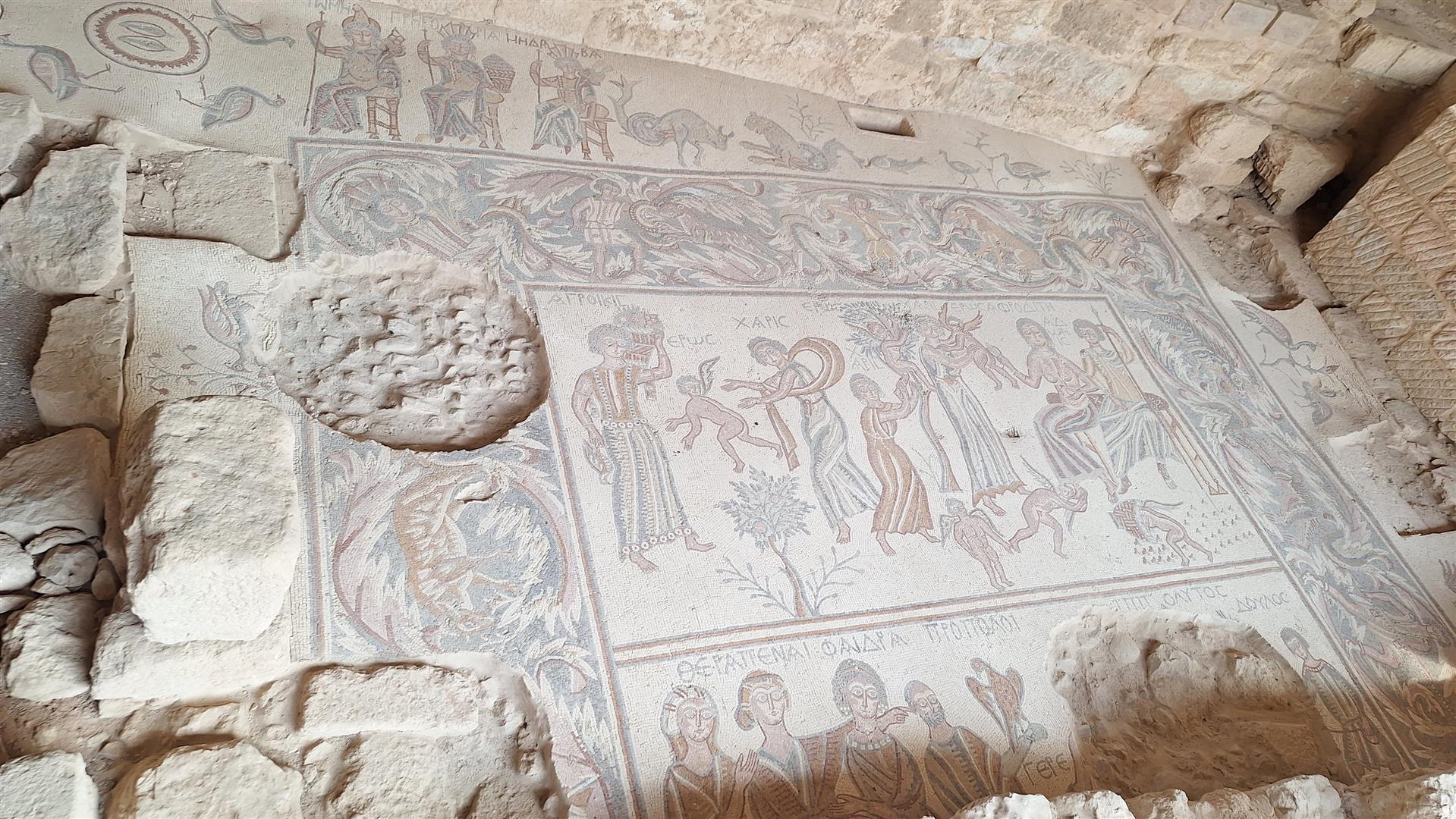
I don’t know which cities were represented here.
Opposite the entrance was a café, so I went in and bought coffee. A woman in there stopped to ask me my name and introduced herself and some other women there.
Then I walked back up towards the hotel. I passed the entrance to the Burnt Palace, so I went in. It was part of the Archaeological Park.
It’s used to be a private house, built on top of older buildings, which had been destroyed during the late 8th century earthquake. There used to be a church there, which had been built on. So, once more, lots of mosaics, plus a good look at the construction methods.
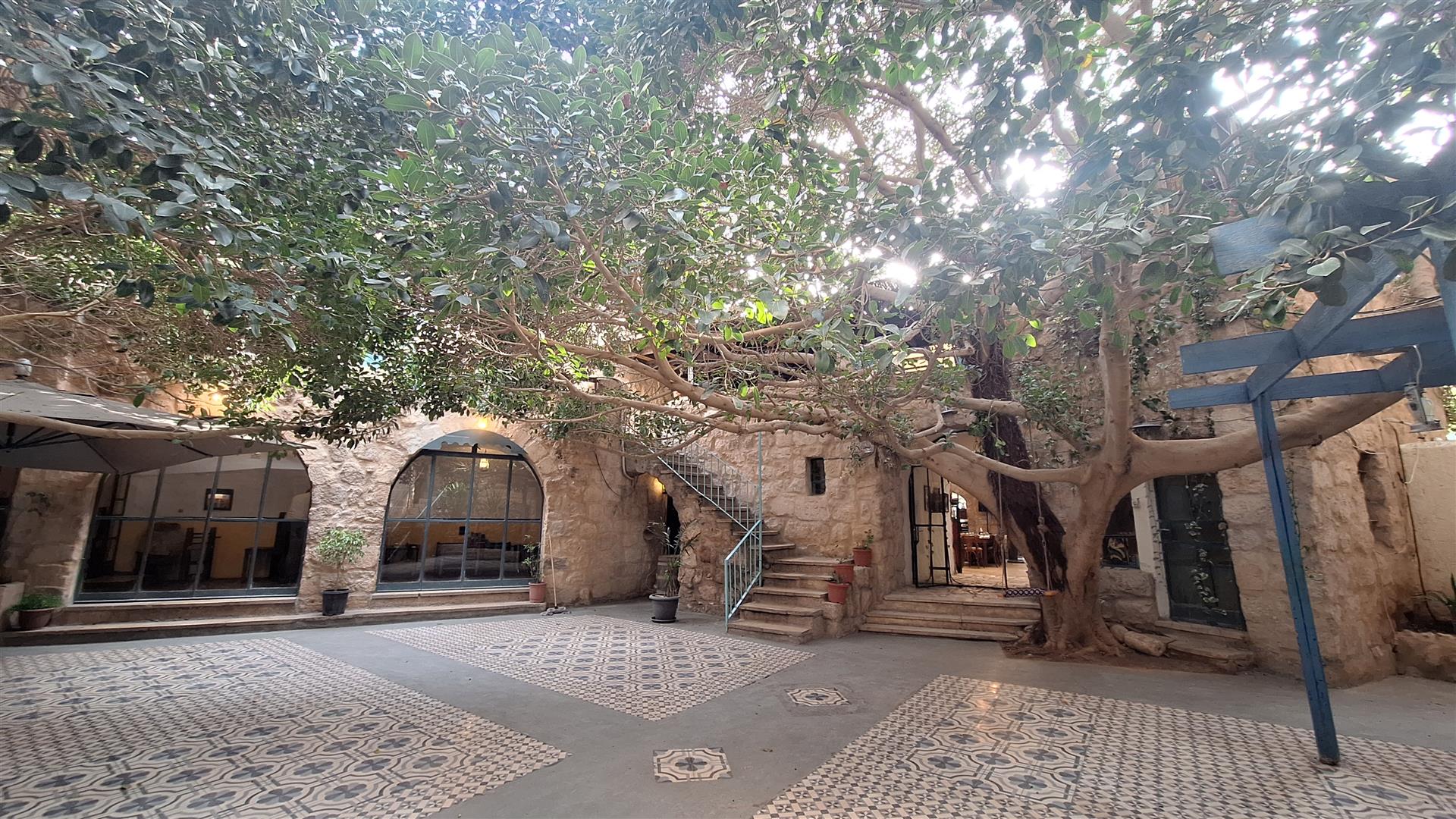
In the courtyard of Haret Jdoudna, a nearby restaurant.
A very good day out came next. I went to Qasr Al Qastal. It was a fairly small place and had free access. It’s an Umayyad desert settlement with several buildings, including a mosque, palace, bath house and others. A lot of the rooms were intact, including the roof structures. But there were no info boards. It took a bit of finding as the Google location wasn’t very accurate.

One of the better buildings at Qasr Al Qastal.
A fairly short ride across to Qasr Al Mushatta, which was close to the airport. But it was closed. There was a chain link fence across the entrance. Fortunately there was a vehicle gate nearby, which I was able to sneak through. They’d only chained it at the top and there was a Geoff sized gap lower down. I kept an eye on the security guys at the nearby airport entrance but they weren’t concerned.
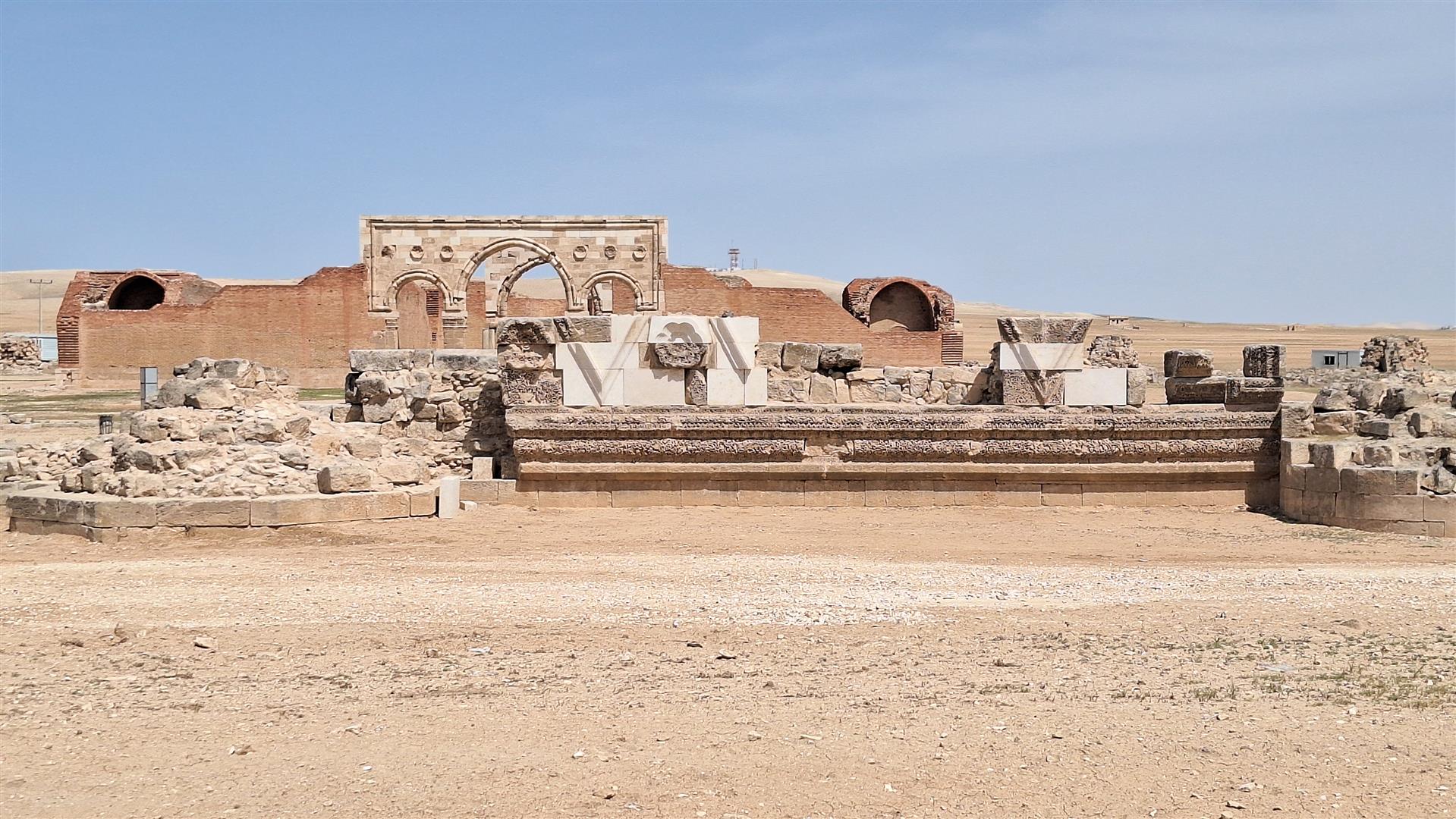
Front view of Qasr Al Mushatta.
It was from the 8th century and was pretty big. It was a local ruler’s winter palace and was designed for important meetings and for housing guests, as well as the family. It’s mostly built of brick, rather than stone, which made it look much different to most other places. There’s a lot of inscriptions on various walls and columns. The info board suggested that several parts of it didn’t get finished.
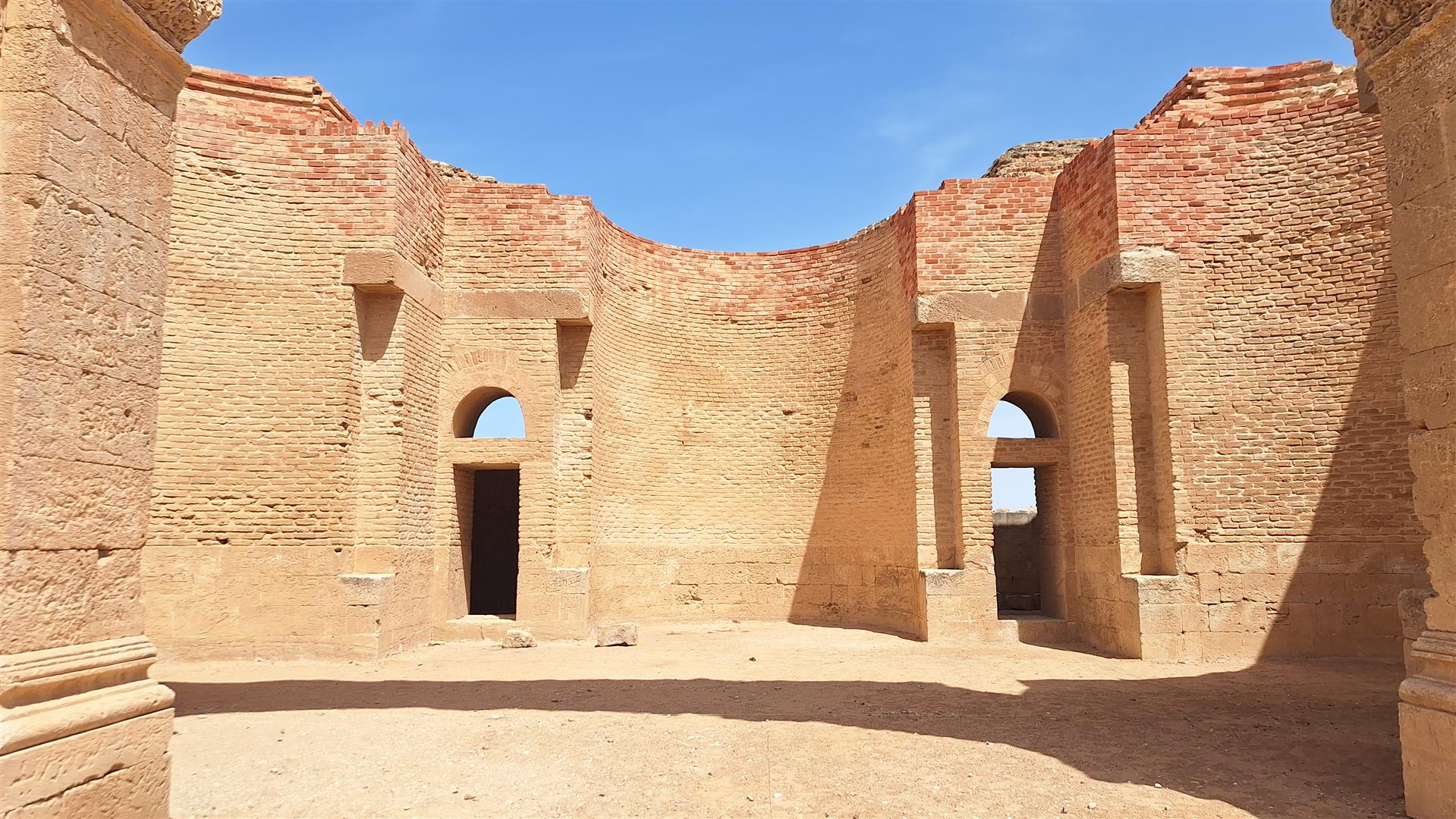
Inside one of the buildings. It was good to see bricks rather than stones.
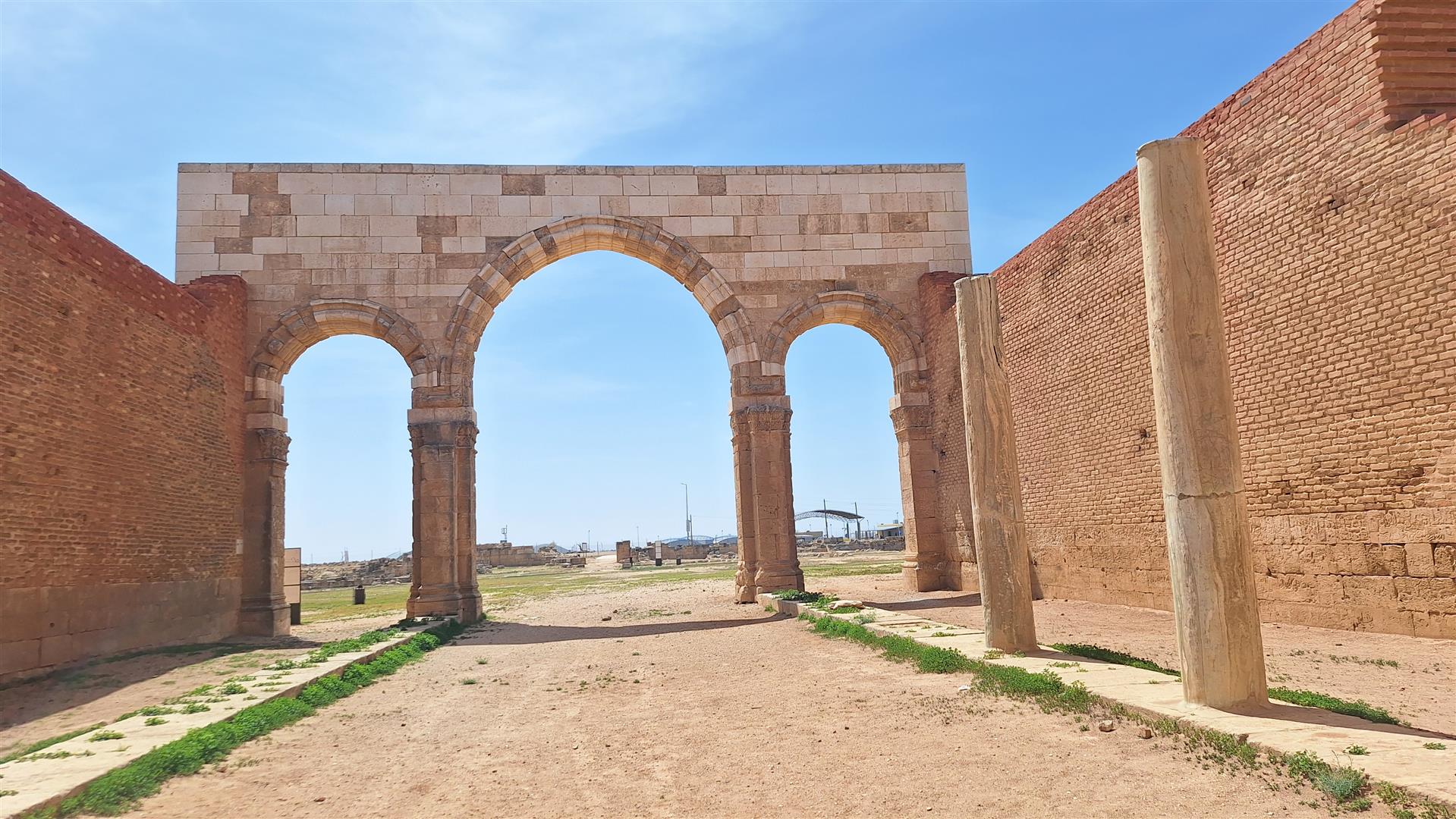
One of the gates.
The next place was the Fortress of Umm ar-Rasas. This was a Roman area and was mostly about Byzantine churches. There was at least half a dozen of them and their key feature was their mosaic floors. They were very detailed and included a lot of animals and geometric designs.
At least, that was what the info boards said. In reality, almost all of them were covered up with plastic. St Stephen’s church had a shelter over it and those mosaics were on display. So I assumed the plastic covering was for protection from the elements and they were awaiting their own shelters.
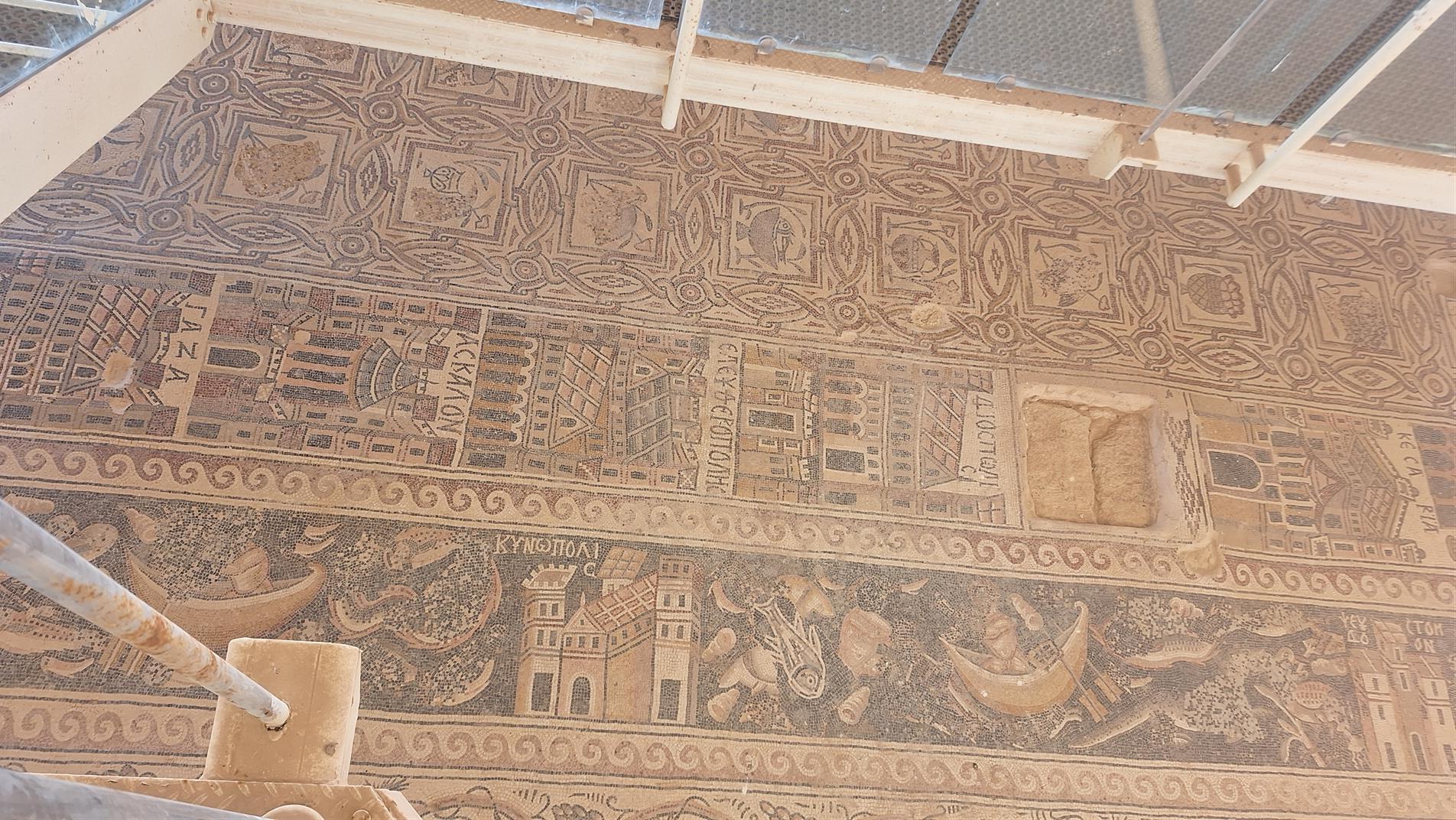
This is great, isn’t it? It looks more like a painting than a mosaic.
It was a very big site, with the lower part of it at least half a kilometre away. I saw a couple of electric vehicles outside the entrance and I guessed they were used as transport on busier days. I stuck to the top half of the complex. I looked at about four of them. They were all still half erect. The ruins showed there had been lots of houses around too.

A really big site.
I looked at my options for what to do next and concluded that it was too late to go the the Dead Sea beach. I decided to book another night at the hotel and go the next day. I also needed to work out what to do following that.
I very much enjoyed the ride back to the hotel. I was thinking about how much I liked this area, with its low hills, gentle valleys, with greenery mixed in. It was really good to be there.
I wanted to visit the Dead Sea and have a float in it. I’d been recommended a place called O Beach for good access. I left at about 12 and had a very good ride down there, fascinated by the ever dropping elevation reading on my GPS. I made the mistake of calling in at a place that I thought was just a viewpoint but I had to pay 2 JOD to go in. It was a restaurant, in fact, although the view was good.

A stunning view of the Dead Sea, with its salty shoreline.
At O Beach I paid the 20 JOD entry fee and wandered around until I found the changing room. I was given a nice big towel at the gate where I paid.
I put my riding gear into a couple of lockers then went to reception to ask about keys for them. 3 JOD each, I was told. I asked her what had I paid 20 JOD for then? She looked at me as if I was mad. I didn’t bother anyway.
I found the stairs down to the beach, which was quite a long way below that level. A guy by the swimming pool took me down there, then stuck around to take some photos of me in the water.
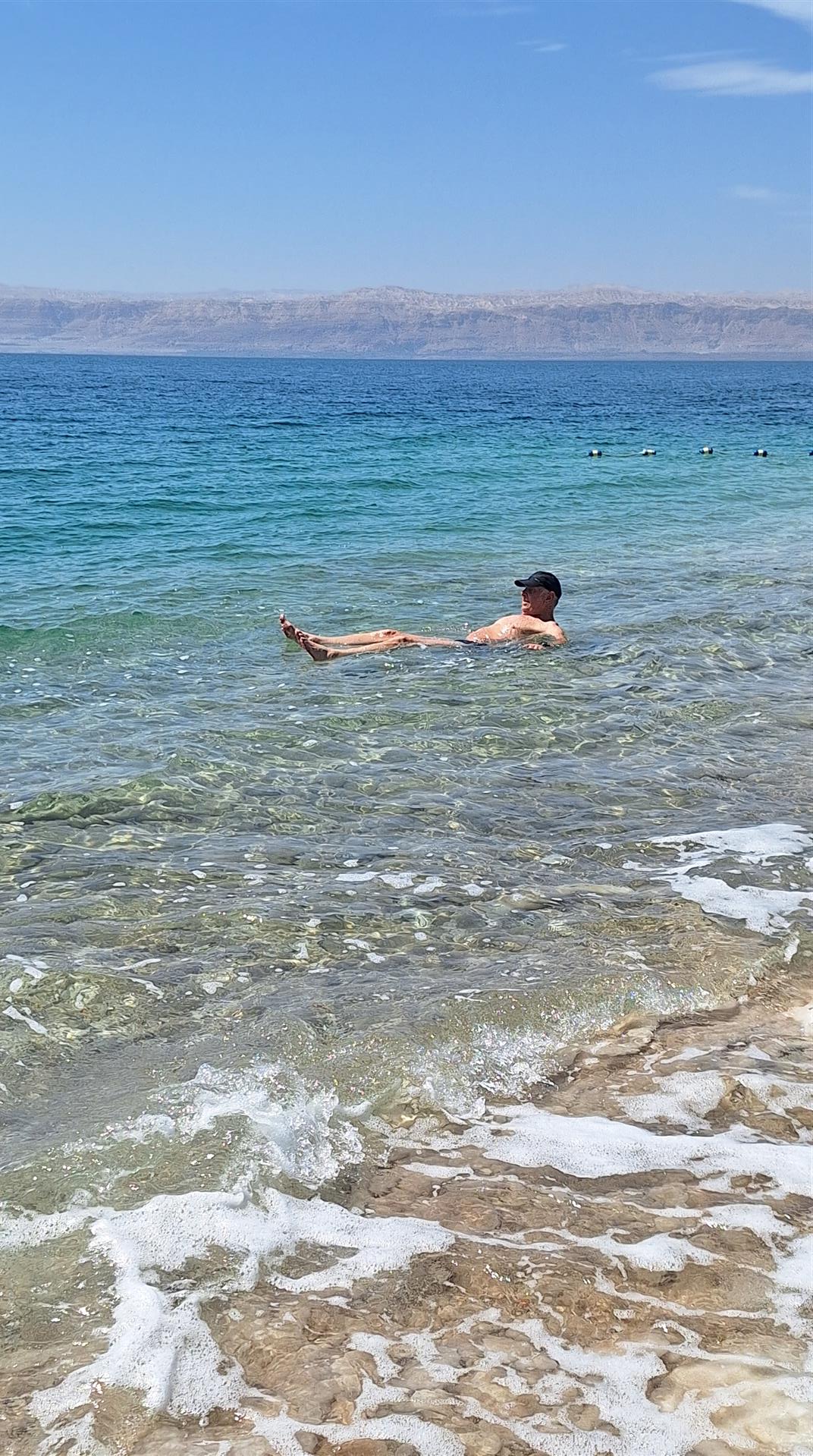
Just floating.
It was really weird. Firstly, the edge of the water was made of salt rock, which was smooth initially but quickly become very rough and sharp. It was very difficult to walk on. The other thing was that the water itself seemed very reluctant to let me go. Once I’d floated around a bit, it was very hard to stand up. An effect of the low elevation? Or the salt? I was very unsteady on my feet and it wasn’t me being old and rickety. There was definitely an odd effect, as if the water was holding me down.

Almost unbelievable!
Once out, I sat on a lounger for a while. After an hour or so I went and got changed. That was followed by a very nice ride home, over those lovely hills that I like so much.
For tea I fancied a pizza but I also fancied a beer. So I identified the nearest place that sold both on Google, nine minutes walk away, but when I got there it was closed. The one that had been next nearest was now twenty minutes away. There were three bottle shops there – all closed. I concluded it was a Thursday night thing, because of Friday being prayer day.
Next morning I left about 11 and went to Kerak Castle. It was a big old Crusader castle up on a hill, another one built by the French. It was fairly intact, especially the arched passages. Annoyingly, there were no info boards, at all. So I just wandered around taking photos. It seemed to have two large sections, linked by smaller buildings. The views out to the hills were really good. I had coffee and biscuits there, which I had to take a mortgage out to pay for.
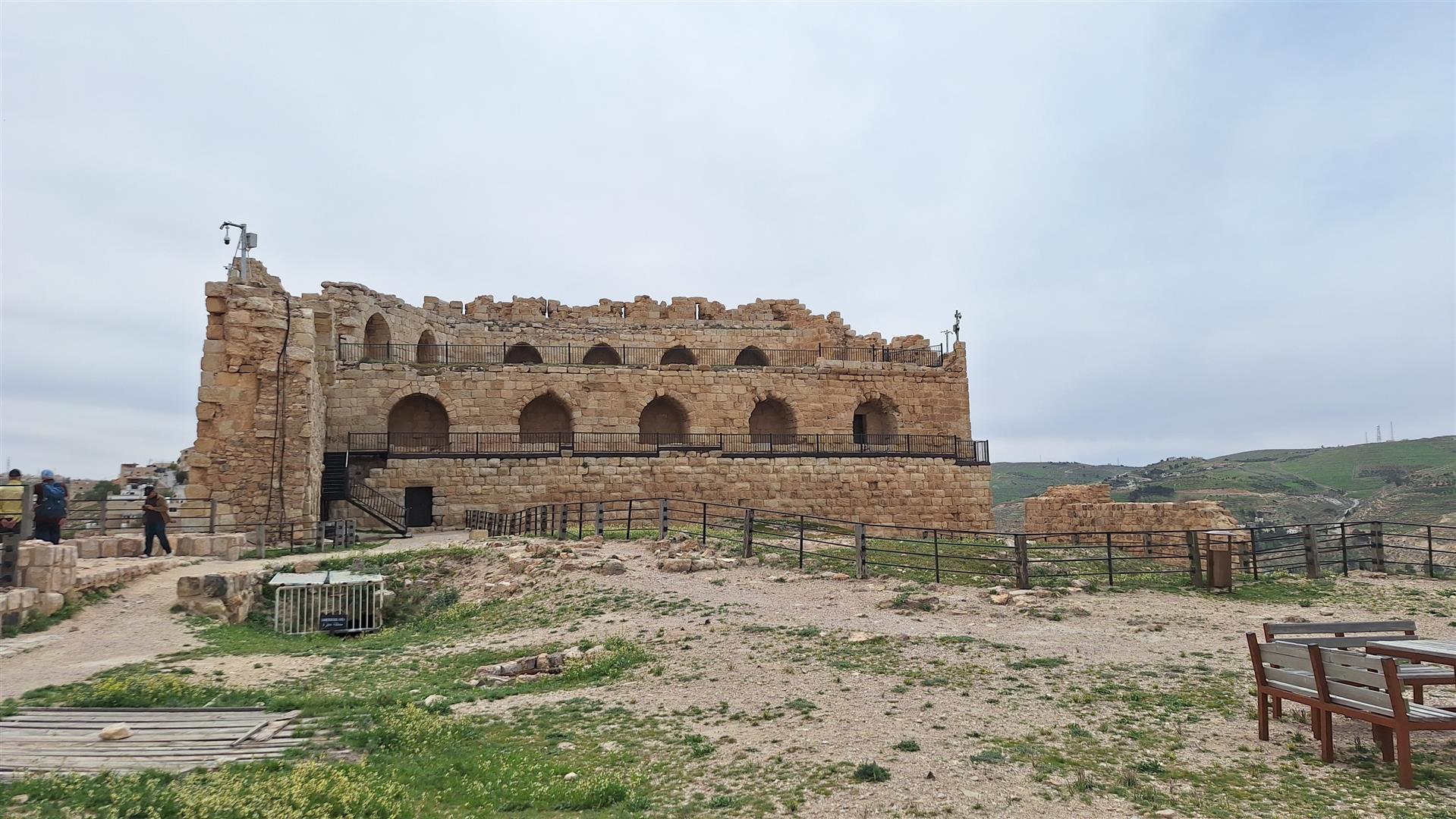
Part of Kerak castle.
Just after I’d parked the bike I got chatting to a Dutch couple, with two little girls. They lived in Amman but had previously worked in East Africa. They’re heading in the same general direction as me so I might bump into them again.
Then I rode down to the Museum of the Lowest Point on Earth. Quite interesting. It was about the local history and the archaeological discoveries in the region. That included Lot’s Cave, which has a church dedicated to him. One of the info boards mentioned that the Dead Sea has naturally forming salt pillars. Almost certainly the origin of the Pillar of Salt biblical myth. I tried to find my way up to the church but the access road up from the museum was closed.

Life at minus 400 metres.
Once again I’ll say how spiritual this whole area was and how good the feeling was when riding around it. Despite being non religious, I found that the feeling of riding through all that biblical history was quite special.
From minus 350 metres I then rode up to a mountain peak at 1550 metres in order to get to my overnight stop in the village of Dana. Luckily it was 300 metres lower, down a side road, and therefore a little warmer – possibly..
That village was very old, around 500 years in its current form, with prior occupation of the area going back much further. That was easy to see. Mine host, whose English was as good as my Arabic, told me it either dates from 800 CE or is 800 years old. I think it’s the former because he referenced the Byzantine period. I went for a walk around. Most of the buildings were of old stone, a lot of them very tumbledown.
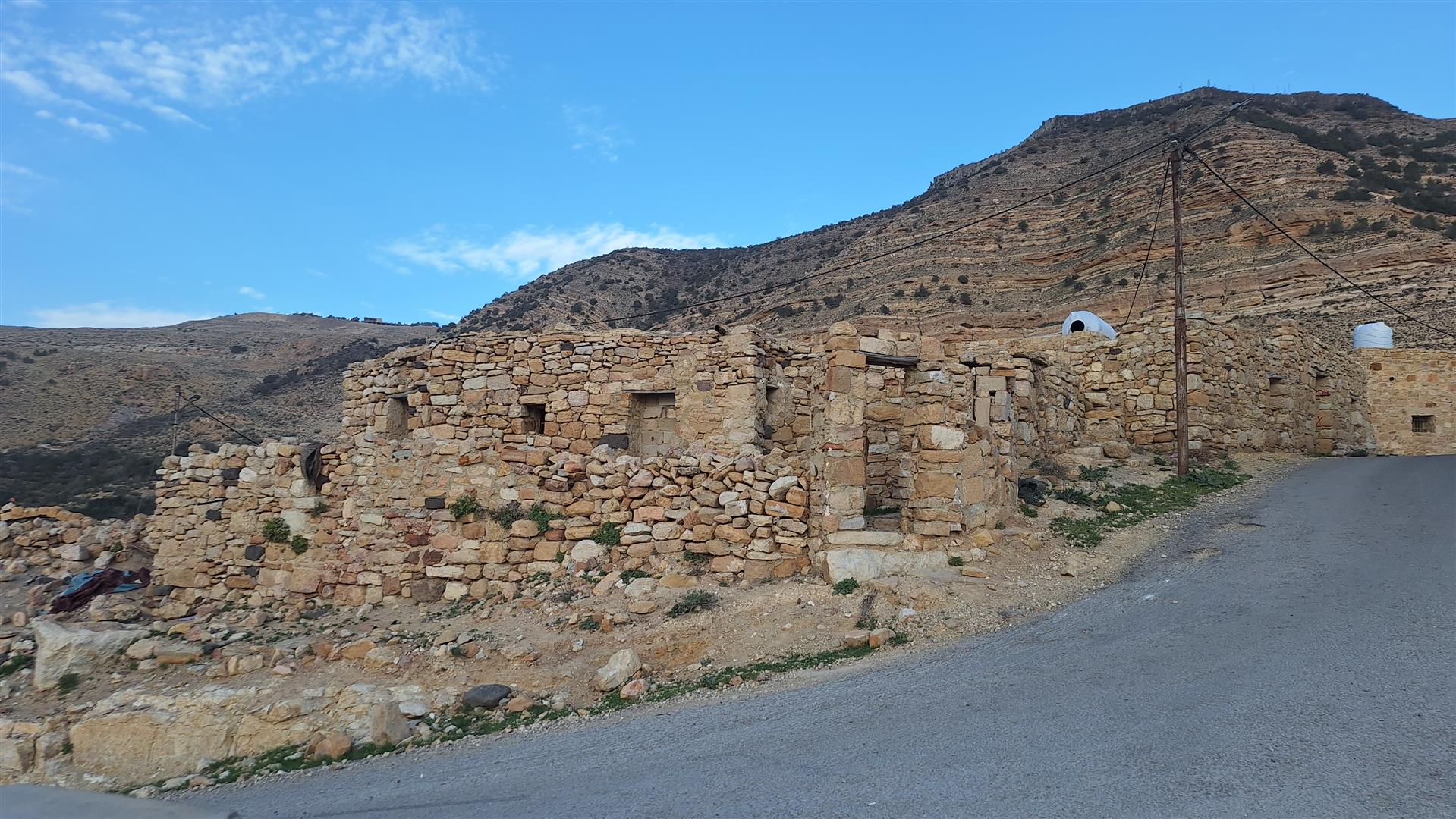
Dana village.
As usual, it was colder in my room than it was outside. My plan for the next day was to go down to Petra via Shobak Castle.
It was misty and cold when I got up. Omelette for breakfast and I was given a little lunch pack. How novel. I waited around until 11am, hoping the thick mist would clear, although I had a feeling I might rise above it. Which was what happened. But then it came in again as I went back down into the cloud, towards Shobak, but not as bad.
I rode right up to the castle gate but was turned away and had to go across to where they were laying out a parking area. 3 JOD got me an electric cart ride back up to the castle and back to the bike again.
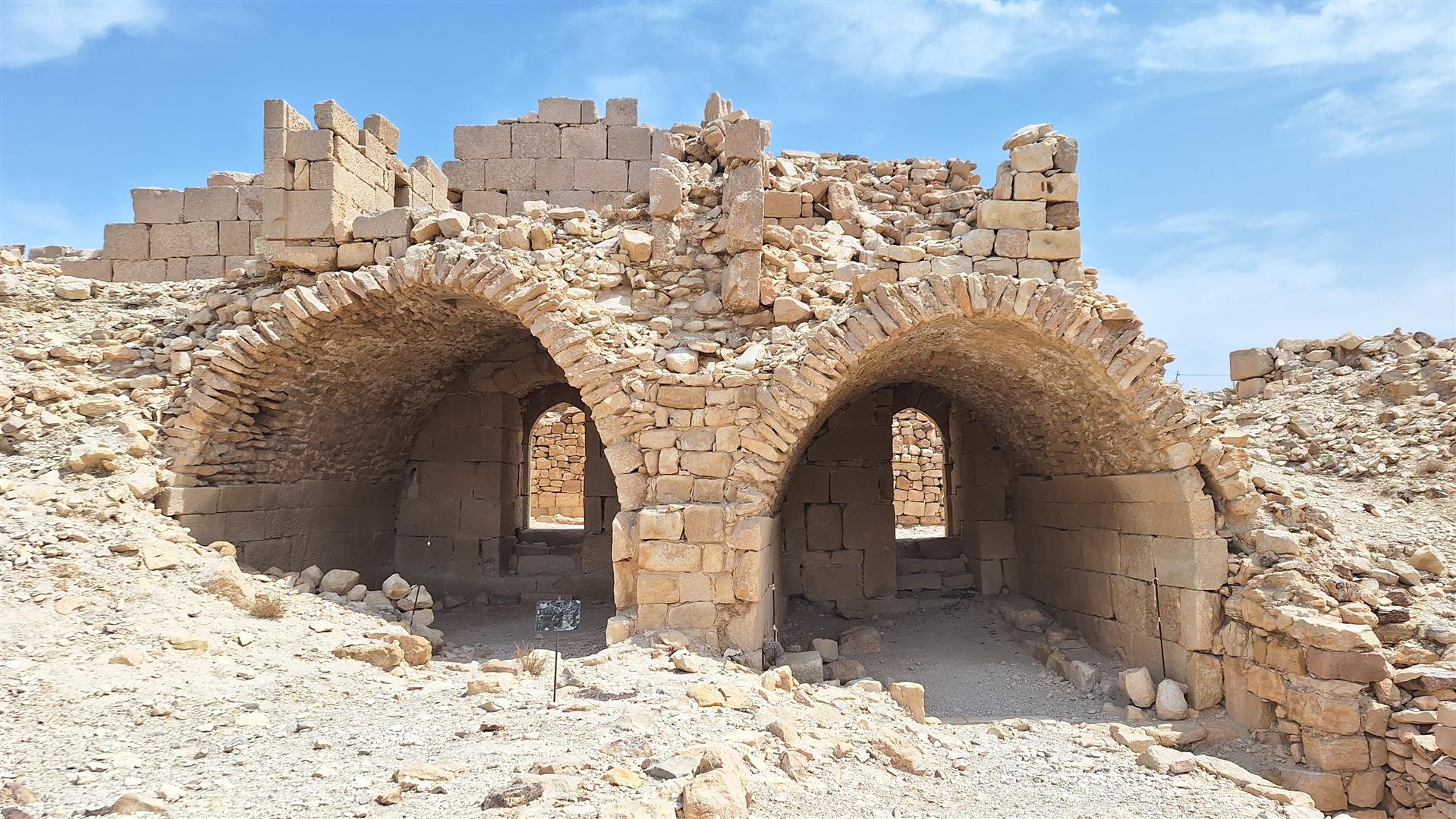
Barrel vaulted rooms.
It was quite a big Crusader castle, reckoned to have been constructed in only a few days, and made easier by building it on the foundations of an old Roman fort. I’m not at all sure I believe that timescale. It seemed impossible to me, although I supposed they could have got the walls up at least.
This kind of scenario led me to wonder where the labour came from. I guessed they must have used the soldiers because it seemed to me that the local Muslim population wouldn’t have wanted to contribute to their own downfall. Although, on the other hand, money and a sharp pointed sword talk.
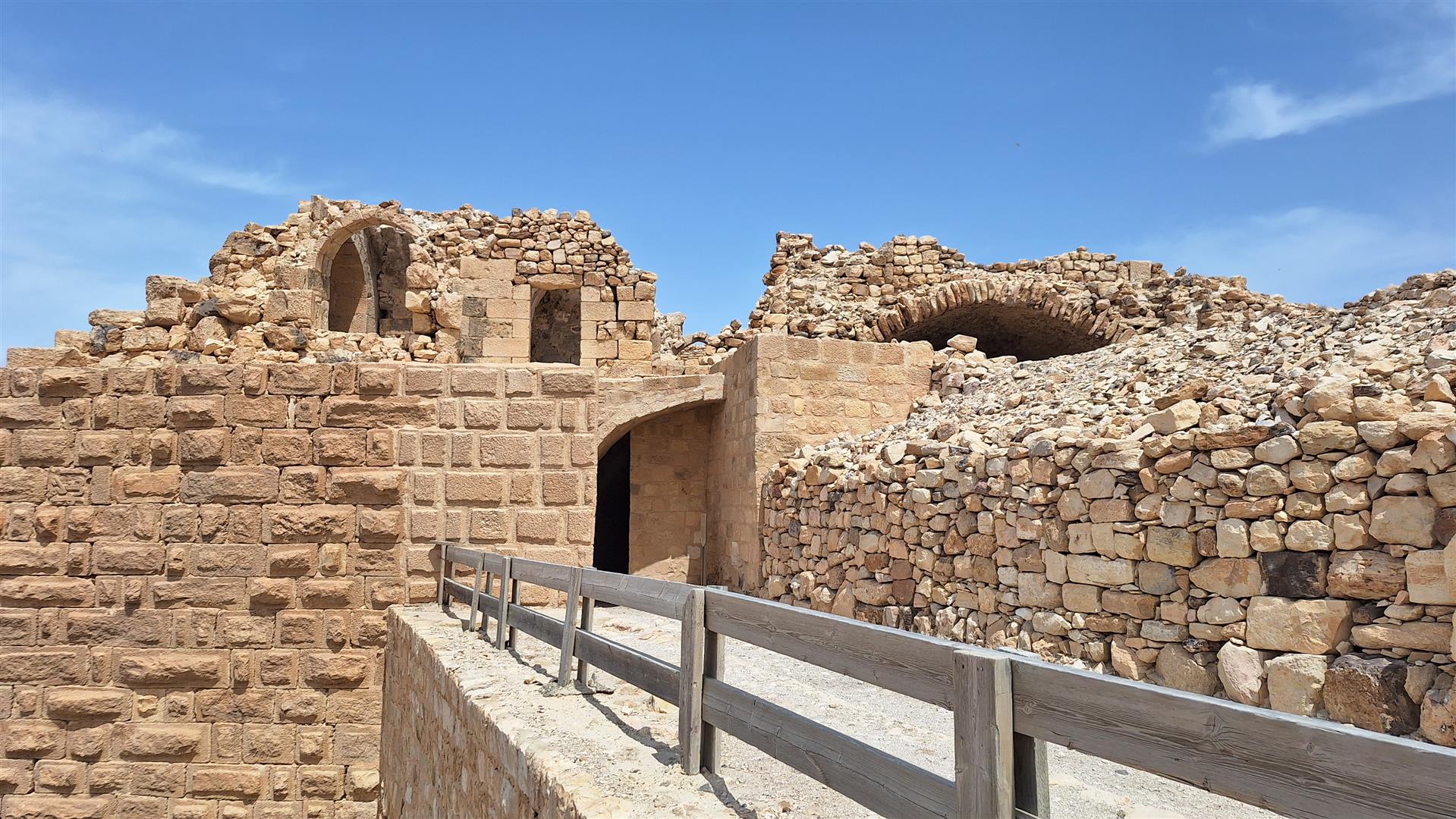
Part of the castle, with varied construction.
It had a church and assembly halls, plus the usual rooms for living. On one side there was a double wall, with a passage between, for extra security. I found a big pile of round rocks for use with their catapult. They looked suitably heavy.
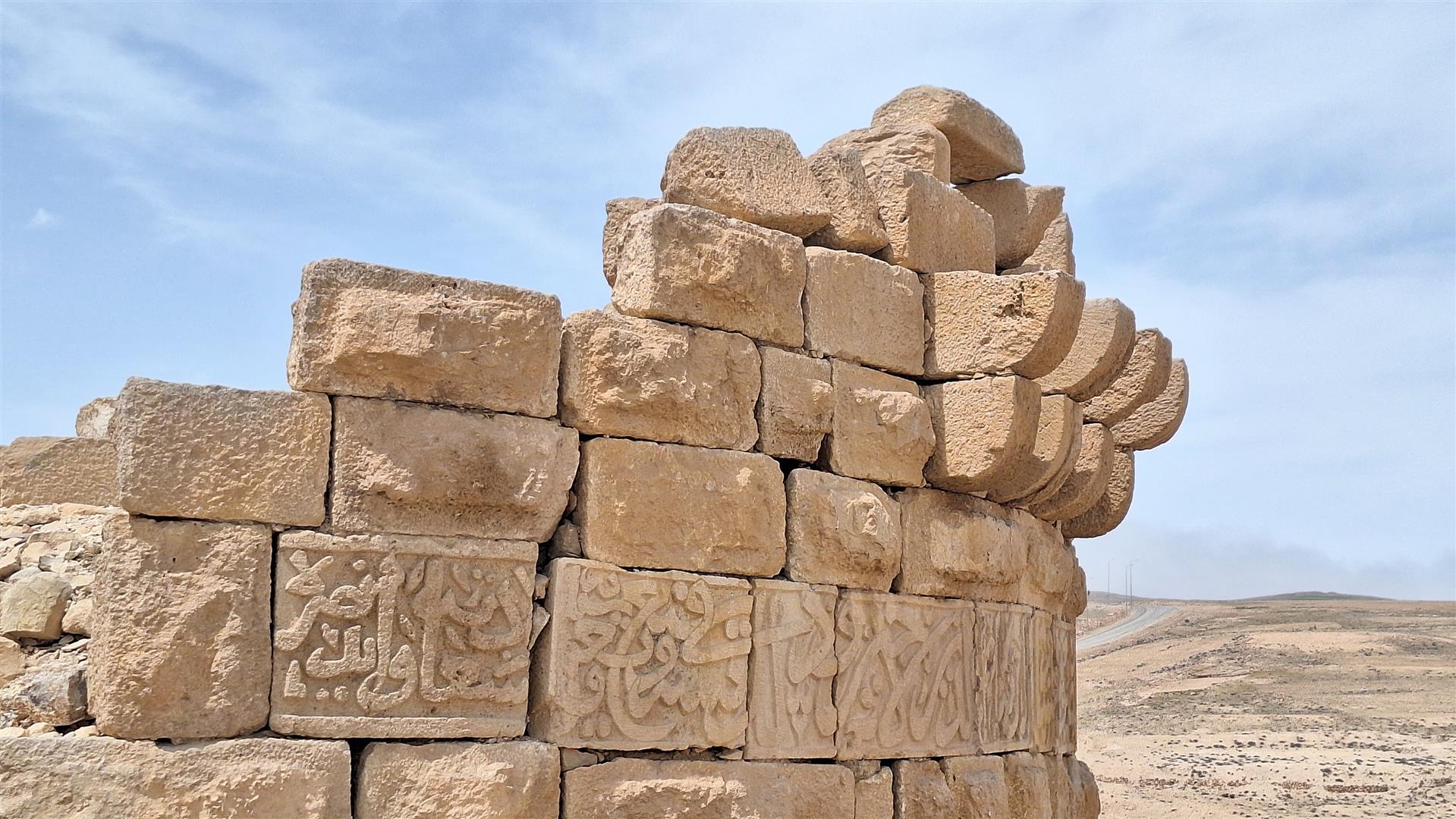
Very good detailing on some of the walls.
It was good place to walk around and there were plenty of info boards. There was refurbishment work going on, which was good to see.
From Shobak I headed south towards Petra. Details of my visit to there, and the rest of Jordan will be along soon.
 MOTOPANGAEA