
Khoy, Iran. 22nd November 2025.
I was excited. There was no doubt about it. Visiting Iran was going to be a challenge. It felt similar to when I was going to Russia. That’s mainly because it would be different to anywhere else I’d been.
Both countries have that ‘here there be dragons’ kind of aura about them, with the consequentially heightened feeling of challenge and adventure. But it was stronger for Iran, given recent events. They have a habit of locking up people that upset them. But my Irish passport had enabled me to get a visa and I had no plans to tread on any toes. So, with a deep breath, I went to the border.
Getting out of Turkey was straight forward enough, although my passport and bike registration was checked twice, for reasons that escape me. All traffic had to stop at the gate into the Iranian section to be searched by the army. A young lad took my details and shared some sunflower seeds with me while I waited. I shared my fruit and nuts with him and the other soldiers. That may, or may not, have been the reason why they only checked my big bag and nothing else.
Once I was through the gate the young fixer met me and took charge. He led me here and there to sort out the Carnet de Passage first. I was a bit concerned because it looked like the customs guy was going to fill out the wrong page. But what he was doing was writing my details on the back of the top tear off section, for when I left.
We went to immigration and that took a while, with the immigration guy seeming to be concerned about what was on my visa. Later, Erfan said it was a slow system and/or the guy wasn’t too sure what to do. Either way, I eventually got back my passport and the visa letter, with an entry stamp on it.
Then we went to another office where the customs guy did the CdP properly. Phew! Job done.
The lad asked me for money for ‘copying’, a favourite trick of border helpers. Fortunately Erfan had said that he would pay him and not to give the lad, or anyone else, any money. So I told him no and eventually he gave up. I left.
The ride into into Khoy was interesting. 50kms of single carriageway road, with some rough sections through roadworks. It went near a river and I saw lots of people enjoying leisure time next to it. There didn’t actually seem to be anything to do there. Mostly just picnicking or having fun with their kids. Drivers were either very slow or charging past other cars on bends.
The city was OK to drive in. Roundabouts were a very lawless. No give way lines and no rules, as far as I could tell. Erfan had booked me in at the Tourist Hotel. I settled into the room and contacted him to meet me. He gave me an hour to refresh.

Erfan and Yours Truly.
He’s a very nice young man, in his mid twenties. Very smart too. He got an Uber and we went out for something to eat. Lamb kofte and chicken shish. Plus flat bread and some tasty rice. Not much different to Turkey in that regard.
We talked about all sorts of things. He’s studying chemistry and wanted to go to Italy. The university accepted him and gave him a scholarship but he was refused an exit visa. What a shame. Instead he’s developing the ‘helping travellers’ business. His problem is that when he leaves his university in Iran he’ll have to go into the army for 18 months. If he can find €8,000 he can buy his way out of it. Going to Italy would have prevented that.
We weren’t able to get a SIM card or change money because it was Friday and all those places were closed. Jobs for the next day then. Erfan gave me a spare SIM so at least I could get on the internet. The hotel wi-fi wasn’t working.
He went through my phone and added in loads of places to visit onto Google Maps. Even if I extend my 45 day visa, I know I won’t have time to visit them all. Tombs and other such places may have to come off the list.
We walked about a bit although I can’t remember what we did or where. Back at the hotel we had some tea and he tried to explain how the money works. For the record, there are Rials and Tomans. One Toman is 10 rial. He also mentioned New Tomans. I’ve been told that the Govt is trying to get rid of the Rial and just use Tomans. Very sensible as none of it is worth anything.
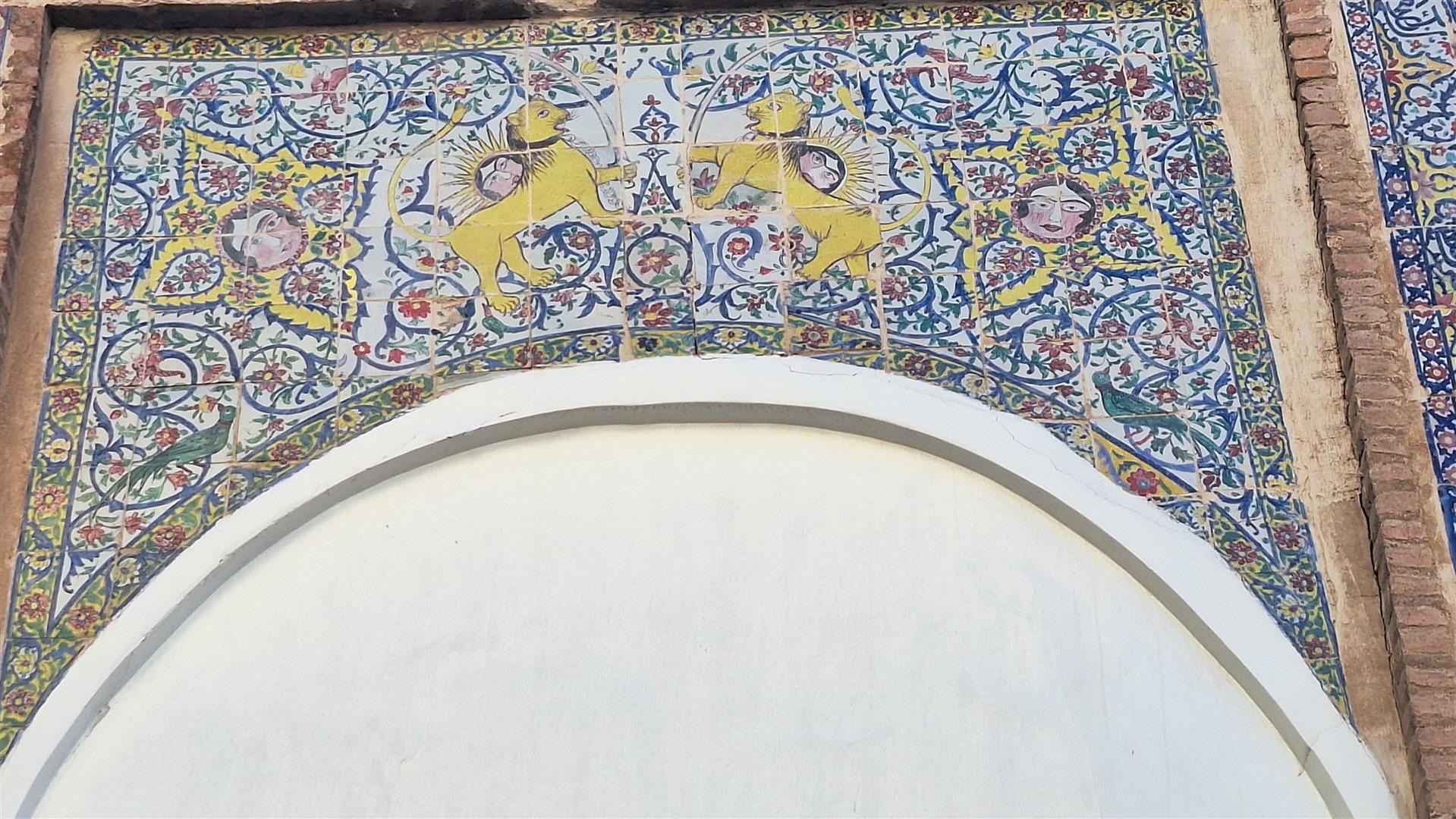
These kind of patterns are on many buildings.
First impression of Iran? Busy. Lots of young people. Struggling because of the sanctions, but somehow hanging it together. Driving was chaotic but I’m used to India. I just needed to get the right head on. They do like close quarter driving and sometimes like to ‘push on’, and will happily squeeze past me if I leave enough room. They must all think they’re on motorbikes! The first day in Iran had been good, but I knew there were more challenges to come.
Erfan came round for me in the morning and we went off to complete the essential tasks. First of those was getting a SIM card. Erfan had to do the business but it was against my passport. I could only get one for 30 days so would need to do it again later. And here I made a huge mistake.
After thirty days the Iranian system blocks the IMIE number on a foreign phone. But if your phone has two SIM slots then each one has a different number. So you should be good for sixty days. But not this idiot. Erfan had loaned me a card, which I’d put into slot two. Because I normally use slot 1, that’s where I put the new SIM. Too late I realised my mistake. And soon after doing this I got messages from the phone system telling me that both IMIE numbers would expire after thirty days. Knackered!
Erfan said he could get me a little wi-fi router which, being made in Iran, wouldn’t expire after 30 days. I could then link my phone to it. He’d need to order it and would send it on to me. I paid for a VPN, essential for getting onto sites such as Facebook etc.
The other thing he was going to do for me was to obtain a bank debit card. Almost everywhere in Iran accepts cards. But not foreign ones because sanctions mean their banks aren’t connected to the international payment system (SWIFT). Erfan said that I should be able to use my foreign currency to load the card at a money changer. Unfortunately that wasn’t the case and the only way to do it was to transfer money from my UK account to a Belgian bank account and, by some nefarious means, the money was put on the debit card. It cost about 4%, but that’s no worse than the average foreign ATM fee. The card was also going to be sent on to me.
We called in at a carpet bazaar for some tea while we waited for the power to come back on. Iran suffers rolling power cuts. Where we sat was an old caravanserai, in the middle of the bazaar.
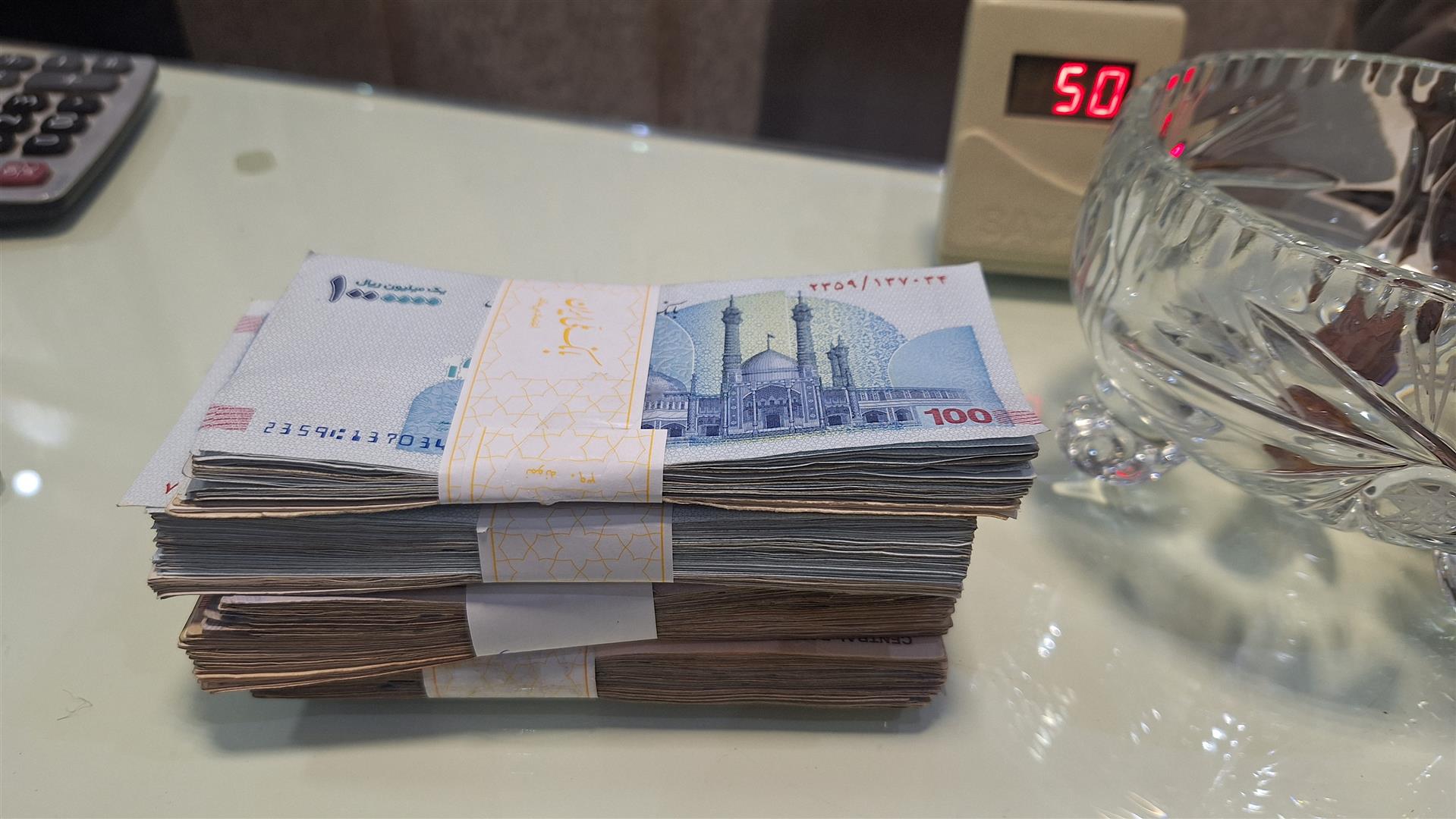
About 300GBP. You need big and deep pockets to carry Iranian cash.
Then we went to a money changer where, after a bit of faffing about, I changed the Turkish Lira I’d drawn out in Ezerum – £300’s worth – into Iranian Rial. It took several seconds for the money counting macine to deal with the Turkish Lira. It seemed to take minutes for it to count the Iranian notes, rattling away like a road worker’s drill. Big bundles of them, which half filled my backpack.
A bit more about the Rial. By the time I left, the exchange rate was 1,000,000 to the GBP, although it was closer to 900,000 when I arrived. The official rate was one tenth of that. But then I learned a bit more about the New Toman, equivalent to 100,000 Rial, in which prices were often quoted. Somebody would say to me, “Oh that’ll be 20” when I bought something. “Twenty what?” was my immediate thought. They meant twenty New Toman, or 2,000,000 Rial. Exceedingly confusing at first but I soon got used to it.
There was a handy little App that was used by everyone to track the unofficial exchange rate, which would change by quite large amount across the day. But the Iranian authorities blocked it, somehow believing that it was responsible for dragging down the value of the Rial. A real nuisance because even the money changers used it. The other place to get money changed were large jewellers.
With all the essentials now in place Erfan took me for lunch. He said it’s common in Iran to eat the main meal at lunchtime. We were brought a small clay pot with some lamb and vegetables in it. The server poured the stock into a soup bowl, which we ate with flat bread. Then I used the supplied pounding stick to squash everything up into a meaty mash. That was also eaten with the bread. It’s a traditional dish and was very tasty.
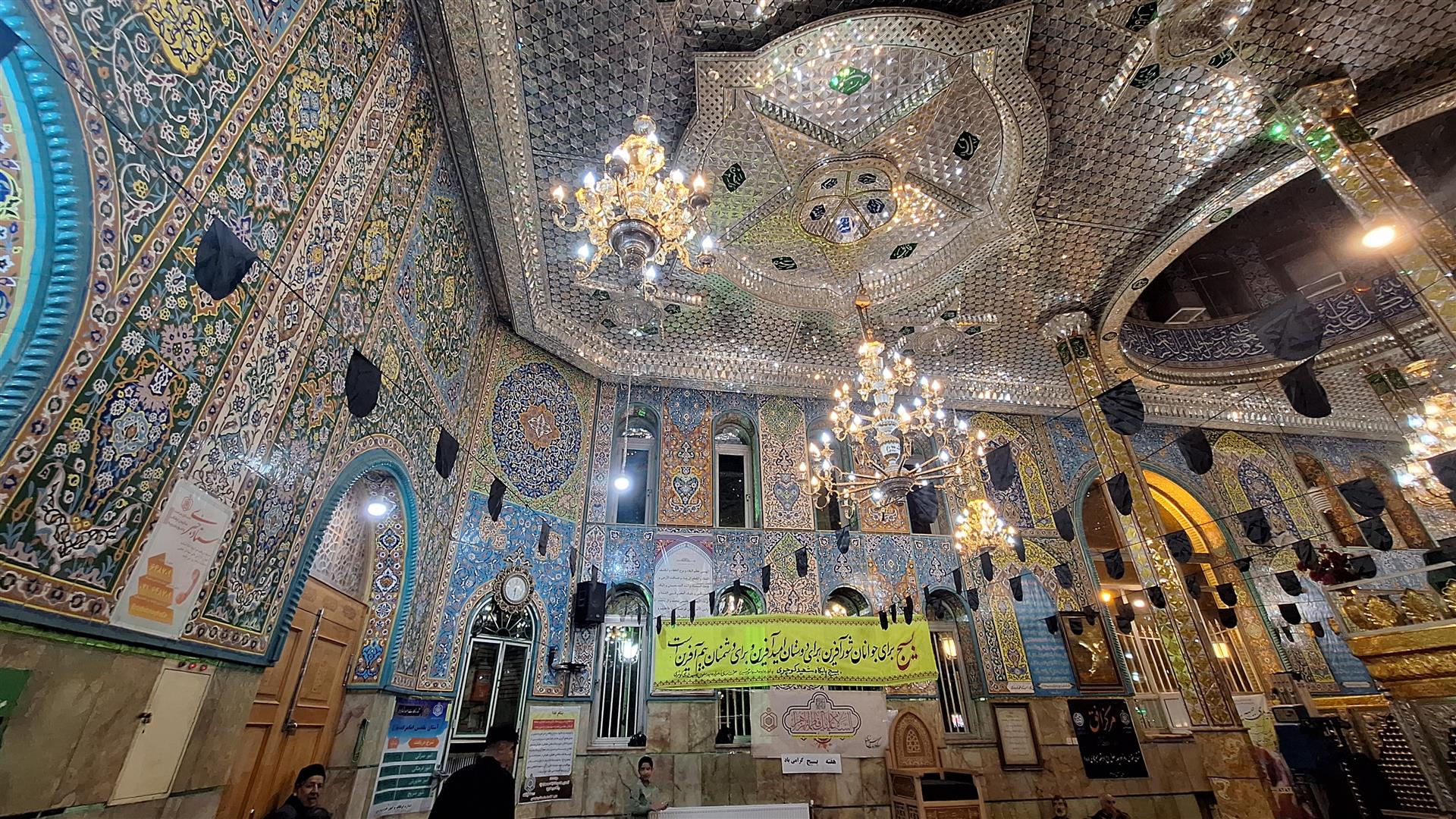
Glassly decorated.
I went back to the hotel for a rest. Later on Erfan collected me and we went to a beautiful mosque, the Imam Zade Seyed Bahlou. The walls were covered in pieces of broken glass, laid out in patterns and pictures. We went to the small one first, then the larger one.
After that we went to look at a different kind of ‘religious’ building: a large shopping mall. It was very nicely decorated and the shops looked to be very expensive. And in here I saw Iran in a different light.
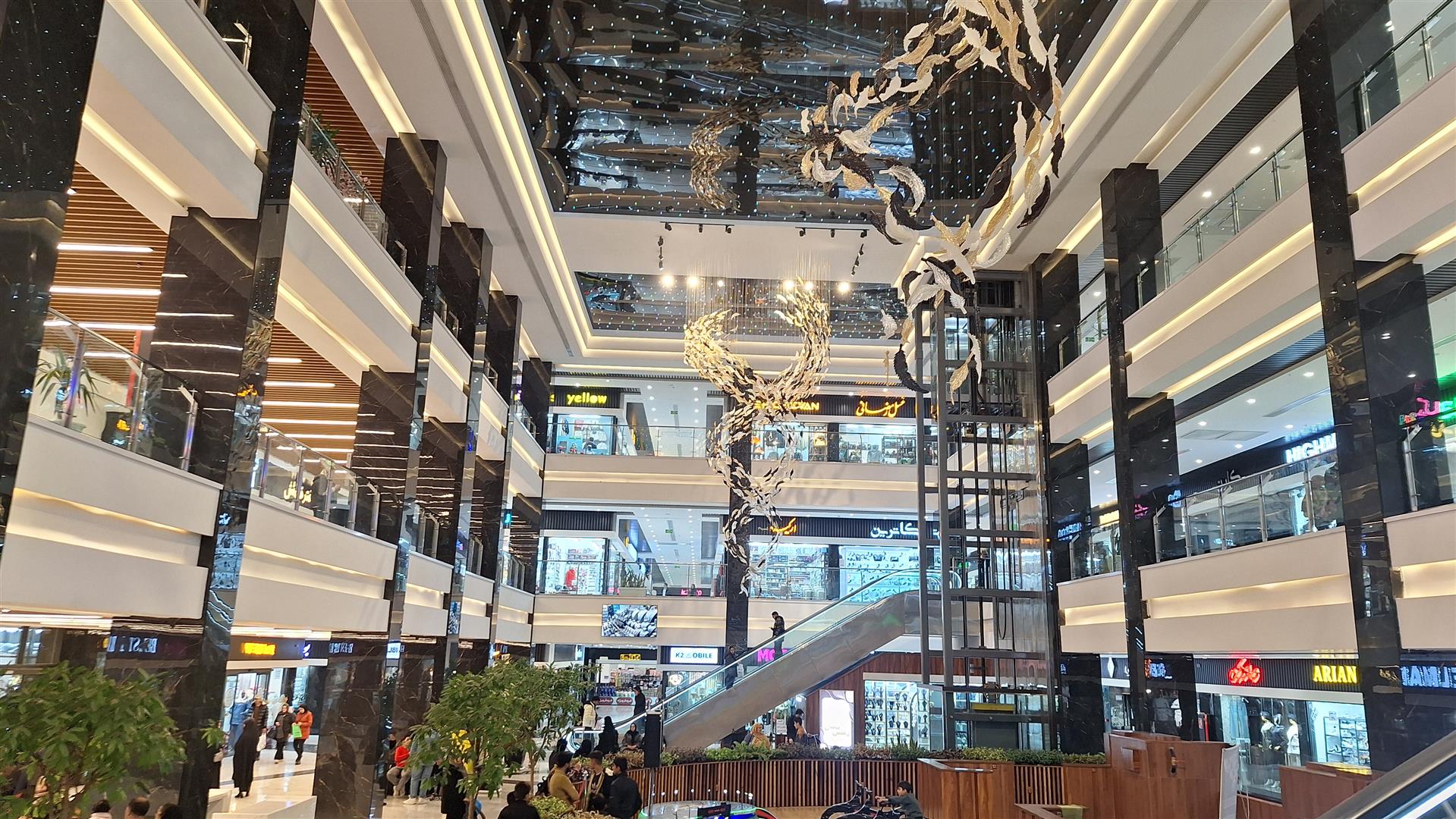
Pretty; expensive.
Some women were wearing Islamic clothing, but they were in the minority. Most of the young women were dressed no different to their Western sisters. Most had some kind of head covering, such as a shawl thrown loosely around their shoulders and the back part of their head. Others wore a fashionable looking hat of some kind, such as a woollen cap. But many had no head covering at all. I wondered how they managed to avoid the religious police of fearful fame. But I was pleased to see it.
We then went to another mosque where evening prayers were underway. To my surprise I was allowed to go in with Erfan. He doesn’t pray so we sat down on chairs near the back and were given chai by a young lad. I had a walk around and was free to take photos. I was surprised. There were men sitting around on the floor, listening to what the Imam was saying. It all looked very relaxed. People came and went, and nobody gave me a second glance. I’ve visited many mosques but have never experienced such a relaxed and hospitable approach towards non believers.

People come in when they choose. Pray and listen to the Imam. We drunk tea.
We walked back to the hotel where I paid the bill, with help from Erfan. This Rial/Toman thing is very confusing. We had a cup of chai then I settled up with him for all the work he’d done and the things he’d bought. If any of you reading this plan to visit Iran, you’d be very wise to contact Erfan via his Facebook page. The help he can give you will make entry into Iran so much easier.
I’d really enjoyed his company and he said he’d been very pleased to spend time with a native English speaker and learn some English idioms. He normally only meets English speaking Europeans. And Aussies. Interpret that how you will!
My first full day in Iran had been very busy and productive. What would tomorrow bring?
‘Tomorrow’ brought a journey south from Khoy, to an area called Urmia. The main feature here was a very large, but mostly dried up, lake, as well as a town. Erfan had booked me into a home stay that he knew of, which wasn’t far away. This meant I had some time to look around.
Erfan had told me about some massive rocks, sitting by the lake shore. They were quite a thing to see. Just two huge, cylindrical lumps of rock sitting on the edge of the lake. There were some open sided shelters there too, either for picnickers or lakeside businesses. But nobody was there on that wintry day.

Massive and very rocky.
For the first time in Iran I needed fuel. I found a place easily enough and put in just under 14 litres to the tank and my spare can. Total cost was 41940 IR. Equivalent to 48 pence. Less than 4p per litre. I’d heard about how cheap fuel was here but experiencing it was still a huge pleasure. I concluded that my wallet was going to enjoy Iran.
I saw a place next door that looked like a café and asked the pump jockey if it was. He said no, but invited me in to the office to share some tea with them. One of those small cups with a teabag in it led to a very strong cup of black tea. One of the guys had two teabags in his. How the hell did he manage to drink it so strong? But it was very kind of them.
I rode on to the town of Urmia. The road had been the usual up and down, with bare hills. Almost no vegetation apart from very short grass. I was surprised to find no animals out there. I expected goats or sheep. All the farms had hay beneath covers and I did see some cattle.
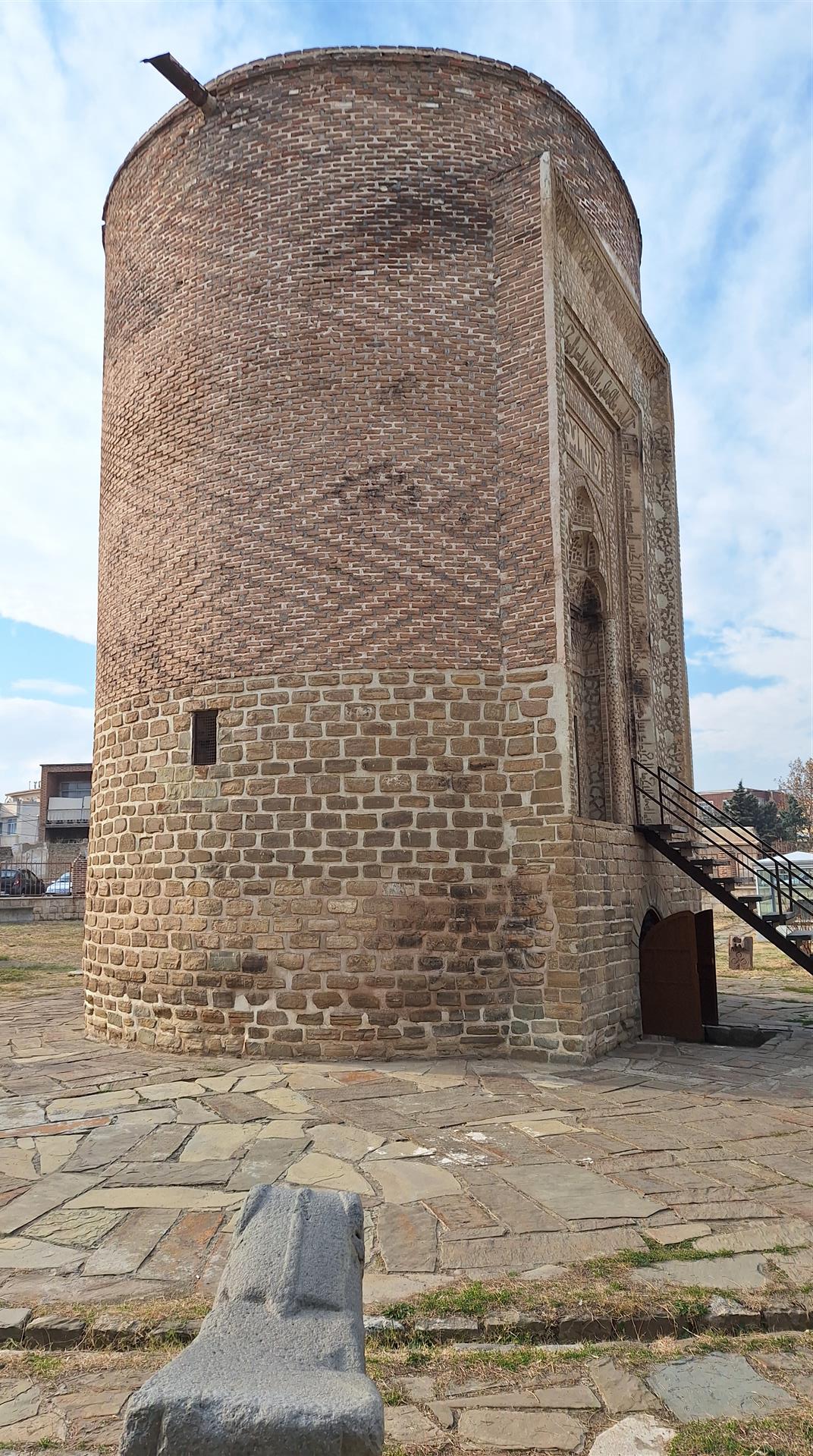
Se Gonbad Tomb Tower.
In the town I went to see Se Gonbad Tomb Tower. An ancient tower containing somebody’s tomb. Around it was a collection of steles found in the local area. Stone slabs with ancient writing on them, in case you wondered. Also some rocks sporting petroglyphs. An interesting place.

Petroglyphs. found in the local area.
Hostel Yagmur, the homestay, was in a small village out in the countryside. Google took me to the local cemetery. After some looking around and asking people, I found it. A local guy rang the owner who explained how to get through the gate. He pointed out the room I’d be staying in, but I had other plans.
There were a few jobs that needed doing on the bike so I started on those while I waited. I moved the brake lever assembly along the bars a little bit so the lever lined up better with my hand. I wanted to bring it in a bit closer to my fingers but there wasn’t a way of doing that.
Next job was to change the front sprocket. I was partway through doing this when the family arrived. The older son, Amin, helped me finish that off, with him taking charge. “I’m a mechanic”, he said. “Me too”, I said. But I let him get on with it.
We got that done and then he watched while I adjusted the chain. It was very slack and took up quite a bit on the adjusters. Did that indicate the end of it? I hoped not. I checked the tyre pressures. The front hadn’t gone down at all. The rear had dropped by a few PSI. But the best part was that I got a proper reading off the rear tyre on the pressure gauge, unlike when they’d first been fitted. Excellent!
I changed into ordinary clothes and went to join the family. Ali, his wife (whose name I didn’t get), Amin (20) and two younger boys (8 and 6). I have a suspicion that Amin is from a former wife, given the age gap of 12 years between the sons. But I had no way of finding out.
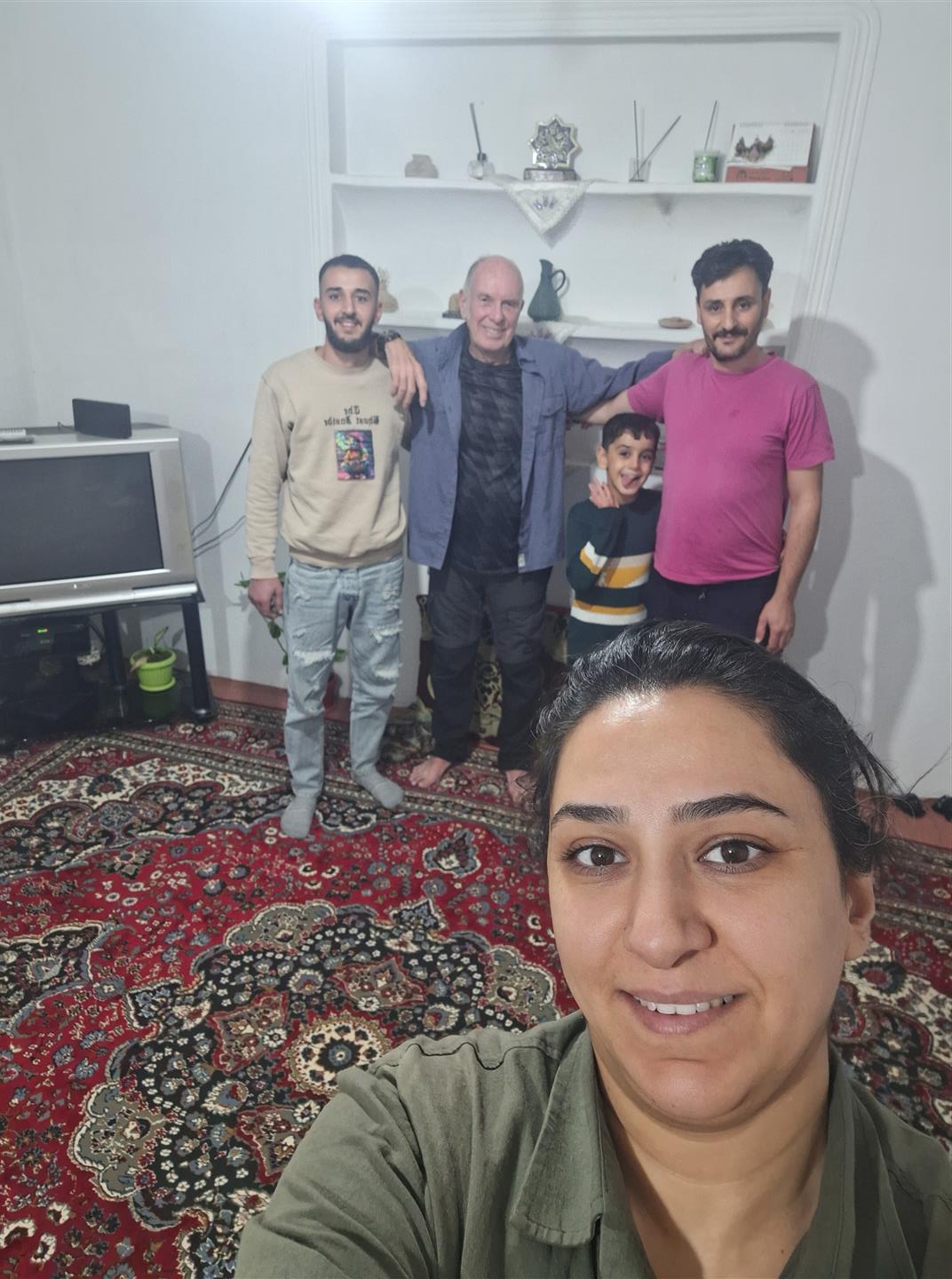
Ali (pink T-shirt) and family.
Mrs Ali was happy to remove her head scarf in my presence. They gave me tea and cracked a load of nuts to go with it. We chatted about various things, using Google Translate when needed.
Ali is a civil servant working for the tourism department. He said the guest house they live in was given to them by the government for them to accommodate tourists and encourage tourism in the area. It was clearly aimed at Iranians as the facilities were quite basic – squat toilet etc – and sleeping was done on bedding on the floor. The toilet was next to the house but was across the yard from were I was sleeping. My room was big enough to have slept 8-10 people on the floor.
Amin said he works on most European make of car, which somehow get imported despite the sanctions. The roads are full of old cars, especially Peugot 405s, favoured by taxi drivers. He’s also in the army, proudly doing the 18 months service that Erfan was so busy trying to avoid.
The family was Turkish, as were most people in that part of Iran. Their kids have to learn Farsi as a second language and will learn English from year 7. Their school day runs from 08.00 to 13.00.
About 8pm we had the evening meal. Ali took me over to the tandoor room to show me the tandoor oven. It’s a round hole in the ground, lined with clay, with a gas burner at the bottom. A round, metal cooking tray sits on top of a tripod, about half a metre in height. The food is cooked from all directions.

Traditional and delicious.
The meal was delicious, with chicken pieces and potatoes roasted in the tray. Then served with some delicious rice. I drunk some fermented (?) milk and then coke. An all round tasty meal, cooked and served in the traditional way. That included sitting on the floor, my least favourite thing.
I paid Ali for the accommodation and he went to great lengths to explain the money to me. I added that knowledge to what Erfan had told me but still felt very confused. It’s fortunate that in a country like Iran you can rely on a vendor taking the right amount of money from you.
Erfan had rung Ali to tell him I’d left my passport in the hotel in Khoy. Hotels are obliged keep your passport until you leave and I’d forgotten to collect it. They were busy working out how best to get it to me and suggesting I stay another day so it could be sent to me. I quite firmly told them that I’d happily go back to Khoy to collect it. After I’d pointed out that Urmia to Khoy, then Khoy to Tabriz, my next destination, was only 4 hours travelling, Ali agreed it was the best way. I made sure that one of them told the hotel I’d be coming to collect it.
Satisfied with all this I went to bed. Ali came up to show me how to unroll and lay out the bedding and then left me to it. An interesting and educational day. And I think I managed to meet my obligations as a guest quite well.
I was given a very good breakfast, served by Mrs Ali. This time she kept her head scarf on. I’m guessing it was because Ali and the kids had already left. Then I headed out to look at the bridge across the lake. It was only a short diversion off my route back to Khoy.
It was in the middle of the causeway that used to cross the lake but now crosses a vast salt pan. There is almost no water left in it. I’d heard there was a ships’ graveyard out there but that wasn’t the case. Almost out by the bridge I saw what I thought was a ferry waiting to load up. But it turned out to just be a mooring point.
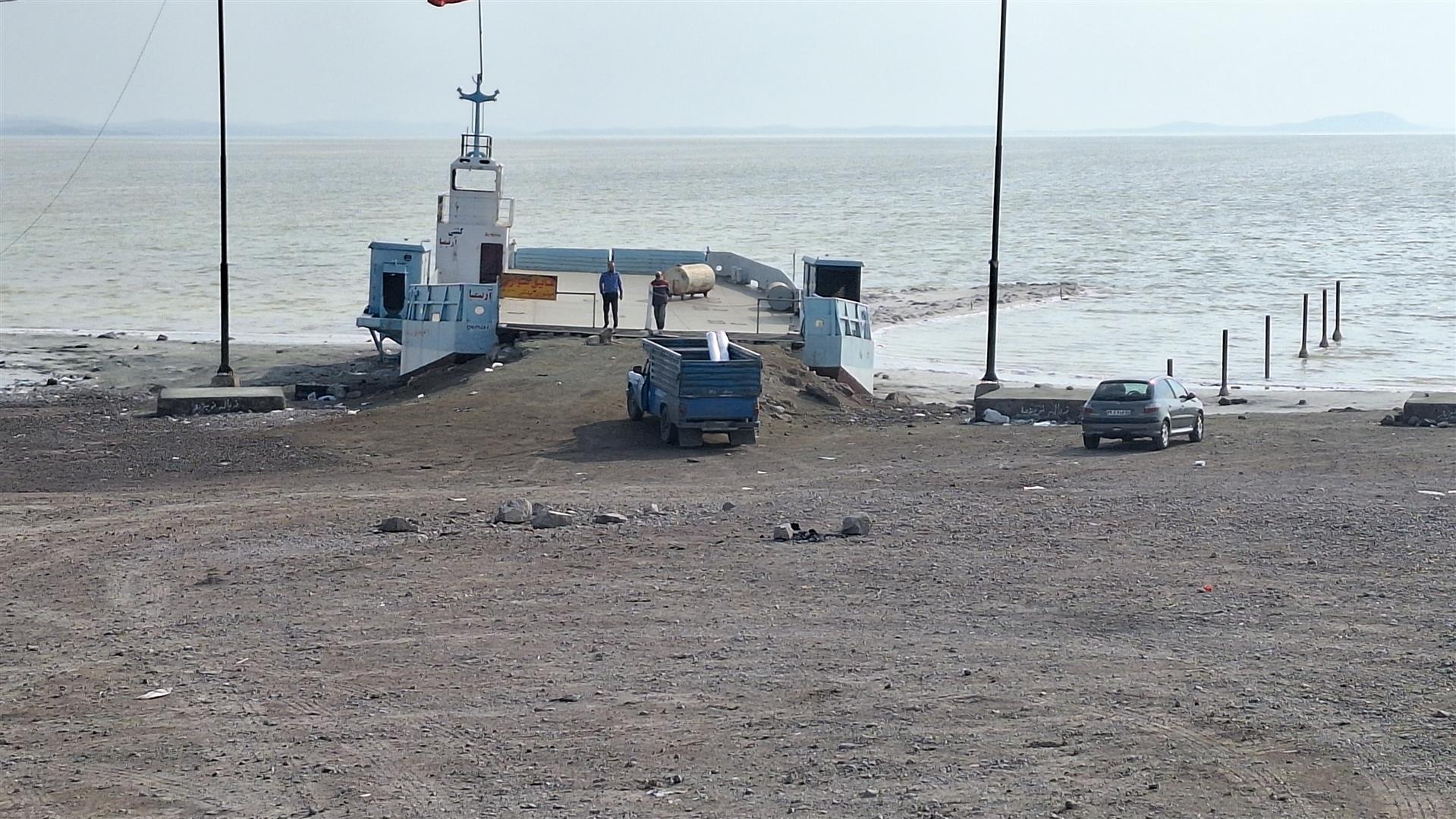
This mooring dock looks like it used to be a ferry.
I rode across the bridge then made a U turn and headed to Khoy. The hotel gave me some tea to drink with my lunch then the women at reception asked to take a photo of me. We went out to the bike for that, then I filled in the visitors’ book. With that it was onwards to Tabriz.
Quite a lot of industry along this road. Erfan had said that sanctions meant they had to make everything for themselves, including armaments. The other thing I’d seen plenty of since arriving in Iran was what I took to be detention centres. That assumption was based on their remote location, high walls, with barbed wire atop, and the watch towers at each corner.
As I approached Tabriz the traffic got much heavier and I ‘enjoyed’ the Iranian driving. The chaotic way of doing things wasn’t so bad but the way drivers tended to force their way through any gap was quite worrying. This would often happen at high-ish speeds. A bit unnerving at times. I needed to get better at owning my road space to prevent cars squeezing past me.
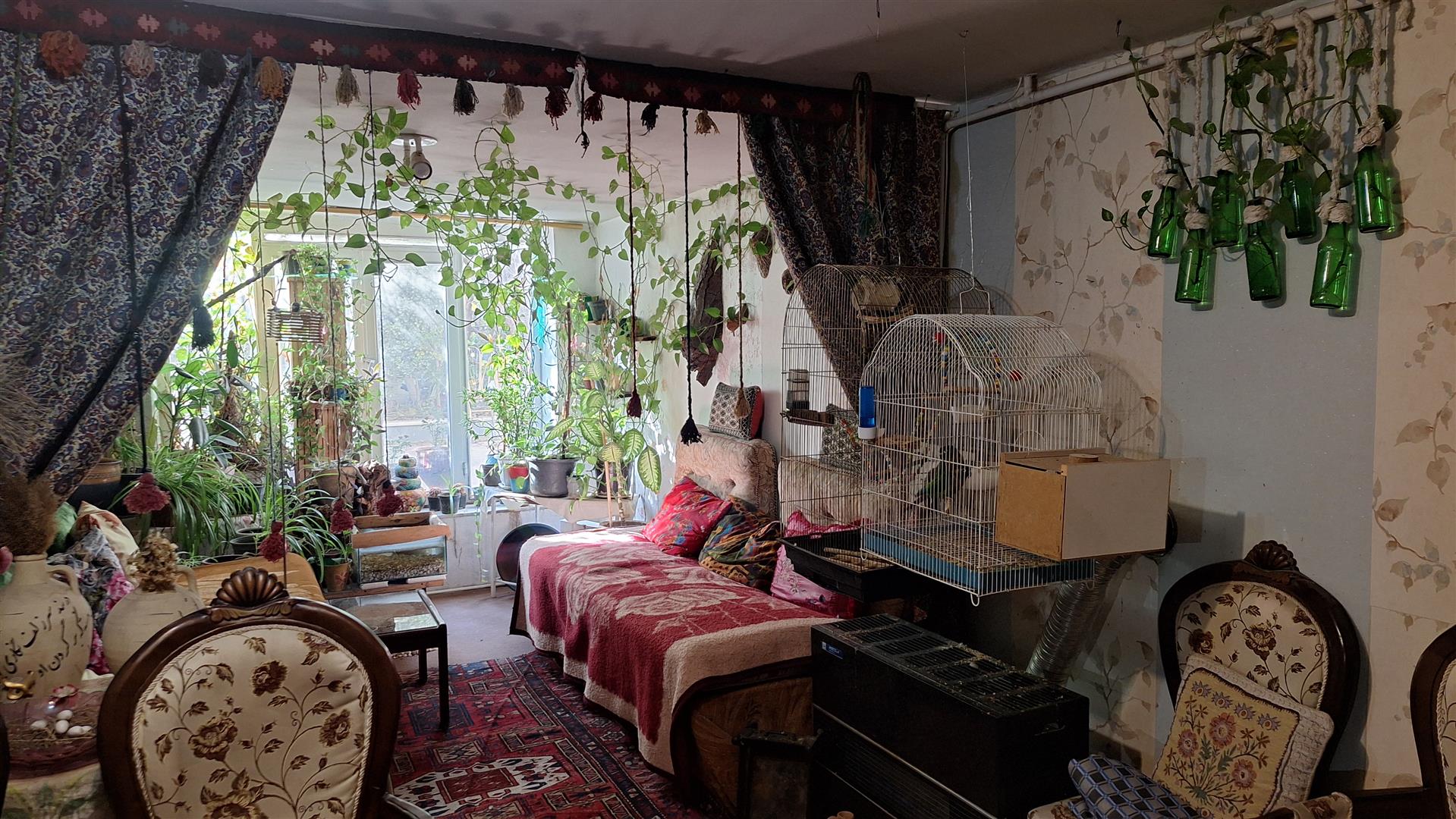
Amin’s delightful hostel.
I made my way to the hostel and found myself in a delightful place. The owner, Amin, was a very nice man and made sure I was comfortable. The bike was brought into the back garden, under a shelter. I was in a room containing four beds and I had a cupboard for my gear. The other guests were all cyclists. A Belgian, a Frenchman and a German couple. I always feel a bit inferior in the presence of cyclists. They really do travel the hard miles, and remember how cold I said the weather had been?
One of them directed me to a restaurant just around the corner where I could get chicken shish – chicken pieces BBQ’d on a skewer. It came with soup, rice and a salad bar. Delicious and all for £2.50. I was impressed.
Next day I spent the morning fighting the poor quality internet, trying to catch up on emails etc. Then I went out to visit some places I’d marked on Google. And these are them.

Jameh Mosque of Tabriz.
Jameh Mosque of Tabriz. The title ‘Jameh’ tells you it’s a Friday Mosque, only used for Friday prayers. A beautiful place, with twin minarets at the front and huge amounts of architectural history inside. But I didn’t go in because when I went through what I thought t was the entrance I found myself in the Grand Bazaar. This place is massive! There are easily several kilometres of walkways inside. Some of the halls off the side are huge. The great thing is the brickwork, which is a kind of 3D herringbone, with vaulted arches throughout. It was very busy, similar to a large shopping centre on a Christmas shopping day. But I’m annoyed with myself for not entering the mosqe too.

Inside the bazaar. They certainly knew how to lay a brick!
I had to take care to avoid being run down by the trolley men, who pushed, or were pulled by, very full and obviously heavy, barrows and carts. It seemed the lot of aged men, almost literally on their last legs, to handle the barrows. Younger guys dealt with the carts. Everything was on sale there and I was particularly taken by beautiful pictures on backgrounds of velvet cloth.

Largest brick structure ever built?
Arg-e Alishah or Ali Shah. A historic building that used to be part of a medieval fortification. It’s reckoned to be the largest brick structure ever built. It was also a mosque of an unusual design in that it didn’t have a domed central hall. Instead the main area for prayers was one of the Iwans (a rectangular space open at one end). These are very common in mosques as overspill areas but there’s usually a domed hall as well.
A coffee shop for a much needed Americano. I also had a huge piece of walnut cake. The cake and two coffees cost more than my meal the previous night!

Inside the Blue Mosque. Refurbishment work is under way.
The Blue Mosque. Dating from the 15th century, it was destroyed by an earthquake in about 1780 and left in ruins for a couple of centuries. It was part of a complex that included a mansion and a tomb. Restoration was started in the 1930s and is still ongoing. It’s easy to see how beautiful it would have been in its heyday. A painting inside showed how it looked following the earthquake.

Earthquake devastation.
On the way back to the hostel I went to the Qari Bridge. About two hundred years old, it has eight arches and very decorative stonework. There is a set of bronze sculptures next to it, showing a camel train. The type of traffic the bridge would have carried in past times.
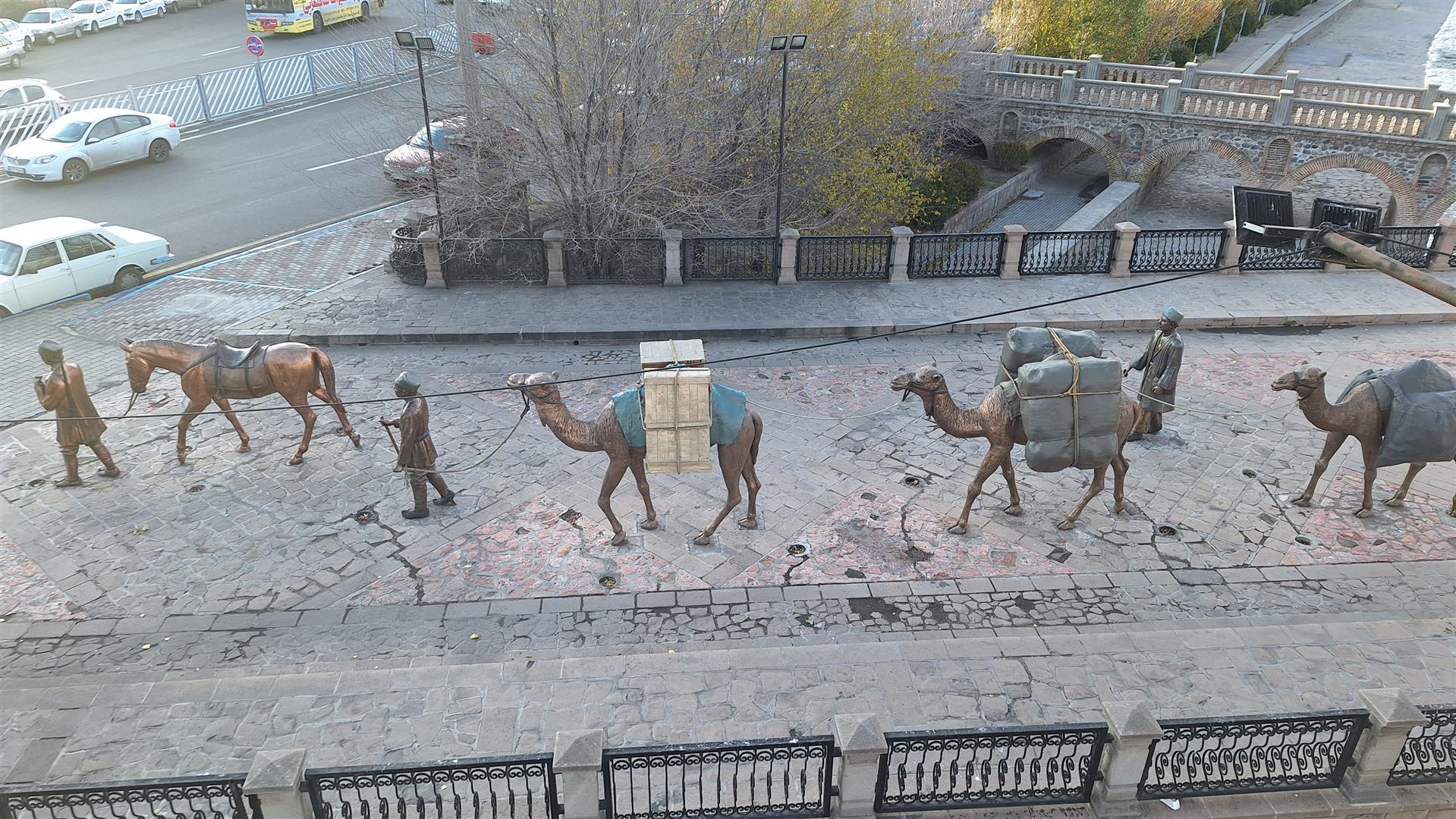
Qari Bridge and camels.
After all that I really needed the relaxed evening that followed, which included another visit to the restaurant I went to previously. The food was just as nice.
My final visit while in Tabriz was to a mountain village named Kandovan, about 50 kilometres away. Its attraction is the stone houses and caves built into, and of, the volcanic rock. It’s still inhabited by around 168 troglodyte families.
The village is up at 2,300 meters and there was around 50-75mm of snow on the ground. It had mostly turned to slush but everything was still slippery. The place I chose to park was next to a wall with water running down beside it. Flowing water means solid ground beneath it, yes? No! There was a layer of ice on top of it and, of course, I dropped the bike.

Safer parking for the bike. Rocky homes in the background.
Unable to get any footing I was assisted by a couple of local guys to pick it up and I found a more secure spot.
I walked around the village, looking at the houses. A guy invited me inside his storage cave for a look around, although I’m sure he was hoping to sell me some of his tea or herbs. The dwellings had been carved out of the volcanic rock pillars and the village had been occupied for around 7,000 years. Some people had come there to esape the Mongol invasion.
The road out was very icy at one point. I had about 100 metres of frozen slush to get over but after that it was all OK. The road back down soon cleared and I had a good ride back to Tabriz.

A home inside a hollowed out rock.
All the biker gang had gone so there was only four people left in the hostel. I’d been chatting to a Dutch guy named Max, and a Vietnamese guy named Duon, and we went back to the usual restaurant for some food. Lamb this time, instead of chicken, and equally as cheap and tasty.
Time to leave the great city of Tabriz, formerly Iran’s second largest. I got the feel of the history just from walking around and many of the buildings are old and fabulous. I was moving on to another place that Erfan had recommended, Sato House in the town of Soltaniyeh. By now I’d realised that his work helping tourists had enabled him to build a network of people and places all around the north of Iran. A very useful guy.

The kind of bikes I saw on the streets of Iran.
 MOTOPANGAEA
Look forward to reading. Wyn
I hope you enjoy it, Wyn.
LikeLike
Wonderful that you are still able to live your dream Geoff! And to educate us all on exactly how this world really is when it comes down to us ‘humans’. Good stuff. Thanks.
Thanks for the comments, Phil. Things are ALWAYS different to the pictures painted by the media.
LikeLike
Thanks for the comments, Phil. Things are ALWAYS different to the pictures painted by the media.
LikeLike
Fascinating, you are very intrepid. Going to London is a big deal for me.
Thanks Wyn. Leaving London was best foor me. 🙂
LikeLike
Thanks Wyn. Leaving London was best for me. 🙂
LikeLike