
Soltaniyeh, Iran. 28th November 2024.
Tabriz behind me and my next destination of Soltaniyeh in front. But getting there proved to be a challenge. I got out of the city and onto Route 32. After a while I came to where a motorway appeared. I stopped and cancelled the ‘no motorways’ instruction on Google maps to see if I would be directed onto it. I wasn’t so I just carried on. Had I cancelled the ‘no tolls’ instruction too it might have sent me on there, but I’ll never know.
Further on I was directed onto a side road. It was a really nice ride, over the hills on a well surfaced, if slightly narrow, road. It was taking me towards a motorway that headed me towards where I needed to go.
When I got to the junction I was forced to turn north, back towards Tabriz. But Google was saying there was a U turn 3kms up the road. The trouble was that there wasn’t! In fact there was no gap in the barrier at all. I had to ride about 45kms north, back towards Trabiz, before I came to an exit.
I didn’t stop to check whether going back down the motorway would have been quicker, I just got back onto R32 and went south. But I now had an ETA of 18.30, a ride of over 3.5 hours. Nothing to be done except get on with it.
So that’s what I did. It was a nice road to ride, with a lot of dual carriageway and some short tunnels. But it was very cold and I was glad that I’d put on my extra clothing.
I stopped for a snack at about 16.30. I bought a couple of chocolate bars and the kindly owner let me off paying for the two cups of chai I had. Then it was back on the road and keep going.
Riding in the dark is never a good thing but it had to be done. The only real issue was that my visor was getting lightly scratched and oncoming headlights were a bit tricky. But no dramas. I finally arrived at Sato House and the warm welcome of Setia and Behzad, the owners.
The chai they gave me was very welcome, as was the hot shower in the very lovely room. It’s a really nice place, except that there’s no wi-fi in the bedroom and the phone signal is very weak.
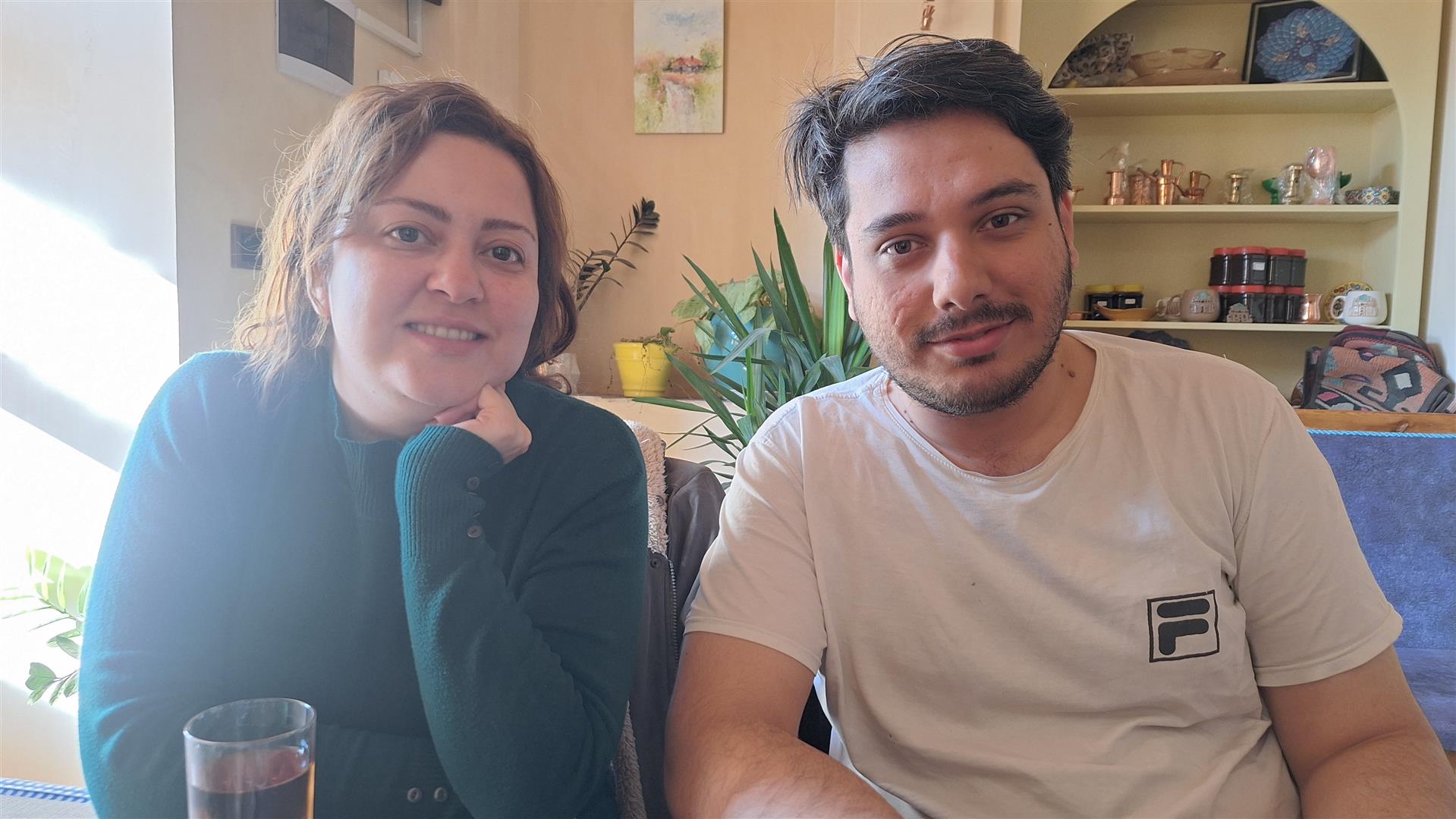
Manizeh and Farzad.
I joined them for dinner, along with Farzad and Manizeh, two young architects who are also boy and girlfriend. They’re working on the refurbishment of the dome that’s here in the town. More on that later.
Dinner was good. Lamb patties with rice and veg. There were some drinks, one of which was that awful, no alcohol beer called Barbican. My hosts spoke good English, as did Farzad, so we were able to chat about each other, about Iran and this guest house.
They bought it about four years ago. It’s 135 years old and used to belong to a local big wig. They’ve totally refurbished it to make a really good place to stay. Very smart, very well furnished and, above all, very warm.
Behzad had promised to take me out to see Dashkasan Temple, an old Buddhist temple dating from the 14th century. Iran was occupied by the Mongols, who were Buddhists and this temple was one of theirs. They’d chosen Soltaniyeh as their capital because of the vast plain of meadow grass that sat between the hills. It was ideal for their herds and it did definitely remind me of Mongolia. But I’ve always struggled to connect a peaceful philosophy such as Buddhism with the rampaging hordes of Mongolia. A definte disconnect there.
The temple was pretty much a ruin. When the later rulers had converted to Islam they’d destroyed it. There were lots of stones with carvings on them, displayed in cases. But the big draw was the back and side walls of the temple, which had been carved into the hillside. That meant they’d survived.
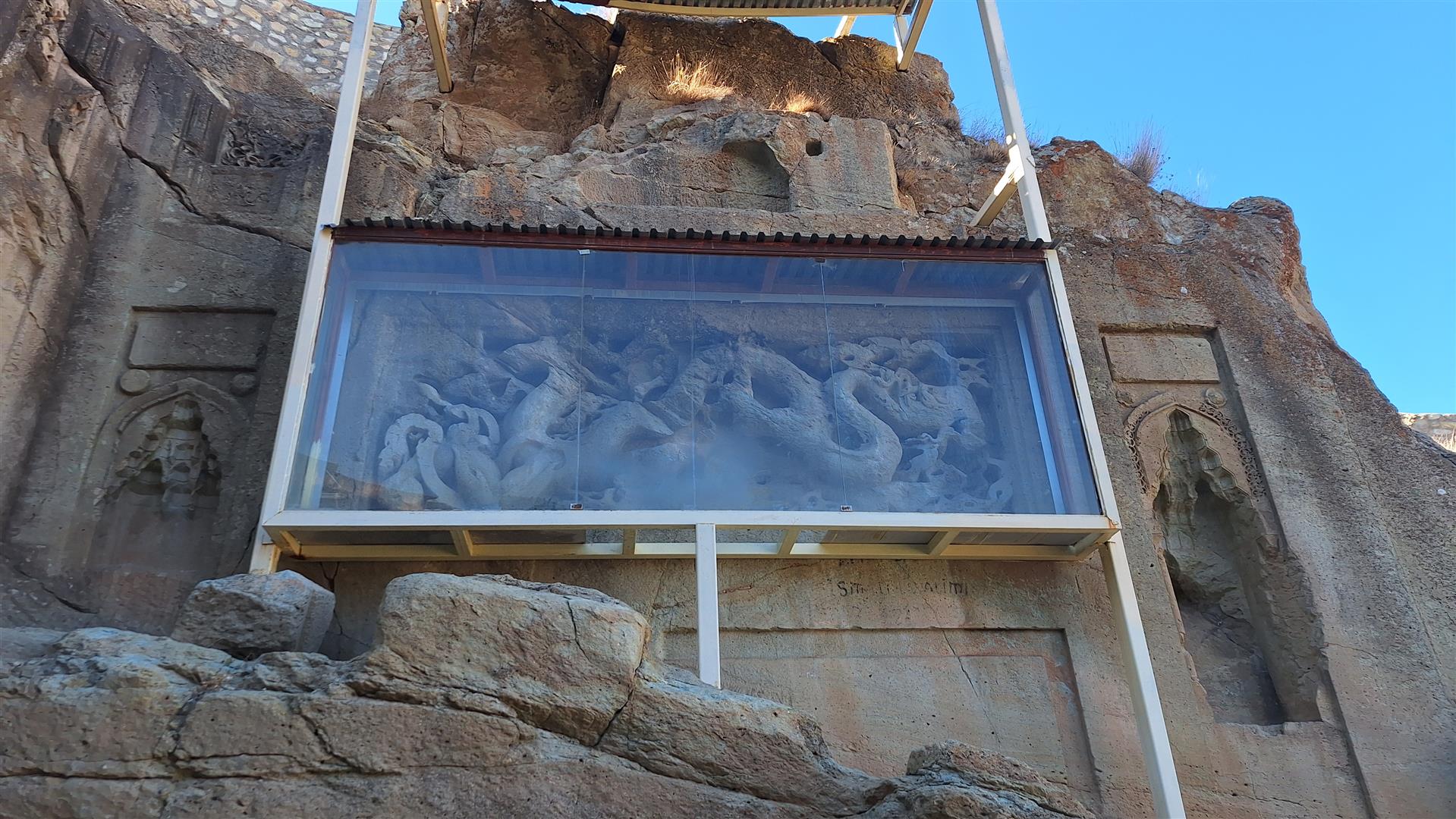
Enter the Dragon.
The back wall had geometric carvings in it but each side wall had a dragon carved into a rectangular recess. One in particular was still very well defined and was protected by a case. It was a complex design, visable despite its age and deterioration.
We went back into town to visit the Soltaniyeh Dome. It is, Behzad informed me, the third biggest in the world. That actually relates to the highest. It sits behind one in Florence, and the Hagia Sophia in Istanbul.
It was built by the local Ilkhanid ruler, Al-Jaito, after he converted to Islam. He was supposed to have been buried in the crypt but no trace of his body has ever been found. It’s thought he may have been buried in the surrounding hills.

Soltaniyah’s Dome.
The interior is mostly occupied by scaffolding, which has been in place since the early 70s. This refurbishment is a long job and it’s nowhere near finished. It’s also the reason why the young architects are in town. I paused to wonder whether they’d be married with kids by the time it was finished.
The building used to be part of a citadel, the perimeter walls of which still exist. But none of the other buildings were still there. However, it was easy to see the site and where the main buildings used to be.
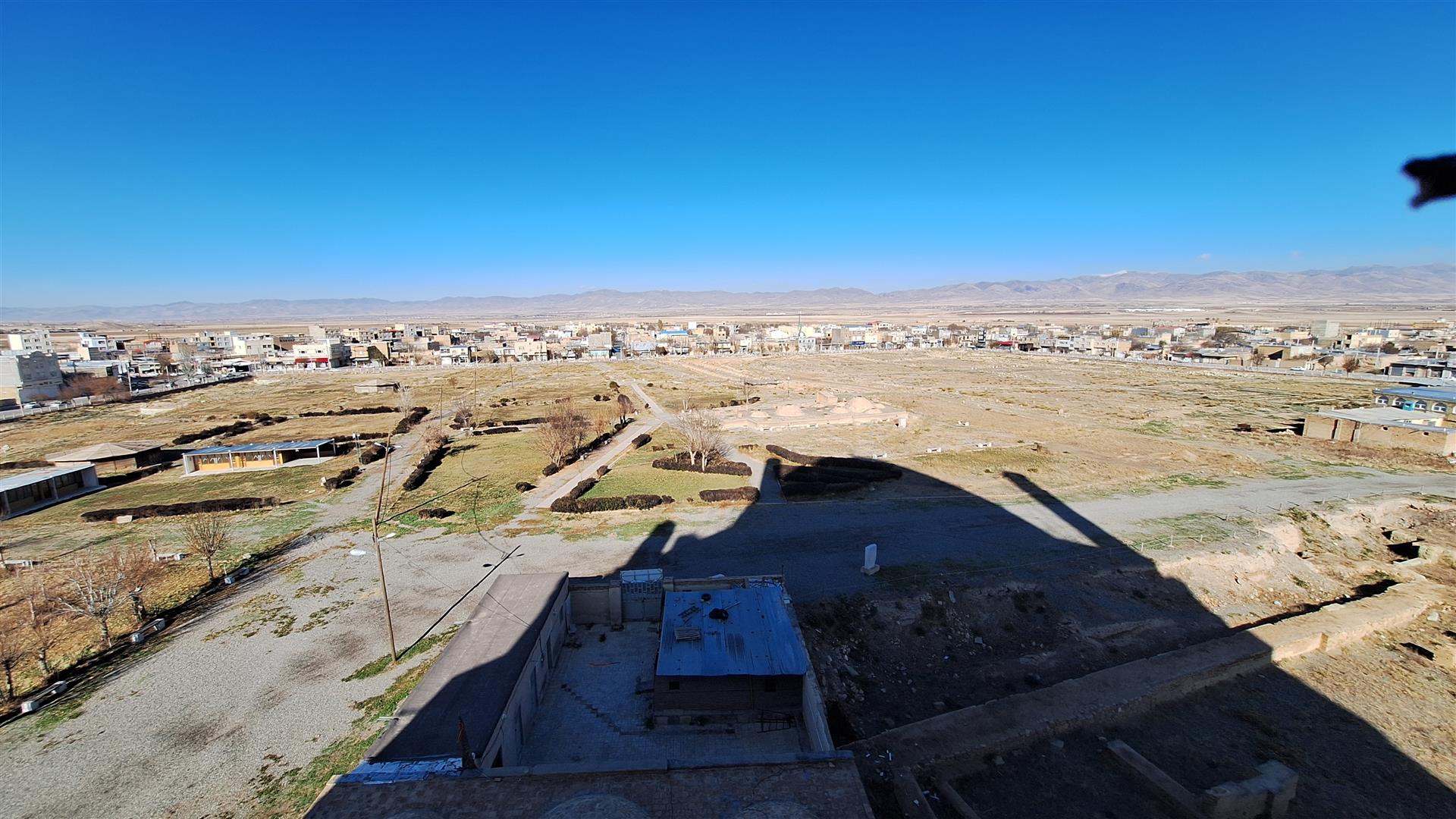
The Perimeter of the citadel. Big!
The Dome is octagonal, as many Islamic buildings are, representing the 8 gates into heaven. Inside each of the corner columns is a spiral staircase going up, eventually, to the open balcony area, just below the roof. We went up to the first level, where there’s some information about the building. The next level is where the lady screens are. Behzad was showing me where the original mosaics had been plastered over to accept painted decorations. He seemed a bit miffed by it and blamed one of the sultan’s wives. I tended to agree with him about plastering over mosaics.
There was a separate room with some info displays but the room itself was also an important place to see, with its own mosaics and some fabulous brickwork.
The construction of the dome itself is fairly unique in that it is double skinned, which isn’t so unusual, but the two layers are interconnected. This is what has given it the strength to withstand the vagaries of time. It is made of bricks. It probably also makes it much harder to repair.
There was a crypt but it doesn’t have much in it. Its only interest was the design and the brickwork. All in all, a fabulous place to visit.

Ceiling art.
Another place I wanted to visit was Ganjan, home of the Saltmen, so I rode the forty or so kilometres to visit them. Their ‘home’ was a museum, which was very good. For once I was actually interested in the stone tools and pots on display, although I still wasn’t interested in the coins. But the skeletons were great.
They were found in the salt mines, although unfortunately they were dug up by bulldozers. That meant that the area around them was destroyed so couldn’t be examined for any ancillary artifacts or useful information. One of them still had hair on its skull and another still had its hat and beard. The salt had preserved them. There’s six altogether.

Saltman, with boot and hat.
The other place I went to was Rakhshooi Khaneh, which is a wash house. It was built in the 1920s by a benefactor so women could go there to wash clothes, carpets and kids without having to suffer the ravages of the weather. A central area is surrounded by a channel with flowing water in it, which comes from a reservoir. An interesting place in which to see some Zanjan culture. It is unique, I believe.
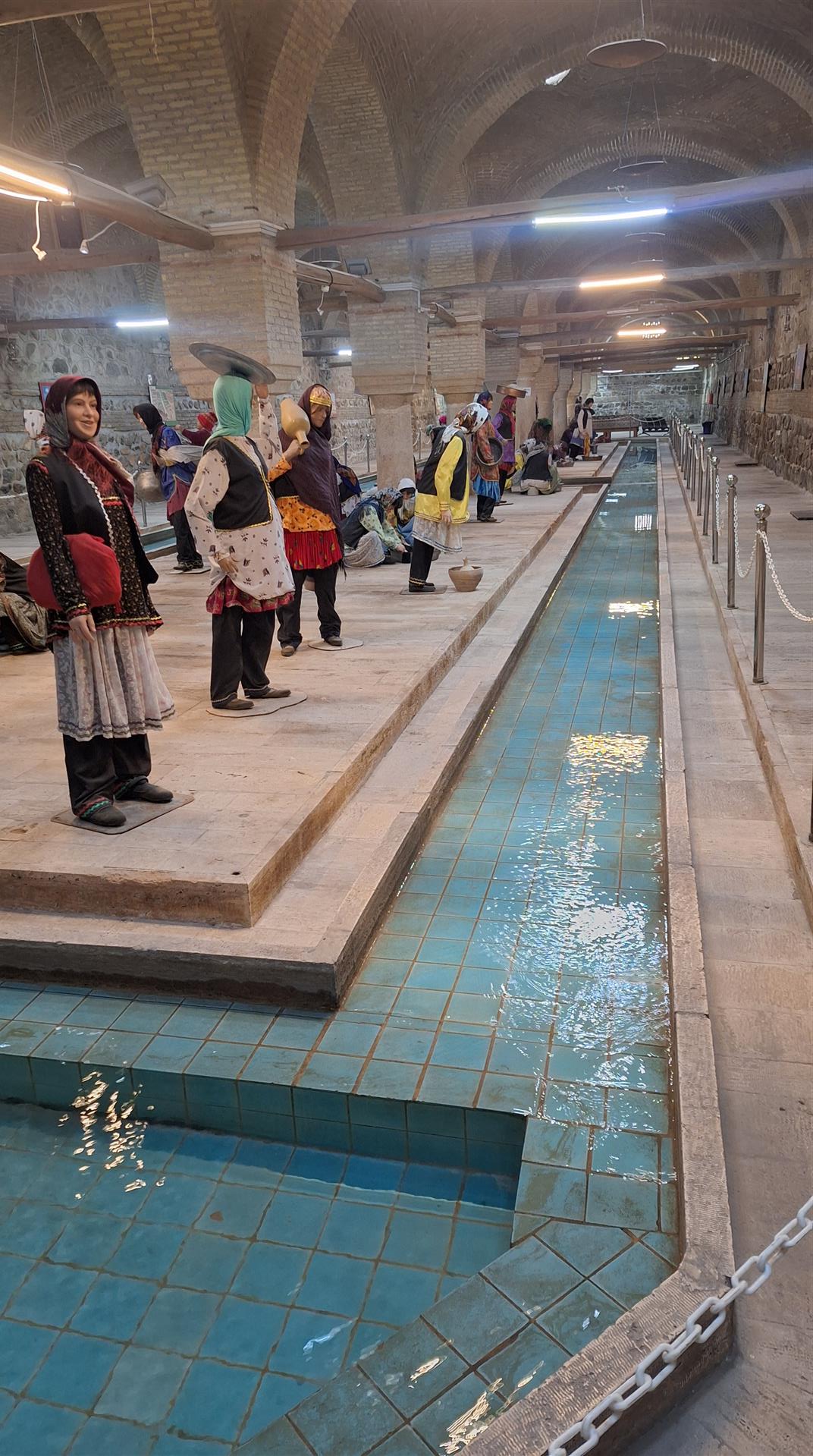
Rakhshooi Khaneh.
Next to that is a small bazaar, mostly selling hardware and home goods of a good standard.
Behzad had suggested I try a local dish called Jaghour Baghour, and he marked a place that sold it, in the grand bazaar, on the map. The dish is made from slices of sheeps’ liver and heart, fried up with onions and tomatoes.
I had to engage the help of a guy from one of the stalls to find it. The location Behzad had given me wasn’t quite right.
The dish was served with the ubiquitous flat bread so I got stuck in and enjoyed the meal. The meat didn’t taste as strong as I’d expected but it was good enough.
A cold ride back to base and on the way I could see, over to my left, clouds on top of the hill,s and rolling down them too. What will that mean for my ride over there tomorrow, was my worried thought.

It’s coming to get me!
Setia and Bhazad have twin boys, around 18 months old, Asoo and Avid. I spent the late part of the sunny afternoon watching them explore the garden, carefully supervised by Setia. That kind of thing is one of the pleasures of being in a guesthouse.
Over dinner there was plenty of chat. That included some politics and I tried to tread carefully. Behzad had been critical of the government earlier on when we were looking at the dry meadows. He said there’s not enough water because the farmers are allowed to extract too much. So the new spring grass doesn’t last very long. It had seemed strange to me that there weren’t sheep or goats out there.
I opined that the Islamic government must surely be better to live under than the Shah’s was. They asked me why and I talked about his oppressive regime. But Setia said the country was much better run in those days compared to how it is now. Fair comment I suppose. It shows the difference between being there and looking in. An example of, ‘well at least the trains used to run on time’. But it’s clear they’d like this regime to be gone. The sanctions have a very bad effect on people’s lives and inflation is high and keeps rising.
In the morning it was time to move on. Once I’d loaded the bike up I sat down with the lovely Setia to sort out the money. €100, all told. 25 x 3 for the room and 25 for the food. Pretty good considering the high standard. The twins had been poorly the last couple of days. I took some photos with Setiya and Asoo. Avid was, I presume, too poorly.
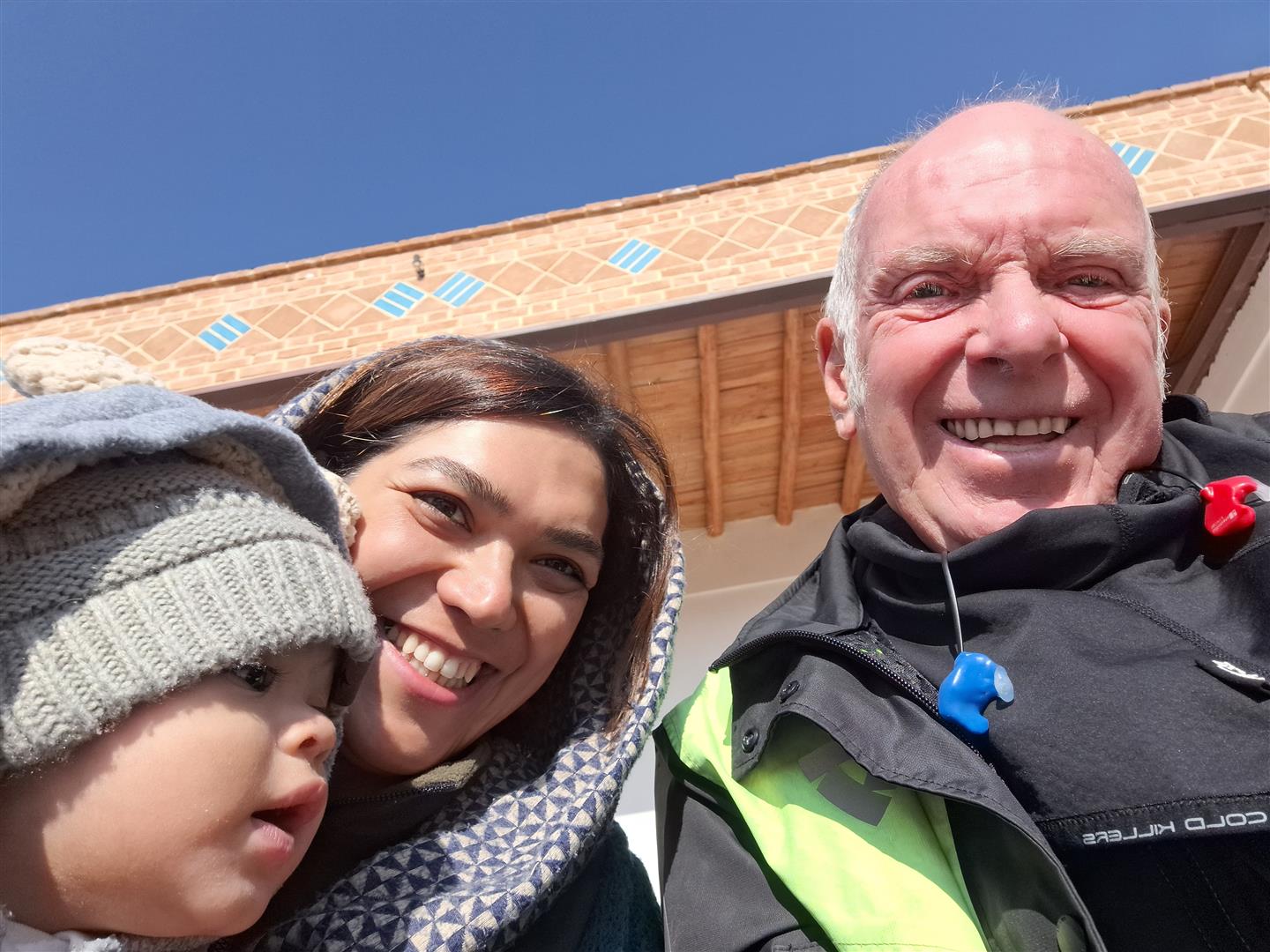
Setia, Asoo and some bloke.
Setia seemed genuinely sorry to see me go, as far as I could tell. I’m usually a bit cynical when people behave like that but she definitely meant it. Very lovely people and I’m very glad I stayed there.
It was a bit of a late start but my next destination of Rasht wasn’t too far away. It’s a town that sits between some mountains and the coast of the Caspian sea. I was meeting a guy named Moon, a tourist guide, who’d invited me to stay at his and his mother’s house. But I was already booked into Orosi hostel, so that’s where I went.
Once I left the main road the route became very good. The road quickly started going up and got to 2200 metres before it started coming back down again to about 1500 metres. Then it went back up to 2150 metres and then came back down, and down, to 500 metres. A very nice ride, swoopy and twisty. And the bike and I were ON IT! I did cut it fine on bends a couple of times and had to tell myself to slow down. But great fun.
Lower down, at about 300 m I passed by some beautiful coloured hills. Photos were taken. Nature does some wonderful things.
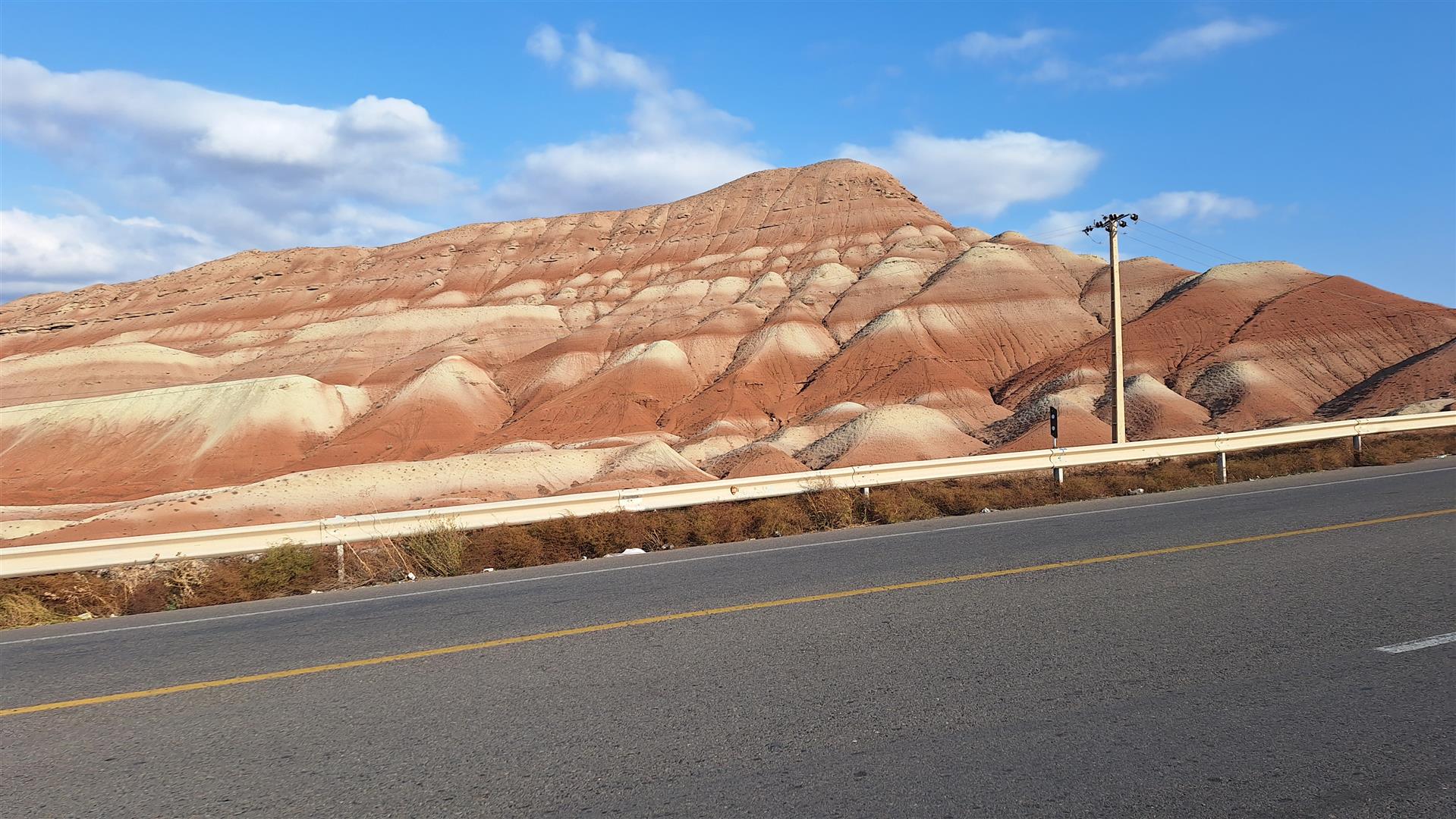
Only a hillside, really. But just look at those colours.
As I got closer to Rasht the road got very busy with trucks. I passed the entrance to a new motorway but Google ignored it so I did too. It seemed to bypass the busy and truck filled hill that I went up, so maybe I should have taken it. But I may have left the ‘avoid motorways’ instruction in place.
As I came into Rasht the traffic meant it took ages to reach the hostel. I had to stop close by and a guy showed me where it was. The bike came into the passageway so was dry and safe. It was another lovely place, with plants and ornaments all around.
I contacted Moon and then the heavens opened up. Coincidence? Almost certainly. The rain had stopped by the time he came to meet me. I’d mentioned to him about taking me up to Masuleh, a town up in the mountains, and the castle there. He said not to bother with the castle as the road up to it would be very slippery and there were 1200 steps to be climbed. On that basis I was happy to agree. He said there’s other things to see near Masuleh anyway.
I asked him the price and he said normally it would be €120 but for me it would be €100. I said I might go up there on my bike if the weather was OK. He said to let him know.
He walked me around the local bazaar, taking me to a shop that made a special sweet. We ate one and had some chai.
He showed me around the fish section and pointed out the white fish that come from the Caspian Sea. He also showed me some sturgeon and the shopkeeper told us that 1kg of caviar would cost €1,000! I was suitably surprised and impressed.
Then he walked me round the town, showing me a walkway that had statues doing various things along it. He kept getting me to pose for photos. He was telling me about all the ‘firsts’ that Rasht can claim. First car; first railway; and various other things. People used Rasht as a gateway to Europe. The train took them to the Caspian Sea where they took ships for Russia and thence into Europe. It seemed a strange route to have taken but maybe Eastern Turkey wasn’t navigable back then.
I tackled him about the price for tomorrow, saying that €100 was too much and offered €75. He smiled and was going on about how friendship was worth more than a mere €25. I thought, “ this isn’t friendship mate, it’s business”. Just as he was making an expansive gesture with his hands I said “OK then, we’ll make it €80”. I grabbed his hand and shook it. Deal done! I was glad I wasn’t staying with him. It wouldn’t have felt right.
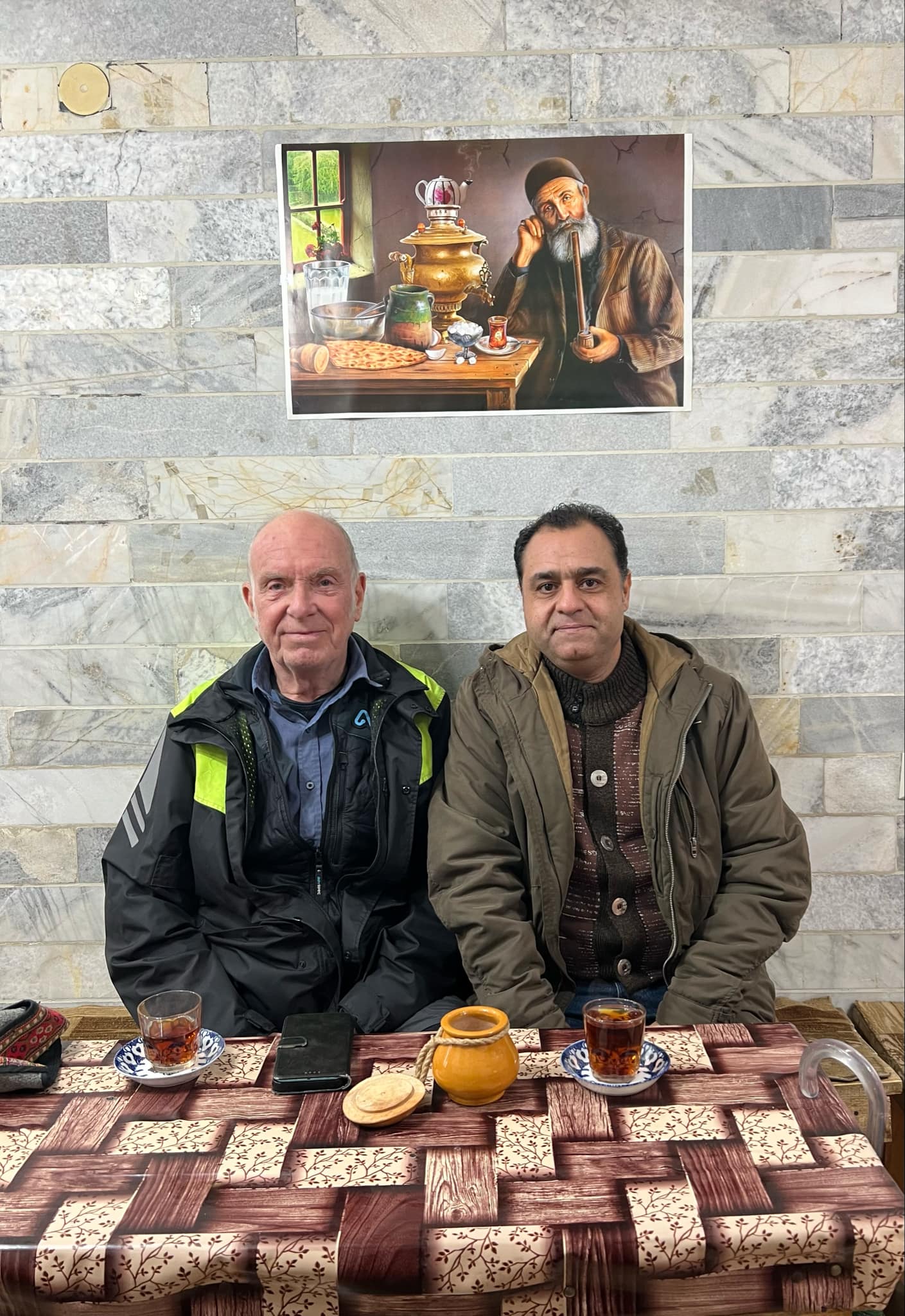
Me and Moon. Possibly contemplating the 20 Euros I’d talked him out of.
He took me to a kebab stall where I ordered a skewer of sheep’s heart and one of mushroom. He left me alone to eat it and I told him I’d be ready at 10am. They didn’t start breakfast at the hostel until 9am.
The day out with Moon, and his driver, Mehmedi, was very good. Moon sat me in the front and off we went. It took a while to clear the city. It looks like the kind of place that’s busy all day, especially it’s damp and drizzly.
After a while we stopped at a place called the Gilan Rural Heritage Museum. Set in some very nice woodland, they’ve created a village out of various houses and other buildings that were brought in from all round the province. This included a hen/duck house and a toilet. They seemed to be around 100 to 150 years old.
Wooden frames covered with mud seemed to be the main building method back then, although there were some built from unfired mud bricks. The school building, supplied by the government, was of proper bricks.

Keeping the river at bay.
One of the houses had been close to a river and was raised up on wooden supports to allow flood water to flow beneath it. The added benefit was improved circulation of cooling air.
There were buildings called Kandoj which were used for storing rice. The rice went on a platform beneath the roof. The area below that was used for other storage. The roof supports were tapered, which prevented mice from getting up there, according to Moon.
A woman from the museum came around with us and was explaining things to Moon, who passed it on to me. It was an interesting place. Additionally interesting was that it existed at all. It’s easy to view a country such as Iran being somehow separated from the doings of the rest of the world, given their isolation. But, of course, it’s not. It has many UNESCO sites, for example, and it’s as proud and interested in its past as anywhere else.
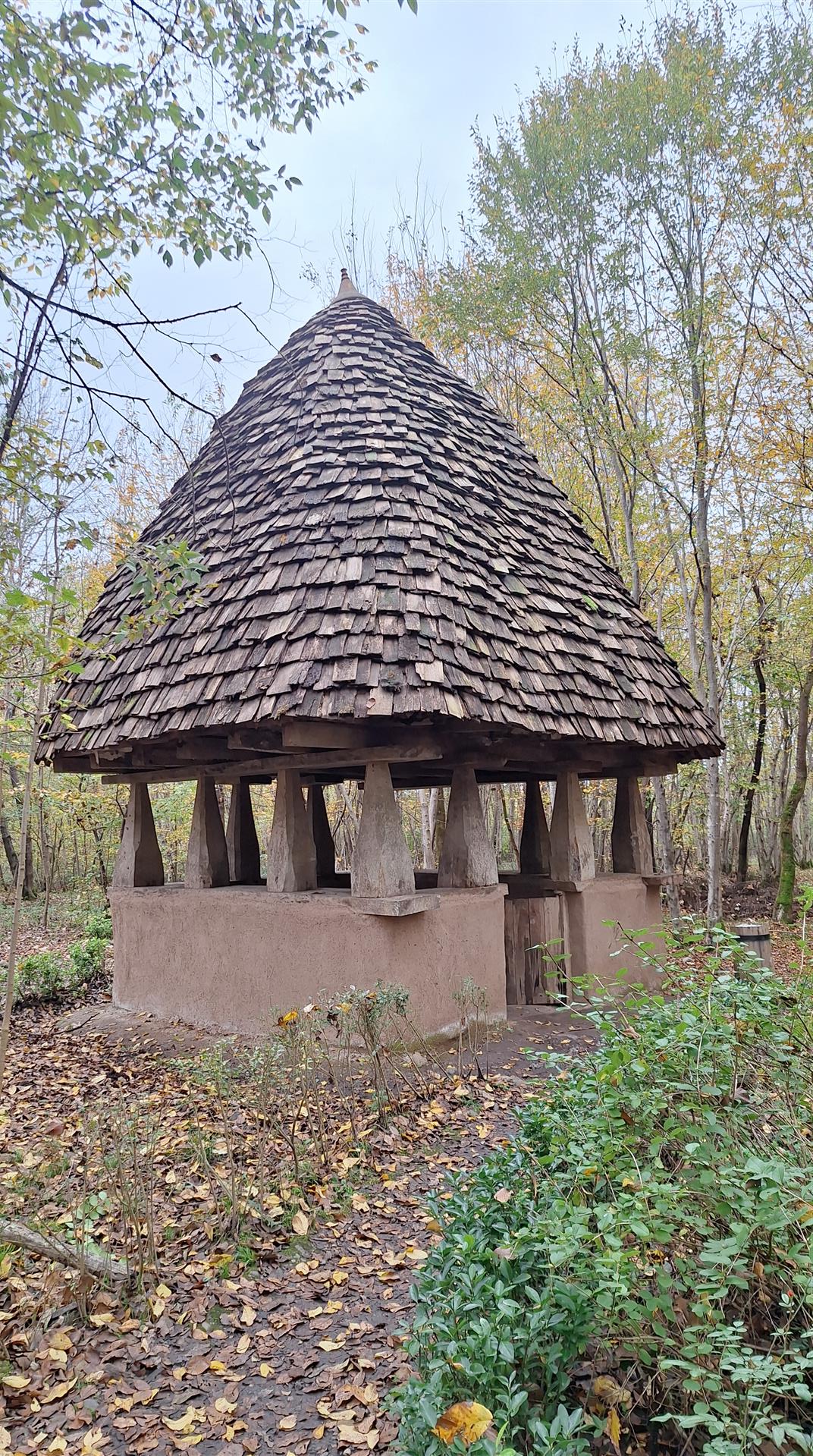
A Kandoj, for storing rice.
We carried on up to Mesuleh, with the road getting steeper and the weather getting gloomier. We had to stop at a toll booth but Moon waved a card at the guy and we carried on. We parked up by the village and walked over a bridge near a waterfall. An info board said that the village came about when Iranians fled there to escape the Mongols. Moon had a slightly different story. He said the village was 1300 years old. It had originally been at the top of the mountain but was abandoned because of disease or earthquake, no one’s sure which. Probably a combination of both.

Damp and dank. Not the dog though.
It was cold and damp but wandering around warmed us up nicely. As did the chai we stopped to drink in a tiny chai house. Moon was paying for everything but, to be fair, nothing cost very much. Mehmedi came with us. He looked very odd in his tight white top and his skinny fit jeans. I wondered how many times he’d seen this place if he was Moon’s regular driver.
We walked around, with Moon pointing out the oldest buildings and some new ones. They, needless to say, had to be built in the original style. The photos show what that style was like. Different to anything I’d seen elsewhere and the location on the steep hillside meant that the houses seemed to be piled on top of each other. They clearly had a unique local style.

It’s the woodwork that makes these houses special.
The rain got heavier, giving us the excuse for more chai, before we walked back down to the car and headed for home.
Mehmedi had to stop every so often because the overheating warning light kept coming on. He’d open the bonnet, mess about with a connector plug, then carry on. We stopped at a garage on the edge of the city. Whether or not that was related to the problem I don’t know. Moon and I drank chai while we waited.
Moon was taking photos of me all day, at every opportunity. He seemed keen to get lots, presumably to use to promote his services. When we got back he asked me to join the FB page he promotes and to put up a post about him.
I paid him his €80, in Rial, and gave him 2 million rial for Mehemedi. I hoped that was enough. He asked me for €€s but I told him I needed to get rid of my Rial. He had to accept that.

Cakes with dates in. Very nice with the chai.
When I got back to the hostel Max was there, the non cyclist I’d met at the hostel in Tabriz. He said he’d arrived yesterday although I hadn’t seen him. We went out for something to eat. We went a bit wrong and ended up wandering around the bazaar, through lanes filled with dry goods with nary a kebab in sight. Eventually we came back out to more or less where we started and found a fast food place.
There were lots of youngsters in the hostel. I presumed they were students as they were all in their early twenties. A nice group who liked to have fun. I asked one of the English speaking girls if they were all one group and were they students? She said no, just random. She explained that Iranians are extrovert and like to have fun. I had to smile when she told Max he was obviously an introvert. And he agreed. So did I.
Before I left next morning I did a bit of comparison on Google maps, between using the motorway or not. I found that the distance would have been the same but quicker by 1.5 hours. I left it that Google can use motorways if it wants to with, of course, the option for me to ignore it. Some of the normal roads are in bad condition so it could prove useful.
I set off for the ride to Rasoul hostel. Located up in the hills near a village called Razmian. There was a freeway I could have used but I ignored it. Instead I had an enjoyable ride up through the mountains.
I was amazed by the terrain. The road was spectacular. Nice and twisty, but it was the topography it went through that made it special. Those bare, almost green hills, which were like a series of rocky waves on the sea, or maybe saw teeth. Sharp edged and steep sloped. The road was above them and looking down on them was quite amazing.
I came in through the village then had to take a dirt road out to there. Nothing difficult. I tried standing up and it was much better than before I adjusted the handlebars. But they’re still way too low., just not as bad. I need to think about other solutions.
Rasul, my host, arrived at about 5.45, with his mother and sister. We went into his house where he women got on with cooking the meal while we chatted. I asked him about getting to Alamut Castle, the nearby place I wanted to visit, and he reminded me that he’d said I can’t go inside because of refurbishment work. But he had said there’s other castles nearby.
Instant decision! I told him I’d have a look at the local place tomorrow and then go to Tehran. He was a bit disappointed, it seemed, because I’d originally talked about staying two nights, but I stuck to that. He showed me some roads to ride that would take me through some nice villages in the mountains. That will be good enough.
He’s an educated guy and speaks excellent English. He even reads James Joyce and Tolstoy. That’s a real challenge for someone whose first language isn’t English. His main living used to come from tour guiding and trekkers. But he was saying that it’s changed beyond measure since covid, and even before that. It’s Iran’s reputation as an unsafe country that’s destroyed it. Prior to 2018 there used to be 4 million foreign visitors per year. Now that’s down to 100k. How awful for people like him.
He makes a living off the small farm he’s got. It was his father’s, who bought the land and built the house.

Country transport.
He was also telling me that the original Assassins came from this area. It was religious differences that led to their rise and before their assignment they’d be taken to a beautiful garden, fed hashish and become convinced that when they died while committing the assassination, as most of them did, heaven would be very similar to that place, plus women of course. So the word Assassin derives from Hashish. Well, who’d a thunk it.
The meal was very nice. Fried fish with fried potatoes and mushrooms, plus rice. He asked me if I liked wine and produced a bottle of home made. He asked me what I thought of it and I suggested that it hadn’t fermented for long enough. It was slightly fizzy and I think that’s what caused it. I was amused because Behzad had said that people brew it – and there it was.
Rasul took his folks back to their house in the village, then we sat down and had a good chat about Iran, the politics and how it’s future might be affected by other events currently taking place in the middle east. Also about religion and the nature of freedom. I got the impression he wasn’t religious himself, which chimes with most of the young Iranians I’ve spoken to so far.
My bed was in the building next to his. It was on the floor and my feet were under a table. That was covered with a large and heavy quilt. It came out over the floor on all sides. The crucial thing was the heater, which sat under the table and kept me warm all night. A brilliant idea and very necessary.
Over breakfast Rasul went through Google maps with me and removed a few places that won’t be worth going to. He said I should turn south ASAP, for warmer weather, but I pointed out the places in the east that were worth visiting. He showed me a route to a nearby castle but I knew I wasn’t going to bother as soon as he said it was a 20 minute walk from the road.
I left about 11 and followed the road that went up over the hills and through some villages. It was excellent riding over the high passes. The bike and I were on it once again and I was loving it. The terrain was that saw tooth style of hill that I’d seen yesterday. I seemed to be riding along a ridge a lot of the time and could see steep valleys on each side. It was a great feeling.
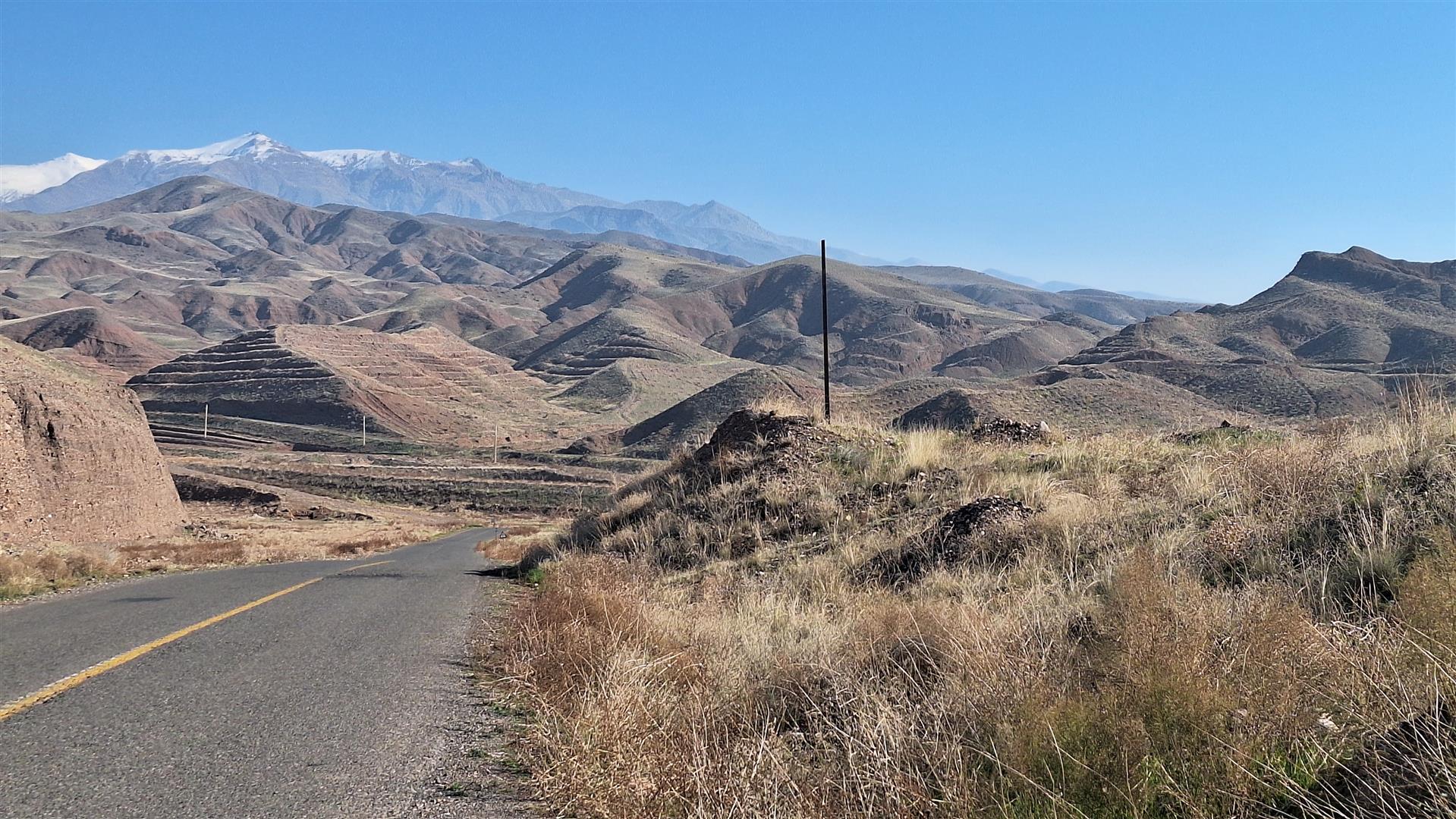
Waves of hiill crests.
When I got to near the end of that ride I refuelled and decided not to go to where I’d marked. To get to Tehran Google wanted me to go back the way I’d come. But I was sure there was a quicker way to the motorway. I did some route checking and Google seemed to confirm that the distance from my original destination to Tehran was shorter.
I rode out to it but then Google wouldn’t show me that shorter route and wanted me to go back. So I gave in and did just that. It wasn’t a total repeat of the route out, but almost.
Two nice things happened on he way. Going down a hill I caught up with some lads on their small bikes. They were grinning and waving at me so I showed off a bit by overtaking them on a bend and then giving them a demo of bend swinging. It must have looked quite something to them, seeing this fully laden, noisy foreign bike giving it large. Or, they were laughing their heads off at how stupid I was. Probably the latter.
In the next big town I spotted an ice cream shop that sold coffee and cakes. While in there I got chatting to a young lady with good English. Her sister lives in Australia and she’d like to move there. When I went back out to the bike a couple of guys in a Land Rover pulled up just for a chat. One of them is a biker. A very nice meet.
I came to the motorway and got onto it. I’d asked Rasul how the toll system worked and he said bikes weren’t allowed to use motorways. This time I looked for a sign forbidding bikes and he was right. I ignored the sign and went for it.
I did get a couple of odd looks but I ignored them. I was feeling a bit nervous about the reaction of other drivers. This wasn’t helped by some mad men who liked to chase each other by weaving from lane to lane through the traffic. I survived and just kept going. But I’m going to avoid them from now on.
As I reached the city traffic got heavier and some severe jams were the order of the day. But eventually I reached Zee Hostel, where I’d booked for three nights. I managed to get the bike into the back garden but have no idea how I’ll get it out again!
I guess you’ll find out soon.
 MOTOPANGAEA
As always, an interesting and insightful read Geoff. And just a thought; it may be prudent not to mention political opinions of people you name in these blogs. It ain’t like Britain you know. 😉
Thanks for the comment Phil. Re. the opinions. Point taken, but I don’t think the Iranian security services read my blog. And if they did, I only mentioed first names and a town. And they may well agrre anyway!
But the views I mentioned are commonly held, just a couple of people among millions the same.
LikeLike
Thanks for the comment Phil. Re. the opinions. Point taken, but I don’t think the Iranian security services read my blog. And if they did, I only mentioed first names and a town. And they may well agrre anyway!
But the views I mentioned are commonly held, just a couple of people among millions the same.
LikeLike