
Watamu, Kenya. 1st July 2025.
On leaving Mombasa I headed along the coast to Watamu, a seaside town popular for holidays, in an area where Omani traders held sway. There were three places to visit on the way.
The first was Jumba La Mtwana, a Swahili museum and old village. There was plenty of information around the site and a room with info boards in it. I walked around looking at the remains of buildings, one of which was a mosque. The buildings were quite dilapidated, just fairly low level walls.
They were built from a particular type of coral, mortared with lime. I read that the coral lies very close to the shore so is easy to obtain.
Next place up the line was Mnarani Ruins, at Kilifi. A much more substantial place. I engaged a guide quite cheaply, and he showed me around.
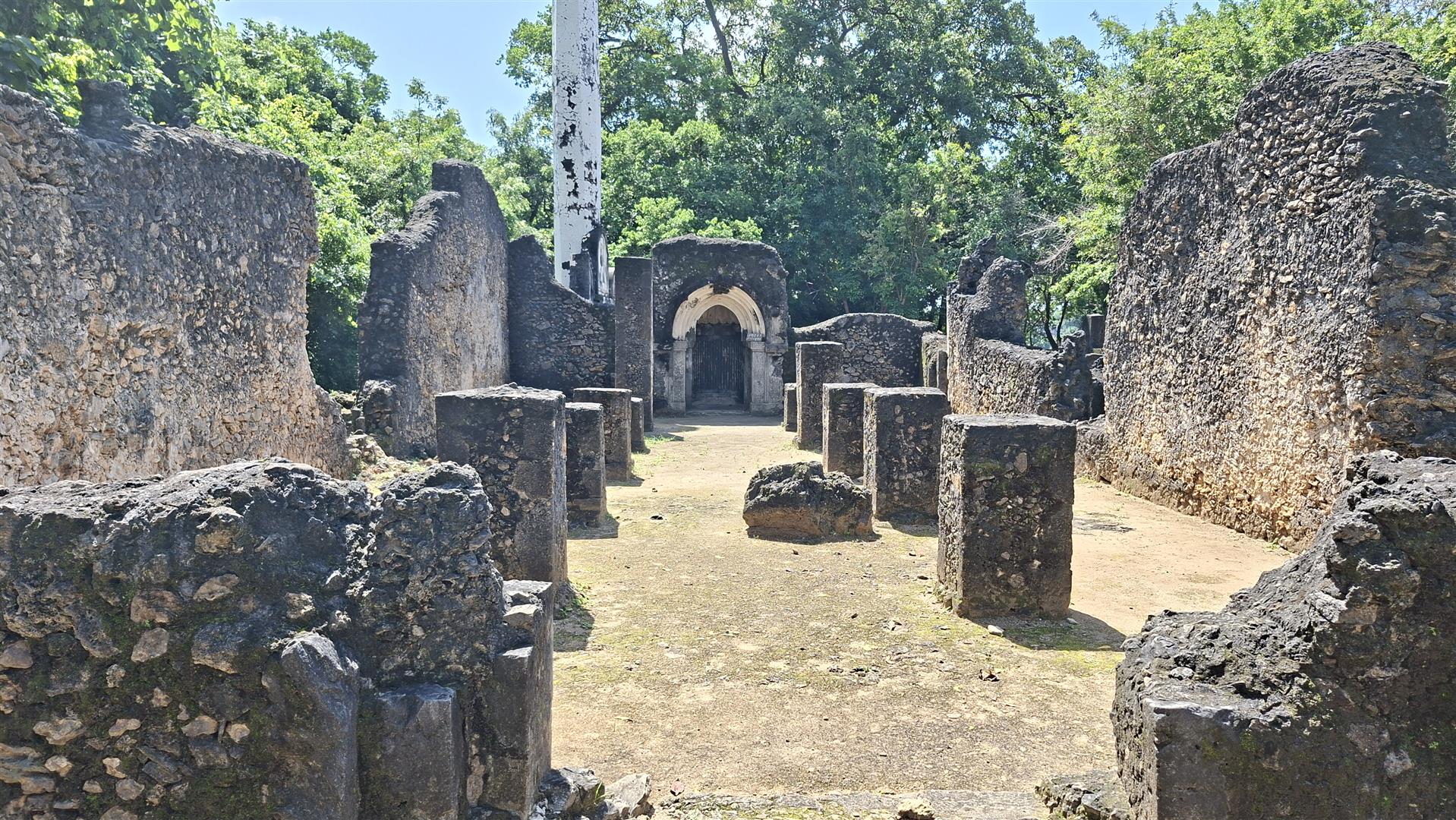
The main mosque at Mnarani Ruins.
This place had two mosques. One was the main one, where the ruler used to go. A smaller one was on the edge of the site. There was a large tomb and all the ruins were generally bigger and more intact.
The lad walked me around, firstly going up 100 steps. He asked me if I needed a rest. Nope! He showed me the mosques, the tombs and a little area where goods were stored. There was a steep slope down to the beach. I got the impression the selling was done down below, then the stored goods were delivered.
There were several massive Boabab trees, which were very important to the local culture. He showed me some snakes and tortoises too. One of them really big. Both them and the trees were very old.

A big old tortoise.
I found a little roadside restaurant, I needed a drink. She didn’t have coffee so I asked for tea with some milk. I ended up with a cup of black tea and a masala tea. I mixed them up as the best compromise. While there I did some research on accommodation and found a place stay in Watuma.
Each place I’d stopped at had been an hour apart and that applied to Gedi Ruins Malindi too. The road to these places was single carriageway and was good to ride on a sunny day. A fair few villages were passed through, and a couple of small towns. The tracks down to each of the sites were a bit rough sometimes, but I managed OK.
I engaged a guide again at Gedi and he did a very good job. It was another place that was much bigger than the previous one, with far more intact buildings. It had one main mosque and several smaller ones. Lots of tombs and family areas. Some decorative archways too.

A touch of Lara Croft in this town.
The town had an inner and outer wall and had a population of around 3,000, according to my guide.
Traders married local women and he reckoned Swahili was a language group developed by mixing the traders Arabic with local Bantu languages. This surprised me and I looked it up. It’s true! But there is no obvious sign of mixture of ethnicity in the local area, i.e. in skin colour or facial features.
This site had more Boabab trees than the others, including one that was so old that nobody knows its actual age.
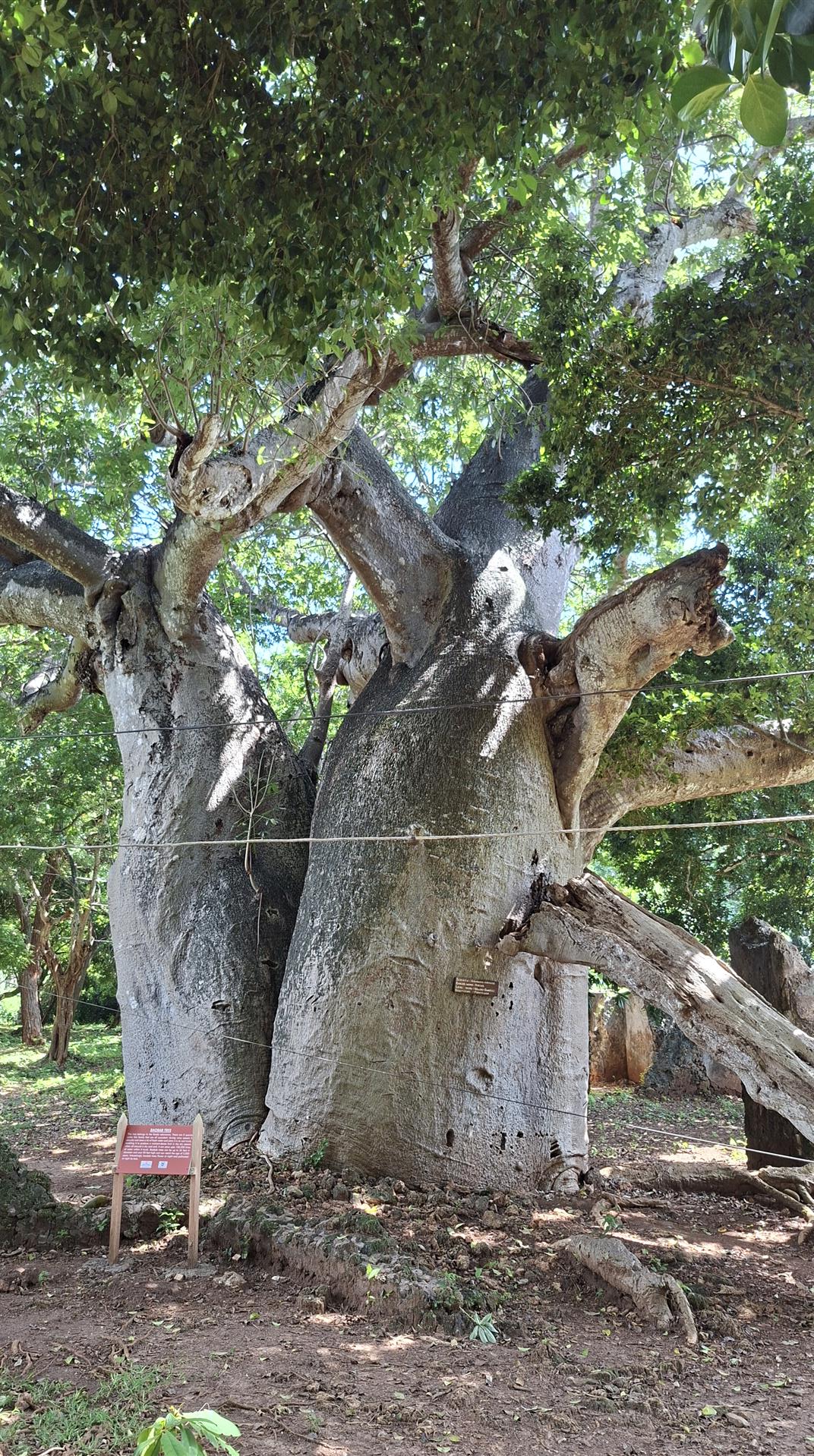
Very big and very old Boabab tree.
I had to pay the guide 500/-, which I hadn’t realised was a set fee, but it was worth it. I gave 100/- to the guy who elected himself to guard my bike. (175/- to the ££.)
In Watamu I found the apartment I’d booked and settled in for a few days. I didn’t do much there, just more writing and a few walks out for supplies. When I left there I rode along the coast a bit and stopped off at an area of sand dunes, Mambrui Dunes.
They’re well known for leisure activities such as quad biking and horse riding. A guy there asked me for 500/-, “To help the village”, he said. I didn’t argue, knowing that if nothing else my bike would be safe. But when he started following me around the dunes I made it clear I didn’t need a guide so he went back.
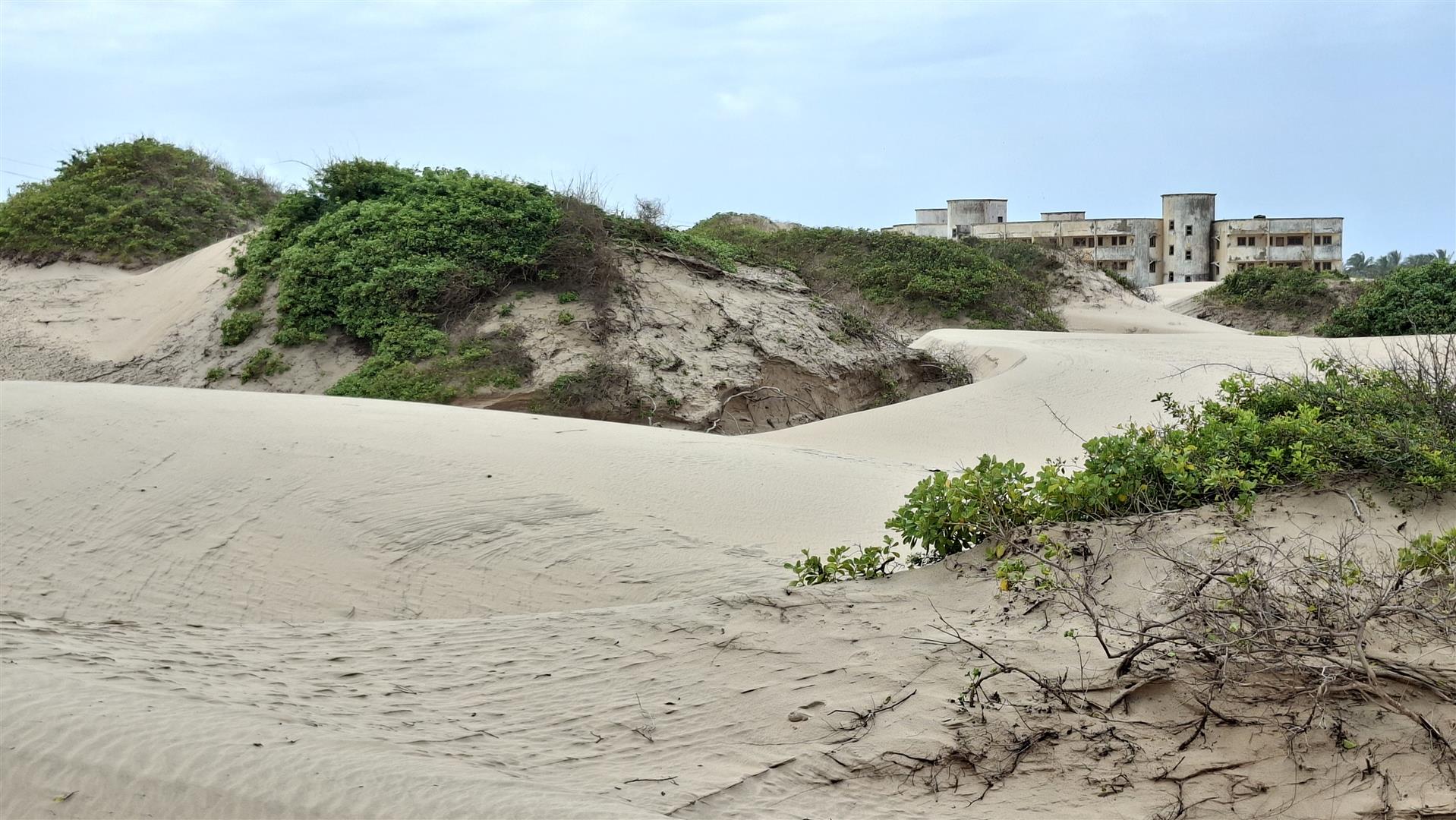
Nice dunes, if you like that kind of thing.
Dunes are dunes. Just sand and bushes, really. But it was an OK little walk. There seemed to be some shelters around, for picnicking. There was an abandoned hotel over on one side. Encroached by the sand, I was told.
I walked around for ten minutes then went back to the bike.
From there I rode to the town of Hola City. I found the hotel that I’d identified on Booking.com but it had burned down! There was another decent one not far away. A comfortable place with a swimming pool, which I didn’t use.
I needed cash so I followed Google to a place that didn’t actually exist. There was a local guy there who took me to a shop where I could have drawn out cash if only I bothered to set up Safaricom’s MPESA system. This is a pay-by-phone app.
The shop couldn’t help me so he said he could conduct me to an ATM. I ended up following this guy through endless back streets and alleyways, getting more and more certain I was being led on a wild goose chase. We passed along rubbish strewn alleys, tiny shops and small street side stalls selling battered vegetables. But in the end he came good and delivered me to the promised ATM. I gave him 100/- for his trouble and off he went.
Now loaded up with cash I had an interesting walk back to the hotel. I think you always get a good feel for what life is like by walking the streets. I saw small and large shops, selling everything anyone might need. These places always remind me of how Britain used to be before large supermarkets came along.
Apart from that walk around the town I didn’t do anything else in Hola City. I spent a couple of days planning and writing.
Food was served outside, in small pagodas. That was very nice except that the hotel cats and kittens wanted to share my it, to the extent of climbing up on me or the table, aiming for my plate. My solution was to throw some scraps into the garden and let them fight over them. I was amused to see that there was always a ‘Boss Cat’ and watched the kittens fighting over what was left.
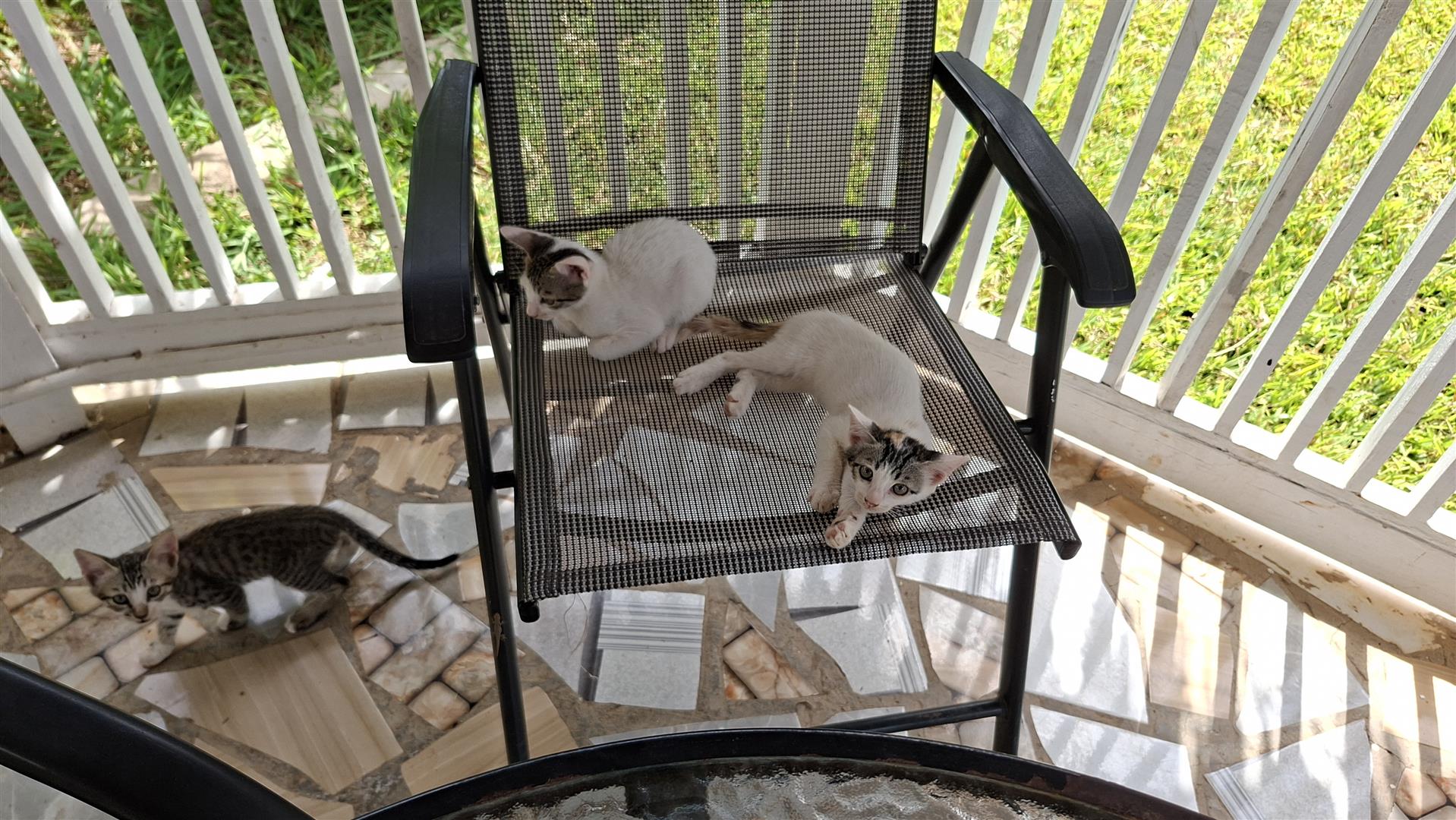
Cute and greedy.
I had a very good conversation with a Kenyan guy named Henry. (Almost all Kenyans had English names.) We were discussing how different family life is in Africa compared to Europe. About how people live far more closely together in Kenya. I immediately related that to Asia.
We talked about the lack of opportunity for young people, which partly fuels the protests I witnessed. We also discussed the activities of the Chinese and their Belt and Road initiatives. These things bring very little benefit by way of jobs but cost the governments a lot of money, often in having to give up mineral wealth too cheaply.
A very interesting talk with an educated man.
Next morning I headed to Mwingi. A good riding day. The road was mostly good, with a few rough bits at roadworks. I stopped to help a couple of guys with a bike, stuck at the side of the road. His front tyre was as bald as a coot and a stone had gone through it. Nothing could be done with that. A car had also stopped, so I left them.
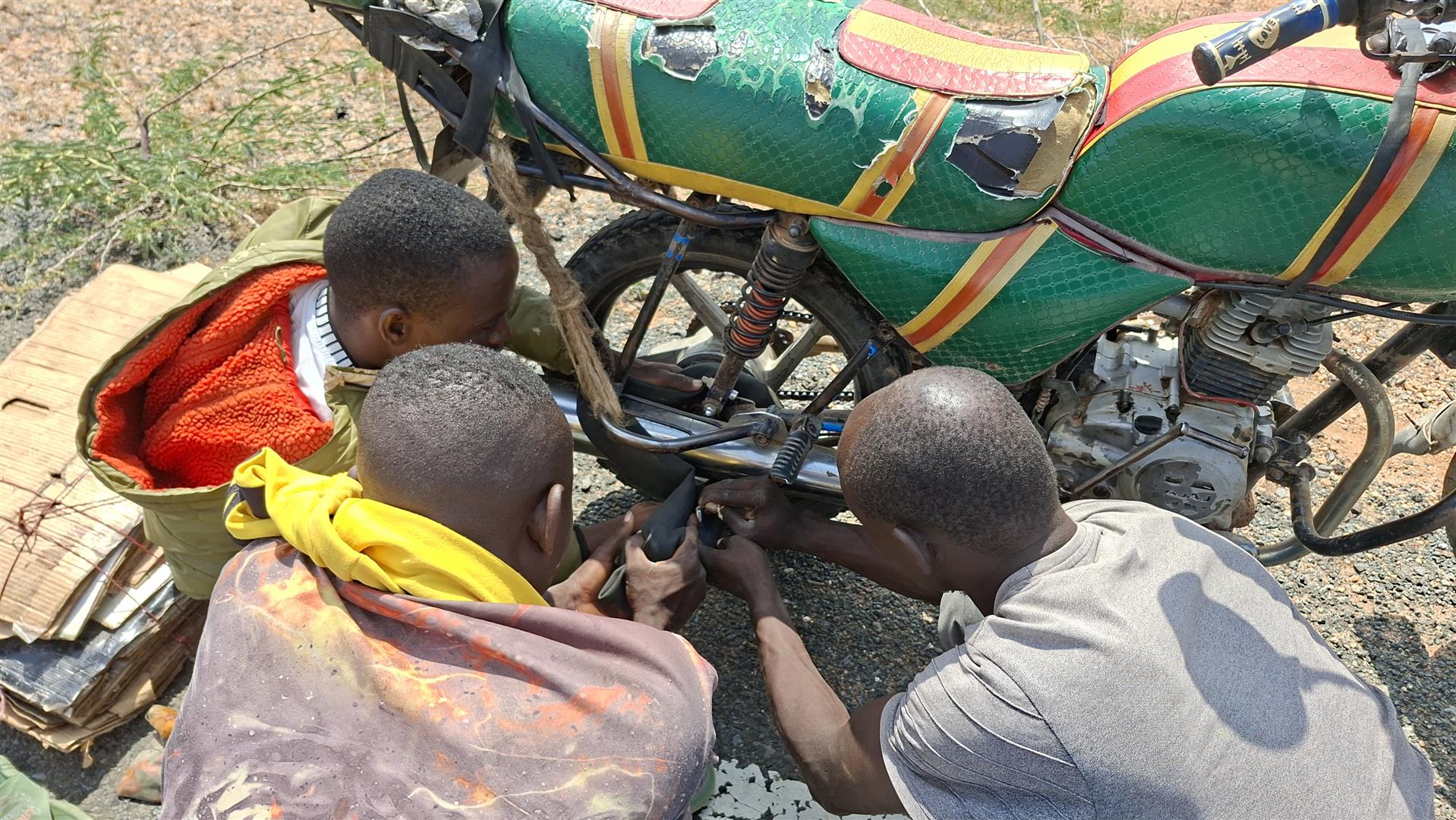
I was able to help these guys.
Further on I saw another bike, with three guys. They waved me down. They had the tube out of the rear tyre, and had a patch to repair it with and tyre levers. But they needed adhesive cement. I gave them some from my tubeless repair kit and helped the guy get the tyre back on. It’s quite possible the glue was the wrong kind but it was holding when I left.
Some things I saw: rondavels near the edge of the road; reed huts, some round; cattle; lots of small, black and white goats; some very sleek looking camels; people pulling water containers along the road; donkeys laden with water carriers. I’m assuming there was a ‘district tap’ somewhere.
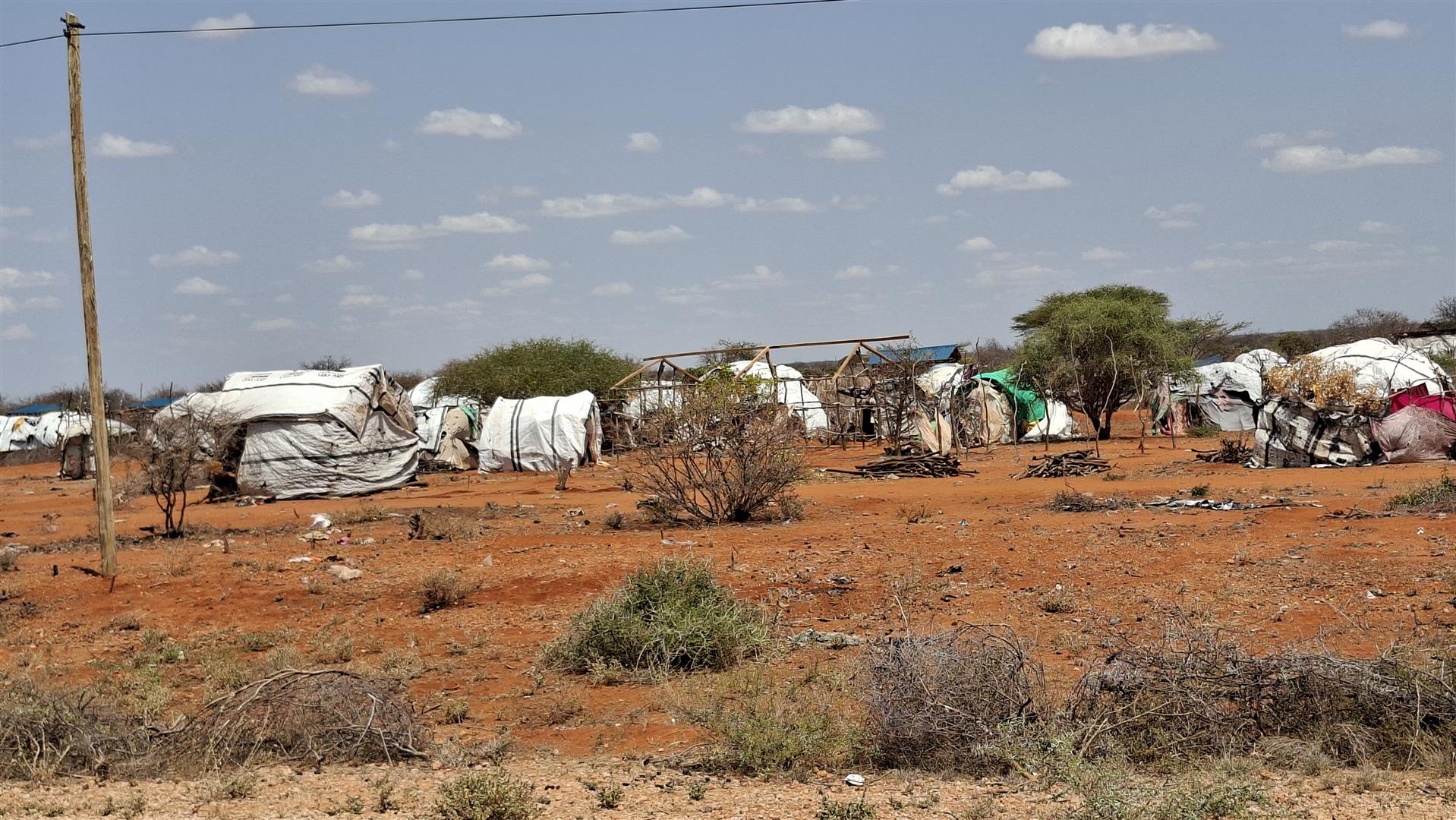
The poorest housing I’d seen so far.
I stopped at a junction for fuel. Further on, in a town, I stopped for tea. Black, sweet and disgusting.
I was definitely out in the sticks by then. A lot of men wear a lungi. Most women at the roadside wore hijabs. There were small, shabby settlements, with nothing around them. I wondered where/if the kids went to school. Going through a couple of small towns, I did see some schools though.
Mwiingi is quite a large town. I searched for a hotel that was on Google, which looked quite good. It didn’t exist. I found another one, which was basic but OK.
Rather than a hot water supply it had an electrically heated shower head, which struck me as a good idea for small hotels. It had a toilet (without a seat) and a bed, table and chair. That’s all I needed for one night. There was no food there but the guy said there were places nearby. I was slowly easing myself into the simple life.
I walked up to, and along, the main road. There were loads of different stalls and small shops, including some selling hardware. I had some pleasant interactions with a few people. A schoolgirl came over and said “Good morning”. I said the same back to her but then pointed out it was actually afternoon. A guy spoke to me who wanted to be able to chat with me. It sounded a bit odd so I asked him what about. He said he was a pastor. I said I’m not religious. So he walked on. I do love to walk along local streets and see local life.
From there I headed across to Nyeri, where I’d already been to see the Baden Powell history. I booked an apartment and once I’d sorted out the non working kettle, I dug in for a couple of days, planning and to do more writing.

I thought this to be clever, if it worked, but odd if it didn’t.
At this point some of you may have noticed that I seem to spend a lot of my time ‘writing’. Well yes, but it’s not as simple as just tapping the keyboard. I need to look back over my journal entries. Do extra research on places I’ve visited. Use Google maps to get a sense of place. Check information on Wikipedia or similar sites. Then all that needs to be pulled together in a presentable manner. Add to that the sorting out of photographs. Let me tell you guys and gals, it can be a bit of a mission!
On the way to Nyeri I stopped off to visit a place called Fourteen Waterfalls. A guy wanted to be my guide but I vetoed that idea. I could see there wasn’t really anything to be guided around. The waterfalls looked very good, set in a semi circle with huge amounts of water rushing over them, driven by the turbulent river. Quite spectacular.

Fourteen waterfalls. Go on, count them!
Although there wasn’t much by way of shops near the apartment I did manage to find a restaurant/bar just up the road and had pork choma. Basically cooked pork pieces with some onion, pepper etc. Plus chips, which were delicious.
Then I moved on to a place called Karagita. I was attracted by the idea of visiting Hell’s Gate National Park. I left at 11.15 and had a good ride, apart from the temperature. It got cold!! No surprise really as I was up at 2700m. I needed to pee so I stopped, then put on my coat. About 1Km further on the road crested the hill and went down by 700m. It was nice and warm then.
I rode on to Hell’s Gate and discovered that I was allowed to ride my bike through the park, to my surprise. A guide would follow me on his bike but there’s a section where we’d have to walk. The cost is £20 for entry fee, £28 for the guide and £3 for the bike. I thought to go there next day.
I was recommended a campsite, Sanctuary Farm, by one of the guys at the visitor centre. They did have one room but it was £56. Camping was £12. I decided to camp, the first time on this trip. I rode down to near the lakeside and set up near to a rented 4×4.
I said hello to the people there, who were James, Sarah and Reuben (8), their son. They’re from Jersey and he owns an IT consultancy. We got chatting and it seems he has a big KTM. I was amused when he said he wouldn’t risk using it on a trip like mine, although he has done a European tour.
He brought me out a beer to drink while we chatted. Reuben is very articulate and had kept a list of the animals they’d seen – about twenty.
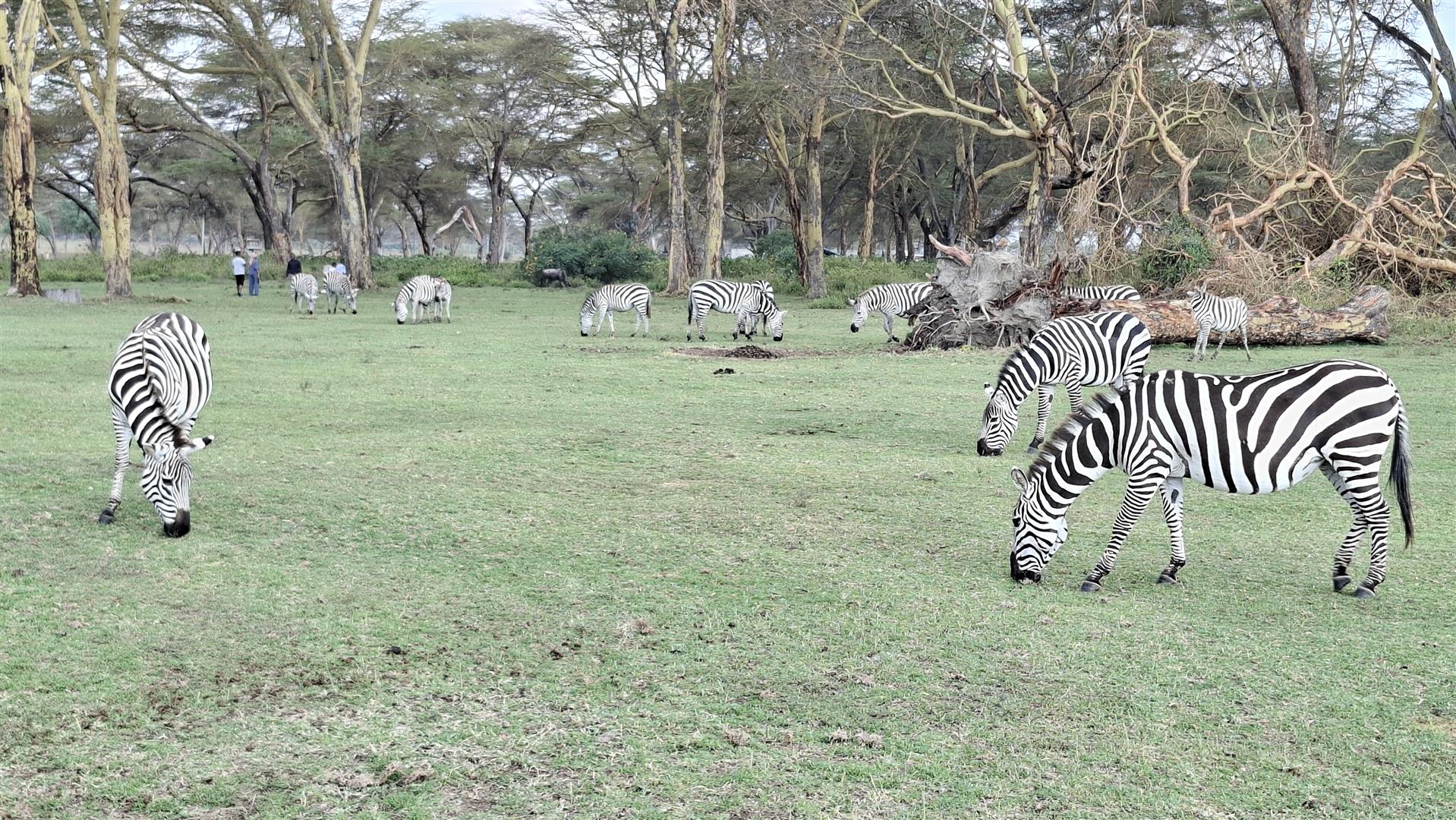
Plenty of Zebras at Sanctuary Farm.
There were lots of zebras around and we even saw a giraffe which suddenly started running through the bush. We were told that all the hippos would come out of the lake to feed once it got dark.
The site had a restaurant so I walked over there to check it out. It wasn’t cheap but it was either that or cook. Having already pushed the boat out by using the tent, I thought that cooking would be pushing it a bit. I was a keen camper over the first three years of my travels but these days I prefer a bed with a roof over it. The food wasn’t cheap but the price of a beer was stupid, so I made tea when I got back to the tent.
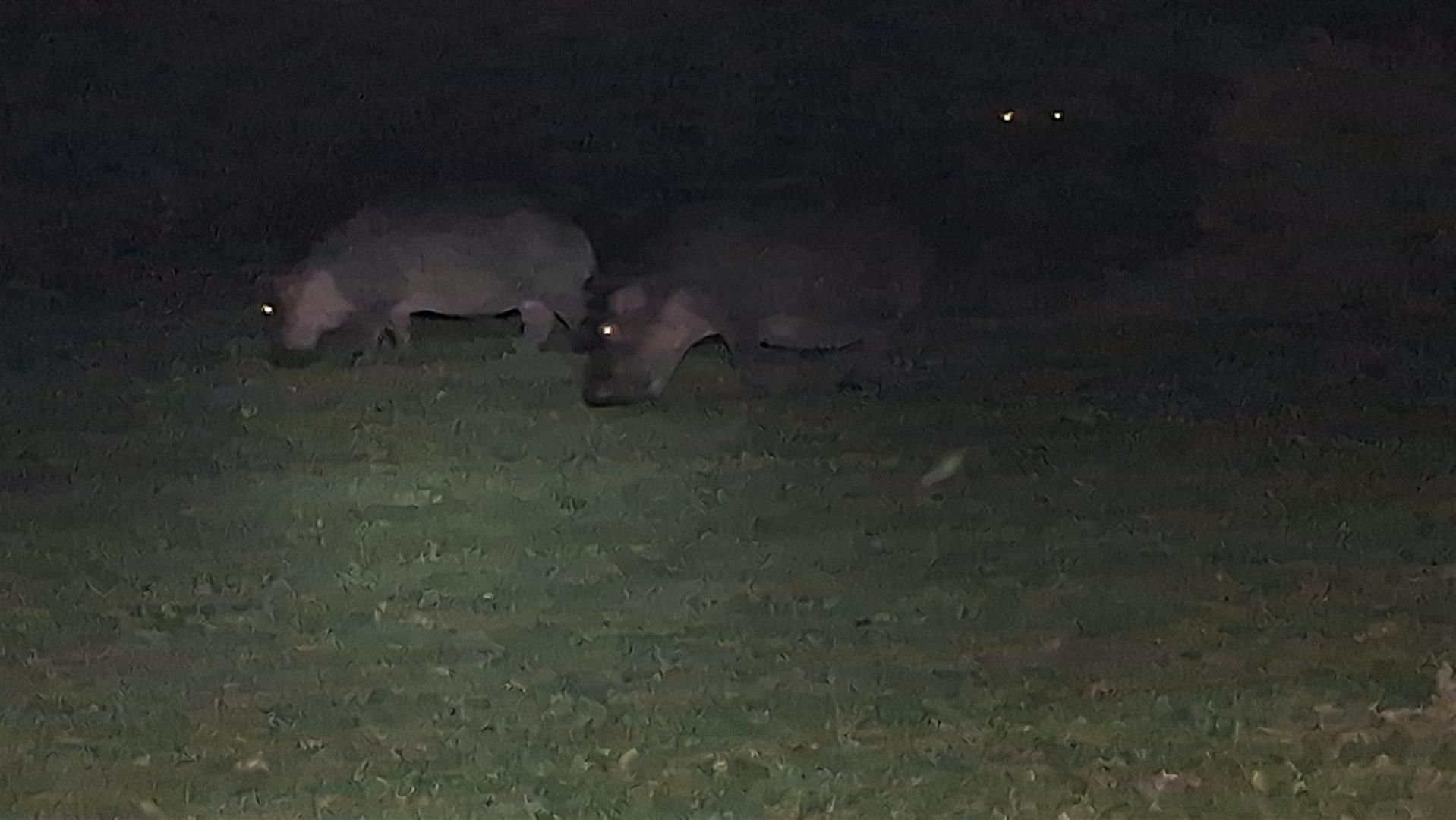
Hippos in the night.
The site was a bit noisy during the evening as there was a large group of Chinese not too far away. Thankfully, their karaoke stopped before it became too late.
James and his family went to Hell’s Gate next morning but I cried off. I’d decided that I’d arrange to go on a safari in one of the cheaper countries at some point in the future. Kenya is an expensive place for these things.

Buffalo, chilling out.
I stayed there for a couple of days and walked around the area couple of times. The hippos only come out of the water when it’s dark so I could only get a couple of distorted photos of them. They can be dangerous creatures as well so I didn’t venture too close. But in the day time, as well as the zebras, there were loads of deer, water buffaloes and more giraffes. My camera was happy enough.

The local Giraffe.
From Sanctuary Farm I made my way, after a late start, to Eldama Ravine. There wasn’t really anything to see there but it had a decent hotel, which was somewhere to stay while the rain came in and eventually moved on.
The staff there were very good but they couldn’t do much about the wet and cold weather. What they could do was cook some good food and serve some cold beer. We spent several happy days together.
When it came time to move on I headed even higher up, to the town of Iten, where it had been suggested I visit. This place sits at 2,400 metres, although I had to go up over 2,700 metres to get there. I definitely regretted not putting my coat on.
I rode up the side of a ridge which overlooked the Great Rift Valley. This is the place where, five to ten million years from now, and as a result of tectonic plate movement, the north eastern side of Africa, the Red Sea and some of Turkey will drift off into the sea. It should be quite a sight. The sad thing is that humanity will be long gone and forgotten. The area is renowned for its diversity of animal and human life. I tried, but failed, to find a good photo stop.
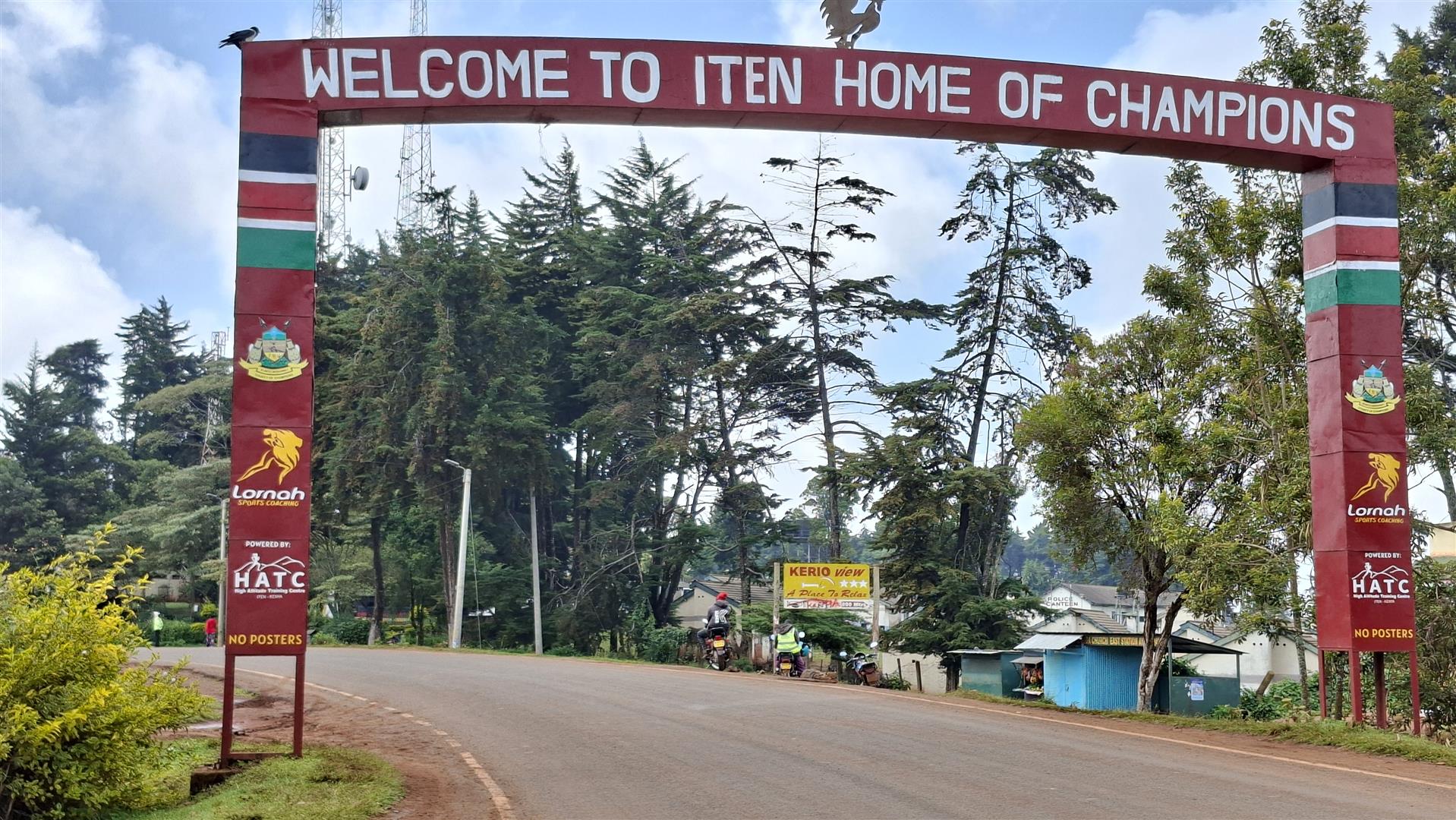
Arriving in Iten. Home of champiions, apparently.
Iten has a claim to fame. It’s where all those Marathon winning Kenyan athletes go for their high altitude training. Running at 2,400 metres elevation helps to expand the capability of the lungs and, in theory at least, an athlete will therefore perform better at lower altitudes. So why was a sedentary person like me going there? Just to see what it was like really.
I looked at the options on booking.com and chose a place called Swiss Side Iten. It seemed to have better facilities than many of the others and would also provide half board accommodation. And all at a very reasonable price.
Initially I was a bit disappointed with the place. I was in a room that had a double bed and it almost filled the room. But when I extended my stay I had to move to a room that had two single beds and this was much better. On the plus side the bathroom had plentiful hot water at the sink and the shower, provided by the roof mounted solar thermal system. I was happy with that. The whole place was modern and very smart, reflecting its Swiss ownership. All of the staff were very helpful too.
I was happy enough that I ended up staying there for three weeks, pretty much my longest time in any one place since covid lockdown in India. The food was always good and plentiful. But in keeping with its healthy atmosphere there was no alcohol available. That didn’t bother me in the slightest.
After I’d checked in I said Hello to a good looking young woman who was sitting in the sun on the lawn. Her name is Aga, from Poland, and she lives in SW London. Over the next few days I got to meet Michelle, a school teacher from Cork; Sebastian and Adrien from Switzerland; Marco from Italy; Giovanni, also from Italy.
They were all there to improve their running times. Only Giovanni was a marathon runner. He’ll be taking part in the Berlin marathon in September and hopes to get a good enough time to be allocated an automatic place in London for 2026. The others run half marathons, 10K races and Iron Man competitions. Some of them were regular visitors to Iten.
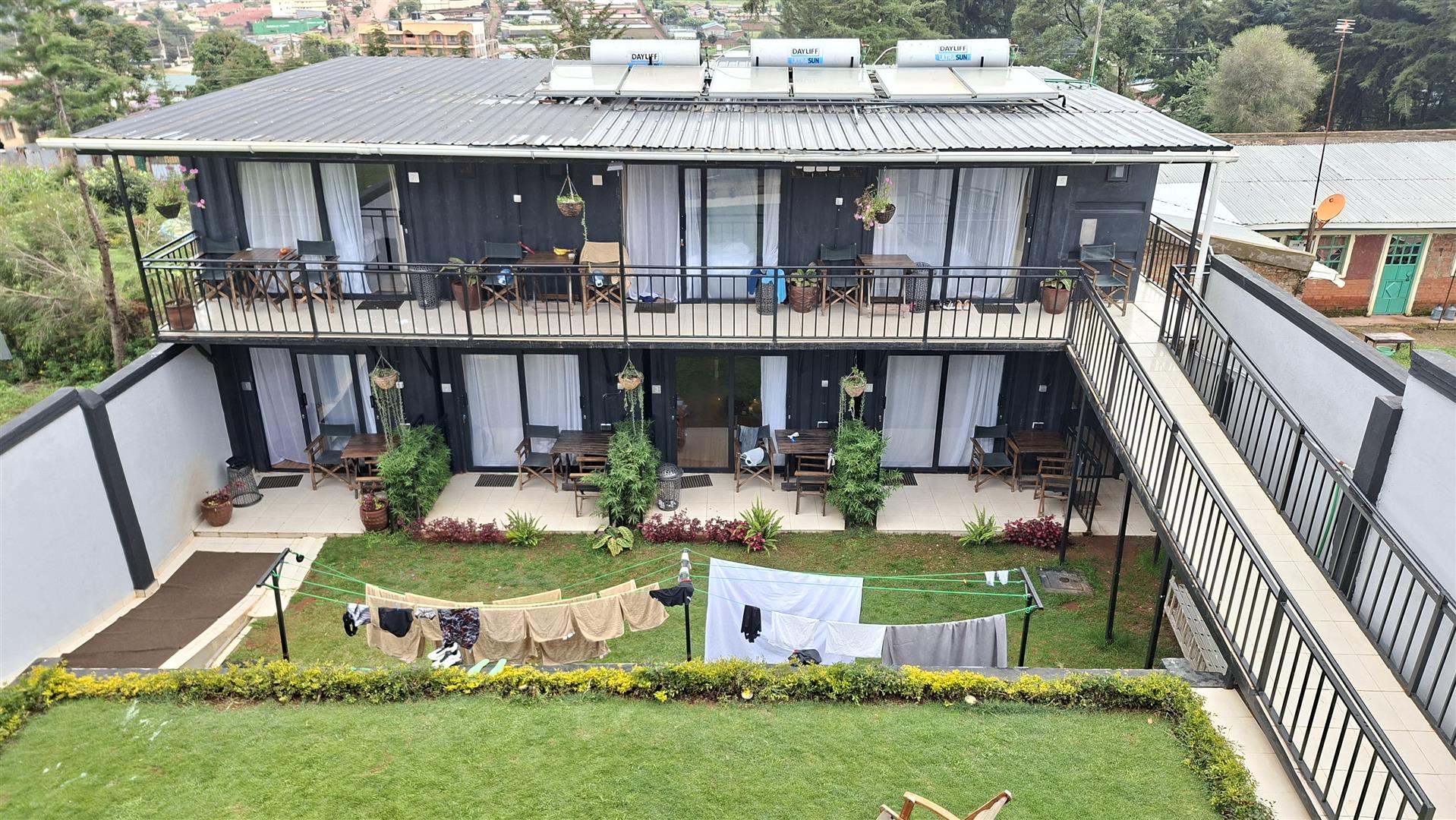
The accommodation block. Great usage of solar thermal heating.
Despite my lack of any athletic ambitions I was welcomed into the group, which was probably part of the reason why I stayed so long. The other reason was that I was in a comfortable place and needed to catch up on writing my blog. I also took the opportunity to replace some photos in earlier blog posts, which I’d accidentally deleted.
I made particular friends with Giovanni because he was deeply involved in football. He’d spent the previous ten years as part of José Maurinho’s back room staff, most recently at Fenerbahce. He said the highlight of that period was when he worked at AS Roma, his home club. He’d resigned from Mourinho’s team at the end of last season as he’d pretty much burned out from the twelve hour days, seven days a week. His role was to analyse the way rival clubs played so that it could be fed into the training regime, and to analys the training as well.
We had lots of long talks about football, his future plans and his desire for a new path. He’d like to set up a sports traing centre. One interesting thing he told me was that when a manager, and his team, get sacked from a club they don’t get the big pay off I’d assumed they did. I thought they got paid the value of their remaining contract. But UEFA rules stipulate that they only receive their original monthly salary until they get another job.
On the afternoon of my arrival I walked up into the town for a haircut. I found a little salon, down a small alleyway and got a short cut. It was really hilarious. The young woman didn’t seem to be too sure what to do. I had to show her which attachment to use, then explain to her that she needed to move the trimmer up across my head rather than down.
One of her friends filmed her doing it, to much amusement, and a guy then finished it off. She then washed my hair and rubbed something into my scalp that came from a small pot with a picture of a cow on it. What was it? I have no idea. We all had a good laugh about everything.
One Saturday morning, towards the end of my time there, the other folks were taking part in a 10km race in a nearby town. I was going to go there and watch them. But when I went out to the bike it wouldn’t start. I had made a big mistake, which was to not go out and try it the previous day.
A smaller mistake (but not by much) was to pump up the front tyre with my electric pump before starting the bike. Would it have started had I not done that? I really don’t know. “But wait”, I said to myself. “I have a jump starter pack.” Well that was flat too. So I didn’t get my day at the races.
I put the jump starter pack on charge but then the bike would try to start but not quite catch. I replaced the spark plug, which was very wet with petrol, but still no start. One of the guys working at the hotel pushed me up and down the road, but with no luck. But then, when I cranked it over with the starter pack connected, it started up. Thank heavens for that!
Apart from the ineptitude of my approach to the bike after it had sat doing nothing for almost three weeks, the lack of starting was because the cylinder was flooded with excess fuel. When the engine is cranked over on the starter fuel is injected even though there may not be enough battery power to start it. Pushing the bike cleared that out and then it ran.
Although I didn’t get to see the race the good news was that Aga, Michelle and Giovanni took part and got their finishers’ medals. Congratulations to them.
All of the training runs that everyone did were very tough. The trainers really push them hard and they’re running on dirt roads with lots of hills to challenge them. But that’s the whole point. Achieve difficult things here and performance is improved back where they normally run.

The view across the Kerio Valley and on to the Great Rift Valley.
One day I walked around to the Kerio View. This is a hotel that looks out over the Kerio Valley, which is a part of the Great Rift Valley system. Once I’d paid my 100/- entry I was able to walk around the gardens and enjoy the scenery as it unfolded across towards the high ridges on the other side. There was valley after valley as the land dropped down into the rift and then up again. Quite spectacular.
We all went out for drinks a couple of times, to the bar at HATC – High Altitude Training Centre. Iten has several such places, including Swiss Side. Guests are linked up with local trainers who make them work really hard to improve their performance. Swiss Side has a gym, a sauna and a cryogenic tank. It’s hard work and I sometimes felt a bit guilty about my inactivity among all this intense effort. But only a bit.
By the time I left there most of the others had also gone. Only Michelle was still there. Unfortunately she had developed the head cold that Giovanni, and then me, had also suffered from. Almost certainly as a result of the high altitude.

Not so keen.
One morning I was chatting to a French family who were just taking a holiday there. The wife, Ness, and her two kids came down to be photographed on the bike. Her five year old son wasn’t too keen. No smile form him. Her daughter, about seven, was much more into it. As was Ness, who threw a couple of nice poses.

Enjoying it.
Her husband was a semi professional footballer and played for several teams in the French equivalent of the Conference League. He said he had a friend who’d played at Charlton Athletic for a season, back in 2017. A nice coincidence.
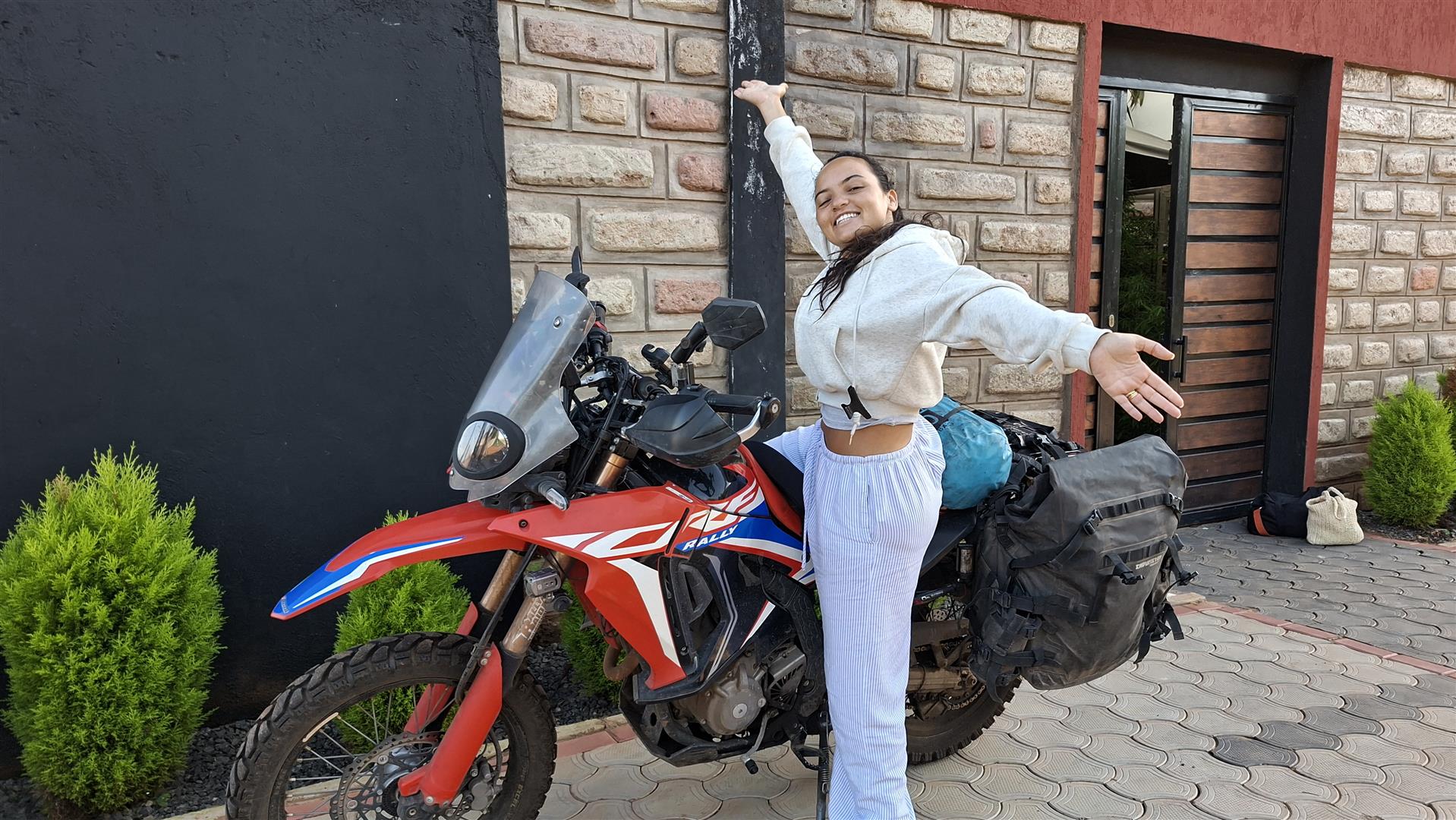
Throwing herself into it.
A couple of days before I left we all went to HATC again, including a couple of Marco’s Italian friends, who were staying elsewhere. I had great fun teaching them how to pour beer from a bottle without raising half a glass of froth. Some skills never lose their value!
We enjoyed a few beers, then brought some drink back with us to enhance the evening meal. Giovanni likes the rock n roll I have on my phone and he got me to play some good tunes. That developed into a bit of a karaoke night. Knowing that ‘kara te’ translates as ‘empty hand’ I wondered what ‘kara oke’ meant. I reckoned it was ‘empty of self awareness’. Great fun and a high note on which to depart.

The Runners of Iten. Sebastion, Aga, Michelle, Giovanni and Adrien.
It had been an excellent three weeks, with productive work and great company.
How was Kenya? A good choice for my first African country. The tourist trade is well developed, although the local electrical supply sometimes struggles to keep up with it. There were daily power cuts at Iten, often caused by the extremely heavy rain and thunderstorms that the high altitude encouraged. But it was a common feature everywhere.
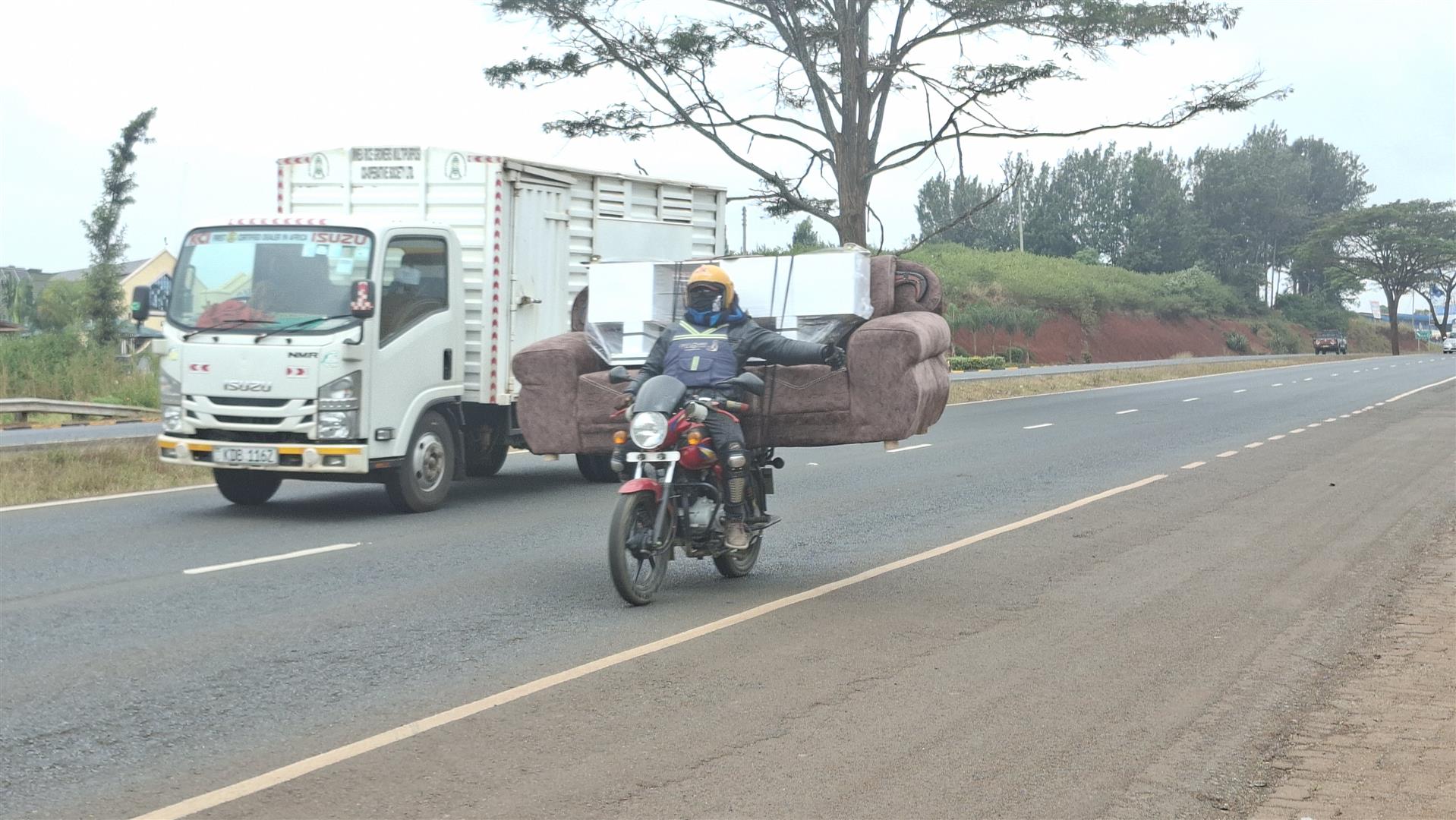
This guy likes a challenge!
The people are very friendly and welcoming, even in the middle of local protests. I always felt safe wherever I was. I don’t regard myself as sufficiently qualified to comment on Kenya’s political situation. But the distinct impression is that young people feel themselves to be very hard done by and get no sympathy from the police or the authorities. They believe there’s too much corruption at high levels and nowhere near enough investment in their future.
The countryside is beautiful. Green hills and valleys, crops growing everywhere in very fertile soil. It’s a very agricultural economy, as witnessed by the number of people who live outside of the cities and towns. Riding around Kenya was as great a contrast to Arabia as it is possible to get. Having said that, there were still plenty of South Asian people there. So plenty of similarities too.
My next destination was the Ugandan border. Bring it on!

A member of staff at one of the hotels. Everyone was always friendly.
 MOTOPANGAEA
Great post Geoff. That sofa motorcyclist photo made me laugh. Hard
LikeLike
Yeah. That’s easily the largest load I’ve seen on a bikes sofa. 😉
LikeLike